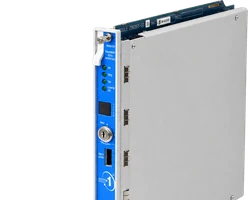
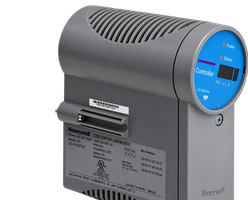
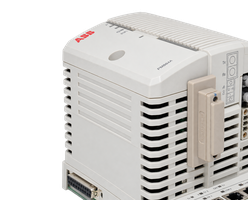
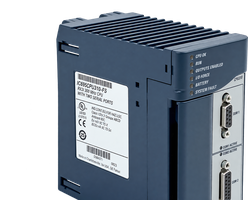
Product image is representative; revision or series may vary. Contact us to request a specific version.
Product Describe:
SYNCHLINK COMMUNICATION MODULE
CONTROLLOGIX
5 MBPS PORT SPEED
1.2 AMP AT 5.1 VDC/3 MA AT 24 VDC
2 FIBER OPTIC PORTS
650 NM OPERATING WAVELENGTH
0 TO 60 DEGREE C OPERATING TEMPERATURE
The 1756-SYNCH is a ControlLogix SynchLink module that provides a high-speed, point-to-point fiber-optic communication link. It is designed to be installed in a ControlLogix chassis and features one transmit (TX) and one receive (RX) fiber-optic port using Versalink V-System connectors.
Deterministic Communication
CST Time Synchronization
Fiber-optic Isolation
The module enables deterministic data transfer and time synchronization (CST) between multiple ControlLogix chassis. It supports 5 Mbps data rates and allows for the transmission of Direct Data, which is consumed by the controller in the same task scan in which it was received to minimize latency.
Important Notice: Other accessories, manuals, cables, calibration data, software, etc. are not included with this equipment unless listed in the above stock item description.
Allen-Bradley 1756-SYNCH SYNCHLINK COMMUNICATION MODULE Manuals, Datasheets, Drivers, Link
Important Notice: Other accessories, manuals, cables, calibration data, software, etc. are not included with this equipment unless listed in the above stock item description.
Coordinated Drive Systems
SynchLink provides the high-speed, deterministic link required for coordinating multiple drives across different chassis. This ensures that speed and torque references are updated simultaneously for precise motor control.
Turbine Control Systems
In power generation, the module is used for high-speed data exchange between turbine controllers and excitation modules. It maintains the tight timing margins necessary for millisecond-level response in steam or gas turbine regulation.
Motion Control Application
The module utilizes Coordinated System Time (CST) to synchronize motion axes across multiple ControlLogix backplanes. This is critical for complex machinery where multiple controllers must execute motion profiles in perfect alignment.
Metals and Mining
The 5 Mbps deterministic link is applied in steel rolling mills and tension control systems where inter-chassis communication must be lag-free. It ensures consistent material tension by synchronizing data between the main controller and remote I/O.
Oil and Gas
SynchLink is implemented in large-scale compression and pumping stations for distributed control architecture. The fiber-optic medium provides electrical isolation and EMI immunity required in hazardous industrial environments.
Aerospace and Testing
Used in high-performance test stands where data acquisition must be synchronized with control actions at microsecond levels. The Direct Data transfer feature allows the controller to consume incoming data in the same task scan.
The 1756-SYNCH module must be installed in a ControlLogix chassis with the power removed or in accordance with the removal and insertion under power (RIUP) guidelines to prevent potential damage to the backplane or the module itself. When connecting the fiber-optic cables, ensure the use of 200/230 micron HCS cable and verify that the transmit (TX) port of one module is connected to the receive (RX) port of the next, maintaining the signal flow required for a valid SynchLink communication link.
It is critical to adhere to the maximum cable length of 300 meters between nodes and to respect the minimum bend radius of the fiber-optic cable to avoid excessive signal attenuation or physical breakage. The module's performance depends on the correct configuration of the Coordinated System Time (CST) within the Studio 5000 environment, where a single module in the SynchLink network must be designated as the Time Master to ensure all other Time Slaves align to the same microsecond-level clock. Users should monitor the front-panel LED indicators, specifically the OK and Link status lights, which provide immediate diagnostic feedback regarding the module’s health and the integrity of the physical fiber-optic connection.
What are the primary communication types supported by the 1756-SYNCH module?
The module supports three types of data transmission: Unicast (one-to-one), Broadcast (one-to-all), and Group Multicast (one-to-group). These allow for deterministic data transfer between multiple ControlLogix chassis.
What is the maximum number of nodes supported in a 1756-SYNCH Daisy Chain topology?
In a Daisy Chain topology, the SynchLink identifier (Node ID) can range from 0 to 9, supporting a maximum of 10 nodes. However, each node adds approximately 1 microsecond of propagation delay.
How does the 1756-SYNCH module achieve time synchronization across chassis?
It uses the Coordinated System Time (CST) to synchronize clocks. One module must be configured as the Time Master to broadcast the CST, while others act as Time Slaves to receive and align their internal clocks.
What are the fiber-optic cable requirements for the 1756-SYNCH physical connection?
The module requires 200/230 micron HCS (Hard Clad Silica) fiber-optic cable with Versalink V-System connectors. The maximum cable length between any two nodes must not exceed 300 meters.
What do the LED indicators on the 1756-SYNCH front panel signify during operation?
The "OK" indicator shows module health, "Link" indicates a valid physical connection, and "TX/RX" flashes to indicate data transmission or reception activity. A red "OK" LED typically signifies a non-recoverable fault.
Manufacturers
Supporting new and legacy automation
Whether you're maintaining existing equipment or sourcing parts for current systems, we provide fast, dependable supply you can rely on.
Please try to be as accurate as possible with your search.
We can quote you on 1000s of specialist parts, even if they are not listed on our website.