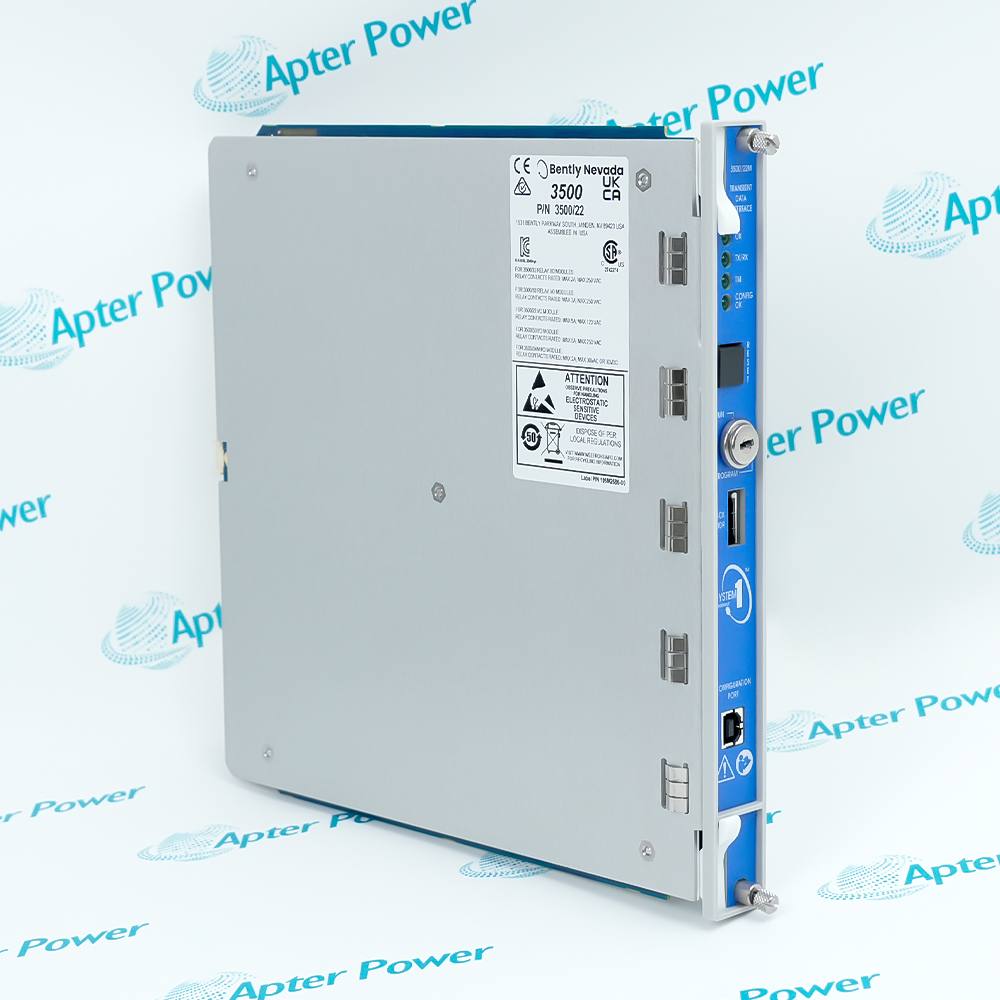
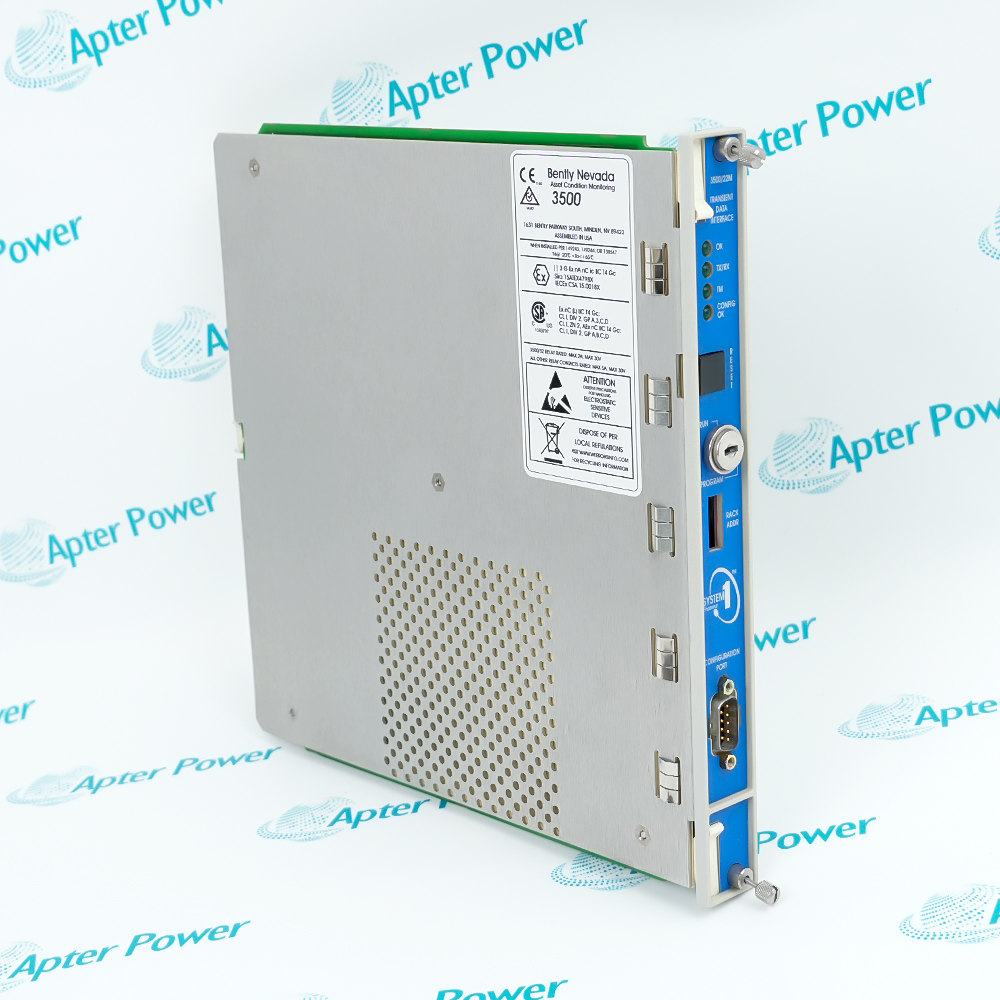
If you need to replace a Bently Nevada 3500/22M TDI, current documentation identifies the 3500/22M 288055-01 as the standard TDI, while the 3500/22M 138607-01 appears in older documentation. That does not make 288055-01 an automatic drop-in replacement for every installed 138607-01. The two generations use different front service interfaces, and the rear I/O module, hardware revision, firmware, rack configuration, and communication path still need to be checked.
At Apter Power, we help maintenance, reliability, and MRO teams source hard-to-find automation spares for urgent repairs. This guide explains what to verify before requesting a quote, what evidence to send us, and what your team should confirm before commissioning the replacement in a turbine, compressor, or other critical 3500 application.
Can 288055-01 Replace 138607-01?
Not on the basis of part numbers alone. Approve the change only after the rear I/O module, front service interface, hardware revision, firmware, and rack configuration have been verified. The table below shows the evidence needed for that decision.
| Question |
288055-01 |
138607-01 |
Approval rule |
| How is the number documented? |
Current OEM Rev AC lists it as the standard TDI with USB cable. |
Archived OEM Rev B lists it as the standard TDI. It is absent from current Rev AC. |
Treat this as a generation change, not automatic proof of drop-in compatibility. |
| Is the front module number enough? |
No. |
No. |
Record the rear I/O module and revision as separate items. |
| Can the installed unit be replaced without configuration evidence? |
Not recommended. |
Not recommended. |
Secure a validated backup and document network and System 1 dependencies first. |
| What should block purchase approval? |
Missing label photos, unknown rear I/O, unclear condition, or no test evidence. |
The same issues, plus no authoritative documentation connecting the number to the intended rack. |
Keep the RFQ open until the evidence gap is resolved. |
The safest conclusion is simple: 288055-01 is the current documented spare and 138607-01 is an older documented spare. The reviewed datasheets do not contain an explicit transition notice declaring unrestricted interchangeability. A reseller cross-reference alone is not sufficient engineering evidence.
What Does the 3500/22M TDI Do in a 3500 Rack?
The 3500/22M TDI is the communication and data interface between a Bently Nevada 3500 monitoring rack and compatible software. According to the Bently Nevada 3500/22M datasheet, it combines the rack interface function with a communication processor that collects steady-state and transient waveform data from compatible 3500 monitors. It can send that data over Ethernet to applications such as System 1 and 3500 System Configuration software.
The TDI occupies Slot 1, directly next to the rack power supplies. It is not part of the critical machinery protection path, so its failure does not by itself remove the monitors' automatic protection functions. That distinction is useful, but it should not be treated as permission to make an uncontrolled change. Loss of communication, event data, waveform collection, or configuration access can still weaken diagnosis and outage recovery.
For procurement purposes, the TDI is not just a replaceable front card. It is part of an installed communication chain:
- The front TDI module.
- The rear TDI I/O module.
- The rack configuration and firmware environment.
- Ethernet or fiber infrastructure.
- System 1, configuration software, and any site data mappings.
All five layers should be considered before a purchase order is released.
How Should 288055-01 and 138607-01 Be Identified?
Identify each number from physical and documentary evidence, not from a shortened description. The archived 3500/22M OEM datasheet lists 138607-01 as the standard TDI. The current OEM datasheet lists 288055-01 in that role. The first task is therefore to establish which hardware generation is installed and what changed between the site-approved baseline and the proposed unit.
Ask your maintenance team for the installed-unit photos, and ask us or any supplier to provide equivalent evidence for the quoted unit:
- The complete front label and barcode.
- The module faceplate and connector area.
- The side label, including assembly, revision, and serial information.
- The rear I/O module label.
- The occupied rack slot and neighboring modules.
- Any packaging label if the part is a stored spare.
The photograph date and the quoted line item should be linked. Generic catalog images are not evidence that the photographed unit is the one reserved for shipment.
Record the Front Module, Rear I/O Module, and Revision
The 3500/22M front module and its rear I/O are separate ordering items. Current OEM documentation lists four rear I/O variants:
| Rear I/O part number |
Communication type |
Additional distinction |
| 146031-01 |
10Base-T or 100Base-TX Ethernet |
Standard OK relay contacts |
| 146031-02 |
100Base-FX fiber |
Standard OK relay contacts |
| 146031-03 |
10Base-T or 100Base-TX Ethernet |
Gold-plated OK relay contacts |
| 146031-04 |
100Base-FX fiber |
Gold-plated OK relay contacts |
The rear I/O number matters because copper and fiber interfaces are not installation details that can be ignored. Relay-contact construction may also matter to a site's drawings, spare strategy, and qualification records.
Build one identification record with these fields:
| Required field |
Why it matters |
| Front module part number |
Establishes the primary TDI identity. |
| Assembly and revision |
Helps identify hardware and documentation differences. |
| Serial number |
Connects photos, test results, and shipment evidence to one unit. |
| Rear I/O part number |
Confirms copper or fiber interface and relay variant. |
| Rack model and slot |
Confirms the intended 3500 architecture and Slot 1 location. |
| Existing firmware and software versions |
Supports configuration and communication review. |
| Agency approval requirements |
Prevents an approval mismatch at a regulated site. |
If a field cannot be completed, classify it as an open question rather than guessing.
Separate Catalog Numbers From Assembly and Spare Numbers
Bently Nevada labels and supplier records can contain a product family, an ordering string, an assembly number, a spare number, a revision, and a serial number. These identifiers serve different purposes. A partial match does not establish functional equivalence.
For 3500/22M 288055-01, the current OEM spare table gives a direct reference point. For 3500/22M 138607-01, the archived OEM spare table confirms the older standard TDI identity. When comparing any supplier, require the quoted assembly, revision, rear I/O, front communication interface, and compatibility basis to be identified. If the only bridge between generations is another reseller's cross-reference, the compatibility question remains open.
The purchasing record should preserve the complete quoted identity. Avoid reducing it to "3500/22M TDI" in the purchase order, because that removes the details the receiving team needs to inspect the delivery.
Compare the Documented Front Service Interfaces
The archived 138607-01 generation used an RS-232 front configuration connection, while the current 288055-01 generation documents a USB-B front port. This is a visible generation difference and an immediate receiving-inspection check. It also means the team should not assume that the old service cable, laptop connection, driver environment, or work instruction carries forward unchanged.
| Check |
Archived 138607-01 documentation |
Current 288055-01 documentation |
Buyer action |
| Front service interface |
RS-232 serial |
USB-B |
Confirm the required cable and approved service computer. |
| Standard spare identity |
Standard TDI |
Standard TDI with USB cable |
Make the quote state exactly which cable is included. |
| Rear network options |
Copper or fiber variants were documented |
Copper, fiber, and gold-plated relay variants are documented |
Verify the exact rear I/O number rather than carrying it over by assumption. |
These differences do not prove that the newer module is unsuitable. They show why a controlled generation transition needs more than a matching product-family name.
Which Compatibility Checks Come Before a TDI Swap?
Compatibility should be checked across hardware, rack architecture, firmware, software, and communications. A matching faceplate or family name addresses only one layer.
Use a hold point before procurement approval. The hold point is cleared only when the person responsible for the installed 3500 system confirms the proposed front module, rear I/O, revision, communication medium, software environment, and required approvals.
Check Rack Architecture and Rear I/O Pairing
Confirm that the target is a Bently Nevada 3500 rack and record the exact installed module in Slot 1. Verify the rear I/O part number independently. Do not assume the rear module can remain in place simply because the replacement front module fits the slot.
This check is especially important when a site is moving from a 3500/20 Rack Interface Module to a 3500/22M TDI. The OEM datasheet contains a specific compatibility warning for that upgrade path and cautions that an incompatible rear I/O arrangement can damage the TDI. The work should follow the applicable OEM manual and the site's approved maintenance procedure. This article is not a removal or wiring instruction.
Also verify:
- Rack size and installed power architecture.
- Rear I/O communication medium and connector type.
- Required agency approvals.
- Existing relay-contact requirements.
- Cabinet space, cable routing, and connector condition.
- Whether the replacement scope includes the front module, rear I/O, cable, or all three.
A quote that says "complete module" should be expanded into an itemized bill of material.
Check Firmware, Configuration, and Communication Paths
Record the current TDI revision and the site's approved firmware baseline. Confirm compatibility with the installed 3500 monitor population and the versions of 3500 System Configuration and System 1 used at the site. The objective is to preserve the existing validated function, not to introduce an unplanned upgrade during an emergency repair.
Map the communication path before removal:
| Layer |
Evidence to capture |
| TDI front port |
Connection type, service use, and current communication status. |
| Rear network interface |
Copper or fiber, network address, link status, and connected switch port. |
| Rack configuration |
Current configuration file, export date, software version, and checksum or controlled revision. |
| System 1 integration |
Rack identifier, mapped points, data collection status, and last known healthy timestamp. |
| Site network |
Approved VLAN or segment, address assignment, and cybersecurity change requirements. |
Do not send passwords, private network diagrams, or unrestricted configuration archives through a public quote form. Use the RFQ to establish the commercial and technical scope, then transfer sensitive files through the buyer's approved secure channel.
What Must Be Backed Up Before Removal?
Back up the current rack configuration and the evidence needed to reconstruct communications. A usable backup is one that another qualified engineer can locate, open with the recorded software version, and associate with the correct rack.
At minimum, preserve:
- The current 3500 rack configuration export.
- Screenshots of the installed module layout and TDI settings.
- Network settings and the approved address assignment record.
- System 1 rack and point mappings relevant to the TDI.
- Current module, communication, and system event logs.
- Photos of the front and rear labels before disassembly.
- The existing firmware and software version record.
- A list of active faults that already existed before the work.
- The approved rollback configuration and the person authorized to use it.
Name the archive with the site, machine train, rack identifier, date, and controlled revision. Store it in the site's maintenance or engineering repository, not on one technician's local device.
The backup should be validated before the outage task starts. A file that exists but cannot be opened is not a recovery plan.
How Should the Replacement Be Commissioned?
Commissioning should prove identity, safe installation, communication, data continuity, and controlled handback. It should not merely prove that the rack powers up.
Use the OEM manual, site lockout and tagout rules, electrostatic discharge controls, and a qualified 3500 technician. Before applying power or returning the system to service, verify the front and rear module identities, connector seating, cable type, grounding, and the absence of visible damage. Do not change monitor alarm or trip settings as part of a TDI replacement unless that change is separately engineered and approved.
A practical commissioning record includes:
- Receiving inspection: Match the delivered serial number, revision, condition, accessories, and rear I/O to the approved quote.
- Pre-installation evidence: Photograph labels and connectors. Record any repaired or replaced components disclosed by the supplier.
- Configuration control: Restore or load only the approved configuration using the documented software version and site procedure.
- Module status: Confirm the expected TDI status indications and investigate any OK, TX/RX, configuration, or system event anomaly.
- Communication test: Verify the approved network path and software connection without changing unrelated rack settings.
- Data test: Confirm that expected steady-state values and available waveform or transient data reach the intended system.
- Event review: Compare post-work events and communication health with the pre-work baseline.
- Rollback decision: If acceptance criteria are not met, stop and use the approved rollback plan.
- Handback: Attach the final configuration revision, photos, test record, and exceptions to the maintenance order.
Acceptance criteria should be written before installation. This prevents the team from redefining success after a problem appears.
What Should a Purchase-Ready Quote Include?
A purchase-ready TDI quote should identify the actual unit and the limits of the supplier's claim. Ask for the following evidence:
| Evidence |
Minimum acceptable detail |
| Unit-specific photos |
Front, side, label, barcode, connectors, and rear I/O if included. |
| Complete identity |
Part number, assembly, revision, serial number, and included accessories. |
| Condition statement |
New surplus, used, refurbished, or another clearly defined condition. |
| Test scope |
What was tested, how it was tested, when, by whom, and the pass criteria. |
| Compatibility basis |
OEM document or buyer-approved engineering reference, not a generic assertion. |
| Stock status |
Date checked, quantity reserved, warehouse location, and reservation period. |
| Warranty |
Applicable supplier warranty, exclusions, return process, and claim contact. |
| Delivery |
Quoted lead time, packing method, destination, and shipping terms. |
For a 138607-01 to 288055-01 change, add one explicit open question: "Which authoritative document or engineering approval supports this exact generation transition with the installed rear I/O and rack revision?" If that evidence is unavailable, the quotation should state the limitation clearly. Transparency is more useful than a confident but unsupported interchange claim.
We are an independent industrial automation spare-parts supplier and are not an authorized Bently Nevada distributor or representative. When you request a quote, we will confirm current stock, quoted condition, lead time, and which unit-specific photos or test documents are available. The quotation will also state any applicable Apter Power warranty; the manufacturer's warranty does not apply to products supplied by us.
View our 288055-01 listing and 138607-01 listing, then send us your RFQ with the installed front and rear labels.
Purchase-Ready RFQ Template
Copy this structure into your RFQ so the engineering and procurement teams evaluate the same scope:
- Required item: Bently Nevada 3500/22M TDI
- Installed front part number: [enter full label]
- Installed assembly and revision: [enter]
- Installed rear I/O part number: [enter]
- Communication medium: [copper or fiber]
- Rack and Slot 1 photos: [attached]
- Current firmware and software versions: [enter]
- Agency approval requirement: [enter]
- Requested condition: [enter acceptable options]
- Required evidence: unit photos, serial number, test report, warranty, stock date, lead time
- Ship-to country and required date: [enter]
- Open compatibility question: [enter any unresolved item]
Do not attach confidential configuration or network credentials to the initial RFQ.
Summary: 288055-01 vs 138607-01 Replacement Decision
The 3500/22M 138607-01 appears in an archived OEM datasheet as the older standard TDI, while current OEM Rev AC identifies 288055-01 as the standard TDI with USB cable. That history supports a generation comparison, but it does not establish unrestricted drop-in compatibility. Confirm the actual labels, revisions, front communication interface, rear I/O, firmware, and site-approved transition basis before approval.
For either number, the replacement decision must cover the front TDI, rear I/O module, revision, rack architecture, firmware, configuration backup, network path, System 1 integration, supplier test evidence, and commissioning acceptance criteria. That evidence-led process reduces the risk of buying a module that fits the rack but does not restore the required communication and data functions.


 Videos
 News
News Applications






Leave Your Comment