-
Match the complete marking
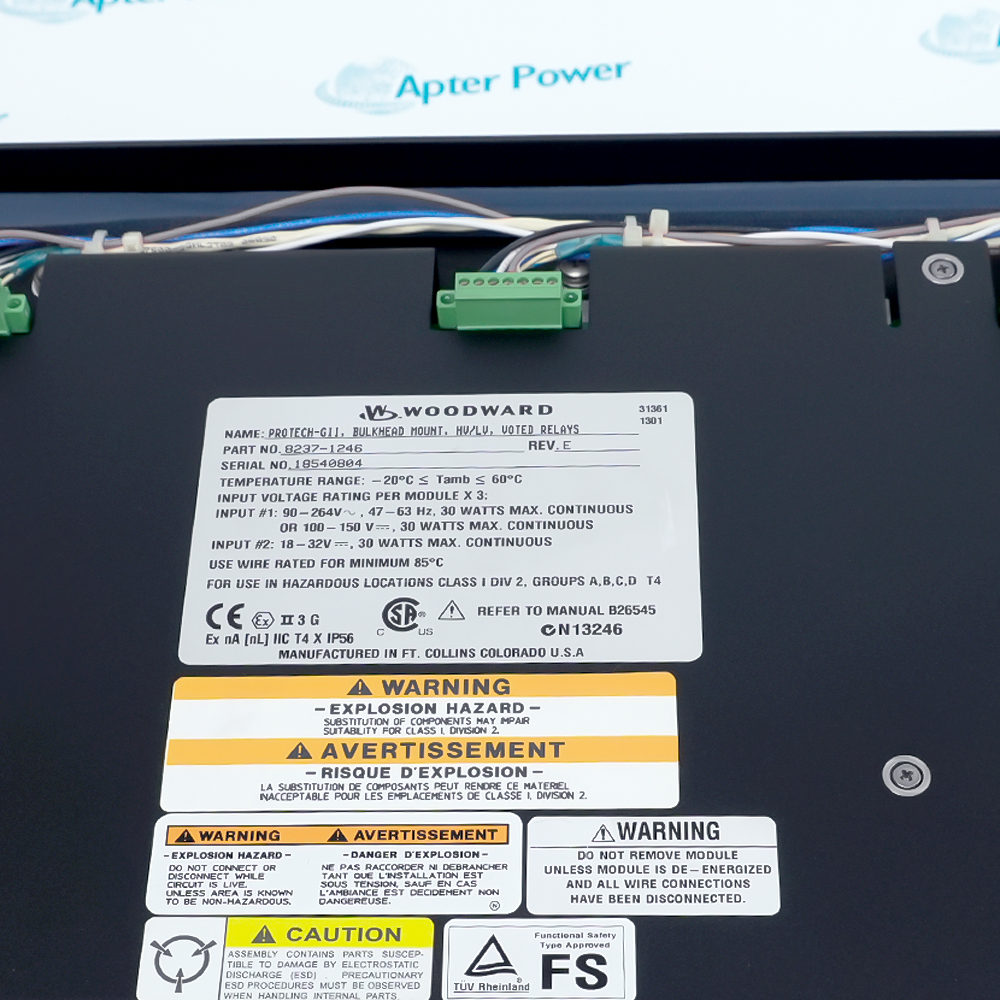
Include 8237-1246 and any revision or assembly number visible on the item. Keep the exact reference on your enquiry and quotation.
-
Check the offered item before ordering
Request available label and connector photos. Have your maintenance team compare the offered 8237-1246 with the installed equipment and applicable Woodward documentation.
Technical specifications for 8237-1246
-
Manufacturer:WOODWARD
-
Product Category:Gas Turbine Control
-
Spare Part Number:8237-1246
-
Weight:1.8 kg
-
Tariff Code:8537101190
-
Voting configuration:2-out-of-3; three independent modules
-
HV input per module:90-264 Vac, 47-63 Hz; or 100-150 Vdc
-
LV input per module:18-32 Vdc; nominal 24 Vdc
-
Module power rating:30 W per module
-
Passive speed input:100 Hz-32 kHz; 1-35 Vrms
-
Active speed input:0.5 Hz-25 kHz; 24 V probe
-
Speed accuracy:±0.04% of current speed at -20 to +60 °C
-
Voted trip outputs:2 simultaneous channels; Form C, dual SPDT
-
Trip contact rating:8 A at 220 Vac or 8 A at 24 Vdc
-
Maximum switching power:2000 VA / 192 W
-
Analog output per module:Isolated 4-20 mA; 12-bit; maximum load 500 ohms at 25 mA
-
Operating ambient:-20 to +60 °C
Information
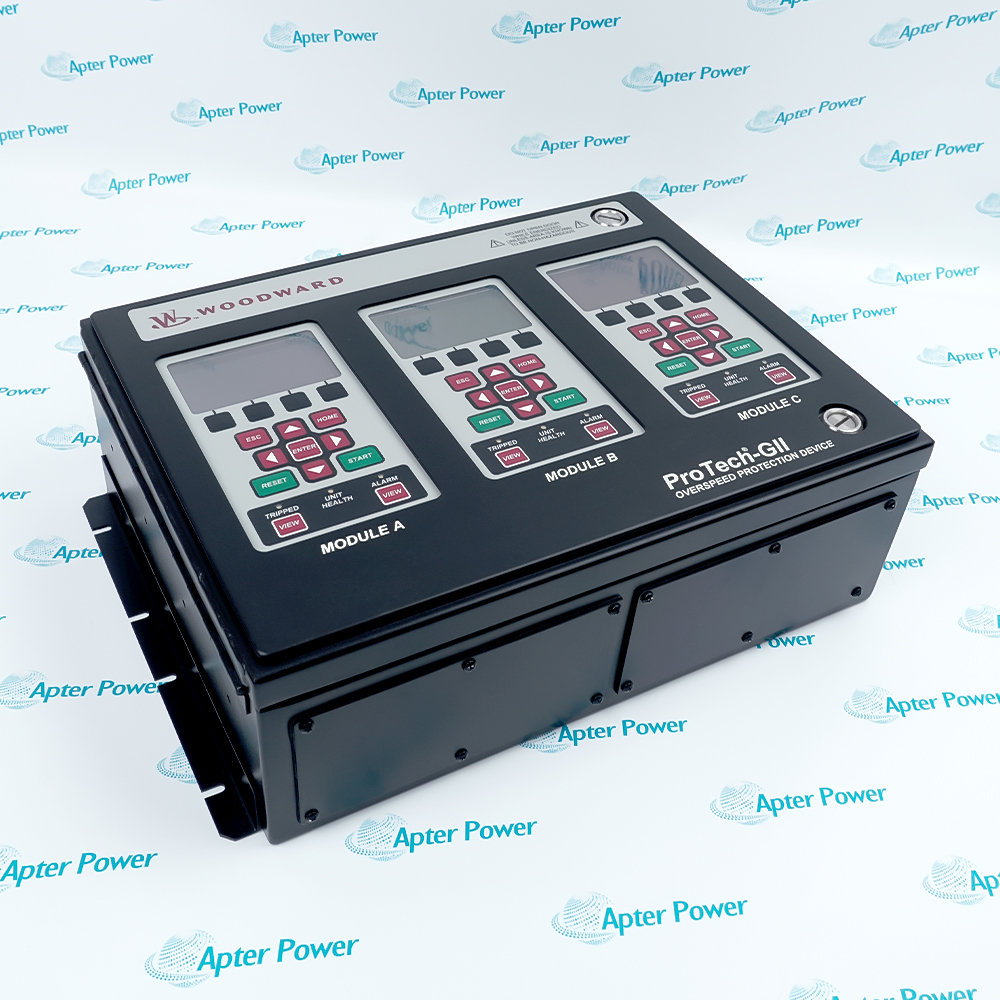
- Woodward 8237-1246 separates speed protection into three independent modules and combines their trip decisions through voted outputs. The HV/LV power arrangement provides two supply inputs per module without internal load sharing.
Power configuration: One HV and one LV input per module
Trip outputs: Two simultaneous Form C, dual-SPDT channels
Each module accepts 90-264 Vac at 47-63 Hz or 100-150 Vdc at the HV input, and 18-32 Vdc at the LV input. The module rating is 30 W. Either input can sustain operation, but the supplies do not share the load internally. Separate supply protection and the correct protective-earth connections form part of the installation.
A module speed input can be configured for a passive MPU at 100 Hz-32 kHz and 1-35 Vrms, or an active 24 V probe at 0.5 Hz-25 kHz. Each input requires its own probe. The voted output uses two simultaneous Form C dual-SPDT channels rated 8 A at 220 Vac or 24 Vdc, subject also to the switching-voltage and power limits.
8237-1246 Original Technical Excerpt
Original ProTech-GII manual pages identify the HV/LV voted-relay model and its power, speed-input and output specifications. PDF · 7 pages.8237-1246 Installation & Verification Guide
Apter Power preparation, connection assessment, diagnostic verification and handover guide. PDF · 5 pages.
Application scope: Suitable integration depends on the machine protection design, independent speed inputs and validated trip path. A protection device must not be substituted for an ordinary speed controller.
Turbine overspeed trip
Use three independent sensing and decision paths with the approved shutdown circuit.Compressor protection
Monitor the shaft speed with probe type and tooth-count scaling configured for the machine.Protection-system renewal
Retain voted-relay behavior and HV/LV power architecture when evaluating replacement hardware.Scheduled proof testing
Verify each module and the final voted trip path under the site-approved protection test procedure.
Match the voted-relay model and review the final shutdown circuit before replacement.
Protect each supply input independently and retain the required PE connections.
Do not connect one speed probe to multiple module inputs.
Select active or passive probe mode and verify amplitude, frequency and scaling.
Meet contact current, switching voltage and switching power limits together.
Complete authorized functional tests and restore test overrides before release.
Alternative Names
Technical notes
Power boundary: Power and current specifications are per module. Dual inputs do not load-share internally.
Probe independence: Each module speed input is intended to operate from its own speed probe.
Voted relay limits: The 8 A contact rating must be considered together with maximum switching voltage and power.

FAQ View All FAQ
-
Which trip architecture is built into Woodward 8237-1246?It is the voted-relay model, using three independent modules and two-out-of-three voting with two output channels actuated simultaneously.
-
Can Woodward 8237-1246 operate from its LV input alone?Each module can operate from either supply input, but both sources are recommended for availability. The LV range is 18-32 Vdc and missing one source can cause a supply-fault alarm.
-
Do the HV and LV supplies in Woodward 8237-1246 share their load?No. Both may be connected, but the internal supplies do not load-share. Size and protect each source for its applicable requirements.
-
What passive pickup signal can Woodward 8237-1246 measure?The passive MPU input range is 100 Hz to 32 kHz with 1-35 Vrms amplitude. Confirm the pickup signal at the intended low and high operating speeds.
-
How does active-probe configuration change Woodward 8237-1246 input requirements?The active input supports 0.5 Hz-25 kHz and a 24 V probe. Its probe power is enabled in active mode; verify the correct sensing mode and signal thresholds.
-
May one probe feed all three Woodward 8237-1246 modules?No. Each speed input should use its own probe. Sharing compromises open-wire detection in passive mode and can affect sensitivity and accuracy.
-
Are the two Woodward 8237-1246 trip channels independent programmable control outputs?No. The voted trip channels actuate simultaneously and use Form C dual-SPDT contacts. They belong to the protection trip circuit.
-
What load limits apply to Woodward 8237-1246 voted contacts?The contact rating is 8 A at 220 Vac or 24 Vdc, with maximum switching voltage 220 Vac or 150 Vdc and maximum switching power 2000 VA or 192 W. All applicable limits must be satisfied.
Supporting new and legacy automation
-
Please try to be as accurate as possible with your search.
-
We can quote you on 1000s of specialist parts, even if they are not listed on our website.
-
We can't find any results for “”.
You May Also Like
Product Browsing History
-
Whatsapp: +86 18030235313
Send us a message. -
sales13@apterpower.com
Complete our online form. -
+86 18030235313
Speak to our team in your native language.