Tiffany Guan is an industrial automation account manager at Apter Power with 20 years of experience supporting international MRO procurement and legacy-system spare-parts sourcing. Her work focuses on PLC, DCS, drives, HMI, machinery-protection systems, and discontinued or hard-to-find automation components.
She works with maintenance engineers, automation teams, and procurement professionals across more than 100 countries, helping customers clarify complete part numbers, revisions, product condition, documentation, testing scope, lead time, and delivery requirements. Her experience connects real plant needs with clear, verifiable sourcing information.
Tiffany contributes to Apter Power's technical and procurement content from a practical buyer-support perspective. Her articles cover supplier evaluation, obsolete-parts identification, compatibility checks, lifecycle planning, and procurement-risk control. Readers can verify her professional identity and industry activity through Tiffany's LinkedIn.
For an accurate quotation, please send the complete model number, nameplate photographs, required quantity, preferred condition, destination, and delivery deadline. Tiffany and the Apter Power team will review the request and respond with available sourcing options.
SCHNEIDER ELECTRIC / PRODUCT LIFECYCLE NEWS04 NOVEMBER 2026
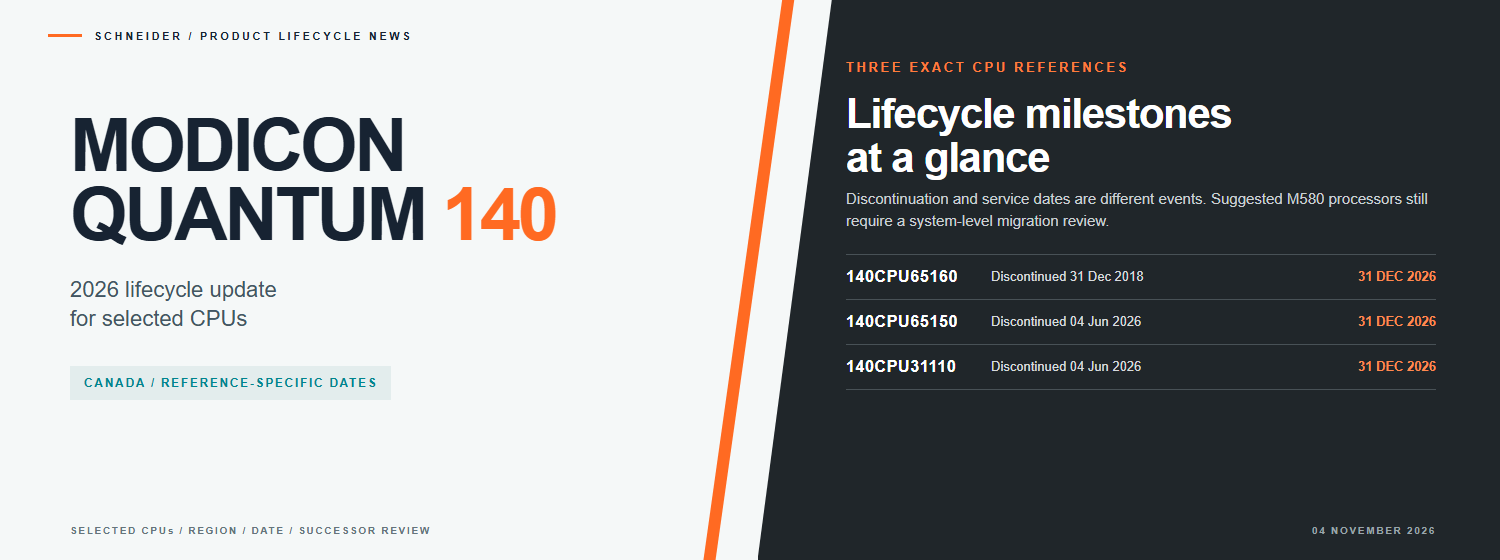
Three selected Schneider Modicon Quantum 140 CPUs carry important Canadian lifecycle milestones in 2026. The records reviewed for 140CPU65150 and 140CPU31110 list 4 June 2026 as the discontinuation date, while 140CPU65160 was discontinued earlier. All three records list 31 December 2026 as the end of standard service in Canada. These dates are reference- and region-specific; they are not a single global end date for the entire Quantum 140 range.
Lifecycle planning overview for the three selected CPU references discussed in this article. Dates must be checked against the exact model and destination market.
01 / MAIN CHANGES
Three exact CPUs, one region and two suggested M580 processors
The table below separates each complete CPU reference from its regional lifecycle dates. This matters because the same base reference can show different commercial or service milestones in different markets. Suffix variants such as coated, safety or hardened versions must also be checked as separate order codes rather than assumed to follow the dates below. The Apter Power Schneider Electric parts index can be used to organize an exact-reference enquiry, but a catalogue listing is not evidence that two suffix variants share the same lifecycle status or system compatibility.
Exact CPU model
Region
Discontinued / end of sale
End of standard service
Suggested successor processor
140CPU65160
Canada
31 Dec 2018
31 Dec 2026
BMEP582040
140CPU65150
Canada
4 Jun 2026
31 Dec 2026
BMEP582040
140CPU31110
Canada
4 Jun 2026
31 Dec 2026
BMEP581020
02 / PRACTICAL IMPACT FOR EXISTING USERS
Discontinuation, service end and equipment operation are different events
Discontinuation or end of sale is a commercial milestone. It indicates that the reference is no longer handled as an active-sale product under the relevant regional lifecycle record. It does not switch off an installed CPU, change the running program or mean that a functioning rack must be removed on that date.
End of standard service is a later support milestone. For the three Canadian records above, 31 December 2026 is the listed limit for standard manufacturer maintenance services such as repair or spare-parts support. It should not be interpreted as a guarantee that every service will remain available until that day, and support after that date should not be assumed.
For maintenance and asset teams, the immediate issue is therefore exposure: how many operating assets depend on each exact CPU, what verified spares are available, whether a recoverable application backup exists, and how long the site can tolerate a failed controller. Procurement should avoid searching only for “Quantum 140 CPU”; a quotation must be tied to the complete order code, suffix, revision, condition requirement and required supply scope.
Minimum evidence for each installed CPU
Record group
Minimum evidence to retain
Decision supported
Identity
Full order code, every suffix, readable nameplate photographs, hardware revision and executive or firmware level
Correct lifecycle status and exact-reference comparison
Application
Project file, engineering-software version, libraries, memory media, communication configuration and last verified recovery point
Program recoverability after a CPU change
Architecture
Rack and power-supply references, slot position, local and remote I/O, network modules, addresses and connected operator systems
Spare priority and timing of engineered migration work
03 / INSTALLED HARDWARE CONTEXT
Lifecycle planning must cover the rack around the CPU
A processor lifecycle record is only the starting point for an installed-base review. A working Quantum system can also depend on its backplane, power supplies, local I/O, communication modules, S908 remote-I/O path, field terminal assemblies and the engineering files required to restore the application. A CPU may be the item named in a lifecycle notice, but the recovery task after a failure is determined by the complete hardware and software chain.
The three Apter Power archive photographs below show representative points in that chain. They are not the three CPUs listed in the lifecycle table and their presence does not extend the dates above to these references. They are included to show the level of exact-model and architecture evidence that maintenance teams should retain.
A / CONTROLLER EXAMPLE
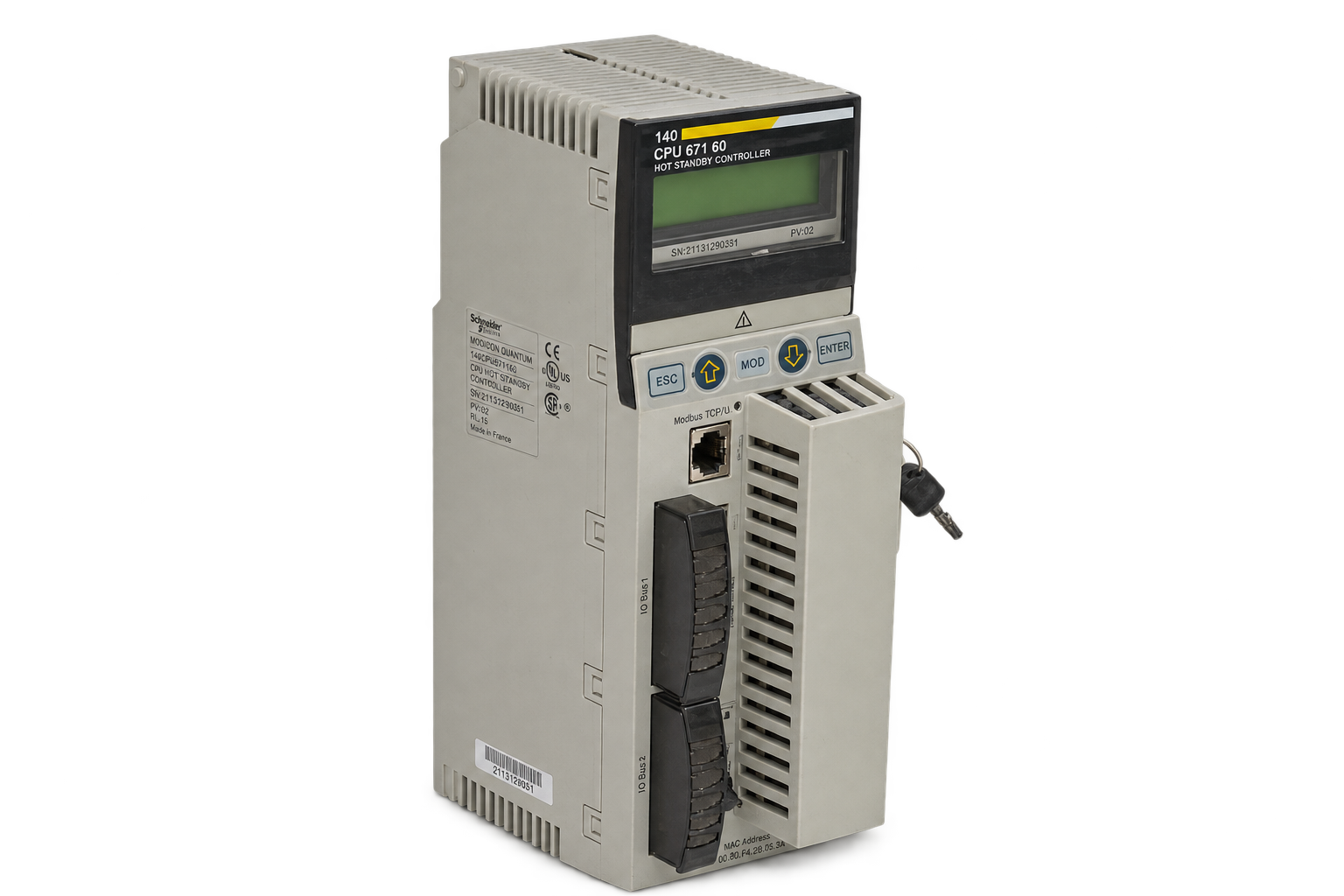
140CPU67160 processor module
This photographed processor is a different reference from the three CPUs in the date table. It illustrates why a controller record should include the complete order code, hardware revision, executive or firmware level, memory arrangement, programming platform and the communication services used by the application.
B / I/O EXAMPLE
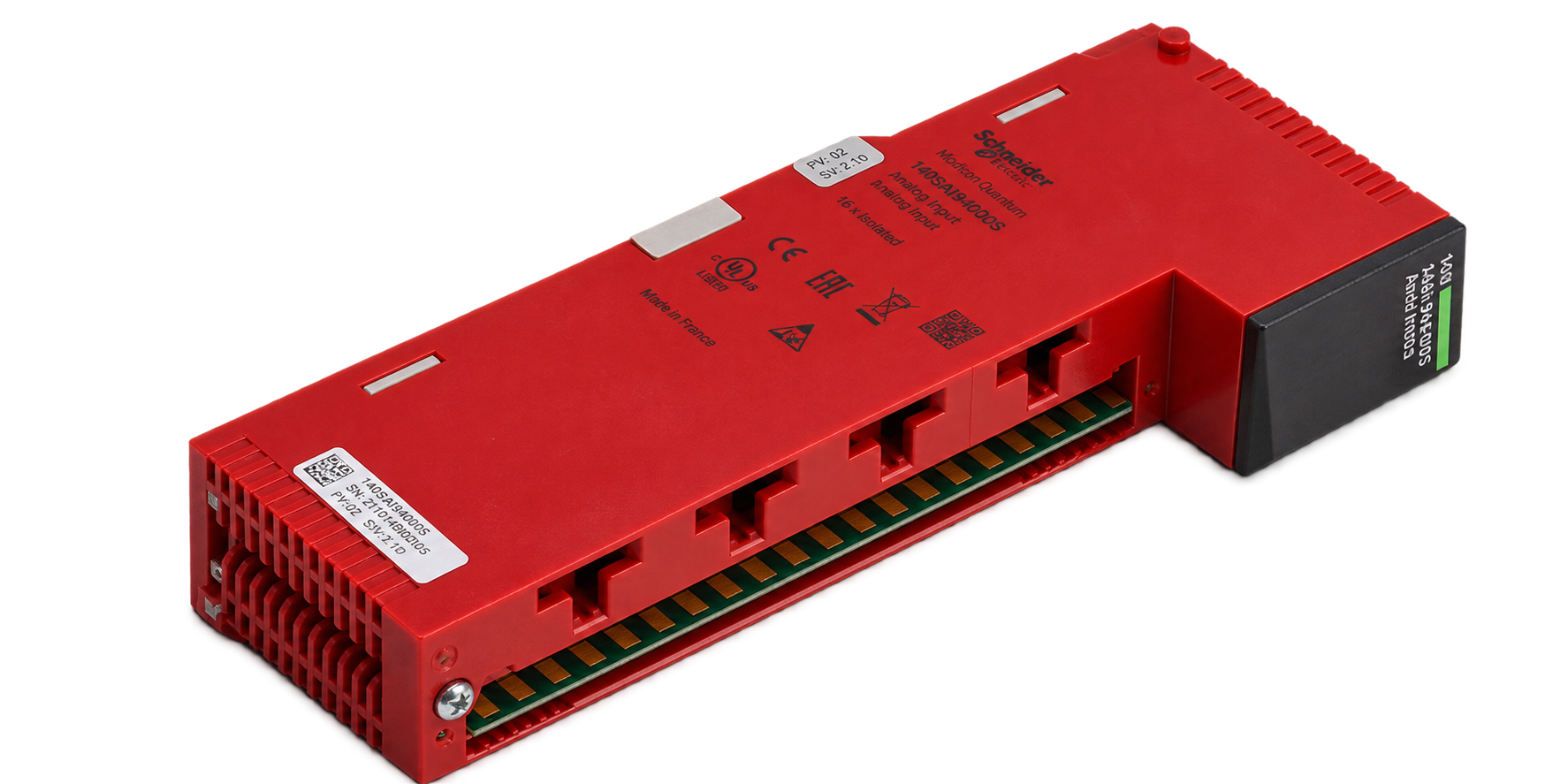
140SAI94000S analog safety input module
This I/O example shows why a CPU-only survey is incomplete. Record the installed module reference, slot, configured channels, field terminal arrangement, wiring documentation and the safety-validation responsibilities that apply before any rack or application change.
C / REMOTE I/O EXAMPLE
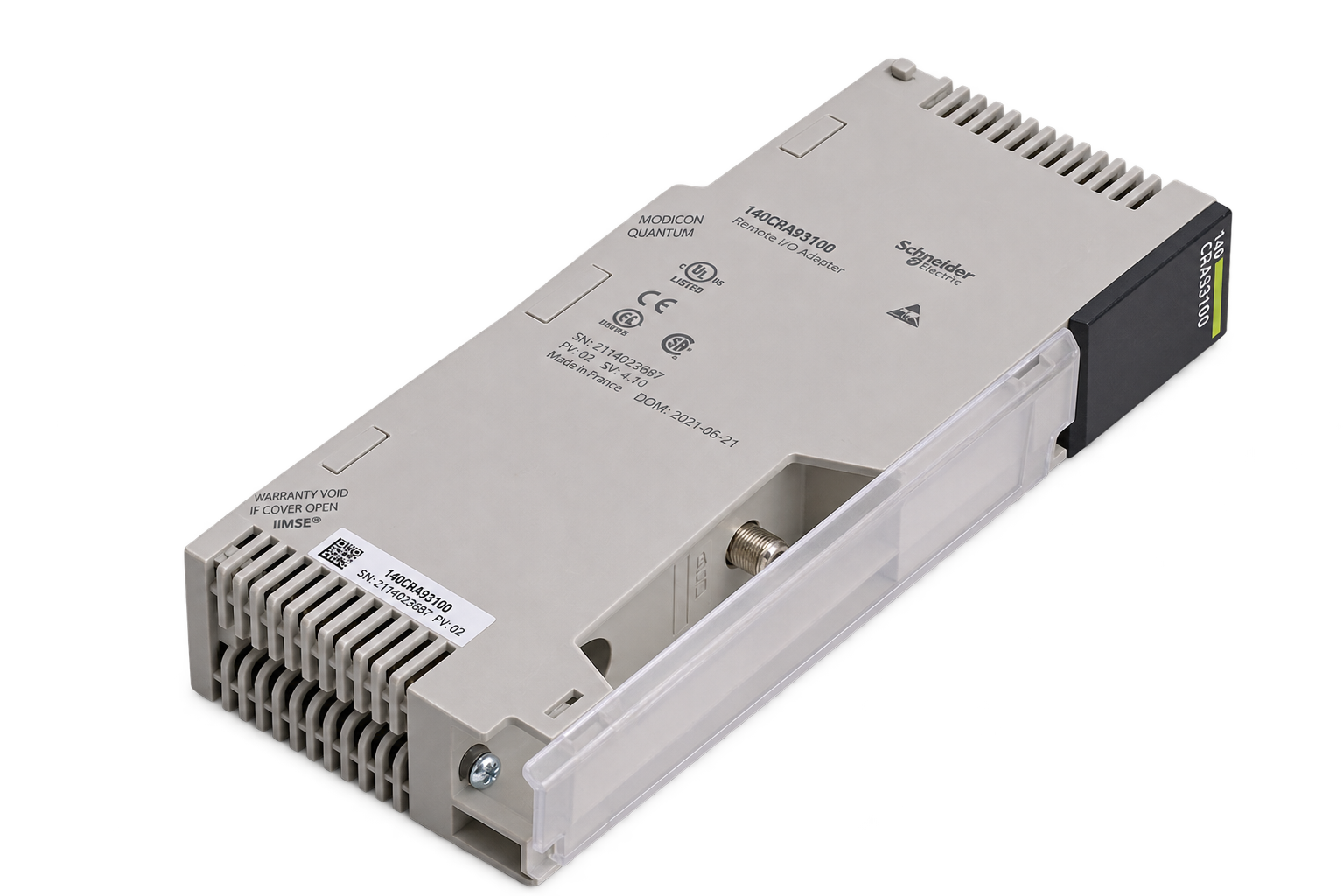
140CRA93100 single-cable S908 RIO drop adapter
This adapter example highlights a dependency outside the processor. Capture the exact head and drop references, coaxial path, drop address, connected rack, termination arrangement and network condition. Systems using a different or redundant cable topology must be documented according to the hardware actually installed.
04 / THREE ACTIONS
What users can do before the 2026 service milestone
01
Confirm the exact model and region
Photograph the front and side labels and record the full order code exactly as printed. Separate 140CPU65160, 140CPU65150 and 140CPU31110 from any suffixed variant. Match the lifecycle status to the destination market; do not apply the Canadian dates automatically to equipment elsewhere.
02
Review spares and secure the program
Map each installed CPU to its rack, site and criticality. Record the completeness of any spare, including memory accessories, connectors and documentation. Create a controlled, recoverable backup of the application and communication configuration. Use Apter Power's part-verification guide to structure label evidence and review the site's product-condition definitions before specifying the acceptable supply condition.
03
Define the migration requirements
Use the suggested M580 processor only as the start of a feasibility review. Document application languages and libraries, Ethernet and Modbus Plus services, S908 or other remote-I/O dependencies, rack and power arrangements, field terminations, shutdown windows, test criteria and rollback requirements. Relevant documentation can be organized through Apter Power's technical resources before the engineering scope is approved.
05 / MIGRATION SCOPE
A successor CPU reference does not define the complete project
BMEP582040 is the suggested successor processor shown for 140CPU65160 and 140CPU65150, while BMEP581020 is shown for 140CPU31110. These references identify a possible M580 direction; they do not prove mechanical, electrical, network or application equivalence in a specific plant.
A practical assessment should cover the controller program, supported instructions, communication services, local and remote I/O, rack and power architecture, wiring and terminal strategy, alarm and interlock testing, operator procedures, cutover duration and rollback plan. Keep this assessment proportionate: the purpose at this stage is to establish scope and risk, not to turn a lifecycle news item into a complete migration tutorial.
Application and software
Confirm that the source project can be opened with the documented engineering-software version. Record custom libraries, derived function blocks, retained data, startup behaviour, memory media and the latest verified backup. Identify instructions or services that may require conversion or redesign.
Networks and remote I/O
Map every Ethernet, Modbus Plus, serial and S908 dependency, including addresses, peer devices, operator stations and gateways. A successor processor does not by itself preserve the installed communication path or the timing expected by connected equipment.
Rack, power and field interface
Compare the existing backplane, power supplies, slot allocation, I/O modules, terminal assemblies and field wiring with the proposed architecture. Decide which elements can remain, which require an interface strategy and which must be replaced during the outage.
Cutover and proof of operation
Define the shutdown window, pre-test environment, responsibility matrix, acceptance tests and rollback point. The plan should cover I/O forcing controls, interlock and alarm checks, network recovery, operator sign-off and the evidence required before the asset returns to service.
Continuity spares and migration planning can proceed together. A verified Quantum spare may reduce near-term downtime risk while the engineered migration is prepared. Conversely, a future migration plan does not remove the need for a current backup, an accurate installed-base register and clear recovery responsibilities. When a spare requirement is ready for commercial review, check the ordering process and shipping and delivery information without treating a quotation or dispatch estimate as an engineering availability guarantee.
06 / TECHNICAL FAQ
Frequently asked questions about the selected Quantum 140 CPUs
Do all Schneider Modicon Quantum 140 products share the same 2026 lifecycle date?
No. Lifecycle status must be checked by complete order code and region. The dates in this article apply only to the unsuffixed 140CPU65160, 140CPU65150 and 140CPU31110 records for Canada; they should not be applied automatically to other CPUs, suffix variants or countries.
Does discontinuation mean an installed 140CPU65160, 140CPU65150 or 140CPU31110 will stop operating?
No. Discontinuation is a commercial milestone and does not stop a functioning installed CPU or change its program. The operational risk comes from future failure, limited service options, incomplete backups or an undocumented architecture.
Can BMEP582040 or BMEP581020 be installed as a direct replacement?
They should not be treated as verified drop-in replacements. They are suggested successor processors that indicate a possible M580 direction. Program conversion, racks, power, communications, local and remote I/O, wiring, testing and cutover requirements still need engineering review.
What should be backed up before changing a Quantum CPU?
Retain the project file, engineering-software version, libraries, communication configuration, network addresses, memory-media details, hardware and firmware or executive revisions, current I/O mapping and a documented recovery procedure. Confirm that the backup can be located and opened before an outage.
What information should be included in a Quantum 140 enquiry?
Provide the complete order code and suffix, readable label photographs, quantity, hardware or firmware revision if available, rack position, required accessories, acceptable condition, destination and required-on-site date. For migration discussions, also provide the current software platform and the network and remote-I/O architecture.
ABOUT THE AUTHOR
Tiffany Guan supports industrial automation enquiries at Apter Power, helping customers organize exact-model, condition and delivery information for quotation review.
QUANTUM 140 ENQUIRY
Send the exact model and installed-system details
Include the complete order code, quantity, label photographs, hardware or firmware revision if available, rack location, required supply scope, destination and required-on-site date. For migration discussions, add the current software platform, network and remote-I/O architecture.
Use the manufacturer name, full part number and revision to describe the item your installed system needs. Share label photos, quantity and delivery requirements with Apter Power so our team can review the sourcing request and clarify the supply scope before you place an order.
12-Month Warranty
Fast Worldwide Dispatch
ISO 9001:2015 certified
SUBMIT YOUR REQUIREMENT
One part or a full list. Start here.
Send a part number, a label photo or your full parts list. Tell us your deadline and we’ll help you work through the sourcing options.