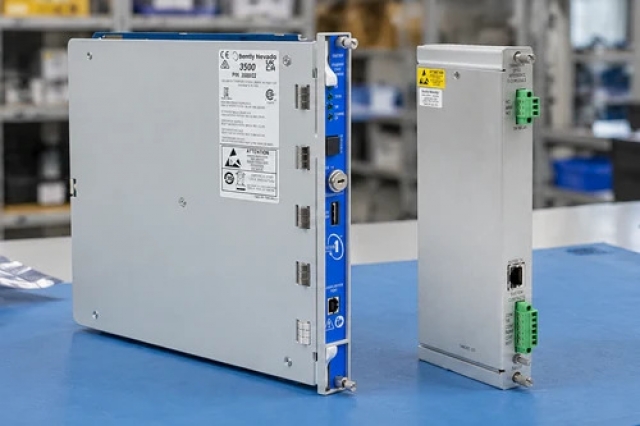
-
Match the complete marking
Include MVME31006E-1152 and every visible revision or serial identity in your enquiry. Keep the same complete reference on the quotation. -
Check the offered item before ordering
Request available label and connector photos. Have your maintenance team compare the offered MVME31006E-1152 with the installed equipment and applicable Motorola documentation.
Technical specifications for MVME31006E-1152
-
Manufacturer:Motorola
-
Product Category:General Automation
-
Spare Part Number:MVME31006E-1152
-
Weight:0.4 kg
-
Tariff Code:8537101190
-
CPU:667 MHz MPC8540 PowerPC e500
-
DDR memory:256 MB
-
Soldered flash:64 MB
-
VME protocol:VME64 with 2eSST-capable series interface
-
Ethernet topology:Two Gigabit and one 10/100 ports in series design; rear access requires matching RTM
-
Serial ATA:SATA controller in -1152 order configuration
-
Expansion:PMC-X sites in MVME3100 architecture; check -1152 population
-
Firmware monitor:MOTLoad
-
Front-panel execution:IEEE handles, 6E
Information
- This 6E MVME3100 build brings an MPC8540 compute core and newer VMEbus transfers to an established VME chassis.
Backplane review: map active P2 signals
Expansion review: identify fitted PMC cards
Commissioning: prove actual VME transactions
The series architecture combines a Tsi148 VME bridge, Ethernet, serial and SATA paths. Some connectors are front-facing while others are available through P2 and an appropriate rear transition module; the original slot and cable map determine which paths are actually usable.
MOTLoad performs initialization, diagnostics and operating-system boot. Preserve the installed firmware version, boot source, network settings and PMC configuration, then test board and peripheral functions under the machine acceptance procedure.
-
Motorola MVME31006E-1152 technical reference
Prepared by Apter Power - PDF, 4 pages. SMART Embedded Computing MVME3100 Data Sheet, MVME3100-DS, 21Feb2020. -
Motorola MVME31006E-1152 installation guide
Prepared by Apter Power - PDF, 3 pages. Model-specific installation, electrical checks and commissioning review.
Integration boundary: 2eSST performance, PMC expansion and rear communications depend on compatible backplane, fitted mezzanines and RTM wiring.
-
VME application processing
Use the MPC8540 board to run a supported PowerPC application with the installed VME address and interrupt map. -
Backplane data exchange
Apply 2eSST only where peer boards and the chassis backplane are verified for that protocol; legacy VME transfers remain an integration consideration. -
Networked control
Route the intended Gigabit or 10/100 port through its documented front or rear path and restore host addressing. -
Peripheral expansion
Use PMC-X and SATA functions only with the fitted cards, power budget and software drivers recorded for the machine.
Shut down the VME chassis and connected peripherals before removing the processor.
Check IEEE handle, slot and rear-transition clearance for this 6E execution.
Identify which Ethernet and serial connections run through P2 and the installed RTM.
Record fitted mezzanines, SATA cabling and boot media; do not assume the base board supplies them.
Preserve firmware and environment settings before changing flash or boot selection.
Run board diagnostics, confirm memory and flash identification, then exercise VME, network and application I/O.
Alternative Names
Technical notes
Order-code boundary: The 6E-1152 row specifies 256 MB DDR and 64 MB flash; -1263 has a different processor and memory build.
Rear interface: Match the installed MVME721-type rear transition arrangement before using P2 network or serial ports.
Technical reference: SMART Embedded Computing MVME3100 Data Sheet, MVME3100-DS, 21Feb2020. The exact 6E-1152 ordering entry defines the offered configuration.

FAQ View All FAQ
-
Why should MVME31006E-1152 not be treated as the -1263 build?The original ordering rows separate 667 MHz/256 MB/64 MB for -1152 from the higher processor and memory option. Firmware and software capacity planning must follow the exact row.
-
How is rear Ethernet access established for MVME31006E-1152?Identify the P2 signals and the fitted MVME721-type RTM, then prove the selected network port with its host configuration.
-
What determines 2eSST operation with MVME31006E-1152?The controller supports the protocol, but effective use requires a matching backplane and other boards. Validate bus negotiation and actual transactions in the installed chassis.
-
What should MOTLoad reveal before MVME31006E-1152 enters service?Check startup diagnostics, 256 MB memory discovery, flash/boot selection and interface initialization before the plant application is loaded.
-
How should SATA devices be checked with MVME31006E-1152?Confirm controller mode, cable route, device power and boot configuration, then verify the device is visible to the chosen software image.
-
Which PMC checks matter when exchanging MVME31006E-1152?Compare mezzanine identity, slot position, PCI/PMC driver and field cable path; a working base processor does not prove optional I/O.
-
Why can a network link appear healthy while MVME31006E-1152 remains offline?Physical link is only the first layer. Check the exact port, address, booted application and host protocol before diagnosing the board as failed.
-
What demonstrates a successful MVME31006E-1152 replacement?Confirm MOTLoad and memory tests, expected VME transactions, selected network and SATA functions, and all application-specific PMC channels against the prior system record.
Supporting new and legacy automation
-
Please try to be as accurate as possible with your search.
-
We can quote you on 1000s of specialist parts, even if they are not listed on our website.
-
We can't find any results for “”.
Related cases and sourcing guidance
View all case studiesYou May Also Like
Product Browsing History
-
Whatsapp: +86 18030235313
Send us a message. -
sales13@apterpower.com
Complete our online form. -
+86 18030235313
Speak to our team in your native language.