-
Match the complete marking
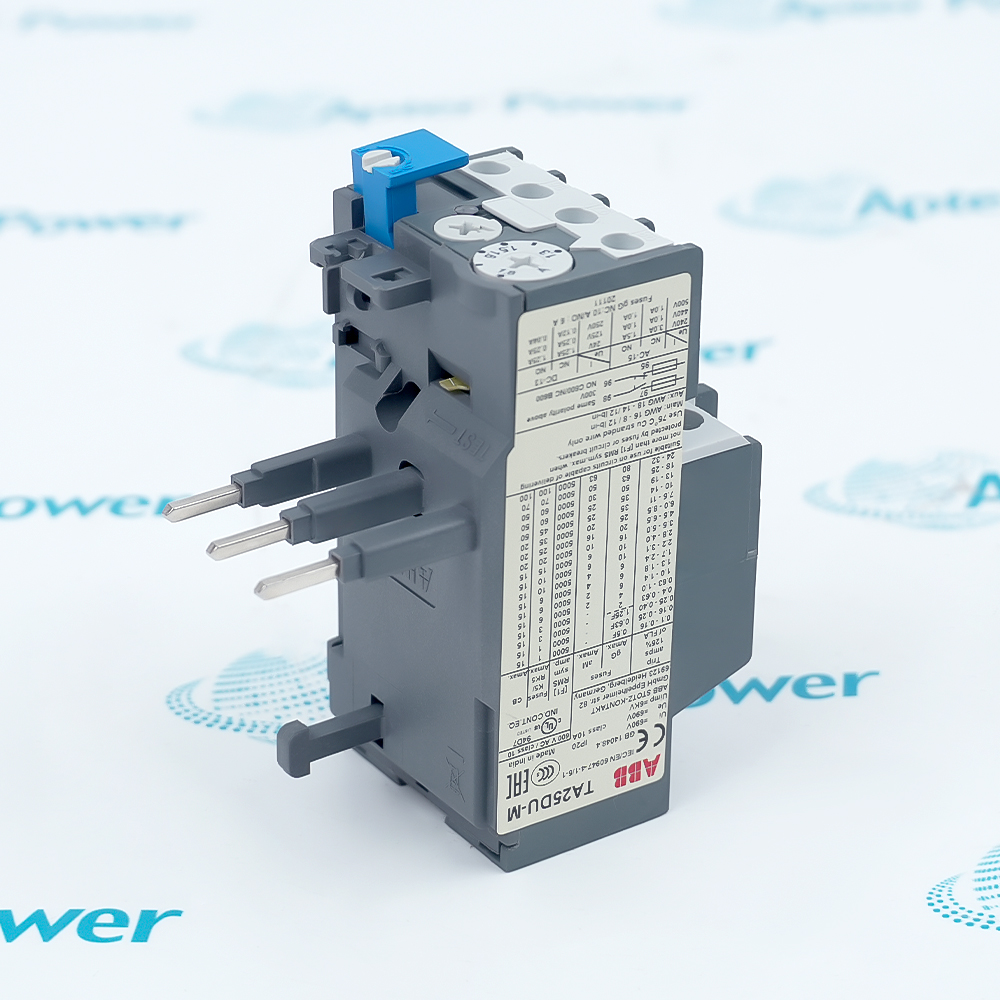
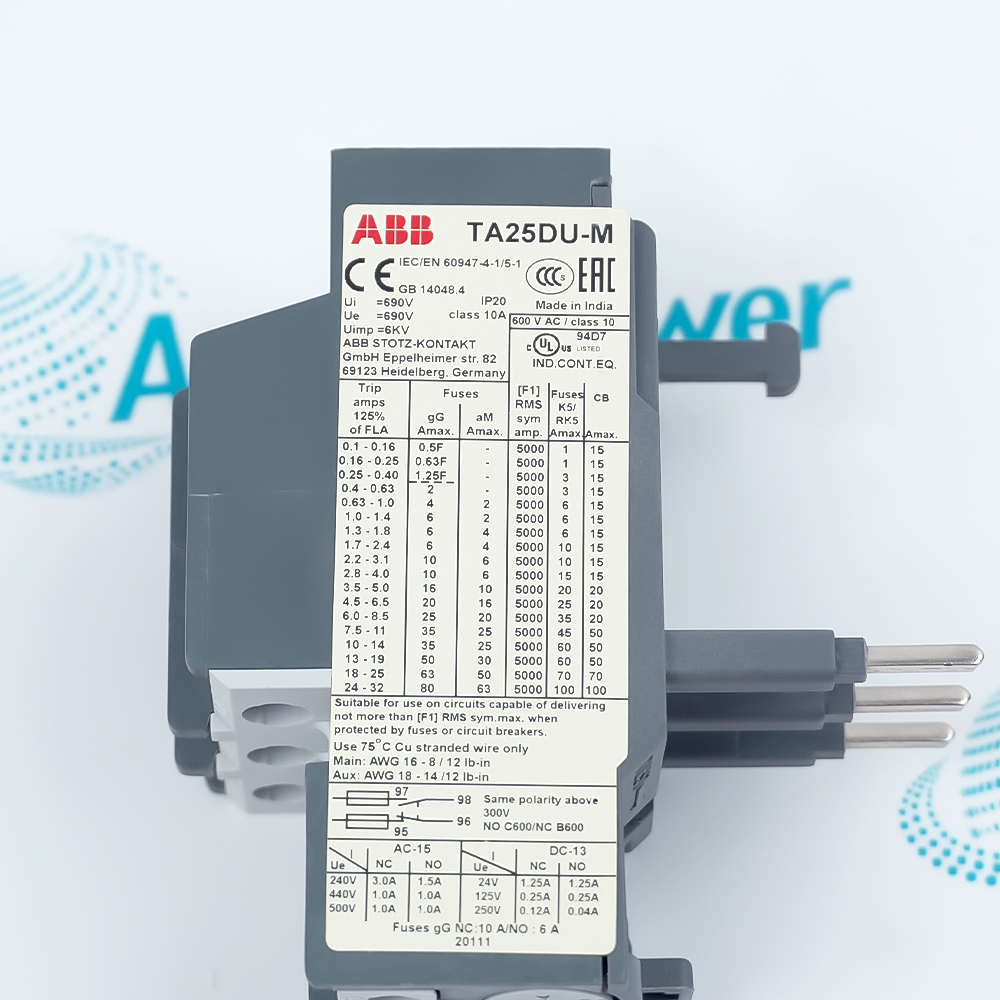
Match the complete ABB TA25DU-M marking, hardware revision and selected configuration to the installed position. Check sensing principle and trip class against the installed configuration.
-
Check the offered item before ordering
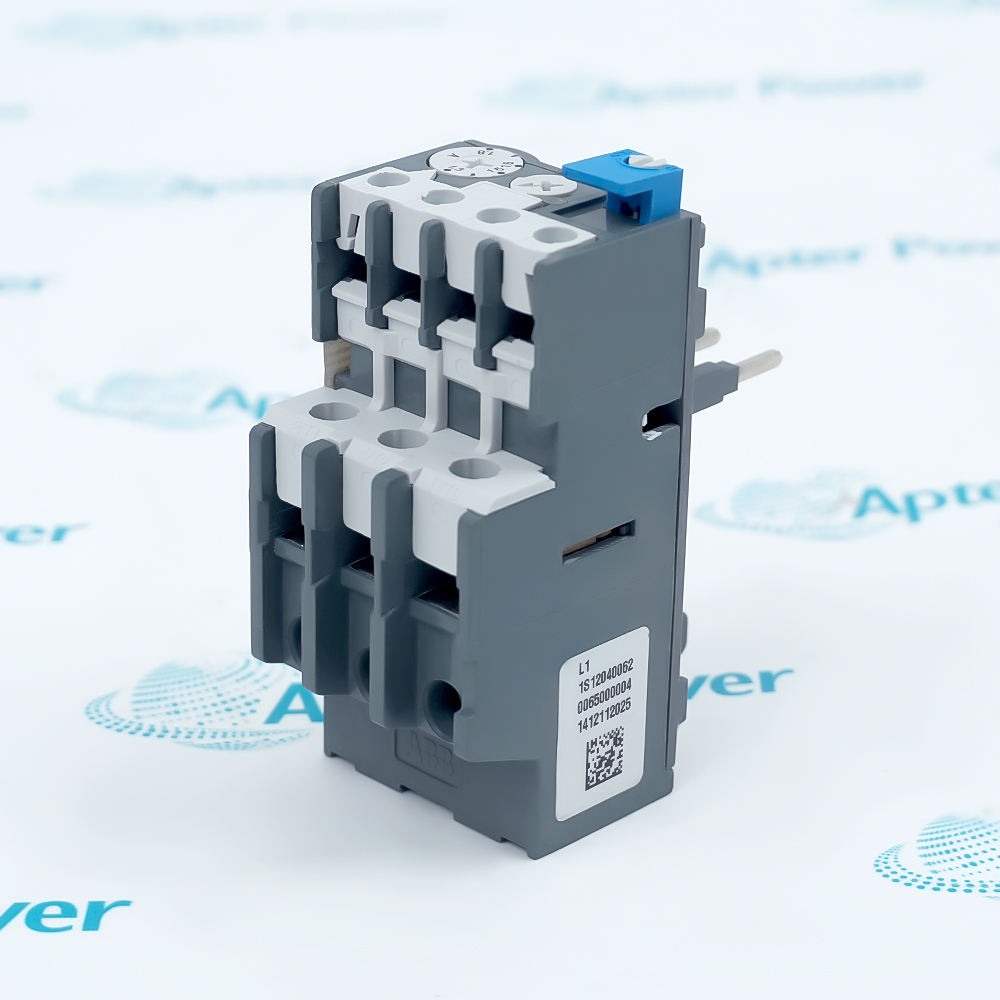
Request label and connection photographs. Have your maintenance team compare the offered TA25DU-M with the installed equipment and applicable ABB instructions.
Technical specifications for TA25DU-M
-
Manufacturer:ABB
-
Product Category:General Automation
-
Spare Part Number:TA25DU-M
-
Weight:0.17 kg
-
Tariff Code:8537101190
-
Sensing principle:Three-pole bimetal thermal overload
-
Trip class:10A
-
Phase-failure sensitivity:Yes
-
Reset mode:Manual or automatic
-
Auxiliary contacts:1 NC (95-96) + 1 NO (97-98)
-
Rated operational voltage:690 V AC
-
Rated insulation voltage:690 V
-
Impulse withstand:6 kV
-
Frequency range:0 to 400 Hz
-
NC conventional thermal current:10 A
-
NO conventional thermal current:6 A
-
Operating temperature:-25 to 55°C
Information
- ABB TA25DU-M responds to sustained motor overload through bimetal elements and provides separate auxiliary contacts for the control-trip and signalling circuits.
Trip class: 10A
Phase-failure sensitivity: Yes
The relay provides one normally closed contact 95-96 and one normally open contact 97-98. Their thermal current ratings differ: 10 A for the NC contact and 6 A for the NO contact. Switching duty ratings must be checked for the actual control voltage and load category.
The three-pole thermal mechanism is temperature compensated and suitable for the specified single- or three-phase applications. TEST, STOP and reset functions support functional checks; thermal overload protection must be coordinated with separate short-circuit protection.
TA25DU-M Official Technical Excerpt
Original ABB technical material applicable to TA25DU-M, covering function, interfaces and operating limits. PDF · 4 pages.TA25DU-M Installation & Verification Guide
Apter Power field guide for the selected connection, configuration and functional tests. PDF · 5 pages.
Application scope: These are TA25DU-M family characteristics. No individual current-range variant is inferred from the family-only model. The examples below address the stated product function.
Motor overload protection
Apply the selected current-range variant to the motor's rated current and starting duty.Contactor control trip
Use the NC auxiliary contact in the designed contactor control circuit.Overload trip indication
Use the separate NO contact for the appropriate signalling load.Controlled reset integration
Select manual, automatic or compatible remote reset according to the machine restart strategy.
Read the current scale and complete marking on the offered relay.
Compare the trip class 10A characteristic with the motor's starting requirement and protection design.
Mark the power conductors before removal and reconnect them in the specified arrangement.
Retain the specified upstream protective device and coordination arrangement.
Trace 95-96 and 97-98 separately.
Compare the control voltage and load category with the auxiliary-contact switching ratings.
Alternative Names
Technical notes
Match the motor starting duty: Compare the trip class 10A characteristic with the motor's starting requirement and protection design. A relay chosen only for steady-state current may not be appropriate for the acceleration time or operating cycle.
Distinguish trip and signal contacts: Trace 95-96 and 97-98 separately. The NC trip path and NO indication path have different functions and thermal ratings, so do not interchange their loads simply because both are auxiliary contacts.
Retain the protection settings: Record the actual current-range variant, motor current, final dial position, reset mode and control-circuit test results. Release the motor only after overload and upstream protection coordination have been confirmed for the installation.

FAQ View All FAQ
-
Does TA25DU-M by itself identify a 32 A overload setting?No. It is a family reference without a specified current-range suffix. Select the exact range from the unit marking and motor full-load current.
-
Which contact on TA25DU-M interrupts the control circuit after a trip?The normally closed auxiliary contact is 95-96. The normally open 97-98 contact is available for signalling in the intended control arrangement.
-
Are the NC and NO contacts of TA25DU-M rated for the same thermal current?No. Conventional thermal current is 10 A for the NC contact and 6 A for the NO contact; switching ratings also depend on voltage and utilization category.
-
What does trip class 10A mean for selecting TA25DU-M?It identifies the overload trip-time class. Check the motor starting duty and required protection coordination rather than selecting the relay only by current range.
-
Can TA25DU-M use automatic reset?Yes. Manual and automatic reset modes are available. The selected mode must agree with the machine's restart and control-circuit design.
-
Does TA25DU-M replace a short-circuit protective device?No. Its thermal overload function must be coordinated with the appropriate upstream short-circuit protection.
-
How is phase loss addressed by TA25DU-M?The relay is phase-failure sensitive. Preserve the specified conductor arrangement so the three-pole thermal mechanism can perform its intended protection function.
-
What control pulse limitation applies when remotely resetting TA25DU-M with DR25-A?The DR25-A reset accessory uses a pulse of no more than 0.2 seconds. Use the correct accessory voltage and do not apply continuous energization.
Supporting new and legacy automation
-
Please try to be as accurate as possible with your search.
-
We can quote you on 1000s of specialist parts, even if they are not listed on our website.
-
We can't find any results for “”.
Related cases and sourcing guidance
View all case studiesYou May Also Like
Product Browsing History
-
Whatsapp: +86 18030235313
Send us a message. -
sales13@apterpower.com
Complete our online form. -
+86 18030235313
Speak to our team in your native language.