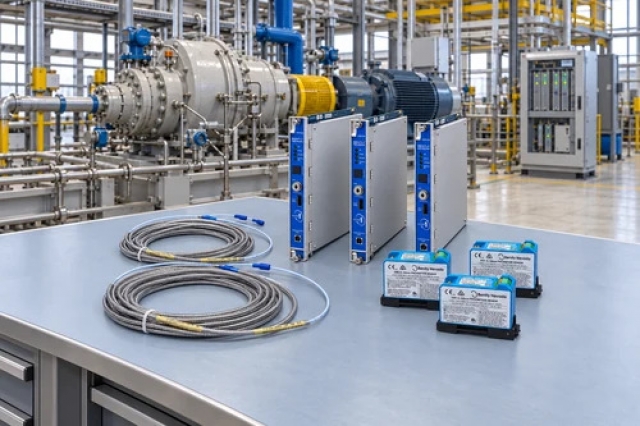
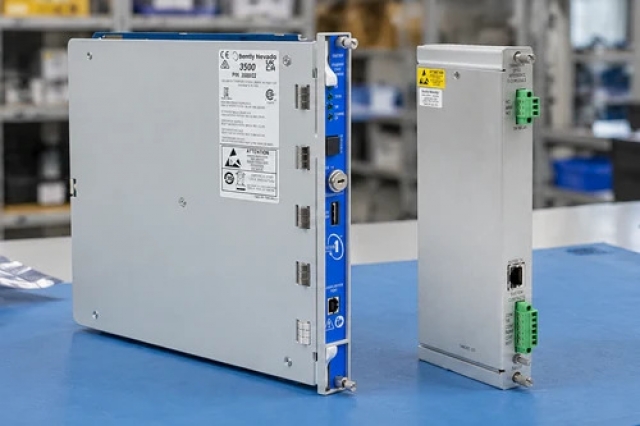
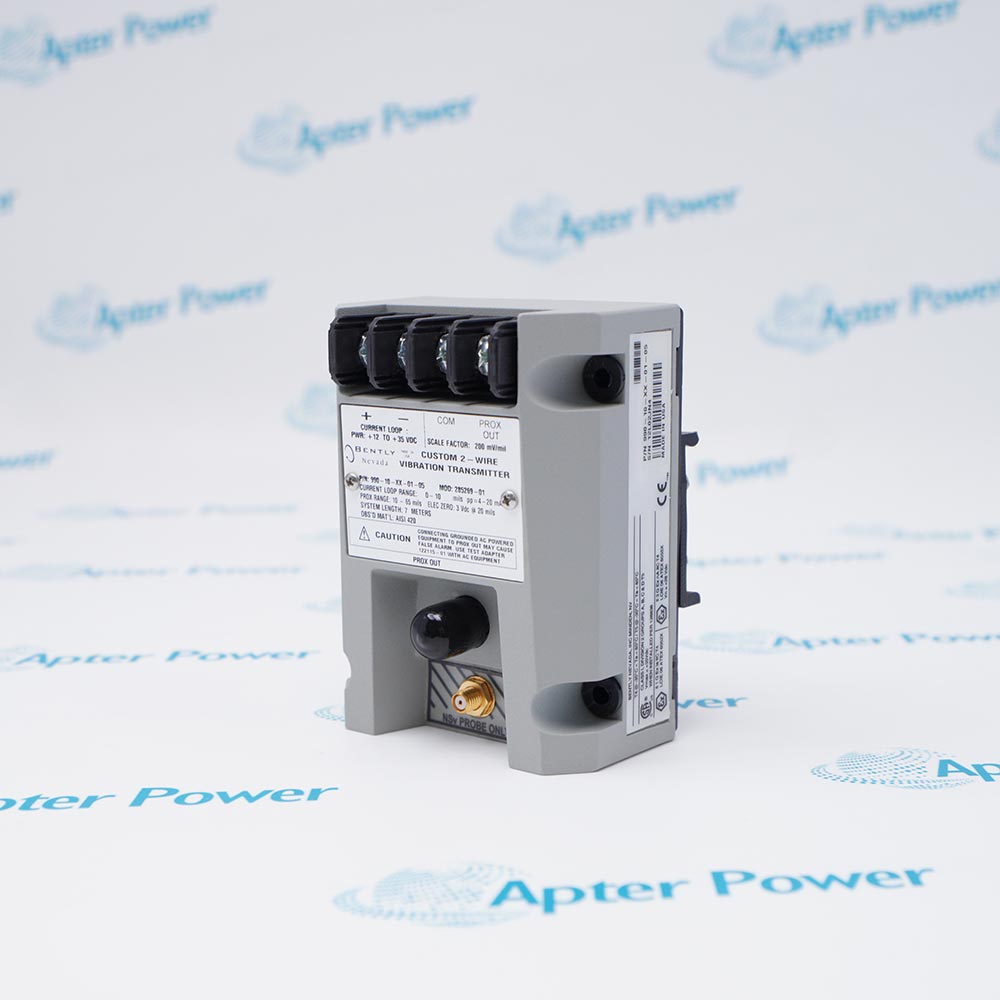
The 83607-00-75-05-02 corresponds to a specialized Bently Nevada proximity sensor. These industrial vibration sensors utilize eddy-current technology to measure displacement, shaft position, and vibration in critical rotating machinery (such as gas and steam turbines).
High-strength stainless steel armor conduit
Encapsulated with high-performance Polyphenylene Sulfide (PPS) engineering plastic
Utilizes high-frequency electromagnetic field interruption technology paired with a miniature coaxial click-lock connector
The component functions as part of a complete loop, requiring a direct physical connection to an external extension cable and a Proximitor sensor calibrated for an 8 mm tip system. It operates by converting the physical gap between the probe tip and a conductive surface, typically an AISI 4140 steel target, into a proportional negative direct current voltage signal.
For robust environmental isolation, the 50.00 cm integrated FEP coaxial cable is enclosed in a high-strength stainless steel armor conduit, terminating in a miniature connector that interfaces with the dedicated extension cable via an insulated connector protector to isolate the signal loop from ground loops.
Important Notice: Other accessories, manuals, cables, calibration data, software, etc. are not included with this equipment unless listed in the above stock item description.
Bently Nevada 83607-00-75-05-02 Proximity Probe Manuals, Datasheets, Drivers, Link
Important Notice: Other accessories, manuals, cables, calibration data, software, etc. are not included with this equipment unless listed in the above stock item description.
Thermal Power
Monitoring the main shaft axial displacement, radial vibration, and Keyphasor speed of steam turbine generator sets to prevent rotor-to-stator friction.
Hydroelectric Power
Measuring the shaft runout (radial vibration) of hydro-turbine generator units and the axial displacement status of thrust bearings.
Nuclear Power
Real-time micron-level shaft surface vibration monitoring for main feedwater pumps, main coolant pumps, and turbine drive shafts.
Petroleum Refining
Installed inside bearing housings of flue gas turbines and rich gas compressors in catalytic cracking units to monitor high-speed rotating shaft axial float.
Steel & Metallurgy
Displacement monitoring within high-temperature oil mist environments for blast furnace blowers and large oxygen plant compressor shafting.
Coal Chemical Industry
Monitoring piston rod drop (displacement variance) of large reciprocating compressors on gasification islands to prevent component fatigue failure.
When installing and operating the Bently Nevada 83607-00-75-05-02 probe, strict attention must be paid to the following key points. First, precisely adjust the initial gap by measuring the Proximitor output voltage (typically set to the -10 Vdc linear midpoint) to establish the correct distance from the shaft and prevent physical impact.
Second, never shorten or extend the integrated cable because its physical length (0.5 m) must remain unaltered to maintain the system's 5-meter or 9-meter electrical length and impedance matching, otherwise calibration will fail.
Third, ensure moisture isolation for the coaxial connector by wrapping the junction with a dedicated silicone connector protector and filling it with insulating grease outside the bearing housing to prevent oil and water ingress from causing signal drift.
Fourth, verify the target material calibration since the probe is default-calibrated to AISI 4140 steel, and the scale factor must be recalibrated if the target shaft is made of a different alloy.
The Bently Nevada 83607-00-75-05-02 is an 8 mm tip diameter non-contact eddy current proximity probe that converts physical displacement into electrical signals via high-frequency electromagnetic field interruption. Constructed with a stainless steel case and a Polyphenylene Sulfide (PPS) encapsulated tip, the component features a 7.5-inch long 3/8-24 English thread and an integrated 0.5-meter coaxial cable protected by a stainless steel armor conduit. Electrically, it maintains a DC resistance of 4.0 to 11.0 ohms, delivering a scale factor of -200 mV/mil (or -7.87 V/mm) across a 2.0 mm linear displacement range when paired with a proximitor. It exhibits a thermal operational limit from -51 °C to +177 °C and a pressure sealing capability of up to 7 bar, making it suitable for continuous exposure within hot oil mist bearing environments.
The 83607-00-75-05-02 is an industrial-grade non-contact eddy current proximity probe manufactured by Bently Nevada. It is primarily used to monitor shaft vibration, shaft displacement, and rotational speed in large rotating machinery, such as steam turbines, compressors, and hydro turbines.
What is the working principle of the 83607-00-75-05-02?
The probe operates based on the eddy current principle. A high-frequency coil inside the probe tip generates an alternating magnetic field. When a conductive metal shaft approaches, eddy currents are induced on its surface, changing the coil's impedance. This change is converted by a Proximitor sensor into a voltage signal directly proportional to the physical gap distance.
How do you correctly install the 83607-00-75-05-02 probe?
It is typically fixed to the bearing housing using a dedicated mounting bracket. During installation, the initial gap between the probe tip and the target shaft surface must be precisely adjusted using a feeler gauge or by checking the gap voltage via the Proximitor (usually set at the linear midpoint, around -10 Vdc).
Can the 83607-00-75-05-02 be connected directly to a PLC's analog input?
No, it cannot. The raw high-frequency impedance signal from the probe must first connect to a matching Bently Nevada Proximitor Sensor, which converts it into a standard negative voltage signal (e.g., -200 mV/mil or -8V/mm) before it can interface with data acquisition systems or monitors.
Are there any special material requirements for the shaft measured by the 83607-00-75-05-02?
Yes, eddy current sensors are highly sensitive to the target material. Standard Bently Nevada probes are calibrated to AISI 4140 steel by default. If the target shaft is a special alloy or another metal (like stainless steel or aluminum), the system must be recalibrated, or a material-specific Proximitor must be used to avoid measurement errors.
Manufacturers
Supporting new and legacy automation
Whether you're maintaining existing equipment or sourcing parts for current systems, we provide fast, dependable supply you can rely on.
Please try to be as accurate as possible with your search.
We can quote you on 1000s of specialist parts, even if they are not listed on our website.