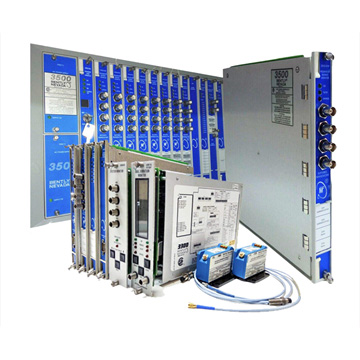
Industrial operations depend on the Bently Nevada 3500 Series for asset safety. The platform integrates specialized modules to monitor vibration, position, and temperature. Analyzing the Proximitor Monitor, Keyphasor Module, Relay Module, and Temperature Monitor reveals how the architecture protects critical turbomachinery from catastrophic failure while maintaining operational uptime.
The Architecture of Machinery Protection
Turbomachinery acts as the heart of power generation and petrochemical processing. Gas turbines, steam turbines, and compressors operate under immense stress, requiring a robust Machinery Protection System to mitigate failure risks. The 3500 Series serves as the industry standard, adhering strictly to API 670 specifications. The system functions not merely as a passive observer but as an active layer of defense, capable of initiating automatic shutdowns when parameters exceed safety thresholds.
Reliability constitutes the core design philosophy. A modular rack design houses various cards communicating via a high-speed internal backplane.
- Data Interface: The 3500/22M 288055-01 Transient Data Interface (TDI) manages data collection, transmitting steady-state and waveform information to diagnostic software.
- External Communication: For integration with plant control systems (DCS/PLC), the 3500/92 136180-01 Communication Gateway provides essential Modbus and Ethernet connectivity.
While the TDI handles communication, the actual protection logic resides within individual monitors, guaranteeing that a network failure never compromises machinery safety.
Proximitor® Monitors: Precision Non-Contact Measurement
The Proximitor Monitor functions as the primary interface for radial vibration and thrust position measurements. Specific modules, such as the 3500/42M 128229-01 Proximity/Seismic Monitor, receive signals from eddy current proximity probes, converting analog inputs into digital data for protection logic.
Eddy Current Theory
Operation relies on electromagnetic induction. A proximity probe contains a wire coil at the tip. The Proximitor sensor drives a radio frequency (RF) signal, typically between 1 and 2 MHz, through the coil. The coil generates a magnetic field. When a conductive material—such as a steel shaft—enters the field, eddy currents form on the surface of the target.
These eddy currents circulate within the target material and create an opposing magnetic field. The interaction extracts energy from the probe's RF signal. The Proximitor measures the energy loss, manifesting as a change in probe impedance. The system demodulates the signal to produce a voltage output proportional to the gap distance.
The output signal contains two distinct components:
- DC Component (Gap Voltage): Represents the average distance between the probe tip and the shaft. Changes here indicate shifts in radial or axial position.
- AC Component (Vibration): Represents rapid fluctuations in distance. The peak-to-peak amplitude corresponds to vibration magnitude.
System Matching and Calibration
Accuracy depends on a matched system approach. A Proximitor sensor acts as a tuned resonant circuit with the extension cable and probe. System lengths typically come in 5-meter or 9-meter configurations. Mixing a 5-meter probe with a 9-meter driver results in significant measurement errors, often attenuating vibration readings or causing scale factor non-linearity. The target material also affects calibration; standard systems are calibrated for AISI 4140 steel. Using the device on other materials requires recalibration to prevent incorrect gap voltage readings.
| Component |
Function |
Key Characteristic |
| Probe |
Generates RF field |
Tip diameter determines linear range |
| Extension Cable |
Connects probe to driver |
Must match system length (5m or 9m) |
| Proximitor Sensor |
Demodulates RF signal |
Converts impedance change to voltage |
Keyphasor® Modules: The Pulse of Diagnostics
Vibration amplitude indicates how much a machine vibrates, but it fails to explain how or why. The 3500/25 Keyphasor Module provides the necessary context through phase angle measurement.
Once-Per-Turn Reference
A Keyphasor signal originates from a transducer observing a physical notch or projection on the rotating shaft. The transducer generates a voltage pulse once every revolution. The 3500/25 module receives the pulse and converts the analog input into a precise digital timing signal shared across the rack backplane. Phase angle represents the timing relationship between the Keyphasor pulse and the vibration waveform peak. The delay, converted into degrees of rotation, constitutes the phase.
Diagnostic Applications
Phase data unlocks advanced capabilities within diagnostic software:
- Balancing: Technicians need phase data to locate the heavy spot on a rotor.
- Resonance Detection: A 180-degree phase shift typically indicates the rotor passing through a critical speed.
- Shaft Crack Detection: A propagating crack changes rotor stiffness, resulting in subtle shifts in 1X and 2X vectors over time.
The 3500/25 module supports Triple Modular Redundant (TMR) applications. Two Keyphasor modules operate in the same slot to provide redundant data, maximizing system availability.
Relay Modules: Logic and Protective Action
The intelligence of the system culminates in the Relay Module. While monitors detect anomalies, the relay executes protective actions. The 3500/33 149986-01 (16-Channel Relay Module) interfaces between the monitoring rack and external Emergency Shutdown (ESD) systems, offering high-density output capabilities.
Boolean Logic and Voting
Flexibility defines the programming of 3500 relay modules. Users configure "Alarm Drive Logic" using Boolean operators to determine trigger conditions.
- Single Channel Logic (OR): If any channel in a group exceeds the setpoint, the relay activates. Such configuration provides high safety but increases false trip risks.
- Voting Logic (AND): To mitigate false trips, engineers employ voting schemes, such as 2-out-of-3 (2oo3). The relay activates only if two independent sensors confirm the danger condition simultaneously. API 670 strongly recommends voting logic for auto-shutdown applications.
Fail-Safe Operation
Relay operation modes fall into two categories:
- Normally Energized (Fail-Safe): The relay coil remains energized during normal operation. If power triggers a trip or rack power fails, the relay de-energizes, opening the contact to shut down the machine.
- Normally De-Energized: The relay energizes only when an alarm occurs.
The 3500/33 149986-01 module allows for high-density outputs, enabling discrete annunciation of specific alarms to control room panels, facilitating granular troubleshooting.
Temperature Monitors: Thermal Health
Vibration analysis dominates rotating element protection, yet thermal monitoring remains paramount for static components and fluid film bearings. The 3500/60, 3500/61, and 3500/65 Temperature Monitors process inputs from Resistance Temperature Detectors (RTDs) and Thermocouples (TCs).
Bearing and Winding Surveillance
Fluid film bearings rely on an oil wedge to support the rotor. Loss of lubrication causes a rapid rise in babbitt metal temperature. Temperature monitors receive data from sensors embedded directly in the bearing shoes. A rise in temperature often precedes vibration symptoms, providing an early warning.
For large electric motors, thermal degradation of stator insulation constitutes a primary failure mode. The 3500/65 module accepts inputs from RTDs embedded in the windings. Monitoring winding temperature allows operators to detect overloading or cooling failures before insulation degrades to the point of a short circuit.
| Feature |
3500/60 & 61 |
3500/65 |
| Channels |
6 Channels |
16 Channels |
| Input Types |
RTD or TC |
RTD or TC |
| Primary Use |
Turbomachinery Bearings |
Motor Stator Windings |
Legacy Support and Supply Chain Strategy
Industrial assets often operate for decades, frequently outlasting the production lifecycle of their electronic monitoring components. While the 3500 Series remains active, managing maintenance for older racks requires a strategic approach to spare parts.
Specialized suppliers like Apter Power play a crucial role in the industrial ecosystem. They focus on sourcing and stocking Bently Nevada 3500 components, including discontinued and surplus parts. Facilities facing long lead times or obsolescence notices from the OEM can rely on such partners to maintain infrastructure.
Apter Power offers distinct advantages for legacy system support:
- Immediate Availability: Over 90,000 spare parts in stock allows for rapid dispatch during unplanned outages.
- Cost Efficiency: Surplus parts often come at a lower cost than new manufacturing orders.
- Warranty Security: A 12-month warranty provides confidence in the reliability of refurbished or surplus units.
- Global Reach: The ability to source hard-to-find parts secures the longevity of protection systems regardless of geographic location.
Access to a reliable inventory of specific units—such as the 3500/22M 288055-01 TDI, 3500/42M 128229-01 monitors, and 3500/33 149986-01 relay cards—allows plant managers to extend the operational life of their protection systems without undertaking immediate, costly upgrades.
Securing Long-Term Reliability for Bently Nevada 3500 Systems
Continuous monitoring safeguards industrial assets from costly downtime. The Bently Nevada 3500 Series provides precise data through Proximitor and Keyphasor modules, while Relay components execute critical protection logic. Temperature Monitors complete the health picture by tracking thermal stress. Partnering with specialized suppliers like Apter Power guarantees access to essential spare parts, securing long-term reliability for critical machinery operations across the US industrial landscape.


 Videos
 News
News Applications







Leave Your Comment