Rotating machinery forms the backbone of industrial operations, yet internal forces constantly threaten mechanical integrity. Monitoring shaft dynamics remains crucial for operational longevity. We explore common vibration sources and examine how the Bently Nevada 990 Transmitter offers a streamlined solution for asset protection.
The Mechanics of Relative Motion
Industrial assets, particularly those employing fluid film bearings, present unique monitoring challenges. Unlike rolling-element bearings where vibration transmits directly to the casing, fluid film bearings dampen energy. The shaft moves within the bearing clearance, riding on a wedge of oil, creating a scenario where casing vibration measurements may fail to detect severe internal faults. Effective monitoring requires measuring the relative motion between the shaft and the bearing using proximity probes. Understanding the root causes of shaft motion allows operators to select appropriate instrumentation and avoid catastrophic failures.
Unbalance: The Persistent Force
Unbalance remains the most prevalent cause of machine vibration. Such a condition occurs when the center of mass deviates from the center of rotation, generating a centrifugal force that rotates at the shaft's running speed. The force pulls the rotor outward, stressing bearings and seals.
The spectrum typically displays a dominant peak at 1X RPM (revolutions per minute). Three primary forms exist:
- Static Unbalance: The heavy spot acts at the center of gravity, causing parallel motion.
- Couple Unbalance: Two equal heavy spots positioned 180 degrees apart on opposite ends create a rocking motion.
- Dynamic Unbalance: A combination of static and couple unbalance, commonly found in industrial rotors.
Operators often dismiss unbalance as a routine maintenance issue. However, left unchecked, the condition degrades components rapidly, eventually leading to outages. The orbit plot for unbalance typically appears circular, indicating a uniform radial force.
Misalignment: The Silent Destroyer
Misalignment occurs when the centerlines of two coupled shafts do not coincide. It manifests in two forms: Parallel (offset) and Angular (gap). Most industrial cases involve a combination of both. The condition introduces a preload force, constraining the shaft and preventing smooth rotation.
Vibration signatures for misalignment are distinct and distinguishable from unbalance. A high amplitude at 2X the running speed often characterizes the spectrum, though 1X is also prominent. Phase analysis reveals a 180-degree phase shift across the coupling for parallel misalignment. Severe misalignment can induce shaft bending, further complicating the diagnostic picture by introducing axial vibration components. The orbit plot often reveals a highly elliptical, banana, or figure-eight shape, reflecting the constrained motion.
Fluid-Induced Instabilities: Whirl and Whip
Machines supported by fluid film bearings face unique hydraulic instabilities known as Oil Whirl and Oil Whip. These phenomena differ fundamentally from forced vibrations like unbalance.
| Instability Type |
Frequency Range |
Root Cause |
| Oil Whirl |
0.40X - 0.48X RPM |
Light loading, excessive clearance allowing the oil wedge to push the shaft. |
| Oil Whip |
Locked at Critical Speed |
Whirl frequency coincides with the rotor's natural frequency. |
Oil Whirl involves the oil film itself pushing the shaft around the bearing clearance. The vibration frequency typically locks onto roughly half the running speed. It is a self-excited instability often triggered by light loading or excessive bearing clearance.
Oil Whip represents a more severe condition arising when the oil whirl frequency matches the rotor's first lateral critical speed. Once the machine enters oil whip, the vibration frequency remains fixed at the critical speed regardless of how much the shaft RPM increases. Such a condition is inherently unstable and can destroy a machine in seconds due to the loss of the oil wedge's load-carrying capacity.
Mechanical Looseness
Looseness introduces non-linear behavior into the system. It generally falls into three categories:
- Type A (Structural): Soft foot or foundation issues.
- Type B (Pedestal): Loose bolts or cracks in the bearing housing.
- Type C (Internal): Excessive clearance between the shaft and bearing or impeller.
Spectral data often shows a "raised noise floor" and multiple harmonics (2X, 3X, 4X, etc.), sometimes accompanied by sub-synchronous fractional components (0.5X, 1.5X). The time waveform appears chaotic or clipped, indicating impacting events during rotation.
The Protection Gap in Balance of Plant Assets
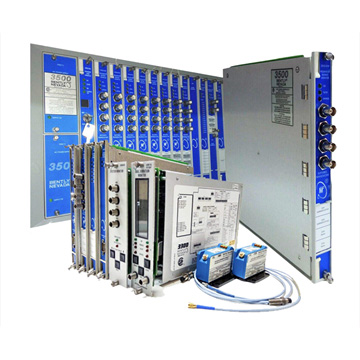
A significant monitoring gap exists in many industrial facilities. Critical turbomachinery receives protection from continuous, rack-mounted systems like the Bently Nevada 3500 series. However, "Balance of Plant" (BOP) assets—such as centrifugal air compressors, small pumps, and cooling tower fans—often lack the budget for full-scale rack monitoring.
Operators historically relied on portable data collection for these assets. Such a method leaves machines unmonitored for weeks between rounds, allowing faults to develop undetected. A cost-effective, continuous solution becomes necessary to bridge the divide between expensive rack systems and infrequent manual checks.
The Bently Nevada 990 Transmitter: Bridging the Gap
The 990 Vibration Transmitter addresses the need for continuous BOP monitoring by providing a streamlined, loop-powered interface for fluid film bearing machines. It is intended specifically for original equipment manufacturers (OEMs) and plant operators who require a simple 4-20 mA proportional vibration signal to feed directly into a control system.
Integrated Proximity Technology
The 990 Transmitter serves a specific niche: it brings eddy current proximity probe technology to general-purpose monitoring. Unlike seismic transmitters that measure casing velocity, the 990 system measures relative shaft vibration (displacement) in mils or micrometers.
The system consists of three integrated components:
- 3300 NSv Probe: A narrow side-view probe designed for tight installation spaces often found in centrifugal compressors.
- Extension Cable: Connects the probe to the transmitter.
- 990 Transmitter Module: A signal conditioner that converts the high-frequency probe signal into a 4-20 mA proportional output.
Such a device allows typically unmonitored assets to integrate seamlessly with a PLC or DCS. Operators receive a simple current signal representing the peak-to-peak vibration level, enabling automated trips or alarms without requiring complex analysis software in the control loop.
The "Prox Out" Advantage: Diagnostics on Demand
A standard 4-20 mA signal provides a scalar value—a single number representing overall vibration. While useful for trending, such a value offers zero diagnostic insight. It cannot distinguish between unbalance, misalignment, or oil whirl.
The 990 Transmitter overcomes the limitation via its "PROX OUT" coaxial connector (BNC) located on the front panel.
Accessing Dynamic Data
The BNC connector provides a buffered, dynamic voltage signal directly from the probe. Access transforms the transmitter from a simple trending device into a powerful diagnostic port.
An analyst can connect a portable data collector to the BNC terminal to view:
- Time Waveforms: To identify clipping, impacts, or non-sinusoidal patterns indicative of looseness.
- Frequency Spectra (FFT): To pinpoint specific fault frequencies (e.g., 0.45X for oil whirl or 2X for misalignment).
- Orbit Plots: If X and Y probes are installed, the analyst can plot the shaft's path within the bearing. As noted previously, an elliptical orbit might suggest unbalance, while a figure-eight shape could indicate misalignment.
Maintenance and Verification
The BNC connection also facilitates sensor verification. Technicians can measure the DC gap voltage to confirm the probe is properly positioned within its linear range (typically 0.5 to 1.75 mm from the target). Capability eliminates the need to dismantle the machine to verify sensor health, significantly reducing maintenance downtime.
Cost-Effective Reliability
Implementing full rack systems for every pump or fan is economically unfeasible. However, leaving these assets unprotected risks unplanned outages. The 990 Transmitter offers a middle ground. It supplies the control room with the necessary overall vibration trends for safety while reserving the high-fidelity data for the reliability engineer when needed.
The device runs on a simple 2-wire loop, minimizing cabling costs compared to multi-wire rack solutions. Furthermore, the potted construction guarantees durability in humid or harsh environments, common in processing plants. The system features a "Not OK/Signal Defeat" circuit, preventing false alarms if the probe fails or connections loosen—a critical feature for automated machinery protection.
Bently Nevada 990 Transmitter: Cost-Effective Shaft Vibration Monitoring
Shaft vibration reveals the mechanical soul of rotating equipment. Whether stemming from unbalance, misalignment, or fluid instability, each fault carries a unique signature. The Bently Nevada 990 Transmitter democratizes access to these insights. Providing a 4-20 mA signal for operations and a dynamic BNC output for analysis allows industrial facilities to extend advanced monitoring to essential, non-critical assets. Such a dual approach secures machinery health without the complexity of full-scale protection systems.


 Videos
 News
News Applications









Leave Your Comment