Precision in monitoring low-speed industrial assets defines operational reliability. Bently Nevada Velomitor® CT 190501 targets cooling towers, whereas the 330505 Low-Frequency Velocity Sensor serves hydroelectric applications. Each employs unique architectures addressing specific physical challenges found in slow-rotation machinery.
The Physics of Low-Frequency Vibration Monitoring
Industrial vibration analysis typically focuses on standard rotating equipment operating between 1,000 and 3,600 RPM. In such regimes, general-purpose accelerometers function adequately, detecting imbalance, misalignment, and bearing faults with fidelity. However, a significant subset of critical infrastructure operates outside standard bounds, specifically in the low-frequency domain below 10 Hz. Cooling Tower Monitoring and hydroelectric generation represent two primary asset classes where low-speed rotation creates a unique diagnostic environment.
The Relationship Between Velocity, Acceleration, and Frequency
Understanding the distinction between various sensor types requires examining the underlying physics governing low-frequency measurement. Vibration analysts prefer velocity as a primary metric for low-speed machinery because velocity relates directly to fatigue and stress energy. Acceleration, while easily measured via piezoelectric crystals, becomes vanishingly small at low frequencies.
As frequency decreases, the acceleration generated from a given velocity amplitude diminishes significantly. For instance, a vibration of 5 mm/s at 100 Hz produces significant acceleration, easily detected via a standard sensor. The same 5 mm/s amplitude at 1 Hz produces acceleration levels two orders of magnitude lower, often becoming indistinguishable from thermal and electronic noise.
Integrating an acceleration signal to obtain velocity introduces a specific noise boost. As frequency approaches zero, the gain applied via the integrator approaches infinity, amplifying low-frequency noise. Therefore, sensors designed for low-frequency velocity measurement must possess an exceptionally low inherent noise floor and stable electronics.
Sensor Architectures: Piezoelectric vs. Moving Coil
The industry employs two primary technologies to solve low-frequency measurement challenges:
Piezoelectric with Integration
Sensors like the Velomitor® CT 190501 use a piezoelectric crystal to sense acceleration. Internal circuitry integrates the signal to output velocity. The advantage lies in robustness; utilizing no moving parts, solid-state sensors endure harsh shocks and offer wide frequency ranges. However, the noise floor at very low frequencies can be problematic unless the sensor includes high-quality electronics and high-pass filtering to reject thermal drift.
Moving Coil / Electrodynamic
The 330505 Low-Frequency Velocity Sensor utilizes a moving-coil design. Here, a coil moves through a magnetic field, generating a voltage directly proportional to velocity. The fundamental advantage is the signal-to-noise ratio. The sensor naturally generates a strong voltage signal from velocity without requiring mathematical integration of a weak acceleration signal. Such designs are ideal for extremely low frequencies found in hydro applications. However, moving parts render the device more susceptible to wear and cross-axis vibration compared to solid-state alternatives.
Cooling Tower Monitoring: Challenges and Solutions
Cooling towers present a hostile environment for instrumentation. High humidity, corrosive vapors, and difficult access combine with complex mechanical dynamics to challenge reliability engineers.
Operational Dynamics of Cooling Towers
A typical induced-draft cooling tower consists of a motor, a long composite driveshaft, a right-angle reduction gearbox, and a large fan.
- Fan Speed: The fan typically rotates between 100 and 300 RPM.
- Gearbox: The gearbox reduces motor speed to fan speed. It generates gear mesh frequencies that can be relatively high, but primary destructive forces often originate from the slow-turning fan.
- Structural Resonance: The fan stack and support structure are flexible. Unbalance in fan blades can excite structural natural frequencies, leading to catastrophic failure where the fan assembly tears itself apart.
The Bently Nevada Velomitor® CT 190501 Solution
The Bently Nevada Velomitor® CT 190501 is engineered specifically to withstand these conditions while detecting relevant fault frequencies.
Frequency Response Optimization
Standard velocity sensors often have a low-frequency cut-off around 10 Hz, effectively blinding the system to the fundamental fan speed of a cooling tower. The 190501 features a frequency response adjusted downward to 3.0 Hz to 900 Hz or 1.5 Hz to 1.0 kHz. Such a range allows the sensor to accurately measure the fundamental running speed of fans operating as low as 90 RPM, capturing imbalance and blade pass anomalies.
Environmental Hardening
Cooling towers are classified as "wet" environments. The Velomitor® CT 190501 is built using a 316L stainless steel case and a hermetically sealed MIL-C-5015 connector to prevent moisture ingress. Furthermore, cooling towers in petrochemical facilities are often designated as hazardous areas. The 190501 carries necessary hazardous area approvals, a feature often lacking in moving-coil sensors due to capacitance constraints.
Sensitivity and Integration
The sensor provides a standard sensitivity of 3.94 mV/mm/s (100 mV/in/s). While lower than the 330505, such sensitivity is sufficient for vibration amplitudes typically seen in cooling tower faults. Internal integration allows the unit to interface directly with standard vibration monitors expecting a velocity signal, simplifying the control loop.
Application Case Study: Fan Blade Imbalance
In a documented case involving a cooling tower fan, vibration levels remained low until the unit reached 101 RPM. Upon reaching 108 RPM, amplitudes spiked significantly. The 190501 sensor successfully identified that the blade pass frequency was exciting a structural natural frequency of the tower. Utilizing a sensor with a standard 10 Hz cut-off would have masked the root cause, potentially leading to gearbox failure or blade detachment.
Hydropower Vibration Sensors: The Unique Demands of Large Hydro
Hydroelectric generating units represent some of the largest rotating machines in existence. Immense mass and slow rotation create a vibration signature dominated via sub-synchronous and low-frequency harmonic content.
Hydropower Vibration Phenomena
Hydro turbines encounter hydraulic phenomena generating powerful low-frequency forces:
- Rheingans Frequency (Draft Tube Surge): In Francis turbines operating at part load, a helical vortex forms in the draft tube. The vortex rotates at approximately one-third to one-quarter of runner speed. For a turbine rotating at 90 RPM, the Rheingans frequency appears at roughly 0.4 to 0.5 Hz. Detecting such surges is critical for preventing resonance with the penstock or generator structure.
- Stator Core Vibration: Magnetic pull forces can cause the stator core to vibrate. While excitation is often at twice the line frequency, modulation and structural response can involve very low frequencies. Monitoring stator core vibration helps prevent fretting of lamination insulation, which can lead to "hot spots" and catastrophic stator ground faults.
- Rough Load Zone: Turbines passing through rough load zones experience chaotic pressure pulsations. These manifest as high-amplitude, low-frequency broadband vibration.
The 330505 Low-Frequency Velocity Sensor Solution
The 330505 Low-Frequency Velocity Sensor is the specialized tool for this domain. It is explicitly designed to measure absolute vibration on stator cores, frames, and bearing housings of hydroelectric turbines.
Extreme Low-Frequency Capability
The 330505 offers a frequency response of 0.5 Hz to 1000 Hz. The ability to measure down to 0.5 Hz is the defining characteristic separating the unit from the 190501. Such capability is essential for detecting Rheingans frequencies and other hydraulic instabilities occurring below 1 Hz.
High Sensitivity Moving-Coil Design
To overcome noise floor issues inherent in low-frequency measurement, the 330505 utilizes a moving-coil architecture with embedded signal conditioning. It delivers a sensitivity of 20 mV/mm/s (508 mV/in/s). That is approximately five times the sensitivity of the 190501. High voltage output guarantees that even minute velocity fluctuations at sub-1 Hz frequencies are transmitted clearly to the monitor without being lost in cable noise or monitor resolution limits.
Operational Restrictions
Unlike the 190501, the 330505 is not approved for hazardous areas due to capacitance constraints. Furthermore, Bently Nevada documentation explicitly states that due to the nature of high-amplitude, low-frequency velocity events, the 330505 is not recommended for automated machinery protection (trip logic). Instead, the device serves as a diagnostic and early warning tool. Tripping a massive hydro unit based on a sensitive low-frequency velocity signal could lead to false positives from transient hydraulic events.
Technical Comparison: 190501 vs. 330505
The following analysis contrasts the two Hydropower Vibration Sensors and cooling tower units across key technical specifications, revealing distinct operational niches.
Specification Matrix
| Feature |
Bently Nevada Velomitor® CT 190501 |
330505 Low-Frequency Velocity Sensor |
| Primary Application |
Cooling Tower Fans & Gearboxes |
Hydroelectric Turbine Stator & Bearings |
| Technology |
Piezoelectric (Integrated Accelerometer) |
Moving Coil (with Signal Conditioning) |
| Sensitivity |
3.94 mV/mm/s (100 mV/in/s) |
20 mV/mm/s (508 mV/in/s) |
| Frequency Response |
3.0 Hz – 900 Hz |
0.5 Hz – 1000 Hz |
| Velocity Range |
63.5 mm/s pk (2.5 in/s pk) |
102 mm/s pk (4 in/s pk) |
| Operating Temp |
-40°C to +85°C |
-40°C to +100°C |
| Hazardous Area |
Approved (Cl I, Div 1/2, etc.) |
Not Approved |
| Mounting Orientation |
Any |
Angle Specific (-01, -02, -03 options) |
| Connector |
2-pin MIL-C-5015 |
2-pin MIL-C-5015 |
| Weight |
~142 g (Stainless Steel 316L) |
< 375 g (Stainless Steel 300 Series) |
| Signal Output |
2-wire Voltage |
2-wire Voltage (Requires -12V Bias) |
Analyzing the Sensitivity Gap
The five-fold sensitivity difference is the most significant differentiator. In hydropower, the mass of the stator frame is enormous, meaning significant forces may only produce small velocity amplitudes. The 330505 amplifies these small signals to a usable level. Conversely, cooling tower fans are lighter structures where faults produce vigorous shaking; thus, the standard sensitivity of the 190501 prevents signal saturation (clipping) during rough operation.
Mounting and Orientation
The 190501, operating as a solid-state piezoelectric device, functions equally well in any orientation. The 330505, relying on a moving-coil mechanism, is sensitive to gravity and orientation. Users must order the 330505 with a specific mounting angle option to guarantee the moving element remains centered in its linear range. Installing a 330505 at the wrong angle can cause the coil to drag or stick, yielding invalid data.
System Integration and Supply Chain Considerations
Successfully deploying these sensors requires looking beyond the transducer itself to the broader monitoring system and supply chain ecosystem.
Integration with Monitoring Systems
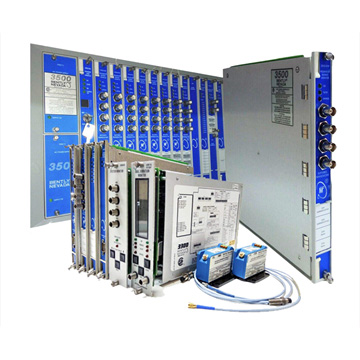
Both sensors integrate with the Bently Nevada 3500 Series machinery protection system, specifically the 3500/46M Hydro Monitor for the 330505. The 3500/46M includes special signal processing for low-frequency hydro applications, such as shear pin failure detection and specific filtering for Rheingans frequencies.
For the Velomitor® CT 190501, standard vibration monitor cards are sufficient, provided the channel is configured for the appropriate voltage range and scale factor. The sensor's 2-wire design simplifies cabling, utilizing standard twisted pair shielded cables which can run up to 305 meters without significant signal degradation.
The Role of Apter Power in Supply Chain Continuity
Industrial assets like dams and cooling towers operate for decades, often outlasting the commercial lifecycle of their electronic components. Obtaining specific legacy or specialized sensors like the 190501 or 330505 can be challenging when manufacturers update product lines or lead times extend.
Companies such as Apter Power specialize in bridging the gap. Apter Power focuses on automation parts, including DCS, PLC, and vibration monitoring components. Their business model revolves around stocking discontinued and hard-to-find industrial modules, including Bently Nevada systems.
- Inventory Availability: Apter Power maintains inventory of Bently Nevada components, potentially including the 190501 and 330505 sensors or compatible monitors.
- Crisis Management: For a power plant facing an outage due to a failed sensor, waiting weeks for a factory order is unacceptable. Suppliers like Apter Power utilize a global network to source and deliver these critical parts rapidly, often offering rush delivery options.
- Legacy Support: As Bently Nevada evolves product lines, operators of older systems rely on secondary market suppliers to maintain protection systems without forcing a complete, expensive upgrade.
Installation Best Practices
Maximizing performance of the 190501 and 330505 requires strict adherence to installation protocols.
Mounting Stiffness
Low-frequency measurement is less sensitive to mounting resonance than high-frequency measurement, but stiffness remains vital. Using magnetic bases is discouraged for permanent monitoring. Stud mounting to a flat, spot-faced surface guarantees transfer of mechanical energy from machine casing to sensor. For the 330505 on a hydro stator, the mounting location must be carefully chosen to avoid local shell modes that do not represent bulk motion of the core.
Cable Management
In cooling towers, cables must be secured against wind buffeting inside the fan stack. Loose cables can generate "triboelectric" noise—electrical charges created via friction within cable insulation—which manifests as low-frequency noise, mimicking vibration. Utilizing the 190501's stainless steel connector and armored cable options mitigates risk.
Grounding and Isolation
Hydro generators often have significant electromagnetic fields. The 330505's moving coil is naturally resistant to high-frequency electromagnetic interference (EMI), but proper shield grounding at the monitor end (not the sensor end) is essential to prevent ground loops.
Future Trends in Low-Frequency Monitoring
The landscape of vibration monitoring is evolving. While the 330505 remains the gold standard for <1 Hz hydro applications, advancements in MEMS (Micro-Electro-Mechanical Systems) and next-generation piezo-ceramics are closing the gap.
- MEMS Accelerometers: New capacitive MEMS sensors offer response down to 0 Hz (DC), theoretically surpassing both 190501 and 330505 units. However, noise floor and durability in industrial environments are still being proven against legacy benchmarks.
- Wireless Sensors: Difficult access to cooling towers drives demand for wireless sensors. However, battery life and data bandwidth for high-resolution waveform transmission remain challenges. Current wireless solutions often lack specialized low-frequency sensitivity found in the wired 190501.
- Smart Diagnostics: Integration with software allows for automated correlation of vibration data with process variables (e.g., megawatts, water head). Such integration moves strategy from simple "level detection" to "condition-based maintenance," where the system can distinguish between a rough load zone and a bearing defect.
Frequency-Driven Sensor Selection for Aging Rotating Assets
Selecting between the Bently Nevada Velomitor® CT 190501 and the 330505 Low-Frequency Velocity Sensor requires analyzing the specific fault frequencies of the asset. The 190501 excels in hazardous cooling tower environments, while the 330505 captures the sub-synchronous surges of hydropower. Global suppliers like Apter Power provide essential access to these critical components, sustaining the reliability of aging infrastructure worldwide through robust inventory management.


 Videos
 News
News Applications







Leave Your Comment