Industrial reliability relies on precise data. The Bently Nevada Velomitor® revolutionizes vibration measurement through solid-state piezoelectric technology, delivering durability superior to electromechanical predecessors. Facilities sourcing components from Apter Power secure these critical assets, guaranteeing continuous machine protection.
The Evolution of Velocity Sensing
Vibration monitoring has long served as the pulse check for industrial machinery. Early diagnostic efforts relied heavily on moving-coil velocity transducers. These devices operated on a principle similar to a loudspeaker in reverse: a coil of wire suspended by springs moved through the magnetic field of a permanent magnet. As the machine case vibrated, the coil remained relatively stationary due to inertia while the magnet moved, inducing a voltage proportional to the velocity of the motion.
While effective in principle, moving-coil designs suffered from inherent mechanical limitations. The internal springs and damping fluids were susceptible to wear, fatigue, and temperature degradation. Furthermore, gravity affected the suspension mechanisms, often restricting the mounting orientation of the sensor. A unit calibrated for vertical operation could not function accurately when mounted horizontally.
The introduction of the velomitor sensor marked a significant technological departure. Bently Nevada engineers sought to eliminate moving parts entirely. The solution involved replacing the mechanical suspension system with a solid-state crystal element. Such a design removes mechanical wear mechanisms, allowing the sensor to operate indefinitely without degradation. The solid-state architecture also permits mounting in any orientation—vertical, horizontal, or angular—without altering sensitivity or accuracy.
The Piezoelectric Principle
At the core of the Velomitor® lies a piezoelectric ceramic material. The term "piezoelectric" derives from the Greek word for "press." Certain crystalline materials, when subjected to mechanical stress, generate an electrical charge across their faces.
In a typical 330500 Velomitor®, the design utilizes a shear-mode configuration. Here, the crystal element is mounted between a center post and a seismic mass. When the machine casing vibrates, the inertia of the seismic mass exerts a shear force on the crystal. Unlike compression-mode designs, which can be sensitive to thermal transients or base strain (bending of the mounting surface), shear-mode designs offer superior isolation from these external error sources.
The magnitude of the electrical charge generated by the crystal corresponds directly to the acceleration of the vibration. However, the industry standard for monitoring general rotating machinery—specifically casing vibration—is velocity, not acceleration. Velocity provides a more consistent indication of fatigue and energy across the typical frequency ranges of industrial equipment (10 Hz to 1000 Hz).
Internal Signal Processing: The Electronic Heart
A raw piezoelectric crystal outputs a high-impedance charge signal proportional to acceleration. To function as a velocity sensor, the Velomitor® must perform complex signal processing internally.
The device contains an integral electronic circuit that performs two critical functions:
- Impedance Conversion: The circuit converts the high-impedance charge from the crystal into a low-impedance voltage. High-impedance signals are notoriously susceptible to electrical noise and signal loss over long cable runs. Converting the signal at the source allows transmission over distances up to 305 meters (1000 feet) without significant degradation.
- Integration: The onboard electronics integrate the acceleration signal to produce velocity. Mathematically, velocity is the time integral of acceleration.
Through performing integration inside the sensor housing, the Velomitor® outputs a signal typically calibrated to 100 mV/in/s (3.94 mV/mm/s).
Internal integration offers distinct advantages over integrating at the monitor. Integrating a signal amplifies low-frequency components. If noise enters the cable between the sensor and the monitor, integrating that noise at the monitor end can result in significant errors, often manifesting as a "ski slope" effect in the data where low-frequency noise swamps the signal. The Velomitor® mitigates such issues via integrating the clean signal immediately at the sensing point.
Robust Construction for Industrial Realities
The Bently Nevada 330500 Velomitor® is constructed to withstand the rigors of the petrochemical and power generation sectors. The 316L stainless steel casing provides corrosion resistance, while the hermetic seal protects internal circuitry from moisture and contaminants.
For environments requiring even greater resilience, the 330525 Velomitor® XA (Extended Application) offers enhanced protection. Standard sensors often require an additional external housing to protect the terminal connections. The 330525 XA incorporates a specialized weatherproof connector and cable assembly directly into the design. Such construction meets IP-65 and NEMA 4X requirements without supplemental housing, rendering the unit ideal for paper machines, food processing, or outdoor applications where washdowns and humidity are constant threats.
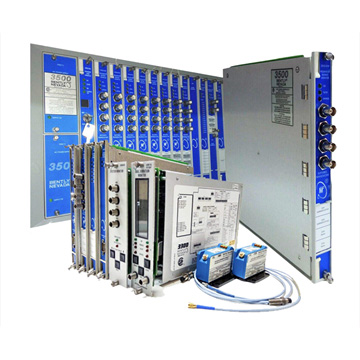
Supply chain managers frequently rely on partners like Apter Power to source these specific variations. As manufacturers update product lines, finding exact replacements for legacy installations—such as specific cable lengths or hazardous area approvals—becomes a logistical challenge. Apter Power maintains inventories of discontinued and active Bently Nevada components, allowing plants to maintain homogenous instrumentation loops without forced upgrades.
Specialized Frequency Applications
While the standard 330500 covers the majority of rotating equipment (4.5 Hz to 5 kHz), certain applications demand specialized engineering.
Cooling Tower Fans: The 190501
Cooling towers present a unique monitoring challenge. The large fans often rotate at speeds between 90 and 300 rpm (1.5 Hz to 5 Hz). Standard sensors may roll off or attenuate signals at the lower end of this range.
The Bently Nevada 190501 Velomitor® CT is engineered specifically for these assets. The internal integration circuit is tuned to extend the frequency response down to 1.5 Hz (-3dB) or 3.0 Hz (-1dB). Accurately capturing the fundamental running speed is vital for detecting unbalance in the fan blades, which can lead to catastrophic structural failure if undetected. The 190501 retains the solid-state piezoelectric benefits while accommodating the slow-speed physics of cooling tower operations.
Hydroelectric Generators: The 330505
Hydroelectric turbines operate at even lower speeds, often below 100 rpm. Here, the limitations of integrating an acceleration signal become apparent. Integrating extremely low-frequency acceleration signals amplifies noise exponentially.
To address the ultra-low frequency requirements of hydro applications (down to 0.5 Hz), Bently Nevada offers the 330505 Low Frequency Velocity Sensor. Unlike its solid-state cousins, the 330505 utilizes a moving-coil design. At these specific frequencies, the physics of a moving coil moving through a magnetic flux provide a superior signal-to-noise ratio compared to an integrated piezoelectric signal. The 330505 serves as a prime example of selecting the right technology for the physics of the machine, rather than forcing a single solution across all assets.
Comparison of Velocity Sensor Types
| Feature |
330500 / 330525 Velomitor |
190501 Velomitor CT |
330505 Low Frequency Sensor |
| Technology |
Piezoelectric (Solid State) |
Piezoelectric (Solid State) |
Moving Coil (Electromechanical) |
| Primary Use |
General Purpose (Pumps, Motors) |
Cooling Tower Fans |
Hydroelectric Turbines |
| Frequency Range |
4.5 Hz – 5 kHz |
1.5 Hz – 1 kHz |
0.5 Hz – 1 kHz |
| Sensitivity |
100 mV/in/s (3.94 mV/mm/s) |
100 mV/in/s (3.94 mV/mm/s) |
500 mV/in/s (20 mV/mm/s) |
| Moving Parts |
None |
None |
Coil & Suspension |
| Orientation |
Any Angle |
Any Angle |
Restricted (Gravity Dependent) |
The Role of Supply Chains in Reliability
Maintaining the integrity of a vibration measurement system requires more than just understanding the physics; it requires access to the hardware. Legacy systems in refineries and power plants often operate for decades. Over time, OEMs may retire specific part numbers or introduce newer models that require different mounting or cabling.
Apter Power plays a crucial role in the reliability ecosystem via stocking a vast array of Bently Nevada components, including the 330500, 330525, and various monitoring modules. When a critical sensor fails, the lead time for a factory-new unit can sometimes disrupt production schedules. Utilizing a supplier with immediate stock of both active and discontinued parts enables maintenance teams to restore protection systems rapidly. Whether replacing a standard 330500 on a boiler feed pump or a specialized 190501 on a cooling tower, availability is as important as functionality.
Velomitor Piezoelectric Sensors: Ensuring Long-Term Reliability
The Bently Nevada Velomitor® represents a pinnacle in industrial sensing, converting the microscopic deflection of a crystal element into actionable velocity data. From the rugged 330500 to the specialized 190501, these instruments provide the durability required for harsh environments. Strategic sourcing through partners like Apter Power guarantees that these vital guardians of machinery health remain available to protect infrastructure worldwide.


 Videos
 News
News Applications







Leave Your Comment