Advanced control-system expertise is no longer a nice-to-have in industrial and commercial power supply systems. If you are responsible for uninterruptible power supplies (UPS), inverters, and power protection equipment, your control architecture is what stands between a minor disturbance and a major outage. System engineer certifications from major control vendors, such as Yokogawa’s programs around distributed and safety systems, are effectively benchmarks for this level of expertise, even if you never sit for the exam itself.
Speaking as a power system specialist and reliability advisor, the engineers who succeed at that level do more than configure screens and loops. They think in terms of complete instrumentation and control (I&C) systems, reliability-centered maintenance, advanced process control (APC), and model-based systems engineering. The research and best practices summarized by organizations such as Boston Engineering, E2G, academic courses in advanced control, and industry sources like Control Engineering point toward the same conclusion: advanced certification is really a proxy for being able to design, implement, and sustain robust, optimized control across a plant’s lifecycle.
This article unpacks what “advanced control system expertise” actually means in the context of UPS, inverter, and power protection projects, using Yokogawa-level system engineering as a reference point and grounding the discussion in published control and reliability guidance.
Why Advanced Control Expertise Matters in Power Protection
Boston Engineering describes a control system as an interconnected set of components that uses continuous feedback to monitor outputs, compare them to desired performance, and drive actuators to minimize error and keep behavior within specified ranges. That description might sound abstract, but it is exactly what a high-performance UPS or inverter does when it maintains clean power through faults, voltage sags, and dynamic loads.
Control systems span simple thermostats all the way to smart grids, microgrids, and energy storage. In power applications, your “plant” can be a single double-conversion UPS, a row of static transfer switches, or an entire critical power distribution system feeding data halls or process lines. The same feedback-control principles apply, but the consequences of failure are safety incidents, production losses, and damage to expensive electrical assets.
Advanced systems and control engineering, as described by academic programs in the field, sits at the intersection of operational technology and information technology. It treats control not just as loop tuning but as an optimization problem across equipment, software, people, and procedures. For power protection, that means designing control architectures that not only keep bus voltage and frequency within limits but do so with energy efficiency, resilience, and cybersecurity in mind.
From Instrumentation to Systems Engineering
E2G characterizes I&C systems as the full chain from process connections and instruments to cables, logic solvers, and programming that must operate reliably 24 hours a day, 365 days a year, with downtime usually limited to planned turnarounds. In a critical power system, the parallels are obvious. Your “instruments” include current and voltage sensors, breaker auxiliary contacts, temperature probes on transformers and batteries, and status from protective relays and static transfer switches. Your “logic solvers” are the UPS controllers, programmable logic controllers (PLCs), and distributed control systems that orchestrate transfer sequences, load shedding, and alarm handling.
Reliability in this context is an instrument or device’s ability to produce consistent, accurate readings and actions under similar conditions over repeated trials. Maintenance includes inspection, cleaning, calibration, repair, and replacement to prevent failures and safety hazards. E2G notes that OSHA 1910.119 places instrumentation within the Mechanical Integrity element of Process Safety Management, requiring written procedures, training, testing records, and timely correction of deficiencies. For a system engineer on a power project, that translates into ensuring your control strategy, logic, and proof-test intervals for things like emergency shutdowns, battery isolation devices, and static transfer switches are documented and defensible.
Safety Instrumented Systems (SIS) are a particular focus. Standards such as ANSI/ISA 61511 require a Safety Requirements Specification that covers operations, maintenance, test intervals, and replacement for each Safety Instrumented Function identified in hazard analyses. In power protection, that might mean treating certain protective trips, undervoltage load shedding schemes, or generator start commands as SIFs with defined risk-reduction roles. A system engineer who truly operates at a certification-ready level can connect loop design, logic, and testing back to those safety requirements.
E2G also emphasizes Reliability-Centered Maintenance governed by SAE JA1011 and JA1012. Instead of treating every instrument the same with fixed-interval maintenance, a consequence-based approach prioritizes devices with high safety, environmental, or commercial impact and uses risk management to decide whether to maintain, monitor, or run to failure. For power systems, that means differentiating between a noncritical status contact and a battery string voltage sense that, if it fails, could mask capacity loss until the UPS fails on demand.
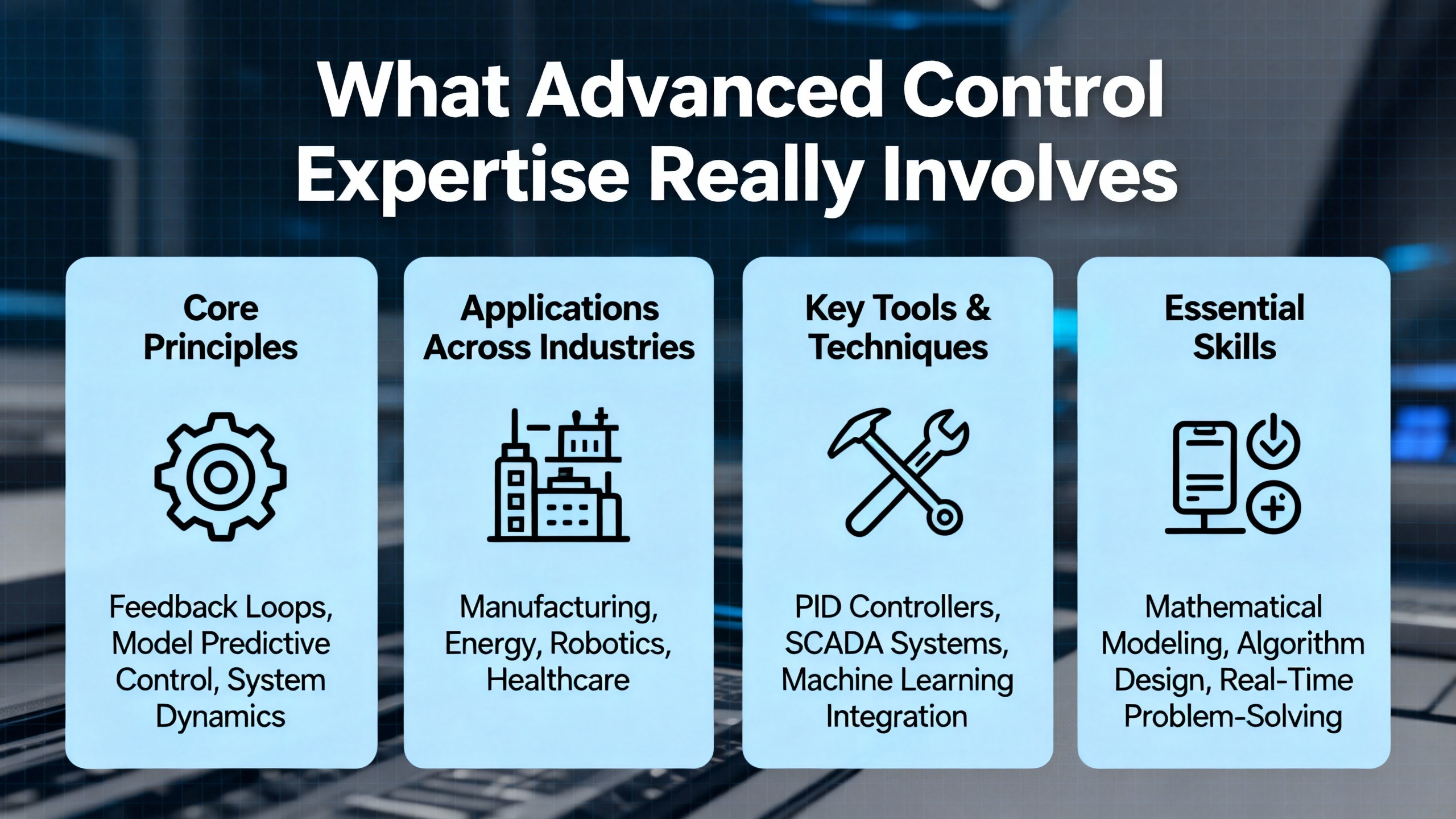
What Advanced Control Expertise Really Involves
When universities and technical organizations describe “advanced control,” they converge on a few essential themes: deep understanding of dynamical systems, mastery of advanced control and optimization methods, and the ability to apply these within complex, interconnected systems.
Control theory and dynamical systems
Graduate-level courses in advanced control engineering, such as those taught at Northeastern University, frame modern control around how uncertainty propagates through dynamical systems and how control can manage that uncertainty. Foundational tools include applied linear algebra, convex optimization, and linear systems theory, covering concepts like controllability, observability, reachability, Lyapunov stability, and state estimation.
In practice, this means being comfortable thinking in state-space rather than only in single-loop transfer functions. For a power engineer, that matters most when dealing with multivariable systems, such as inverter-based resources with coupled voltage and current dynamics, or microgrid controllers managing multiple sources and loads. The course material highlights that optimal control and estimation problems (like Linear Quadratic Regulator and Kalman filtering) are essentially structured quadratic optimization problems over system dynamics. Vendor system engineer certifications implicitly assume you can at least understand these concepts qualitatively, even if you are using prebuilt function blocks rather than coding solvers from scratch.
Advanced process control and optimization
Advanced Process Control, as summarized in process-control resources and in chemical engineering study guides, extends beyond traditional PID by handling nonlinear dynamics, variable interactions, and time delays more effectively. Techniques such as cascade control, feedforward, and ratio control are particularly relevant when you have fast inner dynamics and slower outer objectives, which is common in power electronics and generator control.
Control Engineering’s discussion of advanced process control and real-time optimization places APC within a layered control architecture. Measurement and actuation form the base, followed by safety and regulatory control, while advanced and constraint control, real-time optimization, and plant-wide planning sit higher up. Levels that include advanced control and optimization are optional but economically beneficial, allowing plants to run closer to constraints and improve profitability. For critical power, the “profitability” dimension maps directly onto availability, energy costs, and asset life.
Model predictive control (MPC) is a central APC method in both industry articles and research. According to work on advanced process control and a ResearchGate overview of industrial methods, MPC uses a dynamic process model, past control actions, and an optimization cost function over a receding horizon. It shines in multivariable systems with constraints and dead time but is sensitive to model errors and strongly nonlinear behavior. That trade-off is important in UPS and inverter applications, where operating points and grid conditions can shift quickly.
Real-time optimization (RTO) adds another layer by recalculating optimum operating conditions as equipment availability and economic conditions change. It requires both an economic model and a steady-state operating model with constraints. In a power context, RTO can be used to balance grid power, generator fuel, and battery cycling cost while maintaining power quality, as long as the control engineer respects model fidelity and cybersecurity constraints.
Intelligent, robust, and data-driven control
A special issue of the journal Machines on advanced control systems and optimization highlights intelligent and data-driven control methods, including fuzzy systems, neural networks, and nature-inspired optimization. These approaches aim to handle uncertainties, disturbances, and complex dynamics without relying solely on detailed first-principles models.
Research on industrial advanced control describes fuzzy controllers that use heuristic if–then rules and membership functions to mimic human reasoning. They are useful when rigorous models are hard to obtain yet experienced operators possess rich process knowledge. For power systems, that might translate into rule sets that blend alarm patterns, load behavior, and environmental conditions to determine when to reconfigure power paths or change UPS operating modes. The downside, as noted in the research, is that fuzzy systems can be cumbersome to design and validate across all operating conditions.
Robust control methods, such as H-infinity and H2 design, explicitly incorporate model uncertainty so that stability and performance can be guaranteed across a range of conditions. These methods can be mathematically demanding and conservative, but they provide valuable insight into what level of performance is realistically achievable given nonminimum-phase behavior, unmodeled dynamics, or actuator constraints. Many of the issues raised in advanced control discussions, such as right-half-plane zeros, sensor noise, and actuator limits, are directly relevant to power systems where plant and grid behavior are not perfectly known.
Data-driven control, as outlined in modern control design discussions, uses input–output data to build predictive models and controllers without full physical modeling. This is particularly attractive in existing plants where extensive data historians already exist but model-building resources are limited. However, advanced certifications expect you not just to fit models but to critically analyze whether the data and resulting control are valid and robust.
Comparing control approaches in practice
The sources consistently emphasize that no single method is universally best. Instead, advanced expertise is knowing when and how to combine them.
| Control approach | Where it shines | Key trade-offs |
| Classical PID and cascades | Simple loops, well-understood dynamics, single-variable focus | Limited with strong coupling, nonlinearities, and constraints |
| Advanced process control | Multivariable plants, dead time, tight constraint operation | Requires good models, more engineering and maintenance effort |
| Fuzzy and neural methods | Poorly modeled systems with strong expert knowledge or rich data | Harder to validate and maintain, risk of opaque behavior |
| Robust control | Systems with explicit uncertainty and safety constraints | Mathematically complex, often conservative in performance |
A system engineer working at a certification-ready level can recognize these trade-offs and help choose architectures that respect both performance and reliability requirements.
Reliability and Safety: Where Power Protection Meets Process Safety
Process safety guidance from E2G is particularly instructive for power system engineers. It stresses that emergency shutdown systems, interlocks, and SIS must be tested and inspected, and that risk assessment should distinguish between evident failures, which are self-revealing and immediately consequential, and hidden failures, which only matter when another demand occurs. In a power protection context, an evident failure might be a UPS that trips and drops the load. A hidden failure might be a breaker that appears healthy but will not close on command during a transfer, or a failed underfrequency relay that leaves a generator unprotected.
E2G recommends a consequence-based Reliability-Centered Maintenance approach that prioritizes instruments and systems with significant safety, environmental, or commercial impact, using techniques such as Failure Modes and Effects Analysis and condition monitoring. For UPS and inverter systems, that may include monitoring battery health, capacitor condition in power electronics, and breaker operating counts, then adjusting maintenance strategies for high-impact devices rather than applying uniform intervals.
The same guidance suggests that risk assessment should begin with clear risk-ranking criteria and consequence levels across safety, environmental, and commercial dimensions. It calls for a core team that includes instrument, operations, and maintenance specialists and notes that assessments should not only cover explicitly credited protective functions but also devices that provide apparent risk reduction or can cause disruptive spurious shutdowns. In critical power systems, spurious shutdowns of a UPS, static switch, or generator are commercial risks that must be weighed alongside safety. A certified-level system engineer should be able to structure and contribute to such assessments, then reflect the conclusions in control logic, alarm management, and maintenance plans.

Applying Advanced Control to UPS, Inverters, and Power Protection
Advanced control literature often focuses on process industries, but the patterns translate directly to power electronics and critical power infrastructure.
In advanced process control study guides, cascade control is used to manage processes with multiple time scales, such as a master loop on steam pressure and a slave loop on fuel flow. A similar pattern appears when you use an inner current-control loop on a converter and an outer loop on DC bus voltage or output voltage; the fast inner loop stabilizes the plant, while the slower outer loop shapes overall behavior. Feedforward control, which compensates for measured disturbances before they affect the process, is analogous to adjusting inverter output in anticipation of a known load step or switching event, provided the underlying models are accurate.
The hierarchical view from Control Engineering of measurement, safety, regulatory, advanced control, and optimization layers can help organize a power project. Measurement and actuation correspond to sensors, breakers, contactors, relays, and converters. Safety and protection include overcurrent and ground-fault protection, emergency stops, and safety relays. Regulatory control ensures voltages and frequencies are within required bounds. Advanced and constraint control could include modes that limit load during generator operation or control harmonic distortion under varying nonlinear loads. Real-time optimization could, for example, choose among grid, generator, and battery sources to minimize cost and wear while protecting critical loads.
Boston Engineering’s work on power systems control for smart grids, renewables, microgrids, and energy storage shows that modern control projects increasingly span multiple energy assets and control layers. Integrated building automation, including HVAC and lighting, is cited there as a domain where control and optimization deliver energy savings and comfort. For a system engineer working on UPS and inverters, this multi-domain perspective is crucial when coordinating with building management systems, microgrid controllers, and campus energy management software.
Control system design guidance from Collimator emphasizes a structured workflow: start with system concept, define control objectives and autonomy level, perform feasibility analysis via simulation and experiments, rapidly prototype both models and hardware, then iteratively refine plant dynamics models using physical modeling and system identification. For power projects, that means modeling not just normal operation but transfer sequences, fault conditions, and degraded modes, then validating those models against real data from the facility.
Skills and Practices to Develop on the Road to System Engineer Certification
Beyond theory, advanced system engineers distinguish themselves by how they structure, document, and maintain control software. Articles on control system programming best practices from sources like Control Engineering and CrossCo treat control programming as both art and science and emphasize that programming standards and best practices must work together.
They recommend defining a clear program structure at the start of each project and documenting it with diagrams or in-code legends so others can follow and expand the design. For a power protection system, that might mean separating core protection logic, interlocks, human–machine interface (HMI) code, communication interfaces, and maintenance utilities into well-defined modules. This structure should live in the codebase itself, not only in external documents that can be lost.
Documentation is highlighted as essential. Functional requirements should be clearly captured, including how valves, motors, breakers, and PID blocks are configured and what each state and mode means. When vendor libraries are lacking, engineers are encouraged to build small, well-documented libraries of reusable patterns. For UPS and inverter systems, reusable templates for breaker sequences, source selection, and permissive logic can prevent subtle errors and accelerate troubleshooting.
Planning for change is another theme. Control Engineering sources advise leaving headroom in memory and data segmentation and designing with future expansion and modifications in mind, while avoiding overinvesting in out-of-scope features. Modern control hardware has more capability than past generations, but CrossCo warns that engineers must still understand and test system resource limits, using stress tests to ensure added structure and overhead do not introduce latency or instability. In power systems, where scan times and deterministic response matter during faults, this discipline is critical.
Code reuse and consistency are treated as markers of maturity. Rather than copying and pasting logic, best practices recommend encapsulating common patterns in parameterized functions or function blocks and calling them wherever needed. Keeping naming and design patterns consistent across the project makes it much easier for future engineers and technicians to troubleshoot, especially under time pressure during an outage. The same sources caution against switching to “cooler” methods midproject unless the benefits clearly justify rework; instead, new methods can be reserved for future projects.
Housekeeping and commenting round out the picture. Both Control Engineering and CrossCo urge engineers to organize work areas, clearly isolate experimental code, and remove unused or obsolete structures so that “trash” does not accumulate. Comments should explain why something is done, not just what the code does, with a hierarchy from application-level descriptions down to section-level notes. Detailed change logs within the application itself, including dates, authors, and reasons for changes, are recommended to support long-term maintenance, especially in systems expected to last many years.
All of these practices map directly onto the expectations of a system engineer certification. Vendors care that you can produce systems that are maintainable, understandable, and reliable over the entire lifecycle, not simply that you can pass an exam.

Practical Study and Project Strategies
While the research and guidance discussed here span multiple industries, they point toward practical steps for engineers aiming at Yokogawa-level system engineering in power protection environments.
First, build a strong conceptual foundation. Advanced courses and texts on modern control stress the importance of understanding linear systems, optimization, and uncertainty. You do not need to derive every equation used in MPC or robust control, but you should feel comfortable with the core ideas of state-space models, stability, and trade-offs between performance, robustness, and resource use. Academic course notes in advanced control emphasize applied linear algebra and convex optimization because they underpin optimal control, estimation, and model predictive control.
Second, deliberately practice with multivariable, constrained problems. Study guides on advanced process control and articles on MPC and RTO show that the real value of advanced methods is in handling interactions and constraints. For example, in a lab or simulation setting, you might model a simplified UPS and generator combination, then experiment with constraint-handling strategies such as limiting ramp rates or enforcing minimum on-times while maintaining bus voltage.
Third, treat reliability and maintenance as first-class citizens rather than afterthoughts. E2G’s work on instrumentation reliability and RCM makes clear that control strategy and maintenance strategy must align. When you design a power protection control system, ask which functions are safety-critical, which represent large commercial risk, and which can tolerate occasional failure without serious impact. Then, reflect that ranking in your use of redundancy, diagnostics, and proof-testing.
Fourth, apply systems engineering and model-based systems engineering principles. Case-based discussions of systems engineering and model-based approaches emphasize managing complexity through structured models that serve as a single source of truth. For power projects, that can mean maintaining a consistent model of sources, loads, protection devices, and control logic that flows through design, implementation, and operations, rather than treating drawings, code, and operating procedures as separate artifacts.
Finally, embed best programming practices into every project, even small ones. The control programming guidelines recommend establishing standards, reusing code, planning for change, and keeping codebases clean and well-documented. Practicing these habits on smaller UPS or panel projects makes them second nature when you confront larger, distributed systems and prepares you for the design reviews and audits that tend to accompany vendor certifications and safety assessments.
Frequently Asked Questions
Do I need advanced mathematics to be effective as a system engineer for power systems?
Advanced courses in control engineering emphasize linear algebra, differential equations, and optimization because they underpin modern tools like state-space control, optimal control, and robust design. In day-to-day work on UPS and inverter projects, you often rely on vendor tools and prebuilt function blocks rather than writing algorithms from scratch. However, a working understanding of how uncertainty propagates, what controllability and observability mean, and how constraints affect achievable performance helps you diagnose problems, interpret vendor documentation, and make sound design choices.
How does advanced control actually improve uptime for UPS and inverters?
Advanced control strategies, as described in process-control and APC literature, reduce variability and allow operation closer to constraints without crossing them. Applied to UPS and inverter systems, this might mean more stable voltage and frequency under dynamic loads, smoother transitions between sources, and improved coordination with building or process controllers. Techniques like cascade and feedforward control can improve disturbance rejection, while optimization layers can balance energy costs and asset wear without compromising critical-load protection. The net result, when properly designed and maintained, is fewer nuisance trips, fewer unexpected degradations, and better use of installed capacity.
Where do reliability disciplines like RCM and SIS design fit alongside control-focused certification?
E2G’s guidance makes it clear that instrumentation and control systems sit inside broader mechanical integrity and process safety frameworks. Reliability-Centered Maintenance and Safety Instrumented System design ensure that control and protective functions perform when needed and that failures are identified and managed before they lead to incidents. For a system engineer working toward advanced certification, integrating these disciplines means designing control logic that is testable and maintainable, selecting diagnostics that support condition-based maintenance, and ensuring that changes to logic and instrumentation preserve the safety integrity and risk reduction defined in hazard analyses.
Closing
Yokogawa-level system engineer certification is ultimately a marker of something broader than vendor proficiency. It signals that an engineer can integrate advanced control theory, practical APC and optimization methods, rigorous reliability and safety practices, and disciplined programming into coherent, plant-wide solutions. In industrial and commercial power supply systems, where UPS, inverters, and power protection equipment must deliver reliable performance every day of the year, that combination of skills is what turns good hardware into a truly resilient power infrastructure.
References
- https://online-engineering.case.edu/blog/advanced-systems-and-control-engineering
- https://engineering.purdue.edu/~sundara2/misc/ece380_notes.pdf
- https://user.eng.umd.edu/~austin/ence202.d/optimization.html
- https://www.calstate.edu/csu-system/doing-business-with-the-csu/capital-planning-design-construction/operations-center/Documents/guidelines/control_sys_design_guide.pdf
- https://www.researchgate.net/publication/3363789_Advanced_control_methods_for_industrial_process_control
- https://blog.boston-engineering.com/mastering-control-systems
- https://www.bartechstaffing.com/news-and-insights/careers-in-control-engineering
- https://www.collimator.ai/post/what-is-control-system-design
- https://www.controleng.com/advanced-process-control-and-real-time-optimization/
- https://hal.science/hal-05054733/


 Videos
 News
News Applications





Leave Your Comment