In power protection, people tend to focus on breakers, UPS topologies, inverter efficiency, and battery chemistry. In my experience designing and auditing industrial power systems, the real differentiator for uptime is often quieter: the sensor network riding alongside all that copper and silicon. Sensors become the eyes and ears of your UPS rooms, switchgear lineups, and inverter farms. They tell you where heat, mechanical stress, or energy waste is building up long before a breaker trips.
When those sensors come through an authorized Turck sensor distributor or any serious industrial sensing partner, you are not just buying parts. You are buying data quality, integration support, and long‑term reliability. Recent guidance from sources such as RS Expert Advice, MxD, Adeunis, and Factory AI Group converges on the same message: industrial sensors and their suppliers are now strategic infrastructure, not commodity accessories. For critical UPS and power protection systems, that matters.
This article walks through the key decisions you need to make as a power system specialist and frames how an authorized sensor distributor should help you answer them.
Why Sensors, Not Just Hardware, Determine Your Uptime
Industrial sensors are devices that monitor physical or chemical properties such as temperature, pressure, position, level, flow, vibration, or gas concentration and convert them into electrical signals for control and monitoring systems. Affiliated Control Equipment describes them as central to both continuous process industries and discrete manufacturing, improving quality, automation, predictive maintenance, and worker safety. RS Expert Advice goes further and calls sensors the eyes of Industry 4.0, because without their data, the whole connected factory vision falls apart.
In power distribution and UPS environments, the same logic applies. If you do not sense, you are effectively running blind. Practical examples drawn from Factory AI Group’s work on predictive maintenance show how simple sensors prevent serious failures. In one case, permanently mounted infrared temperature sensors were aimed at main lugs inside high‑voltage switchgear. During a summer heat event, the system flagged about a 54°F rise above ambient on one phase. Investigation revealed a loose lug that could have escalated into an arc‑flash and a facility‑wide outage. A brief planned shutdown to torque the connection eliminated that risk.
That example illustrates two important points. First, heat is an early and reliable indicator of both mechanical and electrical problems in power systems, so temperature sensors offer disproportionate value. Second, the sensor is only useful because the data is integrated into a system that can trigger alerts and work orders, not just store readings on a screen no one watches. Factory AI Group emphasizes that successful sensor deployments are ninety percent strategy and ten percent technology, built on clearly defined objectives, asset criticality analysis, data integration, and scalability.
If your objective is to reduce unplanned downtime of a primary UPS bus by half, that will drive very different sensor choices than a generic goal like modernize my monitoring. As MxD notes in its guidance to manufacturers, mapping your process, identifying where failures actually originate, and then deciding what to measure are the first steps toward meaningful sensor use.
Do You Really Need an Authorized Turck Sensor Distributor?
Given how easy it is to click and buy components from any online marketplace, it is worth asking whether working with an authorized Turck sensor distributor or similarly vetted partner really matters. The short answer, especially for power‑critical facilities, is yes.
An Acton Technology article on selecting electronics distributors highlights basic hygiene that should never be skipped: always verify detailed product information and obtain a proper quotation rather than treating sensors as anonymous commodity parts. Adeunis, writing about IoT sensor suppliers, pushes the bar much higher. They argue that the supplier decision is strategic because sensors form the first link in your data chain. Poor quality devices with vague specs and weak support will generate inaccurate measurements, frequent failures, and hidden costs.
When you rely on a Turck authorized sensor channel, you should expect at least three things that align closely with the Adeunis and Comptus guidance.
First, you gain traceability and real‑world performance rather than marketing‑driven spec sheets. Comptus criticizes what it calls spec range swagger: exaggerated specification ranges that look impressive but have little relevance to the environment where the sensor will actually live. They recommend defining the true operating conditions first, then challenging vendors about performance across that specific temperature, humidity, and contamination profile, not just at comfortable lab conditions. A serious distributor should be prepared to have exactly that conversation and push back on unrealistic RFQ spec inflation.
Second, you get support, documentation, and training that match the complexity of modern sensing. Adeunis stresses that buyers should favor suppliers who provide solid documentation, installation guides, and training, plus ongoing firmware updates and remote diagnostics. RS Expert Advice reinforces this by recommending direct engagement with sensor product experts to sort through overlapping technologies, sensing modes, and form factors. In practice, that means your distributor should be able to read your one‑line diagram, walk through where you want to monitor switchgear, UPS cabinets, or battery racks, and then co‑design a sensing bill of materials.
Third, you gain lifecycle and interoperability planning, rather than one‑off purchases. Adeunis notes that good suppliers focus on interoperability with existing systems, cloud platforms, and protocols like LoRaWAN, Sigfox, Zigbee, or Z‑Wave, and they provide after‑sales service and long‑term support. For critical power applications, that translates into selecting sensors and gateways compatible with your existing PLCs, power monitoring systems, or building management platforms and ensuring you are not locked into a dead‑end product line.
From a reliability perspective, I treat an authorized sensor distributor as an extension of my engineering team. If they cannot answer questions about environmental durability, calibration intervals, or how a device will behave in a high‑fault‑current event, they are not the right partner for a UPS or inverter project.
Which Sensors Actually Improve Power Reliability?
With thousands of SKUs in an industrial catalog, it is easy to get lost in options. Recent technical guidance suggests focusing on a core set of sensor types that underpin predictive maintenance and operational reliability: vibration, temperature, ultrasonic, current and power, plus selected optical and distance sensors where needed. Factory AI Group describes these as the backbone of most condition monitoring programs, and other publishers such as Lasma, RS Expert Advice, and Pixelwise give detailed selection tips for each.
The table below summarizes how these sensor families map onto power systems and what they are particularly good at.
| Sensor type | Power‑system focus | Main strengths | Typical limitations or cautions |
| Vibration (accelerometers) | Motors, pumps, fans supporting UPS and switchgear | Very early detection of bearing wear, imbalance, misalignment, looseness | Needs solid mounting and correct frequency range for low‑speed machines |
| Temperature (contact and IR) | Busbars, lugs, breakers, transformers, batteries | Simple, highly effective detection of overheating and fire risk | IR accuracy depends on distance‑to‑spot and emissivity understanding |
| Ultrasonic (acoustic) | Compressed air/gas, steam traps, electrical gear | Pinpoints leaks, lubrication issues, and arcing even in noisy plants | Inspector must be near target; interpretation requires trained ear/data |
| Current and power | Motors, large UPS feeds, critical feeders | Reveals rotor faults, load anomalies, and energy usage patterns | Requires correct CT sizing and interface with PLC or monitoring system |
| Optical and distance | Position, clearance, counting, safety zoning | Reliable presence/absence and distance in many industrial conditions | Performance depends on target reflectivity and environmental conditions |
Vibration sensors on support equipment
Factory AI Group calls vibration analysis the gold standard for monitoring rotating machinery. Piezoelectric accelerometers track the rate of change of velocity and allow faults to be detected in both the time and frequency domain. Their examples focus on motors, pumps, compressors, fans, blowers, gearboxes, and spindles. In a power system context, think about the cooling pumps for transformer oil, chilled water loops for UPS rooms, or exhaust fans in generator or inverter enclosures. A triaxial sensor on each critical motor can pick up outer race bearing faults, imbalance, or misalignment long before a thermal alarm or breaker trip.
Selection is not arbitrary. The same guidance that applies in manufacturing applies here. Low‑speed machines need sensors with low‑frequency response, down to around half a hertz, whereas high‑speed spindles justify high‑frequency ranges into the kilohertz. Higher sensitivity makes it easier to see small changes on low‑speed gear. Mounting matters; stud mounting gives the best frequency response for permanent installations, while magnetic mounts are useful for route‑based inspections but can dampen high‑frequency content.
Factory AI Group describes a food processing plant where triaxial vibration sensors on overhead conveyor motors detected the characteristic high‑frequency signature of a bearing fault on one motor. The system automatically generated a work order, and the motor was replaced during a planned stop, avoiding a far more expensive failure. The same principle applies to the pumps and fans that keep your power rooms within design temperature.
Temperature sensors on electrical and mechanical hot spots
Temperature sensing may appear basic, but it is one of the highest value techniques in both mechanical and electrical domains. Factory AI Group breaks temperature sensors into contact devices such as thermocouples and RTDs and non‑contact infrared sensors. RTDs offer excellent accuracy and stability for precision process control, while thermocouples are inexpensive and cover wide ranges. Infrared devices allow you to monitor moving, live, or inaccessible targets such as bus joints, breaker stabs, and cable terminations inside energized gear.
One key IR specification is the distance‑to‑spot ratio. An example from Factory AI Group explains that a 12 to 1 sensor measures a one‑inch diameter spot from 12 inches away. For small conductors or lugs, that constraint shapes mounting options. In the switchgear case mentioned earlier, permanently mounted IR sensors aimed at main lugs continuously streamed data to an IIoT platform. A roughly 54°F rise above ambient on one phase triggered an alert and a work order, avoiding an arc‑flash risk and outage.
From a UPS reliability perspective, I routinely specify contact or IR temperature monitoring on transformer windings, UPS IGBT heatsinks, battery strings, and cable bus terminations. The pros are obvious: direct correlation to overheating and fire risk, simple integration, and usually straightforward installation. The main caution is to ensure that sensors are rated for the true ambient temperature, ingress protection, and electromagnetic environment as Adeunis and Comptus advise, and that IR devices are mounted and configured with realistic distance‑to‑spot ratios.
Ultrasonic sensors for leaks, lubrication, and electrical discharge
Ultrasonic sensors listen in a frequency range above human hearing, typically from about 20 kilohertz upward. Factory AI Group notes that they respond to high‑frequency sound generated by friction, turbulence, and electrical discharge. Because these frequencies are highly directional and attenuate quickly, ultrasonic instruments can pinpoint problems even in noisy plants.
The same source highlights four primary applications. First, compressed air and gas leak detection, where turbulence at a leak generates a distinct ultrasonic hiss. Facilities that systematically hunt leaks often recover fifteen to thirty percent of their compressed air energy spend, and they share an example of a single faulty fitting wasting about eight thousand dollars per year in energy. Second, bearing lubrication, where an under‑lubricated bearing produces more ultrasonic noise, allowing technicians to grease until the decibel level returns to baseline and avoid both under‑ and over‑lubrication. Third, steam trap inspection, since failed traps have distinctive ultrasonic signatures. Fourth, electrical inspection, because arcing, tracking on insulators, and corona in high‑voltage equipment produce ultrasound that can be detected from a safe distance.
For power systems, that last category is crucial. Ultrasonic inspection of switchgear, bus ducts, and high‑voltage terminations can reveal partial discharge well before it shows up as visible damage or a trip. The limitation is that inspectors must get reasonably close to the suspect equipment, and interpretation of the ultrasonic signal benefits from training and trend data rather than one‑off readings.
Current and power sensors on critical feeders and motors
Motor current signature analysis uses current transformers around motor feeds to infer mechanical and electrical health. Factory AI Group explains that current and power sensors can detect rotor bar faults, eccentricity due to uneven air gaps, and load problems such as pump blockages or conveyor jams by analyzing the current waveform. They also provide valuable energy consumption data.
The same sensors are relevant in a power system context. Feeding current and power data from large UPS inputs, bypasses, or motor control centers for cooling systems into a modern monitoring platform can help distinguish between supply issues and load‑side problems. For example, a spike in current on a cooling pump motor without a corresponding change in commanded speed may indicate a mechanical obstruction rather than a control issue.
Key selection points include making sure the CT is rated for the motor’s full‑load current, confirming whether AC or DC sensing is needed, and choosing an output compatible with your PLC or IIoT gateway, such as 4 to 20 milliamp, 0 to 5 volt, or Modbus. Split‑core CTs are popular because they can be installed without disconnecting power cables, which is particularly attractive in live power rooms where outages are expensive.
Optical and distance sensors for position, counting, and safety
Beyond these four core families, optical and distance sensors help with position feedback, counting operations, and safety or clearance checks. Lasma describes mechanical limit switches and non‑contact photoelectric sensors for presence detection and leading edge monitoring, while RS Expert Advice and Pixelwise highlight photoelectric and laser distance sensors and 3D time‑of‑flight devices.
Photoelectric sensors consisting of an emitter and receiver detect when a beam is broken or reflected, making them ideal for counting, presence/absence, and basic quality checks. RS Expert Advice explains opposed or through‑beam modes with separate emitter and receiver for long ranges and high tolerance to dust, retroreflective setups using a reflector when power is only available on one side, and diffuse modes where the target itself reflects light, which makes target color and background important. Background suppression modes ignore objects beyond a cutoff distance and are especially useful when trying to detect darker or less reflective targets.
Laser distance sensors add precise range measurement. Triangulation offers high precision at close range, while time‑of‑flight remains more consistent over longer ranges. In a power system, you may not deploy these as heavily as temperature or current sensors, but they are valuable for verifying the position of motorized disconnects, monitoring expansion gaps, or confirming that removable barriers and doors are fully closed before energization.
How Do You Specify Sensors for Real Electrical Environments?
All of these sensor families are only as reliable as their fit with the real world they inhabit. Comptus argues that too many specifications chase extremes that will never occur in operation, and that requests for proposals often copy exaggerated ranges from one data sheet to another until they become entrenched requirements without technical justification.
In a UPS room, battery hall, or switchgear gallery, the right approach is to start with a sober description of conditions. Adeunis recommends characterizing whether the environment is indoor or outdoor, industrial or domestic, and whether it is harsh or potentially explosive. They highlight the need for ingress protection ratings around IP65 or higher and certifications such as ATEX in explosive atmospheres. CHOOVIO emphasizes tailoring sensor selection to operating temperature and humidity, dust, vibration, and exposure to chemicals or washdown. Lasma adds practical installation constraints such as available space, mounting options, and access for maintenance.
Based on that information, you can then ignore spec range swagger and focus on the conditions that actually matter. Comptus suggests prioritizing durability over theoretical extremes, asking vendors how sensors perform under real combinations of temperature swings, rain or washdown, wind, dirt, and UV exposure where relevant. In power environments, you should also add electromagnetic disturbances, transients, and fault currents to that conversation. Accuracy should be evaluated as accuracy where it counts: precision in the temperature range, vibration levels, or position tolerances that define your safety and reliability margins, rather than across eye‑catching but irrelevant ranges.
Powering and connecting the sensors is another key specification area. Adeunis and CHOOVIO point out that power strategy is critical, particularly for hard‑to‑access locations where battery‑powered IoT sensors with years of autonomy can make sense. Adeunis notes that with low consumption modes and energy‑efficient protocols, some sensors can reach up to around a decade of battery life. At the same time, CHOOVIO and Digi‑Key’s best practices stress evaluating supply voltage, current consumption, and output type, whether analog signals such as 4 to 20 milliamp and 0 to 10 volt, or digital links such as Modbus, IO‑Link, SPI, I2C, industrial Ethernet, and others.
Connectivity choices must match your plant infrastructure and risk tolerance. Factory AI Group describes Wi‑Fi as ubiquitous but power hungry and prone to congestion, best suited for high‑bandwidth applications such as video where strong infrastructure exists. Bluetooth Low Energy is very low power but short range, useful for technicians reading or configuring sensors from a phone or tablet. LoRaWAN, operating on unlicensed sub‑gigahertz bands, offers long range and low power consumption and has become attractive for distributed IIoT deployments. Adeunis adds Sigfox, Zigbee, and Z‑Wave as other options for long‑range or local mesh networking, and recommends favoring multi‑protocol capability to ease future expansion.
Security and manageability must be part of the specification. CHOOVIO stresses secure boot, encrypted communications, strong authentication, and remote firmware updates as baseline features for serious IIoT deployments. Adeunis underlines the value of remote diagnostics and proactive maintenance tools that track battery status, connectivity, and measurement quality. For a power system, where an unpatched device on an operational network can introduce cybersecurity risk, your authorized distributor should guide you toward sensors and gateways with robust security features and maintainable update paths.
Finally, compliance and safety requirements cannot be an afterthought. Digi‑Key’s general guidance notes that many applications require certifications such as CE, UL, hazardous location approvals, or functional safety ratings. In power protection, anti‑arcing and fire safety are central, so confirming that sensors and enclosures meet relevant industrial standards is part of risk management.
What Should an Authorized Sensor Distributor Actually Do for You?
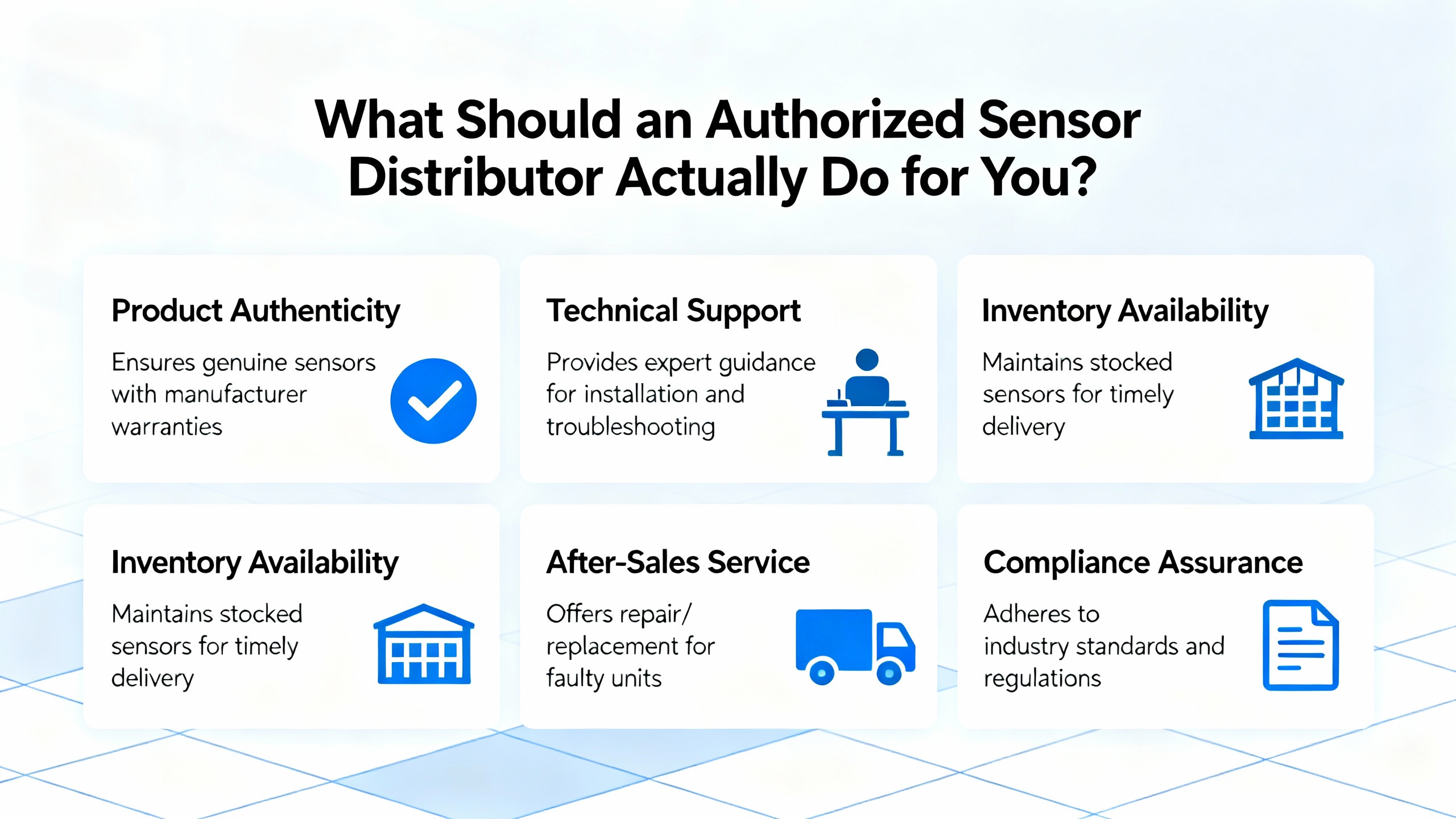
If your authorized Turck sensor distributor is simply taking part numbers and sending bills, you are not getting full value. Multiple sources describe how vendors and distributors should function as technical partners.
RS Expert Advice, quoting a product marketing manager from Banner Engineering, recommends that customers prepare key application details before engaging experts: what targets need to be sensed, at what distance and speed, what output types are required, and what environment and precision are involved. A competent distributor will then help translate those answers into sensor technologies and modes, whether that means opposed photoelectric sensors for long‑range detection or adjustable‑field sensors for tight background suppression.
Adeunis advocates for suppliers that provide customer care, training, and personalized support from installation and configuration through data analysis. They mention deployment support, audits, and post‑training follow‑up as part of a serious offer. MxD, in its guidance for small to mid‑sized manufacturers, underscores that most US firms are relatively small and often lag in sensor adoption, but that sensors are relatively low‑cost, sometimes as little as sixty cents, and can be retrofitted onto legacy equipment as a practical first step toward digital transformation. An authorized distributor that understands this can help you run small pilots rather than forcing a big bang transition.
CHOOVIO’s selection brief emphasizes integration with IoT and cloud platforms via standard protocols such as HTTP or MQTT and through well‑documented APIs. Adeunis prefers multi‑protocol devices and straightforward integration paths to central dashboards and analytics. For a power system owner, that means your distributor should be ready to talk not just about the sensor, but about how its data will reach your power monitoring software, CMMS, or cloud analytics, and what gateways and cybersecurity controls are needed.
Comptus and VDC Research both focus on data trust. Comptus urges buyers to focus on real‑world performance and serviceability, selecting sensors that can be maintained and recalibrated in the field. VDC Research highlights reliability and accuracy as paramount for position sensors and recommends evaluating suppliers on proven reliability data and accuracy metrics rather than on low upfront cost. An authorized distributor aligned with these principles will help you avoid spec‑driven shopping and instead choose devices that deliver trustworthy data over years of operation.
In practice, when I work with a distributor on a UPS or inverter project, I expect them to participate in RFQ refinement, recommend against useless extremes in spec sheets, provide application notes and configuration guidance, and remain reachable when commissioning or field issues arise. If they cannot help interpret ultrasonic readings from a suspect breaker compartment or explain how to set thresholds on temperature channels in a battery rack, they are not fulfilling the role that Adeunis, Comptus, and others propose for sensor suppliers.
Putting It All Together: A Practical Power Room Scenario
Consider a facility with critical UPS‑backed loads, aging switchgear, and limited condition monitoring. Following the approach suggested by MxD, the reliability engineer starts by mapping the power path and applying the Pareto principle to pinpoint the small number of failure modes responsible for most incidents. Perhaps historical records show repeated nuisance trips on one UPS input breaker, overheating cables at a particular transformer, and occasional loss of cooling for the UPS room.
Drawing on Factory AI Group’s framework, the team then defines specific objectives: halve unplanned UPS input trips over the next year, eliminate thermal alarms on that transformer, and ensure cooling faults are detected with enough lead time to avoid UPS derating. An asset criticality analysis ranks the UPS input, transformer, and cooling system as top‑tier risk items.
Working with an authorized Turck sensor distributor or equivalent partner, they design a minimal but strategic sensing package. Vibration sensors go onto the cooling pumps and key fans to provide early warning of bearing and alignment issues. Contact or IR temperature sensors are installed on the transformer windings, the suspect cable terminations, and key UPS components. Ultrasonic inspection is scheduled for the switchgear to screen for arcing or tracking, and the team evaluates whether to add permanent ultrasonic sensors on the most critical compartments. Current and power sensing is added to the UPS feed and the cooling pumps to distinguish between electrical and mechanical problems and to gather energy consumption data.
The distributor helps match sensors to environmental constraints, choosing IP‑rated enclosures suitable for the electrical room’s dust and temperature profile and confirming that devices can tolerate the electromagnetic environment. They also recommend a connectivity mix: hard‑wired 4 to 20 milliamp and Modbus links for high‑criticality data that must flow into the existing PLC and power monitoring system, and a LoRaWAN or similar low‑power wireless overlay for less critical condition data where running cables would be prohibitively expensive.
Following CHOOVIO and Adeunis, the team and distributor plan for security, remote diagnostics, and firmware updates from the start. Based on guidance from Comptus, they write RFQs that reflect actual environmental and accuracy needs instead of copying manufacturer‑promoted extremes. Commissioning includes verifying that sensor data reaches the maintenance software or CMMS and that alerts generate actionable work orders rather than emails to unmonitored inboxes.
Within months, the vibration and current sensors on a cooling pump detect changes characteristic of rising mechanical load, allowing maintenance to intervene before a loss of cooling trips temperature limits. Temperature sensors on the transformer reveal gradual warming on one phase under specific load conditions, leading to a tightening and inspection of joints before any insulation damage occurs. Periodic ultrasonic surveys of the switchgear detect no discharge, providing documented evidence that the gear remains in acceptable condition. The entire program costs a fraction of a single major outage, aligning with MxD’s observation that retrofitted sensors are a low‑cost but high‑impact step in digital transformation.

FAQ
How can I confirm that a sensor distributor is really authorized and suitable for critical power projects?
Start by checking manufacturer listings and requesting documentation that they are recognized partners, then follow the practical advice from Acton Technology and Adeunis. Verify that the distributor provides complete, manufacturer‑backed product information and formal quotations, can explain environmental and certification details, and offers responsive technical support. Ask them to walk through your specific UPS and switchgear use cases and to comment on environmental, connectivity, and maintenance aspects rather than only quoting part numbers; their depth of response is often more revealing than the label on their business card.
How many sensors do I need to justify the effort in a UPS or inverter facility?
MxD’s work with manufacturers shows that sensors can be retrofitted onto legacy equipment at low cost, sometimes for well under a dollar each, and that the right deployment starts small. Factory AI Group recommends focusing on assets that are both critical and prone to failure, based on a simple asset‑criticality analysis. In practice, that often means instrumenting a handful of key feeders, transformers, and cooling assets first and expanding only after you have proven that the data is being used to prevent events, not just collected.
Is wireless sensing reliable enough for electrical rooms and substations?
Factory AI Group and Adeunis both emphasize that wireless should be chosen application by application. Low‑power wide‑area protocols such as LoRaWAN offer long range and low energy use and are well suited to distributed condition monitoring, while Wi‑Fi provides high bandwidth at the cost of higher power consumption and potential congestion. For life‑safety and trip‑critical signals in UPS or switchgear applications, most engineers still prefer wired connections or fieldbus links. Wireless links are often best used for non‑critical condition data, provided they are implemented with appropriate security and interference considerations.
Reliable power systems today are built on more than copper and breakers. They rest on data generated by well‑chosen sensors, integrated into workflows, and supported over the long term by an authorized, technically competent distributor. If you approach Turck sensor deployments with that mindset, aligning strategy, environment, connectivity, and supplier strength, you put your UPS and power protection systems on a much more predictable footing.
References
- http://web.mit.edu/brAAtzgroup/Cao_IEEEInstrumMeas_2025.pdf
- https://www.nap.edu/read/4782/chapter/7
- https://www.sjsu.edu/ae/docs/project-thesis/Todd.Kelmar-S23.pdf
- http://aml.engr.tamu.edu/wp-content/uploads/sites/164/2017/11/R1.pdf
- https://www.mxdusa.org/2020/08/05/five-steps-to-choosing-the-right-manufacturing-sensors/
- https://web-material3.yokogawa.com/2017-09-2245%20Wireless%20Sensor%20Network_Prac%20Consider_v1a.pdf
- https://acton-tech.com/how-to-choose-the-right-electronic-component-distributor-for-your-project/
- https://adamscorp.com/our-blog/how-to-choose-the-right-industrial-sensors-for-your-application
- https://www.arcweb.com/technology-evaluation-and-selection/smart-sensors-selection
- https://www.choovio.com/ultimate-guide-to-industrial-iot-sensor-selection/?srsltid=AfmBOooMBFRPsB73NIkLhlp5X75mJcSsy5yVTyvLOfGxBDg5gnLGT0Lx


 Videos
 News
News Applications






Leave Your Comment