Soft starters are one of those components you rarely think about until a motor refuses to start, trips on overload, or begins cycling on and off for no obvious reason. In industrial and commercial power systems, I see this most often on Schneider Altistart units feeding pumps, compressors, conveyors, and HVAC fans, especially where power quality is less than perfect or where soft starters are fed from generators, UPS-backed buses, or inverters.
When a Schneider soft starter throws an error, the motor is only the visible symptom. The underlying cause can be anywhere in the chain: wiring, power quality, parameter settings, mechanical load, or the starter hardware itself. This article walks through a practical, field-proven way to diagnose and fix Schneider soft starter errors while protecting the rest of your power system.
The guidance is grounded in published troubleshooting from manufacturers and technical sources such as Schneider Electric FAQs, ATO, Geetech, EMHeater, Emotron, AIGOODELE, and others, combined with practical field patterns that consistently show up across brands and models, including the Schneider ATS22 and ATS48 families.
What Schneider Soft Starters Actually Do
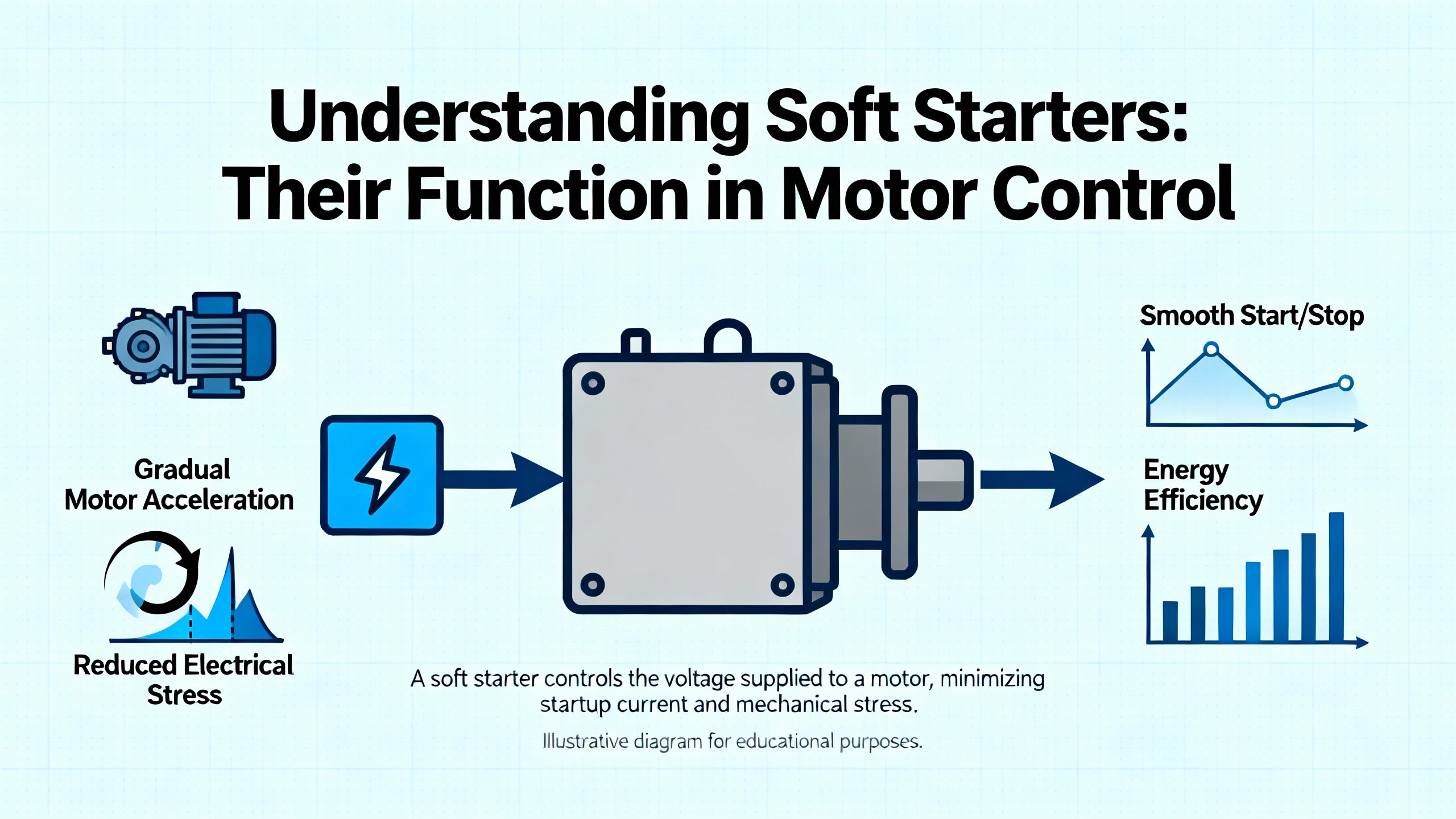
A soft starter is an electronic controller that ramps voltage to an AC motor during startup instead of hitting it with full line voltage. Guides from Geetech, Mingch Electrical, and ATO all emphasize the same core functions: reduce inrush current, lower mechanical shock on the drivetrain, and smooth acceleration so your upstream power system and mechanical equipment are not hammered every time the motor starts.
Schneider’s Altistart series, including the ATS48 line discussed by MRO Electric, adds more than just a simple voltage ramp. The ATS48 uses a torque control system to tightly manage motor torque during acceleration and deceleration, which protects gearboxes and couplings and improves process control. The range covers everything from small motors to several hundred horsepower at common industrial voltages, and integrates with standard control panels and Ethernet-based monitoring.
Because these devices sit between your power system and the motor, they become highly sensitive indicators of anything out of spec. An error on the soft starter does not automatically mean the starter is bad; it means something in the motor starting system is outside the envelope the device is designed to tolerate.
How Schneider Soft Starter Errors Show Up
In practice, Schneider soft starter issues present as a small set of recurring symptoms that match what ATO, Geetech, Asbeam, Mingch, and Emotron all describe for soft starters in general.
You may have a motor that simply refuses to start while the fault or trouble light is on. You may see the motor begin to ramp and then trip out with an error before reaching full speed. Upstream breakers or “air switches” can trip during acceleration. On some systems, the soft starter will start the motor and then repeatedly stop and restart as it detects faults or unstable control commands. Overheating alarms, fans running at full speed, or a soft starter that runs hot to the touch are also common. In more subtle cases, the motor starts but vibrates, buzzes, or exhibits abnormal noise only when running through the soft starter.
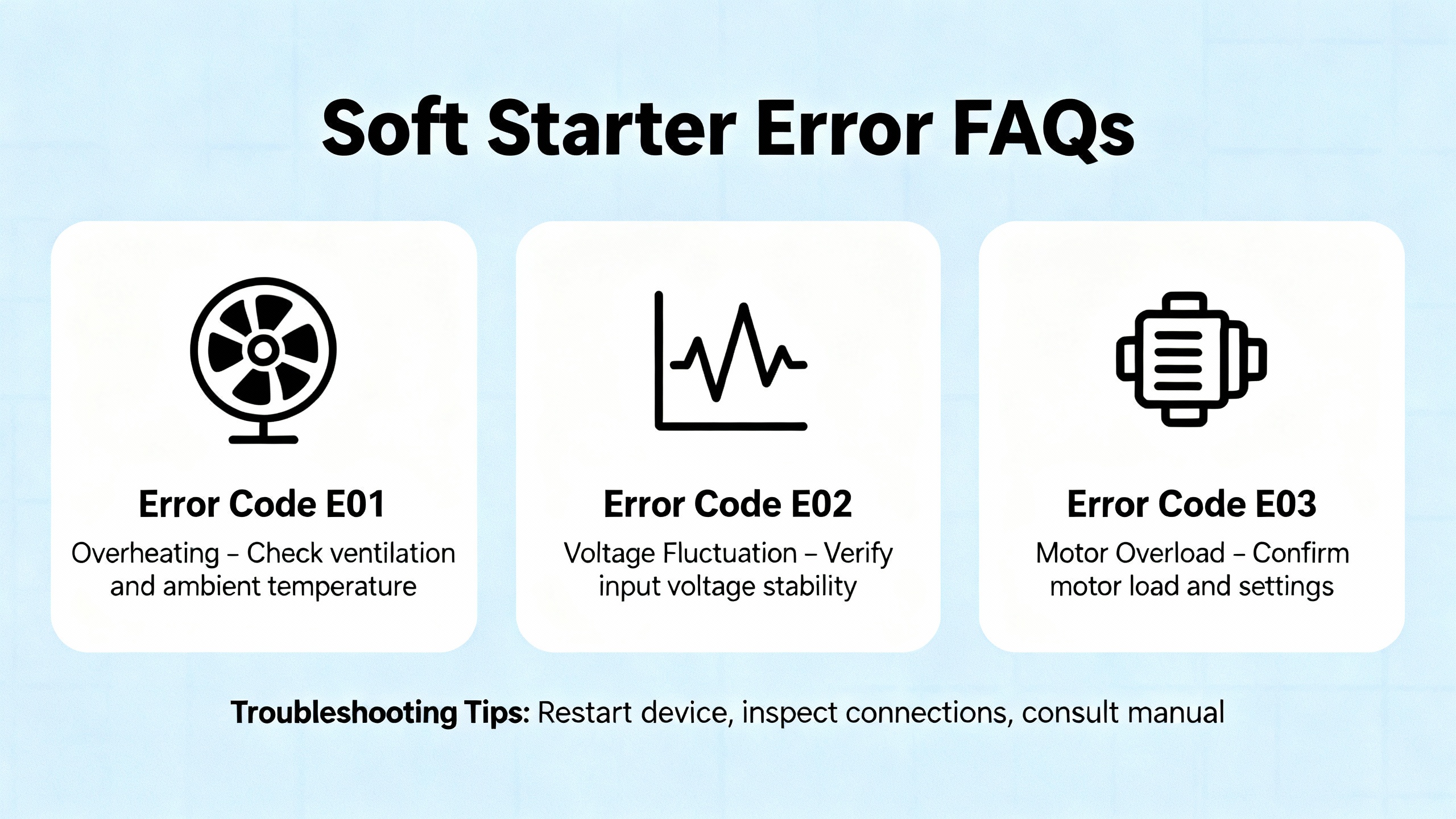
Modern soft starters, including Schneider units, display error or fault codes. Schneider’s own FAQs reference codes such as “StF” on ATS22 and ATS48 devices as starter-fault indications. That code tells you the device has detected a condition it considers unsafe or out of tolerance and has shut down to protect itself and the motor. The code is vital, but it is only the starting point; the real work is tracing why the device sees a problem.
Safety First: Make the Starter Safe to Touch
Before opening a Schneider soft starter or reaching into the motor control center, you need to treat it as live until proven otherwise. EMHeater’s troubleshooting FAQ is explicit on this: de-energize the system, verify that the soft starter’s power indicator is off, and use a meter to confirm zero voltage at both input and output terminals before touching internal parts. Do not trust a single disconnect or breaker alone.
In routine maintenance, EMHeater recommends at least annual inspection for temperature, humidity, dust, corrosion, loose terminals, and signs of arcing. That same discipline applies when something has failed. Many soft starter “errors” ultimately trace back to exactly those basics: overheated terminals, contamination, or a loose wire vibrating in a panel.
Only once the device is safely isolated should you remove covers, tighten terminals, or test components.
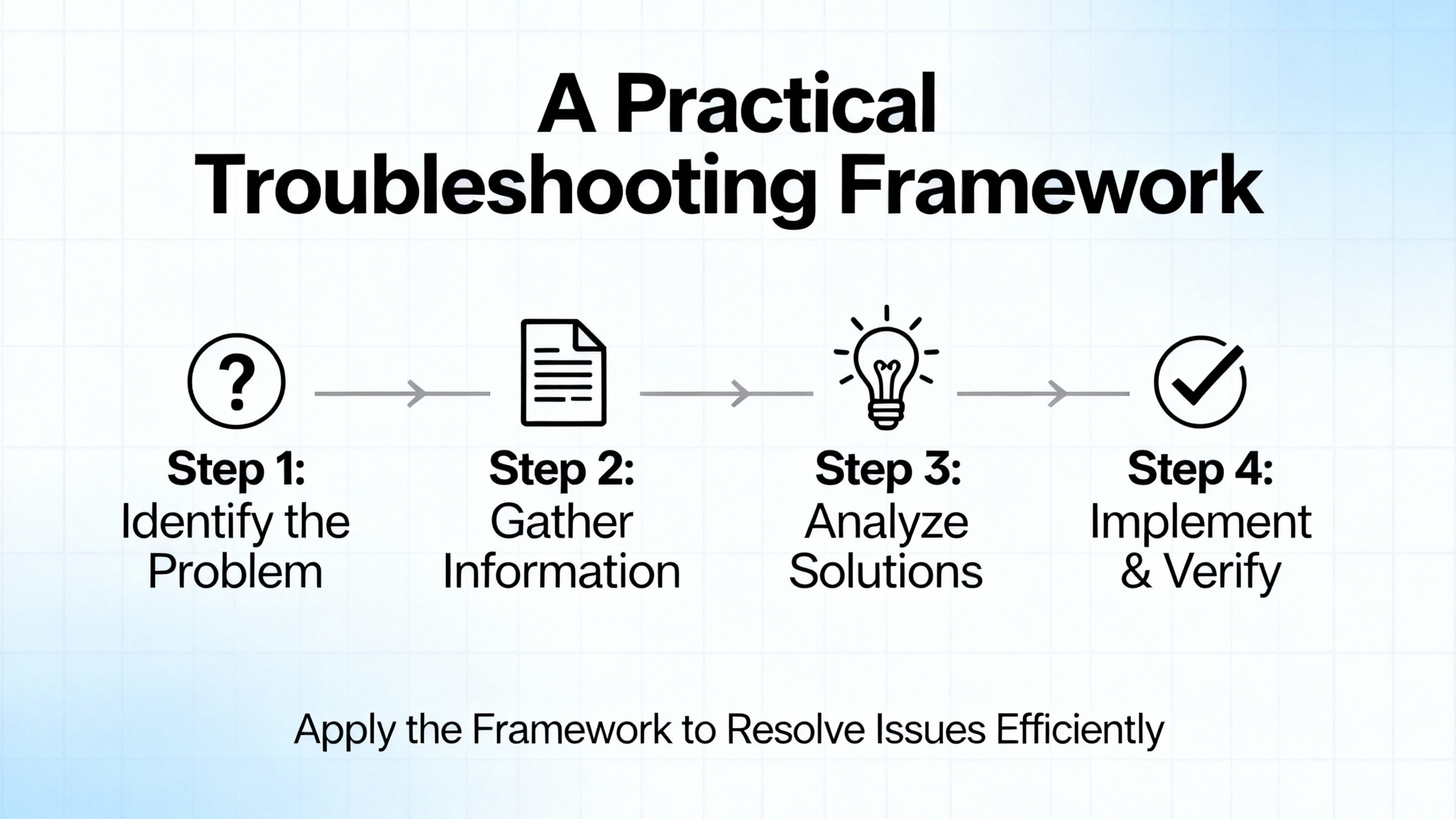
A Practical Troubleshooting Framework
Experienced technicians and the technical guides from Geetech, ATO, Asbeam, Mingch, EMHeater, and Emotron converge on a common diagnostic pattern. The order matters: you eliminate cheap, external problems before assuming the soft starter itself is bad.
Begin with wiring and motor connections
AIGOODELE’s soft starter troubleshooting article begins with the most fundamental checks: confirm that phase conductors are correctly sequenced and that the connections between the soft starter and motor are tight and undamaged. Mis-phased or loose connections can trigger a cascade of symptoms, from no start to current imbalance and nuisance tripping.
Research from Sprecher+Schuh on similar soft starters shows how easily wiring mistakes can defeat the point of a soft starter. Their PF soft starter line provides separate load terminals for delta configurations; if a star-connected motor is accidentally wired to the delta terminals, the motor can run as soon as line power is applied, bypassing the starter’s control entirely. The lesson applies across brands, including Schneider: verify that line and load terminals are correctly assigned, and that the motor’s star or delta configuration matches how it is wired to the starter.
In the field, I start by pulling gently on every power and control wire at the soft starter, motor, and upstream protection devices. Any conductor that moves or shows discoloration, insulation damage, or evidence of heating gets corrected before deeper diagnostics. Most of the “mystery” soft starter problems in older gear come down to wiring issues that a visual inspection can reveal.
Verify incoming power and system configuration
Geetech, ATO, and Mingch all highlight power-supply problems as a major source of soft starter faults. Phase loss, voltage imbalance, and large fluctuations in the incoming supply can trigger protection functions before the motor ever reaches speed. EMHeater recommends static tests with the soft starter disconnected to check phase-to-phase voltages and confirm that all phases are present and reasonably balanced.
Discussions on Eng-Tips about overloads on soft-starter-fed motors add another important nuance: the motor’s voltage and frequency must match the supply. A motor rated for 460 V at 60 Hz expects a specific voltage-to-frequency ratio. In North American plants, feeding that motor from a 480 V bus is normal, because the system is designed for that level and accounts for conductor voltage drop. However, feeding the same motor at significantly lower voltage while holding frequency at 60 Hz, for example around 410 V, reduces torque capability and increases the likelihood of overload trips during acceleration. Before blaming the Schneider soft starter, verify that both the motor and the supply are correctly matched.
Power systems that include rotary phase converters, small generators, or inverters deserve special attention. A Mike Holt forum discussion on using a Schneider ATS22 soft starter behind a rotary phase converter explains why: the converter’s capacitors create a synthesized phase with very steep voltage and current wavefronts. To the soft starter’s SCRs, these wavefronts can look like a short circuit during each capacitor charging event. The high rate of change of voltage can cause SCRs to self-commutate, firing when they should be off and confusing the soft starter’s control logic. High-end units may shut down to protect themselves; lower-cost units risk catastrophic SCR failure.
In that scenario, adding a line reactor ahead of the soft starter increases source inductance, softens the waveforms, and can restore reliable operation. As an experiment, some practitioners insert a 1:1 transformer temporarily between the converter and the soft starter; if performance improves, it is strong evidence that additional impedance or inductance is the cure. Even if your Schneider starter is not behind a rotary converter, that example underscores a key point: if the upstream source is “too stiff” or distorted, the soft starter may respond with protective errors that are not resolved by parameter tweaks alone.
Check protection devices and bypass contactor behavior
Many “soft starter errors” are really reactions to upstream devices that are misapplied or poorly configured. Guides from ATO, Geetech, Asbeam, and Mingch give consistent examples.
If the motor begins to accelerate but the bypass contactor never pulls in, the soft starter remains in circuit, draws higher losses, and may overheat or trip protections. Causes include overly sensitive external protection settings, mismatched or under-rated breakers, damaged or miswired control circuits, or parameter settings on smaller units that do not correspond to the actual load. Conversely, if a bypass contactor closes too early, or fails to release before the soft starter begins firing, the starter may detect short-circuit conditions and trip immediately.
Frequent tripping of an upstream breaker or “air switch” during acceleration is another common complaint. The field notes from ATO and Mingch attribute this to start voltage set too high, acceleration time set too long, or starting multiple large motors simultaneously on the same feeder. Inadequate delay settings or under-sized breakers amplify the problem.
The Schneider ATS48 troubleshooting FAQ summarized in the research notes describes repeated start–stop behavior when control commands are unstable or when protective trips occur shortly after each start attempt. If auto-restart is enabled, the soft starter will keep trying to start into the same fault, leading to a repeating pattern until someone intervenes. When you see that behavior, it is essential to determine whether the stop command is coming from the soft starter (via its own protections) or from upstream devices that are dropping out.
Tune Schneider soft starter parameters to the real motor and load
Every manufacturer whose guidance appears in the research—ATO, Geetech, Mingch, Asbeam, EMHeater, Emotron—emphasizes one central truth: incorrect parameters are one of the most common root causes of soft starter errors.
Key settings include motor rated current, initial voltage, ramp-up time, current limit, and sometimes ramp-down behavior and torque control. If the motor current parameter does not match the nameplate, the starter’s internal protections do not correspond to reality. If start voltage is too low or acceleration time too short, the motor may never break away from a heavy mechanical load, triggering “overtime” faults or stall detection. If starting current limits are too aggressive, the motor cannot develop enough torque and will either fail to start or take so long that upstream protections operate first.
Troubleshooting guides from Geetech and ATO specifically call out soft starters below roughly 55 kW as particularly sensitive to improper configuration, because settings are often changed in the field without referencing the manufacturer’s manual. When dealing with Schneider devices, that translates to a clear recommendation: document the motor data, check every key parameter against the nameplate and application, and reset anything that looks inconsistent. If configuration appears corrupted or unclear, EMHeater suggests performing a factory restore and then re-entering motor data and application-specific parameters from scratch.
Manage overheating and thermal trips
Overheating is both a symptom and a cause. Geetech, ATO, Asbeam, Mingch, and Emotron all identify high temperature as a top failure mode for soft starters. Overheating can result from excessive mechanical load, too-frequent starts, inadequate ventilation, failed fans, or bypass contactors that never engage, leaving the soft starter carrying full load continuously.
Several sources advise limiting heavy-load starts to about six per hour and ensuring that the bypass contactor actually closes once the motor reaches speed. Ambient temperature matters as well. Asbeam’s guidance for soft starters notes that panel-mounted devices begin to struggle when ambient temperature climbs above roughly 122°F, and enclosed units can be stressed at temperatures above about 104°F. Dust buildup on heat sinks and filters, blocked vents, and non-functional cooling fans all contribute.
When a Schneider soft starter is tripping on over-temperature, the correct response is not to defeat or bypass the thermal protection. Instead, reduce starting frequency, verify that the motor and load are not oversized for the starter, confirm that the bypass contactor operates correctly, clean and restore airflow, and repair or replace failed cooling fans. Emotron recommends at least annual maintenance for dust cleaning and thermal contact checks.
Address display, control, and communication faults
Display and control issues can masquerade as deeper failures. Geetech and ATO describe cases where the soft starter’s screen goes blank or shows garbled text because vibration has loosened an internal ribbon cable, not because the electronics themselves have failed. Tightening or reseating the display cable often restores normal operation. If that fails, a defective control board is the usual suspect and should be replaced by the manufacturer rather than repaired in-house.
Geetech also points out that soft starters in networked systems can exhibit communication errors due to damaged interfaces, poor cabling, or software incompatibility. Emotron’s guidance reinforces this: verify communication settings, check physical network connections, and update firmware or software as recommended by the manufacturer.
EMHeater’s troubleshooting steps go further by describing how to verify control-board health, for example by checking a low-voltage supply between specific terminals and using the error log that stores the last several faults. For Schneider devices, the principle is the same: use the keypad’s error history and LED indicators to identify patterns instead of treating each trip in isolation.
Use structured diagnostics before condemning the starter
EMHeater divides testing into static (power off) and dynamic (power on) checks. Static checks include measuring phase-to-phase voltages at the supply with the soft starter disconnected and testing the thyristors for continuity that would indicate a short. Dynamic checks involve applying power, confirming that voltages at the input terminals match the keypad’s displayed supply voltage, and observing output behavior during a controlled start test.
If, after basic wiring, power, parameter, and thermal checks, the Schneider soft starter still trips with internal fault codes such as StF, it is reasonable to suspect internal component failure. Emotron’s guidance provides a useful decision framework: reset when the fault is clearly due to a transient condition such as undervoltage, repair when the fault points to a replaceable module such as a relay or board, and replace when the power devices (such as SCRs) are damaged or when critical faults recur frequently despite correct external conditions. For Schneider units, that generally means involving Schneider service or a specialist repair provider such as those described by MRO Electric, rather than attempting board-level repair in the plant.
Dealing with Surges, Lightning, and Harsh Power Quality
Not all soft starter errors originate inside the enclosure. The ElectricianTalk discussion about Schneider ATS48 reliability at an oil and gas site is instructive. The practitioner reported multiple ATS48 failures in a short period, with later analysis suggesting that control boards, not SCRs, were the primary points of failure. They also highlighted how grid disturbances, including lightning and line faults, can cause overvoltage spikes that damage sensitive power electronics.
SCRs used in soft starters are particularly sensitive to rapid voltage rise. High dV/dt events can cause SCRs to self-commutate, turning on without a gate signal. If several SCRs in a Schneider soft starter fire out of sequence, large uncontrolled currents can flow, potentially destroying the devices or damaging control circuitry. The user on ElectricianTalk recommends installing high-quality surge or lightning arresters ahead of the soft starter, especially in areas with frequent storms or unstable utility service, and ensuring that surge devices include clear end-of-life indication so protection is not lost silently.
The rotary phase converter example from the Mike Holt forum complements this picture. Capacitor-generated phases can create repetitive high-stress events on the soft starter’s SCRs even in normal operation, not just during storms. Adding line reactors or transformers to increase source impedance and filter these transients is often the only reliable way to keep the starter healthy in that configuration.
Taken together, these field experiences support a broad recommendation for Schneider soft starters in industrial power systems: treat surge protection and source conditioning as integral parts of the design, not afterthoughts.
Quick Symptom–Cause–Action Reference
The following table consolidates patterns common to Schneider soft starters and the wider soft starter literature from ATO, Geetech, Asbeam, Mingch, EMHeater, Emotron, and community forums:
| Symptom | Typical underlying causes | First actions to take |
| Motor will not start; fault light on | Phase loss or miswiring; incorrect power-up sequence; no load connected; mis-set parameters | Verify wiring and phase sequence; confirm supply present; check motor connection; review basic start parameters |
| Motor starts then trips during ramp | Start voltage too low; ramp time too short or too long; heavy mechanical load; unstable supply | Increase start voltage moderately; optimize ramp time; reduce load at start; measure supply voltage during start |
| Upstream breaker or contactor trips on every start | Breaker rating or delay too small; excessively high start voltage; multiple large motors starting | Match breaker to motor current; lower start voltage; adjust delay; stagger motor starts on the same feeder |
| Soft starter overheating or thermal alarm | Inadequate ventilation; bypass contactor not engaging; too many starts per hour; failed cooling fan | Improve cooling and airflow; confirm bypass operation; limit start frequency; repair or replace fans |
| Abnormal noise or vibration only when starting through starter | SCR or control-board issues; wiring problems; inappropriate parameter settings or load mismatch | Inspect and tighten wiring; verify parameters; test with known-good motor if possible; consult manufacturer |
| Display blank or garbled; no response | Loose display cable; failed control board; control power issues | Reseat or replace display cable; verify low-voltage supply; replace control board through authorized service |
| Repeated start–stop cycling without operator command | Unstable control signals; persistent fault with auto-restart enabled; external devices dropping out | Stabilize control wiring and logic; read fault codes; check external relays and contactors for chattering |
| Schneider StF or similar starter-fault code displayed | Detected internal starter fault; likely hardware or severe electrical issue rather than simple mis-set | Record the code; verify external wiring and supply; then escalate to Schneider technical support or repair center |
This table does not replace Schneider’s own manuals and FAQs, but it reflects the dominant patterns documented by multiple independent sources and matches what tends to show up in the field.
Repair, Replacement, and Long-Term Reliability Strategy
Once you have a specific diagnosis, the next decision is whether to reset, repair, or replace the Schneider soft starter and what changes to make in the broader system.
Emotron’s guidance is a good starting point. Transient issues such as short-lived undervoltage or a one-off overload can be addressed by correcting the external condition and performing a controlled reset. Faults associated with replaceable modules, such as control boards or relays, justify repair if the soft starter’s age and criticality support it. Persistent or severe faults involving power devices, recurrent internal starter-fault codes like StF, or repeated failures in a harsh environment often justify full replacement, ideally with accompanying upgrades in surge protection, ventilation, or source conditioning.
In critical facilities where UPS systems, inverters, or generators feed Schneider soft starters, the reliability strategy must consider the entire chain. Soft starters help protect the power source by lowering inrush current, but they themselves rely on reasonably clean voltage waveforms. Adding line reactors, isolating transformers, or surge protective devices can dramatically improve uptime and reduce nuisance trips. Regular maintenance—cleaning dust, tightening terminals, verifying fan operation, and reviewing start counters and error logs—turns the soft starter from a mysterious “black box” into a predictable, manageable device.
Frequently Asked Questions about Schneider Soft Starter Errors
What does an StF error mean on a Schneider soft starter?
Schneider Electric’s FAQs describe StF as a protective starter-fault code that indicates the Altistart has detected an internal problem and shut down to protect the motor and equipment. It is not a simple settings issue. When StF appears, you should document the code and operating conditions, verify wiring and power quality, and then consult the Schneider manual or technical support for model-specific guidance. In many cases, hardware repair or replacement is required.
Can I run a Schneider soft starter behind a rotary phase converter?
A discussion on the Mike Holt forum about the ATS22 shows that feeding a soft starter directly from a rotary phase converter is risky. The converter’s capacitors create very steep current and voltage wavefronts that stress the soft starter’s SCRs, causing misfiring and potential damage. Engineers have had success by inserting a line reactor or a 1:1 transformer between the converter and the soft starter to add inductance and soften the waveforms. If a temporary transformer improves behavior, a properly sized line reactor is usually a cost-effective permanent solution.
How many times per hour can I safely start a motor through a Schneider soft starter?
Troubleshooting guides from Geetech, ATO, and Mingch recommend keeping starts for heavy loads to roughly six per hour to avoid overheating the soft starter and motor. Schneider models may specify their own limits in the manual, and those should take priority, but the six-start rule of thumb reflects what many soft starter manufacturers consider a practical upper bound for continuous service with heavy loads.
When should I suspect the motor, not the Schneider soft starter?
If a motor fails to start even when bypassed directly to line (using appropriate safety and control), that points to motor or mechanical issues rather than the soft starter. Guides from Geetech and ATO emphasize verifying that the motor is properly connected, that its insulation and winding resistance are within spec, and that the driven load is free to rotate. Soft starters cannot compensate for jammed machines, seized bearings, or significantly under-rated motors.
Closing Perspective
Soft starter error codes on Schneider equipment rarely point to a single, simple failure. They are the system’s way of telling you that something in the motor starting chain is out of balance: wiring, power quality, settings, load, or hardware. When you approach the problem methodically—starting with safe isolation, progressing through wiring and power checks, validating parameters, and finally considering surge protection and internal faults—you repair more than a single device. You strengthen the reliability of the entire motor starting system and, by extension, the resilience of the power network that feeds it.

References
- https://selfstudy.southernwv.edu/Download_PDFS/fulldisplay/4000008/SoftStarterScrFault.pdf
- https://admisiones.unicah.edu/libweb/tAb17W/4OK076/electric-motor_maintenance-and-troubleshooting__2nd__edition.pdf
- https://web.statler.wvu.edu/~mathews/boat/pdf/manual/Chapter%20Three.PDF
- https://www.ato.com/soft-starter-troubleshooting?srsltid=AfmBOoqvM6KZccPy9uQDVz0JVHTqUO3LKMGKk7jMCEXkyVKAWcGgpHTE
- https://www.asbeam.com/news/softstarter_faults-cn.html
- https://synchronics.co.in/schneider-electric-soft-starter-repair-troubleshooting-altistart-series/
- https://www.naemotors.com/uploads/man_cust_0005_1-2.pdf?srsltid=AfmBOooBxkjcHBUZZsktRd6Ux9cANQFqpB7HFJP9wo3ia5KhrBnupnvL
- https://www.sprecherschuh.com/TechTips/softstarters.html
- https://www.vfd-softstarter.com/news/common-soft-starter-faults-and-troubleshooting-49402014.html
- https://aigoodele.com/blogs/basic-to-know/troubleshooting-a-malfunctioning-soft-starter?srsltid=AfmBOop3Qj4R67s4qrBTAxmHQb3o1AGsQvcAMt26o-MK-PZe4U0QXmmM


 Videos
 News
News Applications





Leave Your Comment