Schneider Altistart soft starters do an essential job: they tame motor inrush and torque shock so your process starts smoothly and your power system stays steady. When they trip, production feels it. As a power system specialist who has commissioned and troubleshot ATS22 and ATS48 starters alongside UPSs, inverters, and sensitive plant distribution, I’ve learned that decoding a fault fast is as valuable as fixing it. This guide translates Schneider soft starter error codes into practical actions, with proven field techniques to get you from red lights back to green starts—safely and reliably.
What Soft Starters Do—and Why Faults Occur
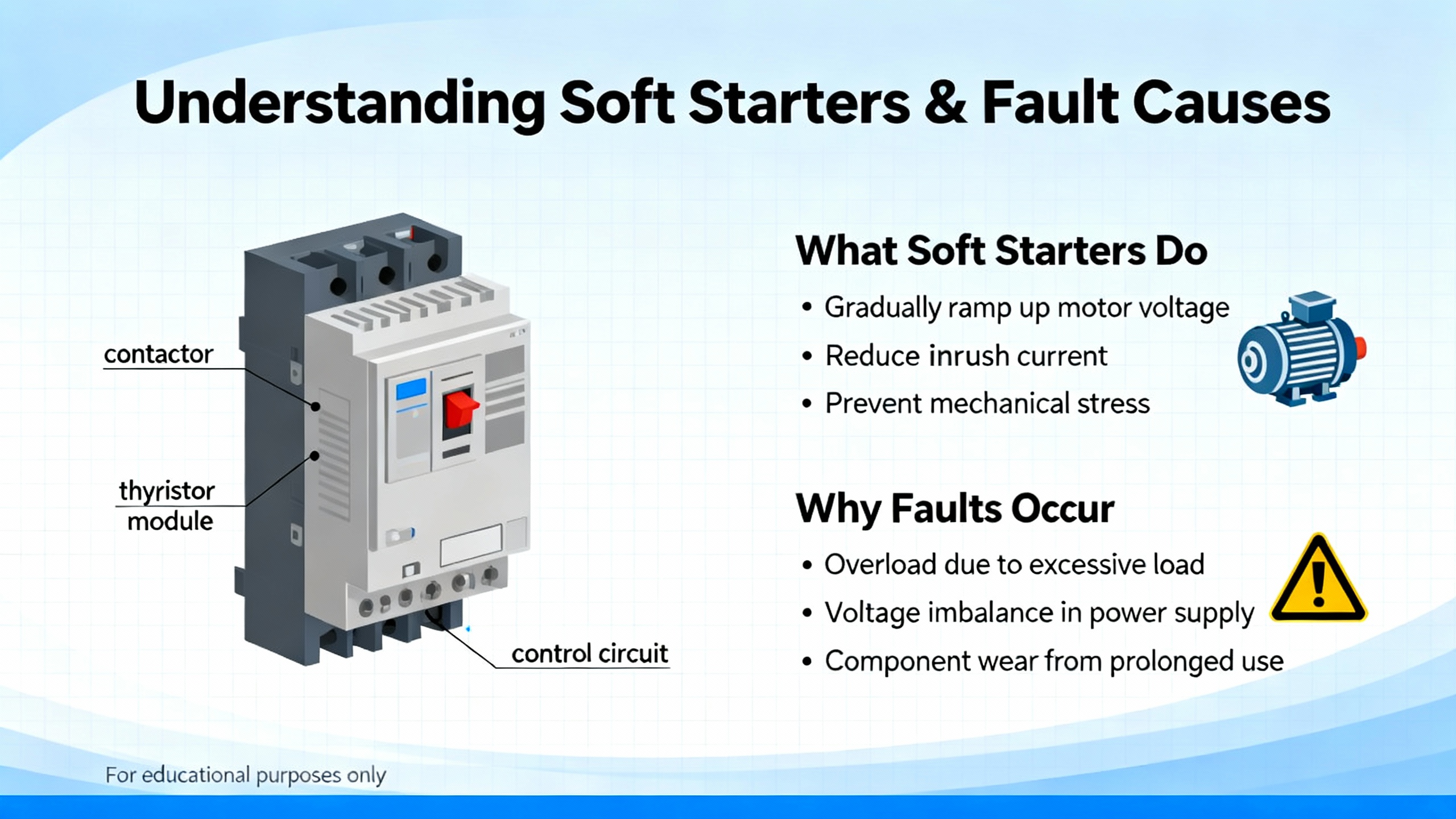
A soft starter is a solid‑state controller that ramps voltage through SCRs (thyristors) to limit starting current and torque. That simple idea prevents the 6–8× full‑load amperes typical of across‑the‑line starts and reduces mechanical strain on gearboxes, belts, and couplings. With appropriate settings, a soft starter typically holds inrush near 2–4× FLA while still achieving a confident run‑up, depending on load and tuning. Those ballpark figures come from widely accepted industry guidance and are echoed by Digi‑Key’s selection notes. Hoyer Motors’ application guidance reinforces the operational benefits as well: controlled starts and soft stops improve process stability and cut hydraulic hammer in pump systems.
Faults arise when supply conditions, wiring, thermal environment, load dynamics, or parameterization diverge from what the soft starter expects. Unlike a breaker trip that only reports overcurrent, a modern soft starter’s diagnostic codes point to specific symptoms—phase loss, thermal issues, overcurrent at start, abnormal current paths, or network communication faults—so you can aim your effort precisely.
Models in Focus: ATS22 and ATS48
Schneider’s Altistart lineup has several families; in industry, ATS22 and ATS48 are the most common. ATS22 is a compact, general‑purpose soft starter that integrates well in fixed‑speed applications with fundamental protections and straightforward parameterization. ATS48 is a more advanced platform designed for heavier duty and more demanding environments, with features like a Torque Control System that reduces drivetrain wear, plus native communications for supervisory integration. Power ranges span from low tens to several hundred horsepower depending on line voltage; MRO Electric’s application notes outline representative ATS48 ranges and emphasize the integrated diagnostics that drive troubleshooting efficiency. While code names may differ slightly across firmware or regional labels, the underlying fault categories are consistent.
Safety First and Fast Triage That Works
Lockout/tagout, discharge stored energy, and verify absence of voltage before touching conductors or power electronics. Start every response by capturing the code, the process state, and what changed upstream or downstream—new contactor, retorqued lugs, adjusted PLC interlock, filter cleaning, seasonal temperature shift. Then perform the non‑intrusive checks: visual inspection, panel temperature, fans running, airflow paths unobstructed, and indicator states on any upstream protective devices. With that context, the code becomes a map rather than a mystery.
Fault Code Reference and First Response
The following table summarizes Schneider soft starter faults explicitly documented in Schneider Electric sources or widely referenced service guidance, along with field‑proven checks. Treat it as a practical crosswalk, then consult the specific user manual for model‑exact details and safety notices.
| Code | Model | Meaning (per source) | Likely Causes | First Checks | Source |
| PHF | ATS48 | Phase fault detection; phase loss upstream or downstream of the starter | Open fuse, loose/incorrect wiring, motor lead issue, line contactor sequencing | Verify three‑phase voltage at L1–L3 and through to motor; inspect terminals; confirm line contactor timing relative to Start | Schneider Electric Community |
| PHL | ATS22/ATS48 | Phase loss/imbalance classification in Schneider repair notes | Supply imbalance, single‑phasing, bad connection | Measure phase‑to‑phase voltages; tighten and retorque power lugs; inspect motor leads | Synchronics Electronics |
| SSCr | ATS22 | Abnormal current: no current at run command or excessive current through the starter | Open circuit to motor, welded internal contactor, leaky/shorted SCR | Confirm motor connected and any disconnects closed; measure resistance L1–T1, L2–T2, L3–T3 both polarities; each should read at least 50 kΩ; near‑zero suggests welded contact, sub‑50 kΩ suggests SCR issue | Schneider Electric FAQ |
| OCF | ATS22/ATS48 | Overcurrent during start | Too‑low current limit, too short accel time, heavy or jammed load, undersized unit | Increase current limit and/or acceleration time, check for binding, validate motor FLA and sizing | Synchronics Electronics |
| OLF | ATS22/ATS48 | Overload per thermal model | Prolonged high current, incorrect motor nameplate settings | Set IL1 to motor nameplate, reduce mechanical load, verify ramp profile | Synchronics Electronics |
| THF / OHF | ATS22/ATS48 | Thermal overtemperature fault | Blocked airflow, failed fan, high ambient, continuous SCR conduction | Clean heatsinks, confirm fan operation, ensure bypass engaged at speed, improve ventilation | Synchronics Electronics |
| USF | ATS22/ATS48 | Unstable/under‑voltage supply condition | Sagging feeder, undersized transformer, high impedance source | Measure upstream voltage stability, review starts per hour, coordinate with facility power team | Synchronics Electronics |
| SCF | ATS22/ATS48 | Short‑circuit/shorted device path | Shorted SCR, wiring short, faulted motor | Insulation tests offline; diode‑mode SCR checks; inspect cabling | Synchronics Electronics; JustAnswer |
| CF | ATS48 | Communication fault on networked units | Broken cable, misconfigured node, noisy bus | Validate network settings, grounding, and cabling; isolate to local control to test | Synchronics Electronics |
| tLS timeout | ATS22 | Maximum start time exceeded | Ramp too short, current limit too low, heavy load | Increase tLS and ACC; verify ILt; example practice: with ACC at 10 s, set tLS at or above 20 s | JustAnswer |
If you see codes such as InF or trAP, treat them as internal or application‑trap indicators and refer directly to the Schneider manual for your specific model. Some of these require cycling control power to clear, and clearing without root cause analysis risks repeat trips.
Deep‑Dive: SSCr on ATS22—The Six‑Measurement Test
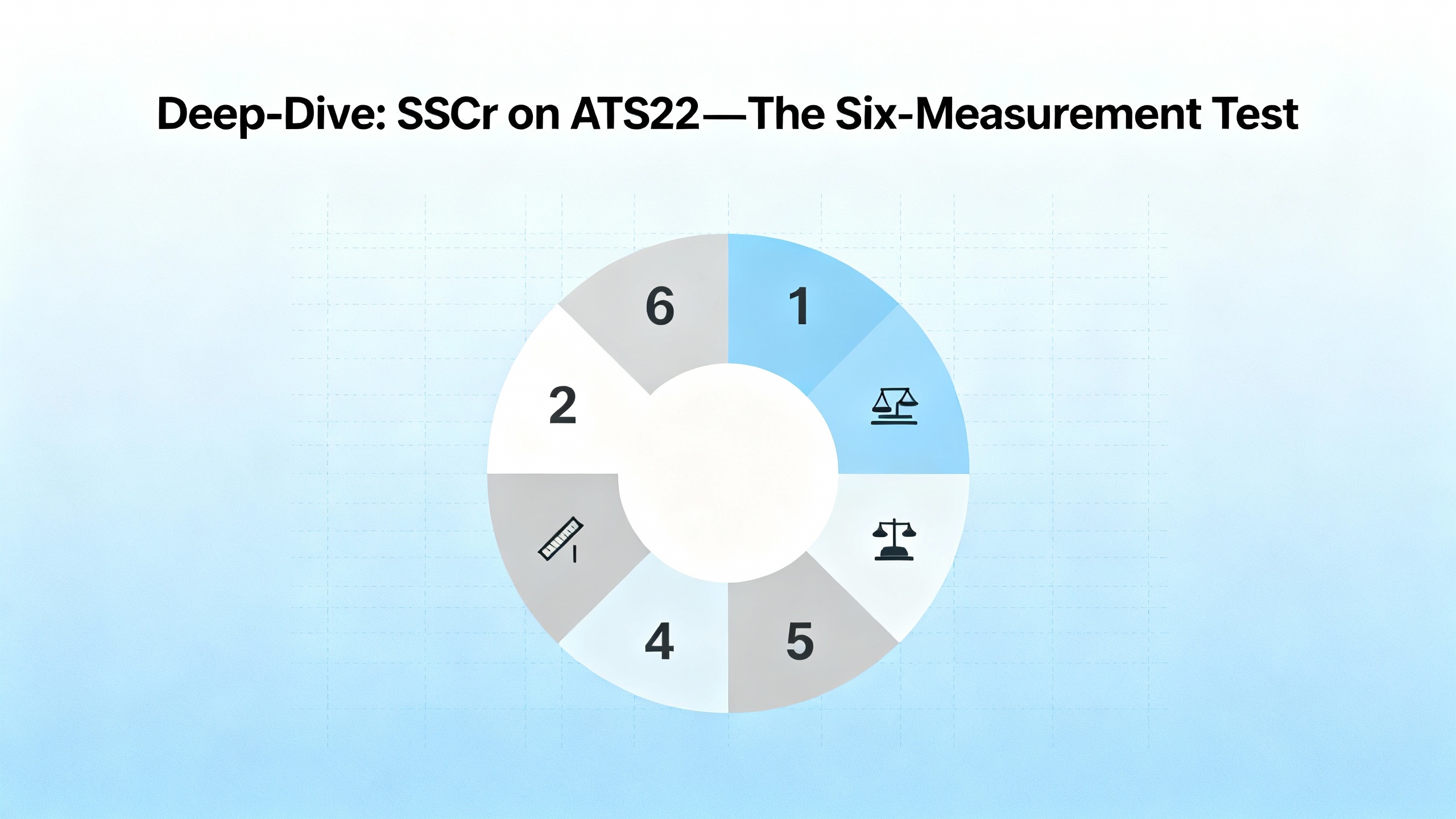
SSCr can be enigmatic until you apply a straightforward diagnostic taught by Schneider’s own FAQ. With the unit de‑energized and safe to test, measure resistance between L1–T1, L2–T2, and L3–T3 with the meter’s red lead on L and black on T. Record all three values. Reverse the leads and repeat. You should have six measurements in total and every one should be at least 50 kΩ. When a reading is near zero, it points to welded contacts in the internal shorting contactor. When a reading is above zero but below 50 kΩ, it suggests a leaking or shorted SCR. If all six are comfortably above 50 kΩ and your wiring is correct, refocus on the “no current at run” scenario: open disconnects between starter and motor, a tripped overload downstream, a disconnected motor, or a miswired contactor path that bypasses the current sensors. This simple, disciplined test sequence prevents random part‑swapping and gets you to the real failure mode efficiently.
Deep‑Dive: PHF on ATS48—Phase Loss and Contactor Coordination
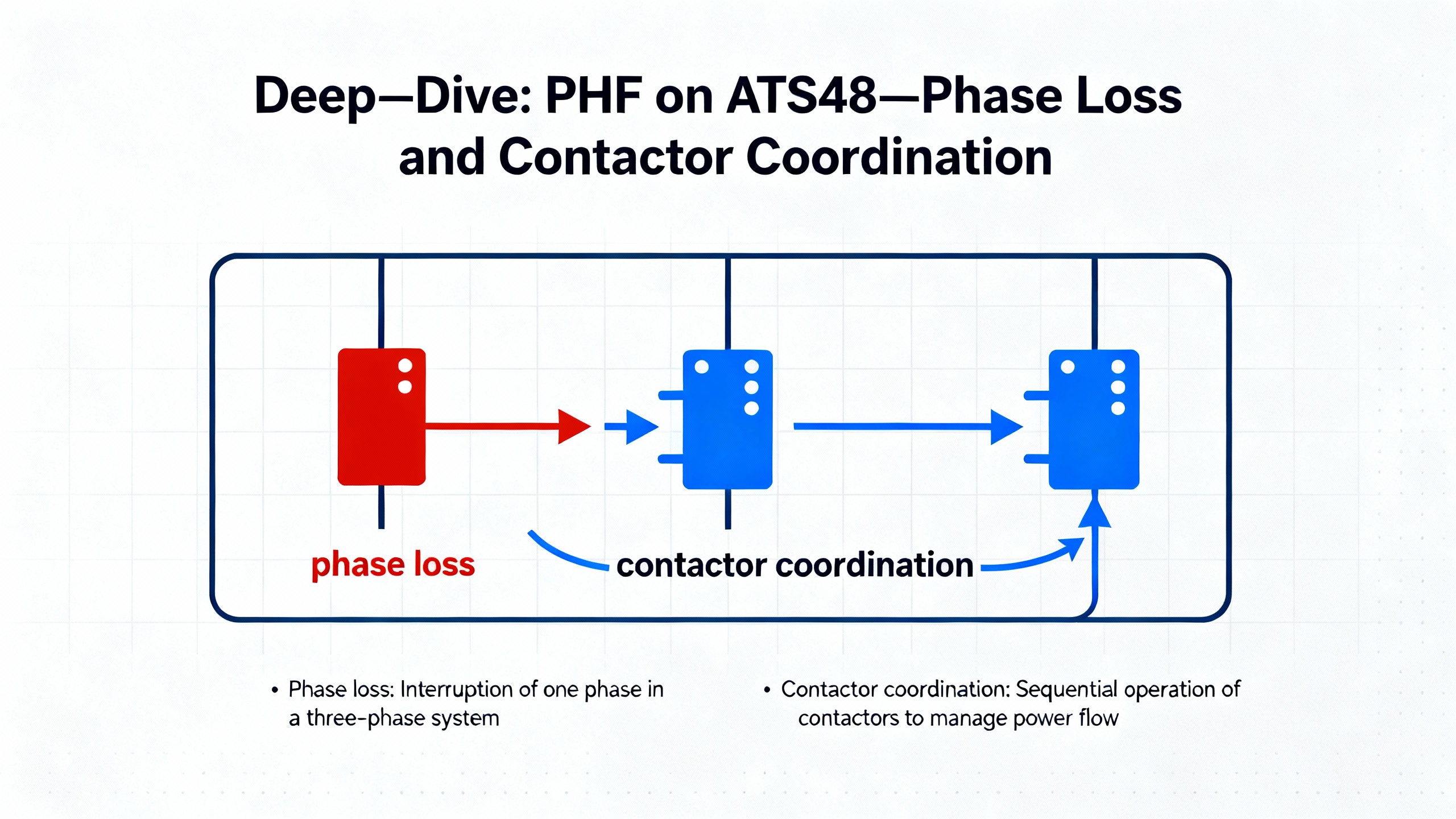
PHF indicates a phase anomaly on either side of an ATS48. From the field, the top three causes are wiring defects, intermittent upstream supply hardware, and mis‑sequenced control logic. One subtle but common pattern occurs when a line contactor closes at the exact moment the ATS48 receives its Start command. That transient can make the starter believe it has lost a phase and it trips PHF. The fix is not expensive: delay the Start signal slightly so the contactor closes, the bus settles, and then the ATS48 ramps. Add verifiable timing in the PLC logic or offload it to a small on‑delay timer. Validate with a single trial start and confirm stable current on all three phases.
Overcurrent and Overload—Parameter Tuning Without Guesswork
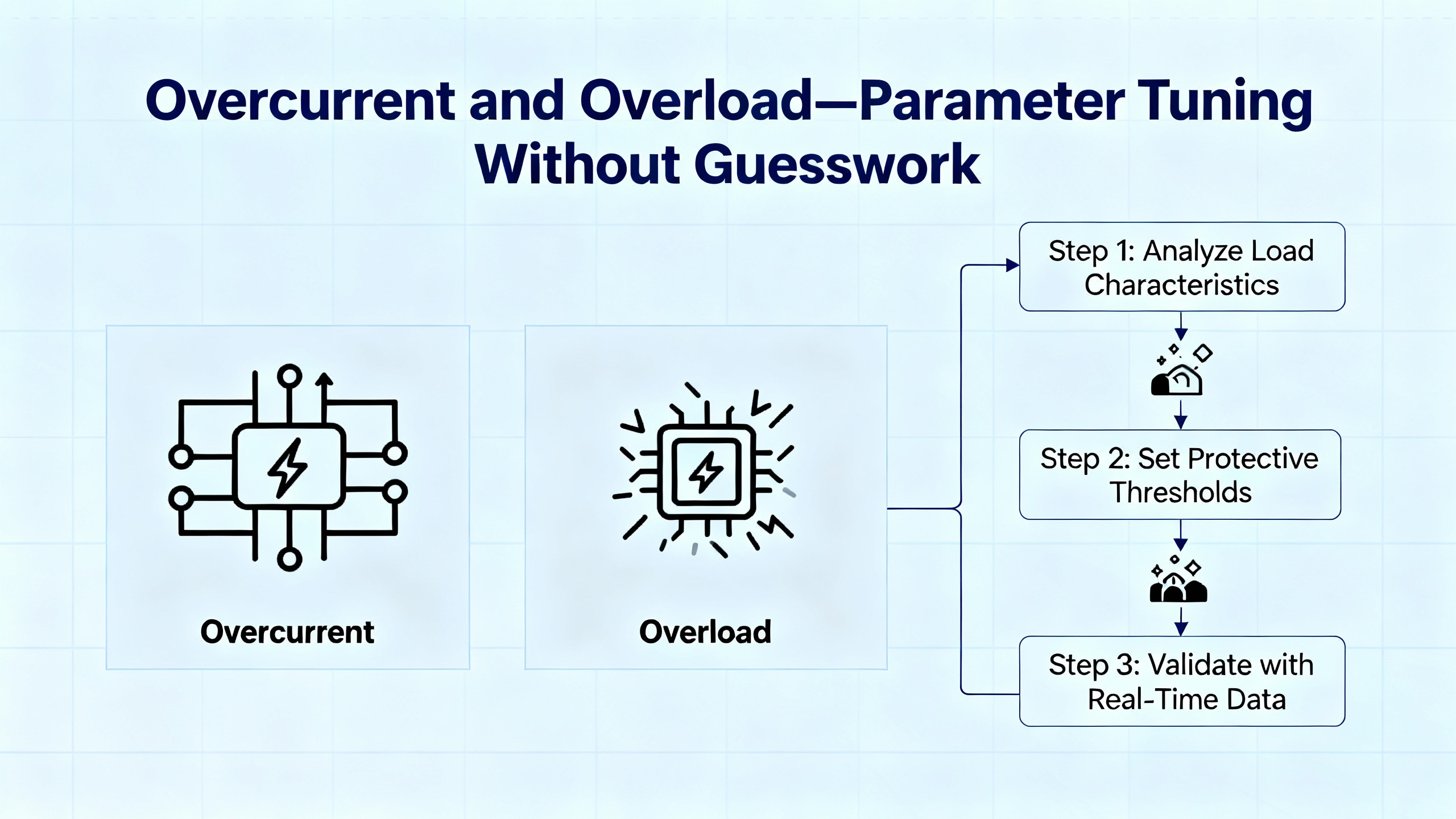
An overcurrent fault (OCF) during acceleration usually means your current limit is below what the load really needs to break away and accelerate, or your ramp time is too aggressive. A thermal overload (OLF) confirms the thermal model has accumulated more heat than allowed. The corrective approach is systematic.
Start by confirming IL1 matches the motor nameplate FLA. Then set ILt, your current limit, with a clamp meter in hand. For most pumps, fans, and conveyors, a soft starter can hold starts near 2–4× FLA with a ramp that is long enough to reduce torque shock but short enough to avoid lingering in the high‑slip, high‑loss zone. If you consistently hit OCF at the start, increase ILt modestly and extend ACC by a few seconds, observing current and speed rise. For OLF that trips after multiple starts or long accelerations, either reduce mechanical load, lengthen stops to avoid repeated heating, or verify that the programmed motor current actually reflects the nameplate and application. If your load is genuinely high torque—crushers, mixers with cold viscous products, high inertia drum starts—acknowledge that with settings and duty cycle. When high‑torque, frequent starts are part of normal operations, a VFD’s torque and speed control is often the right answer; Digi‑Key’s guidance outlines this selection boundary clearly.
Thermal Trips—Make Airflow and Bypass Your Allies
THF and OHF often point to panel thermal issues more than electronic failure. Check airflow path first. Replace clogged filters, ensure vents are not blocked by wire bundles, and confirm fans run at speed. Keep at least about 6 in of unobstructed space around ventilation paths, and do not treat cabinet roofs as storage shelves that smother convection. Synchronics’ experience suggests a 4 in clearance target as a practical minimum in tight spaces, with more margin preferred in hot rooms. For cleaning, keep liquids out and use dry methods; light compressed air around 87 psi is typically sufficient to remove dust without abuse, and a vacuum with a brush works well on fins. If the starter does not engage its internal or external bypass after the motor reaches speed, the SCRs remain in the power path and burn heat continuously; that can push you into thermal trips despite light mechanical load. Verify bypass engagement in diagnostics and correct any wiring or control interlock that prevents it.

Supply‑Side Anomalies—Undervoltage and Weak Networks
USF and other supply abnormalities correlate with poor starts in weak networks where multiple large loads share the same feeder. Even though soft starters reduce starting current relative to across‑the‑line methods, they do not fix a feeder that already drops voltage too far under concurrent starts. Monitor line voltage during start; if sags are significant, adjust start sequencing, stagger loads, or request upstream capacity adjustments. In some facilities I support, a simple interlock that delays a pump start until a compressor is at speed keeps both machines online and fault‑free. Where harmonics or flicker are concern, note that soft starters impose very little distortion compared with VFDs, but power quality is still a system property; active filtering and feeder stiffening remain valid solutions when needed.

Communication Faults—Diagnose the Layer You Own
ATS48 units with industrial networks sometimes report CF when cabling is compromised, terminations are incorrect, or grounding is noisy. Isolate whether the starter itself is healthy by switching to local control or simple hard‑wire mode and attempting a start. If it starts fine, pursue the network stack: correct addressing, proper shield terminations, intact twisted pairs, and reliable switch or gateway configurations. Keep communications independent from essential interlocks so that a network hiccup cannot block a safe local stop.
Parameter Strategy That Prevents Nuisance Trips
A thoughtful parameter set prevents a year of nuisance trips. The interplay between ACC (ramp‑up time), ILt (current limit), and tLS (maximum start duration) deserves attention. tLS should exceed ACC by a safe margin to avoid timing out a legitimate but heavy acceleration; a common practice is to set tLS at roughly twice ACC. If ACC is 10 seconds, a 20‑second tLS is a reasonable starting point in many plants. This does not relax protection; it recognizes that some loads need a beat to climb out of static friction and viscosity. Keep a record of parameter sets and annotate the process state when tuned—cold day, full reservoir, cleaned filter—so your next change is informed. When in doubt, log motor current during a test start and match what you see to the protection’s expectations rather than guessing.
Preventive Maintenance That Keeps Starters Out of Fault
Soft starters are forgiving, but dirt and heat are relentless. Clean cabinets routinely with a dry cloth, vacuum, or carefully controlled compressed air; avoid solvents and moisture. Inspect for discoloration, burned odor, loose lugs, and frayed control wires. Torque terminals to manufacturer specification. Validate fan operation and clear airflow; verify that any filters are clean and sized to the installation. Maintain environmental integrity: temperature within rating, humidity controlled, corrosive dust excluded by appropriate enclosure ratings and gasketing. Back up configuration snapshots after commissioning and after significant changes. Schedule periodic inspections, more frequent in dusty or hot areas, and complete a deeper cleaning and retorque at least annually. Gozyun and Riqno both emphasize the practical side of these routines; the result is fewer thermal and wiring‑related trips and longer asset life.
Repair vs Replace—Economic and Reliability Considerations
When diagnostics point to a failed SCR or a welded internal bypass contactor, a repair with the right parts and techniques is effective. Testing SCRs with a meter’s diode mode, replacing faulty modules with genuine Schneider parts, applying fresh thermal compound, and validating gate trigger circuits are straightforward for trained technicians. Reputable service organizations emphasize proper parts and load‑simulation testing; Synchronics reports that professional repair can save up to 70% compared with replacement, preserve system compatibility, reduce e‑waste, and extend useful life by 3–5 years. Those numbers are credible because in many cases only one power device or fan assembly has failed, and the control logic is intact. When boards are obsolete, verify availability of compatible spares before you commit; if you are facing frequent high‑torque starts or harsh duty that strains a soft starter’s envelope, a VFD upgrade may be the smarter long‑term play.

Coordination With UPSs, Inverters, and the Power System
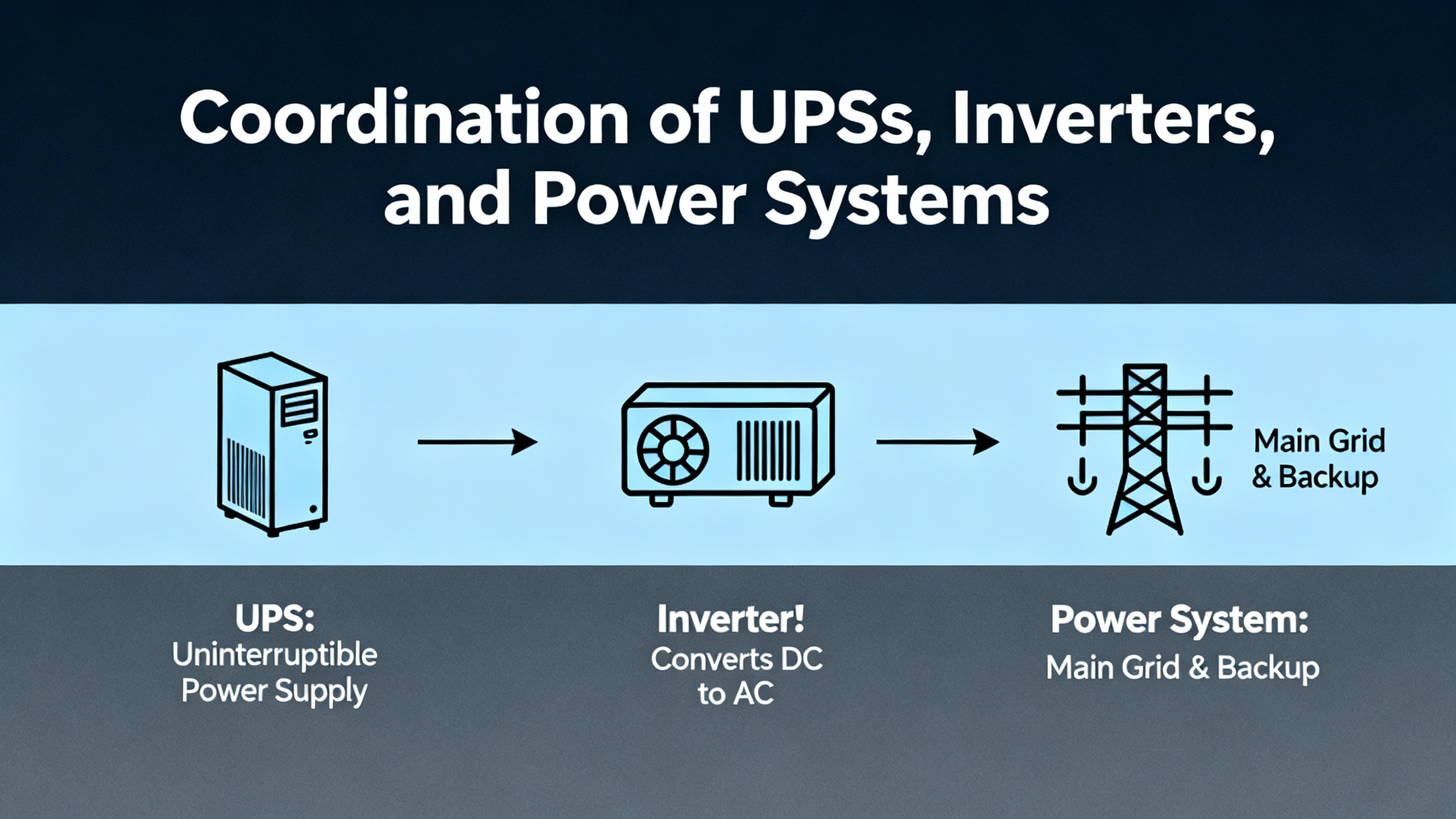
In facilities where UPSs, inverters, and sensitive process controls share upstream feeders with motor loads, soft starters are part of the power‑quality plan. Even though they curtail inrush compared with across‑the‑line starts, they still draw multiples of FLA during acceleration, and SCCR coordination with upstream fuses or breakers remains mandatory. Many soft starters require semiconductor fuses to protect SCRs during faults; this is not optional—mis‑coordinated protection can sacrifice the starter during a short‑circuit event. Ensure bypass contactor wiring and control voltage references are aligned with UPS transfer behavior so that a ride‑through event does not confuse the starter’s state. Careful review of the IEEE 519 context for harmonic limits and the IEC 60947‑4‑2 standard for AC semiconductor motor controllers keeps procurement aligned with compliance.
Soft Starter vs VFD—Which Reduces Fault Risk for Your Case?
A soft starter shines in fixed‑speed applications where gentle starts and stops are the principal need and lower cost, lower heat, and simpler integration are benefits. A VFD is the right tool when you need variable speed, precise torque control, frequent heavy‑duty starts, position‑sensitive ramps, or advanced diagnostics. The Altistart families can run for years when set up well, and in many plants I support they coexist with VFDs: soft starters on pumps and fans that simply need kinder starts, VFDs on conveyors and mixers that benefit from speed scheduling and torque limits. Choosing the right tool reduces nuisance trips because you are no longer trying to force one device to behave like the other.
Quick Actions That Solve the Majority of Trips
Most nuisance trips yield to a handful of disciplined actions. Verify three‑phase voltage at the starter and at the motor; correct any phase loss or imbalance before chasing software. Inspect and retorque power and control connections; feel is not a torque wrench. Clean heatsinks and ensure that fans run; thermal trips are often airflow trips wearing a different coat. Check the line contactor and Start timing on ATS48; a small delay on Start eliminates a deceptive PHF. Validate motor nameplate current in the starter and tune ACC, ILt, and tLS with a clamp meter in hand rather than guessing. When SSCr appears on ATS22, use the six‑measurement test to distinguish a contactor weld, an SCR leak, or an open circuit. This isn’t glamorous, but it’s the fastest path back to reliable starts.

Model Notes and Practical Capacity Context
For planning and spares, it helps to know that ATS48 spans a broad horsepower range across common North American voltages, integrates the Torque Control System to reduce drivetrain wear, and supports supervisory integration for diagnostics and parameter management. MRO Electric’s application overview documents those capabilities and the practicality of using vendor tools for monitoring and configuration. For ATS22 installations, keep an eye on the supply conditions and duty cycle; the compact form factor is a strength, but it relies on accurate parameterization and healthy airflow to stay cool and predictable.

Short FAQ
Can I clear every fault remotely?
Not every code supports a remote reset. Some conditions, particularly internal or trap‑style codes, require removing and reapplying control power. Schneider’s documentation notes that certain codes such as SCF and similar hard faults are not clearable via a simple reset command. Record the fault, correct the cause, and only then clear it.
How do I distinguish OCF from OLF in practice?
OCF is about instantaneous overcurrent during start; OLF is about the accumulated thermal model exceeding limits. If you trip immediately as torque rises, you likely need more current limit or a longer ramp—or a lighter load. If you trip after a longer acceleration or multiple starts, you likely need to reduce thermal stress, back off starts per hour, or improve cooling.
When should I switch from a soft starter to a VFD?
If your starts are frequent and heavy, if you need speed control or torque shaping to avoid process shocks, or if you want richer diagnostics and trending, a VFD is the right tool. If you only need gentle starts and stops at fixed speed, a soft starter remains the simpler, cooler, and more economical solution.
References
This guide draws on Schneider Electric Community discussions regarding ATS48 PHF behavior; a Schneider Electric FAQ detailing ATS22 SSCr diagnostics and acceptance criteria; Hoyer Motors’ primer on soft starter principles and application benefits; Digi‑Key’s selection guidance and starting‑current expectations; Synchronics Electronics’ repair and troubleshooting notes across ATS22/ATS48 fault categories and maintenance practices; MRO Electric’s ATS48 overview with power ranges and configuration tooling; and user‑reported field experience collated from service resources including JustAnswer.
In reliability work, speed and rigor win together. If you want a second set of eyes on a stubborn code or a quick sanity check on parameter choices, I’m happy to help you turn red lights into smooth, steady starts.
- https://pimassetsprdst.blob.core.windows.net/assets/apc_Original/35/20/98153520.pdf
- https://www.micnodrive.com/installation-and-maintenance-tips-for-high-voltage-soft-starters.html
- https://igate.alamedaelectric.com/Modicon%20Documents/Soft%20Start%20Altistart%2048%20Enclosed%20Installation%20Guide.pdf
- https://synchronics.co.in/schneider-electric-soft-starter-repair-troubleshooting-altistart-series/
- https://www.justanswer.co.uk/consumer-electronics/ntkhi-solve-soft-start-fault-inverter-no.html
- https://www.gozyun.com/blog/maintenance-tips-for-soft-start-control-cabinets-prolonging-equipment-life
- https://www.linkedin.com/pulse/ultimate-guide-soft-starters-enhancing-efficiency-longevity-g-s--vbiaf
- https://docs.rs-online.com/3051/0900766b80f58320.pdf
- https://s3.amazonaws.com/Icarus/DOCUMENTS/SchneiderElectric_Manuals_4057.pdf
- https://www.digikey.com/en/articles/key-considerations-when-specifying-soft-starters-for-industrial-motor-applications


 Videos
 News
News Applications






Leave Your Comment