Why PLC Skills Now Sit At The Heart Of Power Reliability
Programmable logic controllers are no longer just the domain of packaging lines and conveyor systems. In modern industrial and commercial facilities, PLCs and PACs sit in the middle of critical power infrastructure: supervising UPS systems, governing inverter transitions, coordinating generator start sequences, and orchestrating automatic transfer switches and switchgear. When these controllers are configured and maintained well, they quietly deliver clean, resilient power. When they are misconfigured or poorly understood, they show up as nuisance transfers, unexplained breaker trips, or UPS events that nobody can fully explain after the fact.
Several training overviews from Schneider Electric and independent automation providers describe PACs and PLCs as open-architecture industrial computers that collect real-time data from sensors, execute control logic, and coordinate with higher-level systems. Training material from Schneider Electric’s own Modicon program emphasizes that these controllers not only drive outputs but also communicate with SCADA, HMI, and other PLCs, log data for diagnostics, and support advanced programming languages beyond ladder logic. In parallel, SolisPLC’s guide to PLC training points out that structured PLC skills are now a core requirement for automation, controls, and maintenance roles across sectors such as power generation and energy.
From a reliability perspective, that convergence matters. Every time your facility adds a new UPS, static transfer switch, or microgrid controller, the PLC layer has to keep up. Technicians who can read and modify Schneider Electric ladder logic, understand communication protocols like Modbus TCP/IP or Profibus DP, and use diagnostic tools effectively are the ones who prevent minor controller issues from turning into major power incidents. Online Schneider Electric PLC training, when chosen carefully, is one of the fastest ways to build that capability without pulling people out of the plant for weeks at a time.
Inside the Schneider PLC Ecosystem: What Training Actually Has To Cover
Before evaluating specific online courses, it helps to be clear about what “Schneider PLC training” really encompasses. A detailed overview of Schneider Electric PLC software highlights several pillars that any serious training path should address.
First, there are the programming languages themselves. Schneider platforms support the IEC style set: ladder logic that mimics relay schematics and is ideal for discrete power control; function block diagrams that structure code as interconnected blocks, well suited for continuous control such as voltage or frequency regulation; structured text, a high-level language similar to Pascal or C for complex algorithms or data processing; and instruction list, a lower-level, assembly-like language still used in some performance-critical routines. Most real projects blend these languages rather than relying on a single style, so training must teach not only syntax but also when each language is the right tool.
Second, communication protocols are central. Schneider PLC software allows configuration of protocols such as Modbus TCP/IP for Ethernet-based integration with SCADA systems and Profibus DP for high-speed communication with distributed I/O. The documentation stresses that misconfigured communication parameters can stop machines outright. In a power system context, that could mean loss of status from switchgear I/O racks, missed alarms from battery monitoring devices, or an HMI that appears alive but no longer reflects real breaker positions. Training that walks through configuring these channels, diagnosing communication failures, and verifying data mapping is not optional if you are relying on PLCs to safeguard critical loads.
Third, configuration tools tie the virtual logic to real hardware. Schneider’s EcoStruxure Machine Expert (formerly SoMachine) and EcoStruxure Control Expert (formerly Unity Pro) allow engineers to define which I/O modules are present, specify addresses, scale analog signals, and set communication parameters. The Schneider-focused article notes that incorrect configuration can lead to malfunctions, safety hazards, or complete system failure. In practical power work, that might look like a current transformer being scaled incorrectly so that an overload is never detected, or a digital input wired for normally closed but configured as normally open. Effective training must not treat configuration as an afterthought.
Fourth, diagnostic capabilities are a major theme. Schneider Electric PLC software offers real-time monitoring of variables and I/O, status indicators for communication links, error logging with timestamps, and online debugging tools that let engineers watch logic execute and step through code in real time. Some packages also include simulation or emulation so programs can be tested without hardware. The overview stresses how these features reduce downtime and support safe commissioning. With power systems, simulation and online diagnostics are particularly valuable when you want to test transfer logic or load shedding strategies without risking live buses.
Finally, HMI integration and cybersecurity overlay everything else. The Schneider software article describes how HMI integration maps PLC variables to graphic elements, alarms, and historical trends, and gives the example of critical temperature thresholds triggering HMI alarms that allow timely intervention. It also highlights emerging cybersecurity features, such as access control and authentication, as increasingly important for interconnected control systems. For anyone exposing PLC networks to corporate networks or remote support, online training that addresses account management, firmware updates, and basic network-hardening practices is now part of protecting power availability, not just IT hygiene.
In short, when we talk about Schneider Electric PLC training, we are really talking about skills that span languages, networks, configuration, diagnostics, HMI design, and cybersecurity, all in service of safe and reliable control.
Flexible Learning Options: From Digital Libraries To Vendor Platforms
Not every facility can send people to an in-person Schneider Electric class, and not every technician learns best in the same way. The good news is that the current ecosystem of Schneider PLC learning options is broad and increasingly flexible. The research notes point to three main categories: digital libraries and open resources, beginner and intermediate online courses focused on Schneider PLCs, and comprehensive or vendor-led programs that include Schneider content alongside other vendors.
Digital libraries and exercise collections for self-paced practice
Several documents describe digital library platforms hosting titles such as “PLC And Motor Control Training” and “Collection Of Exercises For PLC Programming.” These platforms emphasize simplicity, accessibility, and trust. Files are organized and indexed, quality checked, and offered in formats like PDF and ePub that can be read in a browser or downloaded to a computer, tablet, or smartphone. Built-in reader tools like bookmarking, highlighting, and note-taking help learners manage study schedules and revisit key sections. Crucially, access is available around the clock, with no constraints on copy counts or library opening hours.
For a power-system-focused technician, these digital libraries are valuable in a few specific ways. They make it easy to scan a wide range of PLC and motor-control material, cherry-pick chapters on relay logic, motor starters, and interlocking, and then revisit them quickly when a real job calls for that knowledge. Collections like “Collection Of Exercises For PLC Programming” provide structured practice problems, which can be mapped to real power applications such as transfer logic, overload protection, or permissive chains for generator starts. The platforms also stress security and privacy, which matters if you are accessing them from a corporate machine or during off-hours through a company VPN.
The main limitation of these resources is that they typically do not offer guided feedback or lab environments. They are best used as reference material and as a reservoir of exercises to implement in Schneider’s software environment, not as standalone replacements for platform-specific training.
Beginner-friendly Schneider PLC training courses
The next layer is platform-specific courses that walk through Schneider PLC tools from the ground up. A Schneider PLC course for beginners from Automation Community is a good example. The course outline lists dozens of short, scenario-based video modules. It starts with downloading Schneider PLC software and creating a new project, then moves through fundamental digital logic topics such as AND, OR, NOT, NOR, NAND, XOR, and XNOR gates, all demonstrated in ladder logic.
From there, the course progresses into practical examples: controlling LEDs, programming for multiple switches and motors, stepping through conditions and problem–solution exercises, and introducing core concepts like memory bits, latching, and set/reset coils. Later sections cover timer instructions such as TON, TOF, and TP, and apply them in real-world style examples including pumps, alarms, blinking lights, batch mixing, traffic lights, conveyors, washing machines, and elevator logic. Even though many scenarios are generic, the structure closely mirrors the kinds of patterns used in power applications, such as timed pump starts, delay-on-transfer sequences, and alarm handling.
Another beginner course, “Schneider PLC Tutorial For Beginners With Ladder and SFC” hosted on Udemy, explicitly targets new learners and focuses on ladder diagrams and Sequential Function Charts. While the available notes do not list its full syllabus, they confirm that the course introduces Schneider PLC software, basic setup, and foundational ladder and SFC programming to represent sequential control processes. For technicians who will later work on more complex Schneider systems such as Modicon M580, this kind of foundation in ladder and SFC is indispensable.
RealPars provides a course on the Schneider M580 PLC using EcoStruxure Control Expert. Their training platform in general is described as practical and step-by-step, with short, easy-to-review lessons and a user-friendly interface. Testimonials highlight that RealPars training helps learners perform PLC repairs faster and more efficiently, contributing directly to reduced downtime and cost savings. For a team that has already standardized on the M580 family for power management or process control, a targeted course like this can be an efficient way to get from basic ladder knowledge to the specifics of Schneider’s high-end PAC.
Comprehensive and vendor-led programs that include Schneider content
For engineers and technicians looking at a longer horizon, comparative research from PLCProgramming.io describes a broad landscape of PLC training programs. That analysis evaluates programs on content quality and comprehensiveness, instructor expertise and support, practical learning opportunities, career value, cost effectiveness, and learning format. Among manufacturer-led options, Schneider Electric University stands out in the comparison as emphasizing sustainable automation and energy management on EcoStruxure platforms, with features such as augmented reality training, digital twins, and green-skills certifications geared toward utilities and infrastructure.
Schneider’s own Industrial Automation Training catalog details courses on Modicon PLCs and PACs, Altivar variable-speed drives, EcoStruxure Foxboro DCS, Triconex safety systems, EcoStruxure Machine Expert, EcoStruxure Control Expert, and Wonderware SCADA and HMI solutions. The training is positioned as a bridge between current capabilities and desired performance, with a focus on product-specific, practical skills that improve reliability and safety.
Complementing these vendor programs are multi-platform providers. PLC Academy offers a large online curriculum with virtual PLC labs and live Q&A, and the PLCProgramming.io comparison reports an 89 percent completion rate, about a 31 percent average salary increase within 18 months, and 92 percent job placement for career changers in that program. SolisPLC offers free and paid tutorials covering Allen-Bradley, Siemens, HMI/SCADA, and industrial networking, and cites a 2023 report from ISA indicating that engineers with PLC skills can earn up to roughly 25 percent more than peers without formal PLC training. PLC Dojo, led by working automation professionals, markets heavily project-based training and career coaching, with the claim that graduates feel ready to perform on the job and arrive at interviews with a portfolio of completed projects.
Many of these multi-vendor programs focus more on Allen-Bradley and Siemens than on Schneider specifically, but they are valuable for building general automation thinking and cross-platform resourcefulness. For a power reliability team that must integrate Schneider PLCs with other equipment, a mix of Schneider-specific and multi-vendor training often makes sense.
Snapshot of learning options
The research supports a simple way to visualize the choices. The table below summarizes several representative options drawn from the notes.
| Training type | Example providers or resources | Primary focus | Typical use in power-focused teams |
| Digital libraries and exercise collections | University-hosted digital libraries with “PLC And Motor Control Training” and “Collection Of Exercises For PLC Programming” | Broad PLC and motor control theory, practice problems, offline reading with annotations | Reference material, self-study for fundamentals, exercise bank to implement in Schneider software |
| Schneider beginner courses | Automation Community Schneider PLC Training for Beginners, Udemy Schneider PLC tutorial with Ladder and SFC | Software installation, ladder and SFC basics, timers, latching, small application examples | Onboarding technicians into Schneider tools and core patterns used in power control logic |
| Schneider platform-specific courses | RealPars M580 course, Schneider Electric Modicon PLC and PAC training, EcoStruxure Machine Expert and Control Expert training | Specific Schneider controllers, configuration tools, diagnostics, communication, HMI | Aligning skills with installed Modicon hardware in switchgear, UPS control, and process units |
| Multi-vendor and career-oriented programs | Schneider Electric University, PLC Academy, SolisPLC, PLC Dojo, Automation Training Institute | Systematic PLC education, multi-platform exposure, career development and certification | Building broad automation competence, preparing engineers for cross-vendor integration |
Matching Schneider PLC Training To Power-Supply Use Cases
Power systems bring their own priorities to PLC training. In many plants, the same small team is responsible for everything from battery strings to generator governors, and the training path has to serve that reality.
At the foundational level, everyone who will touch Schneider PLC logic should be comfortable with ladder diagrams representing interlocks, permissives, and safety chains. The beginner courses described earlier, with their focus on logic gates, switch–motor examples, alarms, timers, and latching, map well to tasks like designing transfer schemes that prevent closed transitions between incompatible sources, implementing undervoltage and overcurrent lockouts, and latching alarms that require operator acknowledgment even after a fault clears.
At the configuration level, EcoStruxure Machine Expert and EcoStruxure Control Expert training helps engineers accurately declare I/O modules, scale analog signals, and map communication channels. In a UPS or inverter system, this directly affects how DC voltages, load currents, and breaker statuses are interpreted. Training that emphasizes how misconfiguration can lead to malfunctions or safety risks reinforces the discipline needed when dealing with critical feeders or paralleling switchgear.
At the integration level, training on communication protocols and HMI integration pays off in better SCADA and operator interface design. Schneider PLC software allows you to map PLC tags to HMI elements, configure alarm thresholds, and log historical data. The Schneider HMI example in the research notes describes how a temperature alarm from a reactor is presented to an operator along with historical trends to prevent an incident. The exact same pattern applies to load bus temperature monitoring, transformer oil temperature, or breaker SF6 pressure in a power context. Technicians who have practiced setting alarms and logging in training scenarios are better prepared to build meaningful one-line diagrams and alarm panels for real switchboards.
Finally, cybersecurity-oriented modules are increasingly relevant as more power systems are monitored remotely. The Schneider PLC software overview notes access control and authentication within PLC tools as a key defense. In practice, this means training people to avoid using shared administrator accounts, to understand user role assignment, and to recognize that exposing a Modbus TCP port outside a plant network without appropriate safeguards is a direct reliability risk. Power system reliability now depends as much on keeping unauthorized logic out as it does on putting correct logic in.
How To Build A Learning Roadmap For Your Reliability Team
A good Schneider PLC training strategy for an industrial or commercial power team rarely consists of a single course. Instead, it is more effective to think in stages that align with how people actually encounter PLCs in your power infrastructure.
In the beginning stage, learners focus on fundamental PLC and motor-control concepts and basic ladder logic. Digital libraries that host the “PLC And Motor Control Training” eBook and the “Collection Of Exercises For PLC Programming” provide inexpensive, self-paced exposure. Pairing that reading with a beginner-focused online Schneider course such as the Automation Community program or the Udemy beginners tutorial helps learners move from abstract gate symbols to working ladder code inside actual Schneider software. At this stage, the goal is comfort with the environment, the ability to interpret simple power-related logic, and familiarity with the standard programming languages Schneider platforms support.
In the intermediate stage, attention shifts to platform specifics and diagnostics. Courses on EcoStruxure Machine Expert, EcoStruxure Control Expert, and Modicon PLCs, whether directly from Schneider Electric or through providers like RealPars for the M580, deepen skills in hardware configuration, communication setup, online debugging, and HMI tag mapping. As a reliability advisor, this is often where I suggest people start working directly on non-critical projects such as adding logging to a power-quality meter, creating an alarm summary page for non-essential loads, or simulating transfer schemes in a lab environment using the simulation tools described in the Schneider software overview.
In the advanced stage, training expands into system-level design, safety, and cross-platform thinking. Schneider Electric University modules on sustainable automation and energy management, along with broader multi-vendor programs like PLC Academy, SolisPLC, or PLC Dojo, expose engineers to best practices across different vendors, as well as advanced topics such as safety PLCs, data logging integration with plant historians, and structured problem-solving approaches. The PLCProgramming.io comparison notes that structured programs at this level often achieve completion rates near or above 90 percent and support meaningful salary and career progression. For a power system group, this is also the stage where leadership can formalize internal standards for coding practices, alarm philosophy, and change management based on what trainees are learning.
Evaluating Schneider PLC Training: A Reliability-Focused Lens
Choosing among all these options can feel overwhelming, but the same criteria used in the PLCProgramming.io comparison can be applied specifically to Schneider PLC training, with a power-system twist.
Content quality and comprehensiveness matter first. For a team maintaining UPS-backed switchgear and generator systems, training that spends time on communication configuration, diagnostics, and HMI integration will be more valuable than content that stays at the level of blinking lights. When reviewing course outlines, look for explicit mention of Modicon platforms, EcoStruxure Machine Expert or Control Expert, communication protocols like Modbus TCP/IP, and diagnostic tools such as online monitoring, error logs, and simulation.
Instructor expertise and support are next. Platforms such as PLC Dojo emphasize that their instructors are working automation professionals and provide career coaching and project feedback. RealPars is known through testimonials for connecting theory with real-world troubleshooting. For Schneider-specific courses, check whether instructors mention field experience with Modicon systems or EcoStruxure environments. For power-reliability outcomes, instructors who have actually commissioned switchgear or process units are particularly valuable.
Practical learning opportunities are non-negotiable. The most praised courses in the research, whether Schneider-focused or multi-vendor, share a heavy emphasis on hands-on projects and scenario-based exercises. The Automation Community beginners course builds skills through dozens of practical examples such as multi-motor control, alarm programs, and timing scenarios. PLC Dojo emphasizes a “fat stack” of portfolio projects. A Schneider PLC course without exercises that resemble real plant scenarios is unlikely to move the needle for reliability.
Career value and outcomes should also be part of the evaluation, especially if you are making a business case for training investment. The PLCProgramming.io comparison reports double-digit salary increases and high placement rates for some structured programs, and SolisPLC cites a 2023 ISA report with up to about a 25 percent pay premium for PLC-skilled engineers. While these figures are not specific to Schneider, they help quantify that structured PLC training is more than a nice-to-have; it is a lever for retention and recruiting in a competitive labor market.
Cost effectiveness and format flexibility complete the picture. Digital libraries that offer free or low-cost access to PLC textbooks and exercise collections are ideal for self-directed learners and for filling gaps between formal courses. Online Schneider PLC courses on platforms like Automation Community, Udemy, and RealPars typically use short videos that fit around shift schedules and on-call duties. Schneider Electric’s own training catalog includes both classroom and online formats, which can be mixed to suit budget and travel constraints.
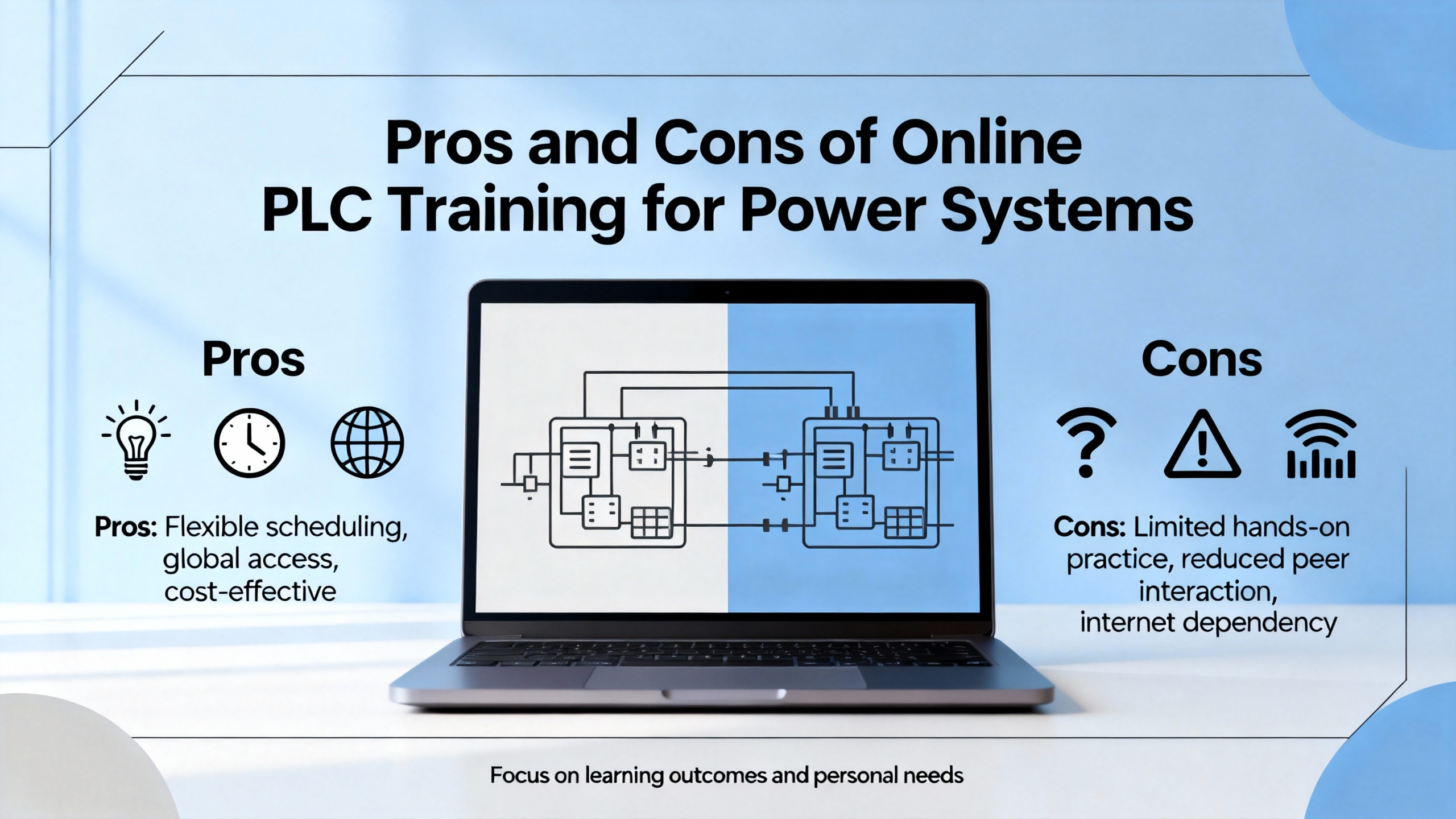
Pros And Cons Of Online Schneider PLC Training For Power Systems
From a power-system perspective, online Schneider PLC training has clear strengths but also some limitations that need to be addressed deliberately.
On the positive side, online training delivers flexibility. Technicians can learn from a tablet in a control room during quiet periods or from home without the overhead of travel. The digital library overviews make it clear that modern platforms support multiple devices and offline reading, and the online course providers emphasize short, focused modules. That flexibility matters in facilities where taking a full week off for training is unrealistic.
Online resources are also inherently repeatable. Lessons on configuring a Modicon communication channel or setting up a timer can be replayed as many times as needed, which is particularly useful for complex topics such as structured text or advanced diagnostics. Many platforms mentioned in the research, from RealPars to SolisPLC, highlight learners’ ability to revisit specific topics whenever needed, turning courses into ongoing references rather than one-time events.
Another advantage is the diversity of perspectives. Vendor-specific training such as Schneider Electric University ensures alignment with product roadmaps and best practices, while independent providers like PLC Dojo, PLC Academy, RealPars, and SolisPLC offer different teaching styles and emphasize resourcefulness and real-world troubleshooting. Combining these perspectives tends to produce engineers and technicians who are comfortable both within Schneider’s ecosystem and when interfacing Schneider PLCs with other platforms.
On the downside, online training alone cannot fully replace hands-on time with real power equipment. Simulations and virtual labs, which Schneider software and some third-party programs provide, are extremely valuable, but they cannot capture the tactile aspects of wiring verification, signal tracing in a switchgear lineup, or the dynamics of a real generator transfer. Another limitation is that online formats demand self-discipline. Facilities that do not carve out protected time for study often find that even excellent courses go unfinished.
A final consideration is alignment with your installed base. Not every “Schneider PLC” course will focus on the exact controller families or software versions you use. Careful mapping between course content and your equipment, along with internal mentoring, helps prevent frustration and ensures that time spent in front of a screen translates into better performance on the plant floor.
Practical Steps To Turn Training Into Reliability Gains
To translate the flexibility of online Schneider PLC training into tangible reliability improvements, it helps to treat training as part of your power system strategy rather than an isolated HR activity.
One effective approach is to tie specific training modules to concrete reliability objectives. For example, if your facility has experienced nuisance generator starts during minor voltage dips, assign modules on analog signal scaling, diagnostic logging, and timer instructions, then have trainees apply what they have learned to review and adjust the relevant logic. Use the error logging and online debugging features described in Schneider’s software documentation to confirm that the new settings perform as intended during staged tests.
Another practical step is to encourage trainees to implement exercises from digital libraries and online courses directly in a controlled Schneider environment, such as a test PLC or a software simulator. Exercises on multi-motor control can be adapted to represent redundant pump sets or fan arrays. Timer-based examples like traffic lights or interval timers can be reimagined as load-transfer delays or staggered motor starts. The goal is to build a library of internal example projects that both reinforce learning and serve as templates for future work.
It is also important to align online training with internal standards. As engineers complete courses on EcoStruxure Machine Expert or Control Expert, capture best practices for naming conventions, alarm design, and HMI layout. Over time, this creates a shared language across your reliability team, which is essential when multiple people must understand and maintain complex Schneider-based power control schemes.
Lastly, consider leveraging the career and pay data highlighted in the PLCProgramming.io comparison and the SolisPLC guide when making the case for investment. Demonstrating that structured PLC training correlates with higher completion rates, stronger career outcomes, and recognized industry credentials can help justify both course fees and dedicated study time, especially in organizations where power reliability is mission-critical.
Brief FAQ
Where should a power technician new to Schneider PLCs start?
For someone with basic electrical knowledge but little PLC experience, a good starting point is a combination of a digital library textbook on PLC and motor control, plus a beginner-focused Schneider PLC course that covers software installation, ladder logic, and simple examples with switches, motors, and timers. The Automation Community beginner course or the Udemy tutorial for Schneider PLCs with ladder and SFC are typical examples described in the research notes.
Do I need physical Schneider hardware to benefit from online training?
Physical hardware is valuable but not strictly required at the start. Schneider PLC software environments such as EcoStruxure Machine Expert and Control Expert, along with built-in simulation and emulation features highlighted in the Schneider software overview, let learners test and debug programs virtually. Over time, however, pairing online training with at least one physical Modicon controller or a small training kit will significantly improve confidence for field work.
How does online Schneider PLC training help with safety and compliance?
Structured PLC training, as described in the SolisPLC guide and Schneider Electric University materials, reinforces correct use of safety logic, proper configuration of I/O and communication, and best practices for alarm management and diagnostics. While formal functional safety certification may require additional specialized courses, online Schneider PLC training is an essential foundation for designing and maintaining safety-related power controls that behave predictably and support compliance with modern safety standards.
Online Schneider Electric PLC training, grounded in solid digital resources, vendor tools, and practical multi-vendor programs, is no longer optional for teams tasked with keeping industrial and commercial power systems stable. Approached strategically, it becomes one of the most cost-effective levers a power system specialist can pull to strengthen reliability, reduce downtime, and prepare the next generation of engineers and technicians to handle the increasingly digital backbone of critical power.
References
- https://www.academia.edu/90326865/Training_Kit_and_Module_on_Plc_Programming_Competence_for_Students_of_Electrical_Engineering_Education
- https://digitalcommons.calpoly.edu/cgi/viewcontent.cgi?article=1734&context=eesp
- https://ddg.wcroc.umn.edu/schneider-electric-plc-software/
- https://www.perrytech.edu/alumni/jobs/job_detail.html?id=21050
- https://jatran.jacksonms.gov/Resources/ihYVfW/278053/CollectionOfExercisesForPlcProgramming.pdf
- https://web.ncti.edu/fulldisplay/bK1785/3531066/Mitsubishi%20Plc%20Programming%20Training.pdf
- https://prodigy.ucmerced.edu/scholarship/LgTVZR/0OK010/mitsubishi_plc__programming-training.pdf
- https://admisiones.unicah.edu/Resources/6oUjCF/3OK056/plc-and_motor_control__training.pdf
- https://upcommons.upc.edu/bitstream/handle/2117/392108/Report.pdf?sequence=2
- https://do-server1.sfs.uwm.edu/list/R6487647V2/edu/R55009V/build-your-plc_lab-manual.pdf


 Videos
 News
News Applications




Leave Your Comment