When you spend your days keeping industrial and commercial power systems running, the control layer quickly proves itself either as your best ally or your biggest risk. Schneider Electric PLCs and EcoStruxure-based architectures are common in switchrooms, process lines, and building plants, but there are plenty of situations where you need an equivalent solution from another vendor. Obsolescence, corporate standards, supply-chain constraints, or SCADA platform changes all force the question: what is truly “equivalent” to a Schneider PLC, and how do you integrate it without compromising reliability?
From a power system specialist’s perspective, this is not an abstract choice. Every extended outage, every stuck breaker, every battery room that drifts out of spec translates into real cost. As a DigiKey engineering forum discussion points out, downtime in PLC-controlled processes can easily run from hundreds to thousands of dollars per minute once you count idle labor, scrap, and lost goodwill. When that PLC is coordinating power distribution or feeding data to your protection schemes, the stakes climb even higher.
This article pulls together grounded guidance from control-system vendors, system integrators, and automation practitioners to map out how Schneider Electric PLC equivalents fit into the broader control landscape, what “compatibility” really means, and how to migrate in a way that protects uptime and safety.
Schneider Electric PLCs in the Control Ecosystem
Multiple independent sources consistently place Schneider Electric among the global leaders in industrial control and automation. A ranking of top industrial control system companies from R.L. Consulting lists Schneider alongside Siemens, ABB, Rockwell Automation, Honeywell, Emerson, Mitsubishi, Omron, and Yokogawa as part of the core global control ecosystem. A separate review of the most popular PLC brands from an OEM integrator emphasizes Schneider’s broad PLC portfolio, spanning small automated machines through advanced automation systems, and notes that these products are widely available through major U.S. distributors.
On the building side, a building automation vendor comparison from D-Tools describes Schneider Electric as a provider of open innovation platforms for buildings, with strong emphasis on IoT connectivity, sustainability, and efficient resource use across building automation, home automation, industrial safety, and electric power distribution. Another review of automation companies in eWEEK highlights Schneider’s range that includes telemetry and remote SCADA systems, PLC and PAC controllers, motor starters, motion control, robotics, and HMIs, anchored by the EcoStruxure family for edge control, analytics, and services.
A Vista Projects engineering brief on “best PLC brands” positions Schneider Electric PLCs as tightly integrated into EcoStruxure, focusing on IoT connectivity, wide protocol compatibility, and sustainability, particularly attractive to organizations pursuing energy-efficiency and data-rich operations. Taken together, these sources paint Schneider PLCs as part of a larger digital platform rather than as isolated controllers. That is exactly why replacing or supplementing them demands careful attention to compatibility beyond simple I/O counts.
What “Equivalent” Really Means for Schneider PLC Replacements
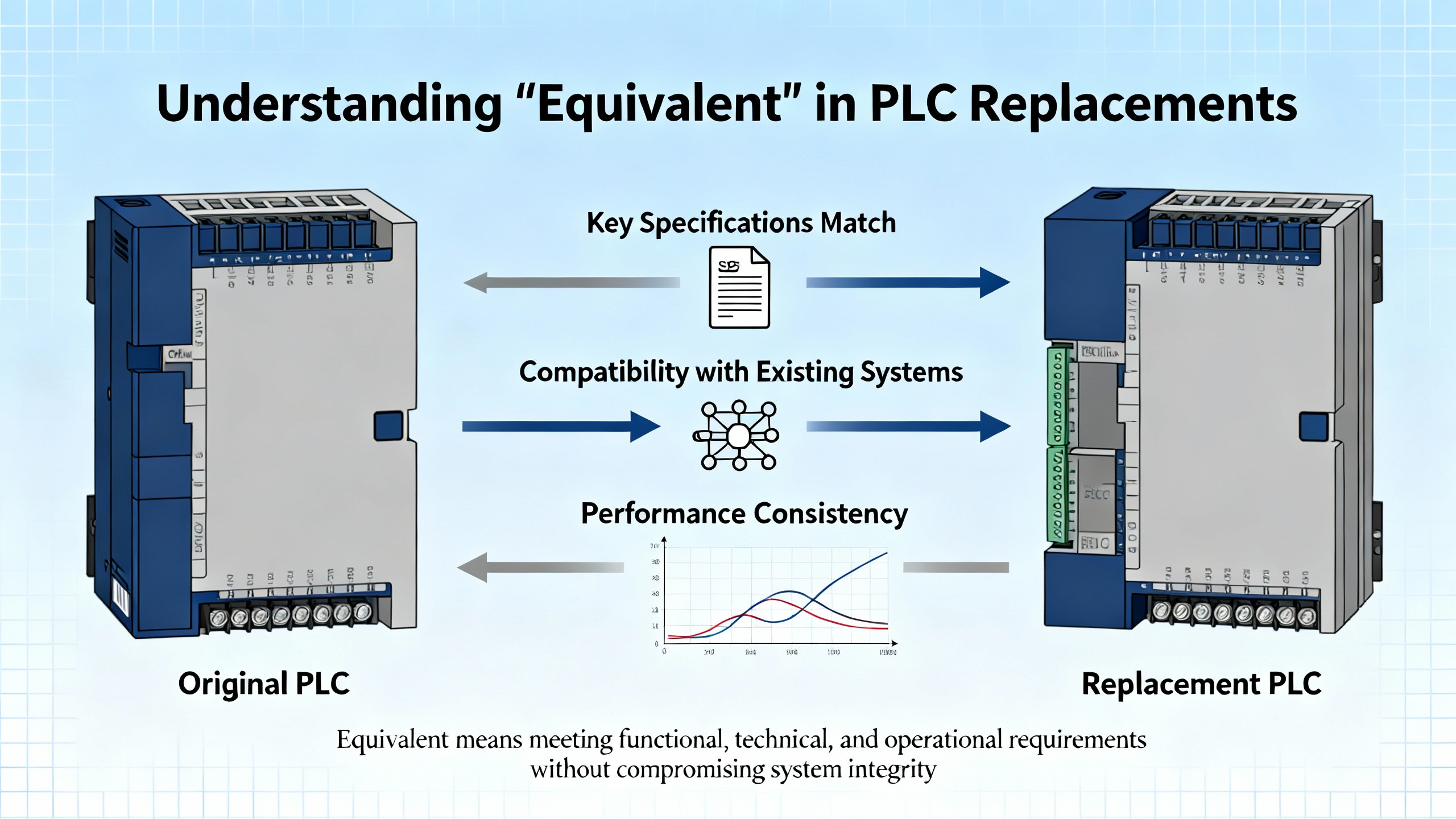
When teams ask for a “Schneider equivalent,” they often mean “something with similar I/O that I can buy quickly.” In practice, equivalence spans several dimensions that all matter to reliability and lifecycle cost.
A Maple Systems guide on choosing a new PLC stresses that the right controller must align with hardware capability, software tools, power and performance characteristics, and system compatibility. DigiKey’s discussion of “soft requirements” adds workforce skills, long-term support, expansion capacity, and obsolescence risk to the equation. Vista Projects urges a focus on total cost of ownership, not just purchase price. Andrews Cooper’s controls selection guide reinforces that real-time performance, reliability expectations, support paths, scalability, and online versus offline editing all shape the true suitability of a platform.
For Schneider replacements, those ideas distill into a few concrete dimensions.
| Dimension | Role in Schneider‑equivalent projects | Typical comparison focus |
| Hardware and I/O | Replace field wiring and signals without surprises | Voltage levels, analog ranges, I/O density, modular vs compact |
| Power and performance | Match or exceed existing control responsiveness | CPU speed, memory, scan time, real‑time needs |
| Communications | Integrate with existing SCADA, HMI, and EcoStruxure or other platforms | Protocols such as Modbus TCP, Ethernet/IP, Profinet, OPC UA support |
| Software and skills | Keep development and troubleshooting manageable | Languages, tools, online editing, training ecosystem |
| Lifecycle and TCO | Maintain reliability and manage change over decades | Vendor support horizon, parts availability, expansion options |
Thinking in these terms helps prevent the classic trap of treating PLCs as interchangeable black boxes. Especially where power and protection equipment are involved, small mismatches in these areas can create large operational risks.
Hardware and I/O Compatibility
Schneider Electric PLC installations typically terminate dozens or hundreds of “real world” signals. Any equivalent platform has to honor that electrical reality.
The Quora-based PLC explanation and Maple Systems guide both emphasize that industrial PLC inputs and outputs are designed to support specific voltage and current levels with galvanic isolation. Digital inputs commonly handle 24 VDC sourcing or sinking and sometimes 110 VAC. Analog inputs are often 0–10 VDC, 4–20 mA, or sensor-specific types such as thermocouples and RTDs. Outputs may be 24 VDC transistor, relay contacts, or 110/230 VAC triacs. A mismatch between existing field devices and new PLC I/O cards can cause unreliable operation, nuisance trips, or outright equipment damage, which the Maple Systems guide calls out as a significant reliability and safety concern.
That same guide differentiates compact PLCs, where CPU and I/O live in a single housing with limited expansion, from modular PLCs mounted on a backplane with separate CPU, power, and I/O modules. High-end platforms may also support remote I/O racks connected by data cables, which is critical in large or spread-out processes. Schneider’s own range, as described by OEM integrators, spans both compact and modular architectures, so an equivalent solution must match not only I/O count but also physical layout and future expansion needs.
From a reliability advisor’s point of view, the safest path is to start with a detailed I/O survey of the Schneider system you intend to replace. Document voltage levels, analog ranges, special sensor types, and any high-speed or interrupt-driven inputs. The Quora article notes that some PLCs have dedicated high-speed counters, pulse outputs, and fast inputs that bypass the normal scan cycle. If your Schneider implementation relies on these for pulse metering or fast protection logic, you must choose an equivalent that offers similar hardware capabilities, not just the same number of channels.
Power, Performance, and Real-Time Behavior
At one time, PLCs were divided cleanly between discrete logic control and analog-heavy process control handled by DCS platforms. An article from Applied Control Engineering describes how that gap has largely closed. Modern PLCs support extensive analog I/O and advanced functions such as PID, feedforward, and dead-time compensation, while DCS platforms have improved their discrete capabilities. The remaining differences are more about platform integration, supplied libraries, and scalability than raw ability.
That evolution matters when you search for Schneider equivalents. If a Schneider controller is running critical process loops, the replacement must meet or exceed its real-time requirements. The Quora PLC description explains how scanned logic imposes a minimum scan time that grows with program complexity. If the scan time becomes too long relative to how fast inputs change, deterministic control can fail. For example, a slow scan that misses a fast status change on a breaker auxiliary contact can undermine interlock logic in a power system.
Maple Systems highlights CPU speed, memory size, and scan time as key selection factors, particularly for high-speed or real-time applications. Andrews Cooper’s discussion of real-time processing warns that when control logic runs on top of general-purpose operating systems, competing tasks and OS overhead can introduce unpredictable delays that are unacceptable for tight control loops. For Schneider-equivalent PLC projects, that argues strongly for staying with industrial-grade controllers rather than migrating core protection or fast logic to consumer PCs or non-real-time platforms.

Communications, Protocols, and SCADA/BMS Integration
Schneider Electric emphasizes EcoStruxure and open, IoT-friendly architectures. Vista Projects describes Schneider PLCs as tightly integrated with EcoStruxure, highlighting wide protocol compatibility. D-Tools characterizes Schneider’s building automation platforms as “open innovation” environments designed for rapid connection of devices and systems. eWEEK notes Schneider’s offerings in telemetry and remote SCADA.
If your SCADA, building management system, or historian relies on Schneider’s ecosystem, a “compatible” controller from another vendor has to speak the right languages on the wire. The Applied Control Engineering article notes that many modern PLCs now support Ethernet-based protocols such as Ethernet/IP, Modbus TCP, and Profinet either natively or via expansion cards. An Ignition SCADA forum thread underscores the value of OPC UA and tag-browseable Ethernet/IP in minimizing manual tag work and ensuring smooth SCADA integration. In that thread, an integrator praises a low-cost PLC family but laments the lack of built-in OPC UA, which forces tags to be added one by one over Modbus TCP.
For Schneider equivalents, it is not enough to confirm “Ethernet support.” You should verify which protocols are supported, whether they enable tag browsing, and how they will integrate with your existing or future SCADA platform, whether EcoStruxure-based or something else. In power and energy applications, where you might be aggregating data from multiple controllers into centralized reliability dashboards, this protocol alignment directly affects engineering effort and long-term maintainability.

Software, Skills, and Lifecycle Support
The “Beyond Specs” piece from DigiKey emphasizes that PLC selection must also account for the people who will live with the system for decades. Over the life of a control system, system integrators, maintenance technicians, commissioning engineers, and upgrade teams will all touch the PLC. The article notes that standardized platforms across a plant simplify training, spare parts, and software management, while inconsistent platforms increase downtime risk and ownership cost.
Programming approach is another soft factor. Maple Systems lists ladder diagram, instruction list, function block diagram, structured text, and sequential function charts as common IEC 61131-3 languages. The choice should align with the team’s background, whether more electrical or software oriented. Several sources point out that user-friendly programming environments with good diagnostics, cross-referencing, and simulation reduce commissioning and troubleshooting time.
Andrews Cooper adds that platform support and obsolescence paths are critical. During the end-of-support period for Windows 7, they observed customers struggling with PCs running control software that could no longer be patched or upgraded without costly rewrites. By contrast, industrial controller vendors often provide extended support and defined migration paths. DigiKey’s example of Rockwell Automation’s SLC 500 line, introduced over thirty years ago and supported long after its discontinuation through repair and secondary markets, is a reminder that popularity and installed base can effectively extend a platform’s life.
When you consider Schneider equivalents, these soft factors often outweigh small differences in hardware specifications. A Siemens or Rockwell platform might cost more up front, but strong training resources, documentation, and long-term visibility can reduce lifecycle risk compared to a less established vendor.
Major PLC Brands Comparable to Schneider Electric
Several independent sources review PLC vendors and automation companies, and Schneider Electric appears consistently alongside a familiar set of competitors. That provides a pragmatic starting point when you are looking for equivalent control platforms.
A Vista Projects brief on PLC brands highlights Siemens, Rockwell Automation (Allen-Bradley), Mitsubishi Electric, Schneider Electric, and Omron as leading options. A PEKO Precision review of the “most popular PLC brands” covers similar ground, while the R.L. Consulting list of top industrial control system companies adds ABB, Honeywell, Emerson, General Electric, and Yokogawa. An eWEEK feature on automation companies further elaborates on these vendors’ portfolios.
Siemens controllers, especially the SIMATIC family mentioned by both PEKO and eWEEK, are associated with quality, reliability, and strong integration of operational technology with information technology. Vista Projects notes that Siemens offers a comprehensive range from simple to complex applications and extensive global support, which suits large and geographically diverse operations. The trade-off, as PEKO observes, is that Siemens controllers often sit at the higher end of the price range.
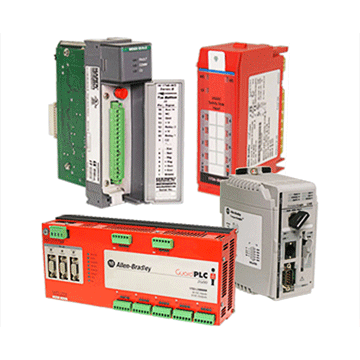
Rockwell Automation’s Allen-Bradley PLCs are described by PEKO as covering large, small, and micro applications with pre-engineered solution packages and online configuration tools. They rank in the top five globally by PLC market share and offer extensive support, but they are also characterized as relatively expensive. Vista Projects notes their dominance in North America, user-friendly programming tools, and a broad partner ecosystem.
Mitsubishi Electric’s MELSEC PLC line appears in both PEKO and eWEEK coverage, with variants for high-speed, safety, and compact applications. They are described as easy to source with a solid reputation, and Vista Projects highlights their affordability, performance, and compact size, particularly well-suited where panel space is tight and budgets are sensitive.
Omron is portrayed by PEKO as providing durable and accurate PLCs across multiple series, supported by software that simplifies application development. Vista Projects adds that Omron emphasizes safety, quality, intuitive interfaces, and advanced sensing, investing heavily in research and development. That combination makes Omron attractive in safety-critical and precision applications.
ABB’s AC500 PLC series, as discussed by PEKO, offers scalable, flexible solutions under the umbrella of a major industrial automation brand. Honeywell markets ControlEdge and MasterLogic PLCs that focus on cybersecurity, modular I/O, and multiple communication interfaces. Both vendors also appear on general industrial control and building automation leader lists, alongside Schneider.
Emerson and Yokogawa, highlighted in industrial control company rankings and in automation vendor overviews, sit closer to the distributed control system and hybrid control space, providing control systems, instrumentation, and asset management tools for process industries, power generation, and energy management. Emerson’s own guidance on asset optimization stresses that selecting the right control system architecture is foundational for integrating device diagnostics, asset health dashboards, and predictive maintenance.
In practice, any of these vendors can provide Schneider-equivalent PLC capability for many applications. The better question is which ecosystem best fits your plant’s installed base, workforce skills, and future direction.
When Non‑PLC Alternatives Make Sense
Not every Schneider PLC application calls for a like-for-like PLC replacement. A DPS Telecom article on alternatives to PLCs describes how some sites are turning to remote telemetry units (RTUs) or programmable logic relays (PLRs) when looking for control functionality at lower cost or with different integration characteristics.
That article defines PLCs as rugged, small digital computers with many inputs and outputs, built to withstand wide temperature ranges, electrical noise, and vibration. They gather data from sensors, perform logical processing, and drive outputs, replacing older relay-based automation. Because of their high initial installation cost, the article notes, PLCs tend to be used where automation requirements are complex and subject to change, and where the resulting productivity gains justify the investment.
PLRs are discussed as a lower-cost option for lighter-duty applications, with fewer I/O points and less scalability. More interesting for power and remote sites are RTUs: small PLC-like devices equipped with many discrete and analog inputs, capable of monitoring processes and controlling relays. DPS Telecom cites its NetGuardian RTUs as examples used for network, communications, and transport processes, providing alarms, email or cell phone notifications, and even voice alerts, often using SNMP and simple ASCII integration rather than proprietary protocols.
The same article compares RTUs and PLCs by pointing out that RTUs are generally more rugged and have higher monitoring and control capacity per site, making them stronger at locations where many items must be monitored and controlled in one place, such as server rooms and IT environments. PLCs, conversely, are described as better suited when there are many locations each with only a few monitor or control points, where customization for each process is valuable.
For Schneider PLC users, that suggests a pattern. Where a Schneider PLC is acting purely as a telemetry concentrator or alarm system for remote power or communications rooms, a high-quality RTU might be an acceptable and even superior equivalent. Where it is running complex interlocks, process loops, or machine control, a full PLC replacement from another major vendor is more appropriate.
Open and Low‑Cost Platforms: Arduino, Maker‑Style, and PC‑Based Control
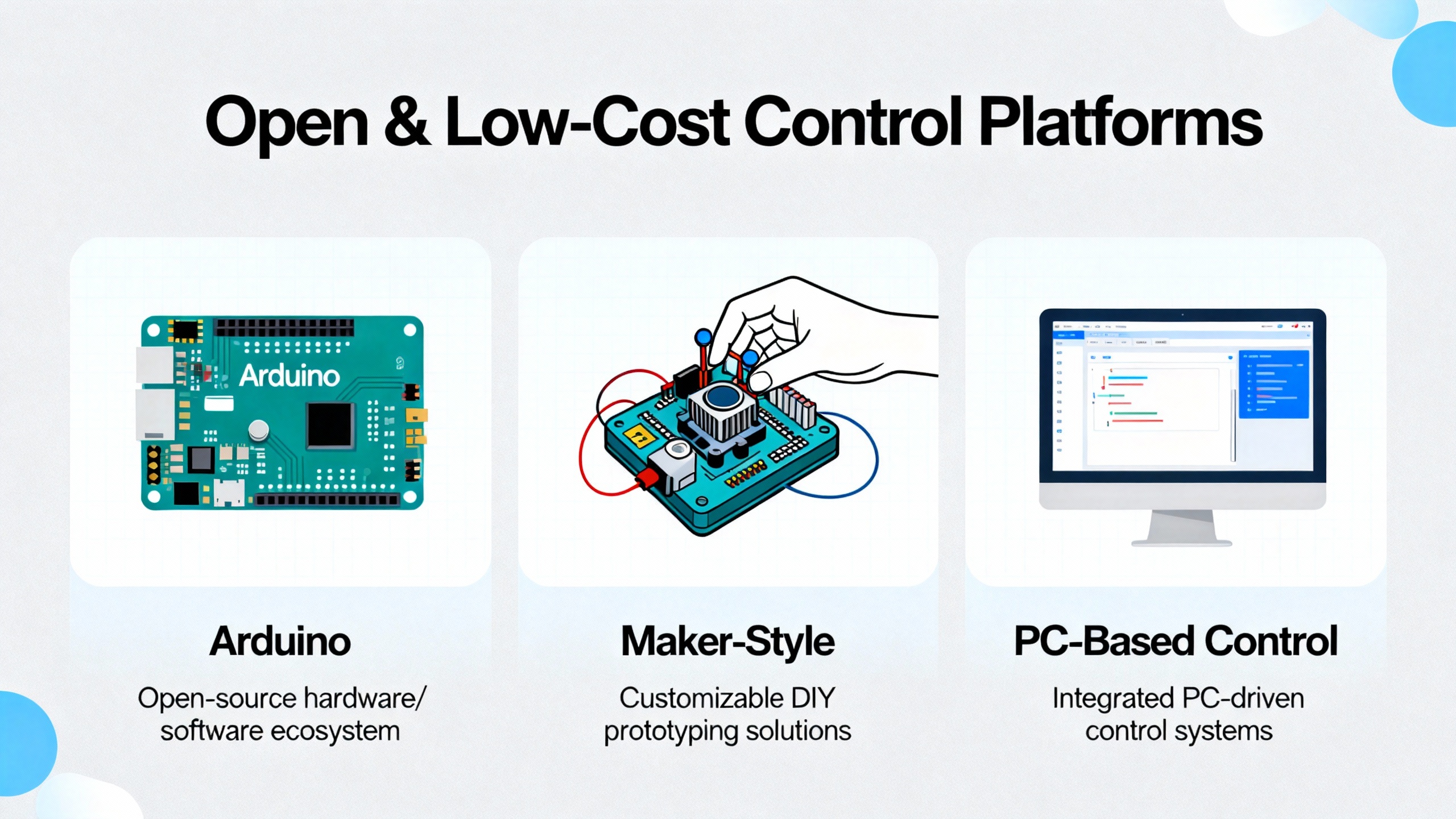
Cost pressure sometimes drives teams to consider alternatives far outside the traditional PLC ecosystem. A Dojo Five article on replacing PLCs with Arduino OPTA describes an Arduino-based, open-source, industrial-grade control platform positioned as a flexible and cost-effective alternative to traditional PLCs. Arduino OPTA is built on the familiar Arduino programming environment, lowering the learning curve and enabling rapid prototyping, with modular hardware that can scale and adapt to changing production needs. The article emphasizes its significantly lower cost compared to traditional PLCs, especially attractive to small and medium-sized businesses.
But the same source stresses critical caveats. Before replacing PLCs, organizations must thoroughly test Arduino OPTA against their reliability and robustness requirements, particularly in demanding industrial environments. Integration with existing systems using proprietary communication protocols may require additional engineering effort. Longevity and lifecycle management must be evaluated, including support and update paths, to avoid future compatibility or obsolescence issues. The recommended approach is to carefully assess automation requirements, test the platform in situ, and plan a staged transition.
Andrews Cooper’s controls selection guide echoes similar concerns for general-purpose PC-based controllers. While they can be attractive in prototyping or short-life applications, reliance on consumer operating systems and hardware accelerates obsolescence and exposes systems to support gaps, as seen during the sunset of Windows 7. Industrial controllers, whether from Schneider or its peers, often provide longer support horizons and clearer migration paths.
In short, open or maker-style platforms may be part of a Schneider PLC equivalence strategy for non-critical, low-risk, or short-lived applications. For critical power and protection functions, they should be treated with caution and subjected to rigorous qualification.
Migration Strategies: Moving Away from Schneider PLCs Safely
Choosing a Schneider-equivalent controller is only half the challenge. Executing the migration without jeopardizing uptime requires as much planning as the initial platform selection.
Panelmatic’s overview of PLC upgrades explains why modernization becomes necessary: hardware obsolescence, unsupported software, rising downtime, and evolving safety requirements. They describe two main paths. A PLC migration replaces CPU and software while leaving I/O wiring and field devices intact, reducing cost and downtime but constraining long-term scalability. Full PLC replacement swaps the entire control system, enabling state-of-the-art processing, communications, and integration at the expense of higher capital and more extensive commissioning.
Hallam-ICS, in a series on replacing obsolete control systems, recommends upgrading the SCADA or HMI front end first so operators retain a stable and familiar interface. Then, convert the underlying PLC hardware in small steps behind the scenes. They advise breaking the plant into well-defined control “chunks” and assigning each new PLC to a small section, so you can convert one area at a time without shutting down the entire operation. During the transition, the SCADA front end can temporarily act as a data bridge between legacy and new PLCs, enabling mixed old–new operation until PLC-to-PLC communication is fully established.
A key design principle from Hallam-ICS is to avoid splitting fast control loops across PLCs. Sending a sensor input to one PLC and the corresponding actuator output to another over the network introduces latency that may be unacceptable, especially for tight PID loops. They point to ANSI/ISA-88 concepts as a useful philosophy: break systems into small, consistent, standardized modules, and apply that mindset even in continuous processes.
Panelmatic adds a practical seven-step roadmap for PLC upgrades, starting with site evaluation, followed by system design, panel work, software development, testing and factory acceptance, installation and commissioning, and finally training and support. In the context of Schneider replacements, that roadmap applies regardless of whether you remain within Schneider’s ecosystem or move to another major vendor.
Toward a Practical Selection and Migration Approach
Bringing all of this together, Schneider Electric PLC equivalence is less about finding a one-for-one model number match and more about tailoring a solution that matches your plant’s technical, operational, and business realities.
For facilities already standardized on a particular competing brand, DigiKey’s advice to maintain platform consistency carries real weight. If your maintenance and engineering teams are fluent in Siemens or Rockwell tools, and your existing SCADA and historians are tuned to those ecosystems, migrating Schneider PLCs into that standard may offer the best long-term reliability, even if the controllers are more expensive than lower-tier brands.
Where budgets are tight but industrial robustness is still required, Mitsubishi and Omron offer plausible equivalents, combining high-performance and compact form factors with space and cost advantages noted by Vista Projects and PEKO. ABB and Honeywell can be strong candidates in process-heavy environments, especially where you already rely on their drives, instrumentation, or DCS platforms. Emerson or Yokogawa may be the right “equivalent” in plants leaning toward hybrid DCS architectures and deeper asset management integration, consistent with Emerson’s own focus on asset-optimizing control systems.
In remote network rooms, data centers, or communications shelters, the DPS Telecom perspective suggests that an RTU can sometimes be a more appropriate equivalent to a Schneider PLC than another PLC family, particularly where the main need is high-density monitoring, robust alarm delivery, and integration with IT monitoring systems.
For small, low-risk skids or temporary equipment, open platforms like Arduino OPTA, when engineered and tested properly, may provide enough capability at a lower cost. Dojo Five’s guidance to stage transitions and validate reliability should be followed carefully, especially when any amount of downtime is painful.
Above all, Schneider-equivalent decisions should be framed in terms of total cost of ownership, not initial purchase price. Vista Projects, DigiKey, and multiple integrator sources converge on this point. Lost production, emergency outages, and rushed migrations can dwarf the price difference between PLC platforms. The right equivalent is the one that maintains or improves reliability, keeps your workforce effective, integrates cleanly with your data and SCADA environment, and leaves a clean migration path for the next decade.
FAQ: Schneider PLC Equivalents and Compatibility
Can I simply swap a Schneider PLC for another brand without touching field wiring?
Sometimes, but you should not assume it. As Maple Systems explains, PLCs differ in I/O voltage levels, analog ranges, and wiring conventions. Even if the replacement PLC has the same number of channels, misaligned voltages or sensor types can create reliability or safety issues. A thorough I/O survey and, where necessary, use of interposing relays or signal conditioners is essential.
How important is matching communication protocols when replacing Schneider PLCs?
It is critical. Schneider’s EcoStruxure and building automation platforms rely on particular protocols and data models. Applied Control Engineering and the Ignition SCADA forum show how the lack of OPC UA or tag-browseable Ethernet/IP can dramatically increase integration effort. When you move away from Schneider hardware, verify that the new platform supports the same or compatible protocols used by your SCADA, historian, and peer controllers.
When is an RTU a better equivalent than another PLC?
According to the DPS Telecom comparison, RTUs shine at sites where you need dense monitoring and basic control of many points, especially in network, communications, and IT environments. They often offer rugged construction, SNMP and ASCII integration, and direct email or voice alerts, reducing the need for on-site specialists. If a Schneider PLC is currently serving mainly as an alarm and telemetry concentrator rather than a complex logic engine, an industrial RTU may be a more cost-effective and operationally appropriate equivalent.
In power-critical environments, control systems are part of your protection strategy, not just an automation convenience. Whether you stay within the Schneider Electric family or move to a different ecosystem, treat PLC equivalence as a reliability and lifecycle decision. When you do, you are far more likely to end up with a control layer that supports, rather than undermines, the resilience of your power supply systems.
References
- https://www.plctalk.net/forums/threads/exploring-alternative-plc-hardware-seeking-recommendations-and-insights.139706/
- https://www.ace-net.com/blog/how-to-select-the-perfect-plc-for-your-process-application-key-factors-to-consider?hsLang=en
- https://controlbyweb.com/plc/?srsltid=AfmBOooj-LOyaNLAv5ftKmF6wkvoTVhT1IjLL7jHgx9f4X7krfd9i7Pq
- https://www.hallam-ics.com/blog/replacing-your-obsolete-control-system.-step-2-upgrade-the-plc-hardware
- https://ipvm.com/discussions/trying-to-decide-which-high-end-automation-system-we-should-use-crestron-or-control4
- https://maplesystems.com/10-things-to-consider-when-choosing-new-plc/?srsltid=AfmBOooyEqRfrXxfpTyZCio_aCqAatY1tfLSk9_urlYba0fhXikiZBlE
- https://community.oxmaint.com/discussion-forum/best-plc-hardware-alternatives-insights-and-recommendations-wanted
- https://www.vistaprojects.com/best-plc-brands-for-industrial-automation/
- https://www.andrews-cooper.com/tech-talks/guide-to-selecting-an-automation-controls-system/
- https://www.d-tools.com/resource-center/industry-insights/best-building-automation-system-vendors


 Videos
 News
News Applications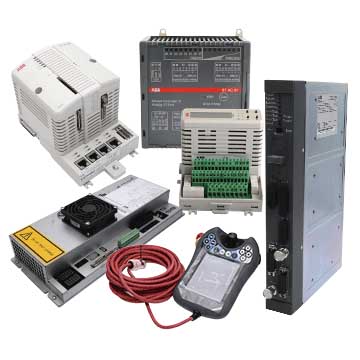





Leave Your Comment