Rockwell Automation sits at the center of many North American plants. Allen‑Bradley PLCs and FactoryTalk, PlantPAx, and Logix controllers are often the default choice for control panels, MCC rooms, and power-control skids. As a power system specialist who spends most of the week around UPS rooms, inverters, and switchgear, I see Rockwell gear driving transfer schemes, load shedding, and breaker coordination every day.
Yet more and more facilities are asking a simple question: if Rockwell is not the best fit for my next project, who can I trust instead?
This is not just a procurement exercise. When you are feeding critical loads through UPS systems and inverters, and you depend on automated transfer, ride‑through, and orderly shutdown, your industrial controls are part of the power‑protection system. Choosing alternative suppliers to Rockwell means rethinking reliability, lifecycle support, integration with MES and quality systems, and the long‑term skills base for your operators.
The good news is that you have a deep bench of credible alternatives. Market overviews from sources such as RL Consulting, Plant Automation Technology, eWeek, PLC Department, Mordor Intelligence, and Standard Bots consistently highlight a group of industrial control suppliers that compete head‑to‑head with Rockwell at global scale. On top of that, specialist vendors offer alternative architectures such as RTU‑centric designs, and MES or AI‑driven quality tools that complement or replace Rockwell’s software stack.
The rest of this article walks through how to think about alternatives in a power‑critical environment, and which suppliers are worth a serious look.
Why Look Beyond Rockwell Automation?
Based on what I see in substations, MCC rooms, and data‑center electrical galleries, there are a few recurring reasons teams look for alternatives to Rockwell.
First, there is risk diversification. If every UPS, static transfer switch, and generator control panel in your fleet depends on a single vendor’s PLC platform and software licensing, a supply chain disruption or licensing change hits the entire operation at once. Many organizations now deliberately standardize on at least two control families to avoid that single‑vendor risk.
Second, there is technology and integration fit. Rockwell remains a very strong factory‑automation player, particularly in North America, and sources like eWeek and Standard Bots describe how it integrates PLCs, motion, and analytics across discrete and process industries. But for some projects, especially large process plants or multi‑site digital transformations, other suppliers offer tighter integration between control systems, digital twins, and enterprise IT. Siemens’ Xcelerator platform, ABB’s OmniCore and Ability suite, Schneider Electric’s EcoStruxure architecture, and Emerson’s DeltaV and Plantweb ecosystem are good examples documented in recent market analyses.
Third, there is the global footprint and ecosystem question. RL Consulting’s and Plant Automation Technology’s lists of top industrial control system vendors underline that Siemens, ABB, Schneider, Mitsubishi Electric, Omron, Yokogawa, Honeywell, Emerson, General Electric, and others all have long track records across industries and regions. If your growth plans involve plants outside North America, you may find service, training, or spare parts more easily from one of these vendors.
Finally, there is the power‑system reliability angle. When you design UPS and inverter systems around complex automation sequences, you are trusting the control platform with safe transfer, battery management, and orderly shed of nonessential loads. The level of redundancy, diagnostics, protocol support, and cybersecurity you can get from alternative DCS, PLC, RTU, or MES vendors may materially improve your power‑quality outcomes.
What Rockwell Does Well Today
It is important to be fair to Rockwell Automation before you talk about alternatives. Multiple sources, including eWeek and Standard Bots, describe Rockwell as a leading factory automation supplier with:
Allen‑Bradley PLCs and PACs that scale from micro controllers to high‑end ControlLogix systems, along with CompactLogix for midrange applications. The broader Rockwell portfolio integrating motion control, power systems, and software such as PlantPAx distributed control systems, HMIs, industrial networks, and manufacturing execution systems. The FactoryTalk platform and Logix controllers tying together control, analytics, cloud, and even AI elements for North American manufacturers that want vertically tailored solutions.
A PLC‑focused overview from PLC Department reinforces Rockwell’s position as a global PLC leader via its Allen‑Bradley brand, while also noting that engineers should weigh complexity, IIoT and cybersecurity requirements, and integration needs rather than choosing purely by brand.
The point is not that Rockwell is weak. The point is that you now have credible choices with different strengths, especially when you view the control layer as a part of a bigger reliability stack that includes UPS systems, inverters, battery strings, and generator controls.

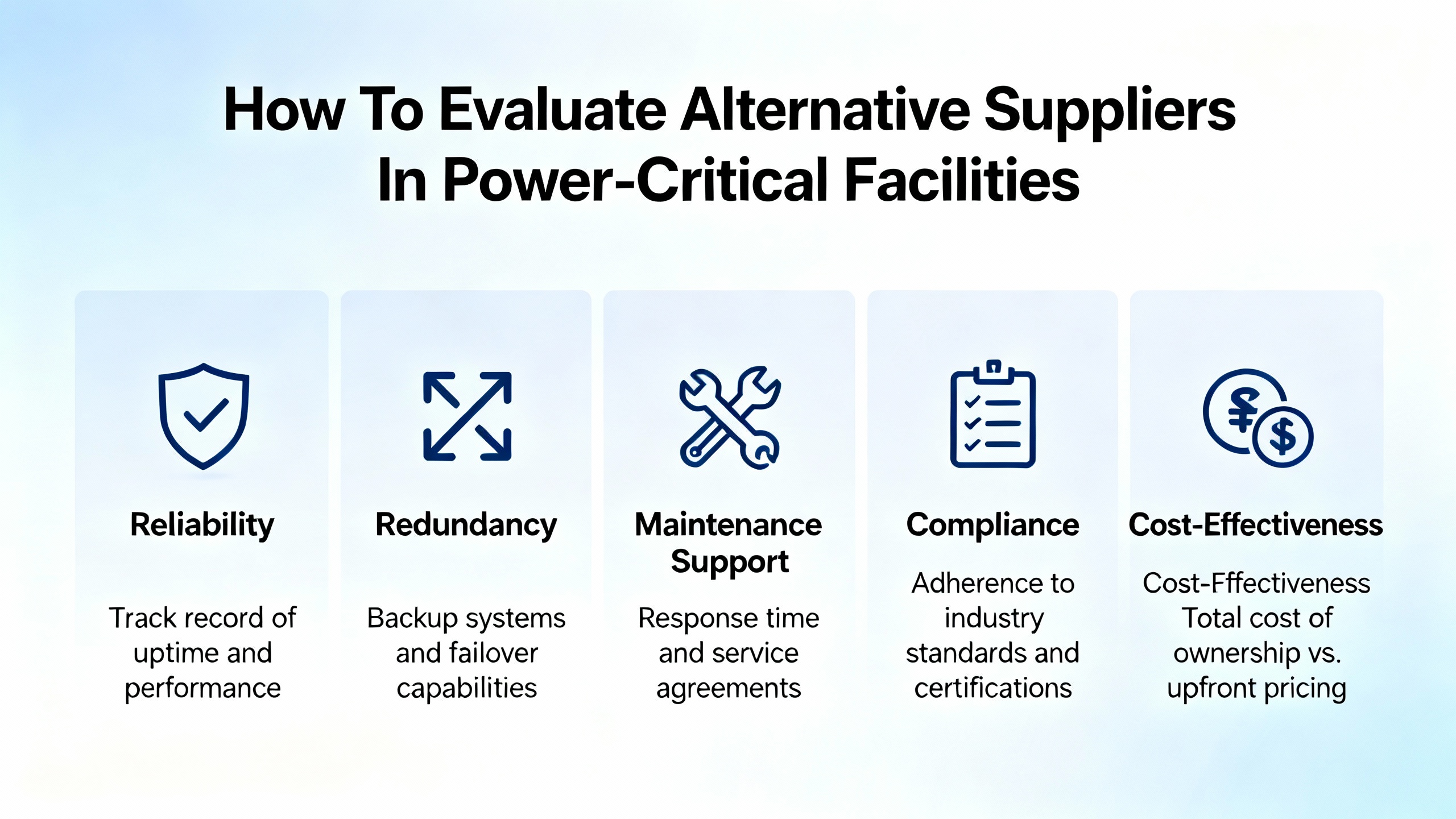
How To Evaluate Alternative Suppliers In Power‑Critical Facilities
When I help teams reevaluate their control vendors around UPS and power‑protection projects, I start with a few practical criteria that show up again and again in independent guidance from eWeek, PLC Department, and others.
One criterion is proven industrial control depth in your sector. RL Consulting’s review of top industrial control system providers highlights vendors such as Siemens, ABB, Schneider Electric, Honeywell, Emerson, Mitsubishi Electric, Omron, GE, and Yokogawa as major players across manufacturing, process industries, and infrastructure. For power‑critical environments, that track record matters more than glossy demos.
Another criterion is how well the platform integrates with your existing power gear and higher‑level systems. You want controllers that can speak the right field protocols to your UPS and inverter systems, breakers, protective relays, and monitoring RTUs, and at the same time integrate cleanly with your MES and quality systems. Articles from eWeek and Standard Bots emphasize end‑to‑end digital integration through platforms such as Siemens Totally Integrated Automation, ABB Ability, Emerson Plantweb, and Schneider EcoStruxure.
A third factor is lifecycle support and service. eWeek’s buyer guidance stresses choosing automation vendors with proven industry experience, a clear range of services and pricing, and a dedicated team for long‑term implementation, maintenance, and support. For a power‑protection project, that translates into questions like: who answers the phone at 2:00 AM when your UPS rides through a storm but your control layer mis‑sequences the restart?
Finally, consider openness to complementary technologies. A 2025 industrial automation article from Averroes AI points out that manufacturers increasingly use AI‑driven visual inspection alongside traditional automation, with defect‑detection rates approaching 99 percent and large reductions in false positives. A LinkedIn piece profiling leading automation companies in 2025 explicitly recommends hybrid stacks where, for example, Siemens or Rockwell controls work alongside AI inspection from Averroes AI. Choosing a control vendor that can interoperate with AI, robotics, and advanced MES platforms future‑proofs your power‑system automation.
Major Global Alternatives To Rockwell Automation
Market surveys from RL Consulting, Plant Automation Technology, eWeek, and Standard Bots repeatedly surface a consistent set of global suppliers that compete directly with Rockwell in control and automation. While each has its own style, most can support the kind of high‑availability automation you need around UPS, inverters, and power‑distribution schemes.
Siemens
Siemens appears in virtually every ranking of top industrial automation providers. RL Consulting describes it as one of the world’s largest industrial control system companies, and eWeek details its SIMATIC automation portfolio, SIMOTION motion control, SINUMERIK CNC, and process control systems such as SIMATIC PCS 7 and PCS neo. Standard Bots adds that Siemens Xcelerator blends software, hardware, and services into a digital twin ecosystem tested across hundreds of Siemens’ own factories.
In practice, Siemens tends to be a strong alternative to Rockwell when you are pursuing full‑scale digital transformation. If you want your control systems, digital twin, and MES to live on one tightly integrated platform, Siemens’ Totally Integrated Automation and Xcelerator can be compelling. For power‑critical plants, I see Siemens often used where owners want deep simulation of process and power behavior before they commission a new UPS or generation scheme.
ABB
ABB combines industrial automation and robotics, and RL Consulting lists it as a major industrial control system supplier. eWeek notes ABB’s divisions in electrification, power grids, robotics, and process automation, with PLCs, drives, controllers, and industrial robots in its portfolio. Standard Bots highlights ABB’s OmniCore control architecture and Ability digital suite, emphasizing cycle‑time reduction and energy savings, and points out a large installed base of robots worldwide.
As a Rockwell alternative, ABB is particularly strong in process industries, utilities, and heavy manufacturing where you want tight integration between drives, motors, and control logic. In power‑supply applications, ABB’s focus on electrification and drives can simplify coordination between UPS output, motor loads, and variable‑frequency drives in energy‑sensitive facilities.
Schneider Electric
Schneider Electric is consistently listed among the top industrial automation and energy‑management companies in sources such as RL Consulting, eWeek, Plant Automation Technology, and PLC Department. RL Consulting describes Schneider’s industrial control portfolio as including PLCs, HMIs, and variable frequency drives. eWeek notes its focus on energy and automation, telemetry and remote SCADA, and the EcoStruxure platform delivering edge control, apps, analytics, and services. The Standard Bots blog emphasizes Schneider’s differentiation through combined energy management and industrial automation, using EcoStruxure to connect automation with real‑time energy monitoring and cost and carbon reduction.
PLC Department’s profile of Schneider’s Modicon line adds useful detail: compact Modicon M221 controllers suit small and medium machines, while the higher‑end Modicon M580 targets large, complex systems with built‑in cybersecurity and redundancy, and integrates into EcoStruxure Plant for real‑time analytics and predictive maintenance.
For facilities where power quality, energy efficiency, and sustainability KPIs matter as much as throughput, Schneider Electric is a natural Rockwell alternative. Its explicit focus on energy management and its EcoStruxure ecosystem aligns closely with projects that include large UPS systems, advanced metering, and centralized power‑quality analytics.
Mitsubishi Electric
Mitsubishi Electric appears as a leading factory automation provider in RL Consulting’s and Plant Automation Technology’s coverage, and both eWeek and Standard Bots highlight its strengths. RL Consulting points to its PLCs, HMIs, and industrial robots, while eWeek expands that into a portfolio spanning industrial computers, HMIs, SCADA software, MELFA industrial and collaborative robots, MELSEC controllers, motion control, CNCs, and data logging analyzers. PLC Department notes that Mitsubishi is the second‑largest PLC manufacturer by industrial automation revenue, and details the MELSEC‑F series for high‑speed manufacturing and MELSEC‑Q for complex process control.
Standard Bots emphasizes Mitsubishi’s MELFA robots and MELSEC PLCs, plus the e‑F@ctory digitalization platform, and notes Japan’s leadership in industrial robot manufacturing, reinforced by Mitsubishi exports.
In my experience, Mitsubishi Electric is a good fit when you want high‑speed control for manufacturing with tight integration between robotics, motion, and PLCs, and you have regional support. In power‑centric projects, you often see Mitsubishi‑based control panels in plants where the broader automation strategy is already aligned to its ecosystem.
Omron
RL Consulting lists Omron as an industrial control supplier whose systems are used in automotive, healthcare, and food‑and‑beverage industries. eWeek describes Omron Industrial Automation as a major PLC and SCADA producer with programmable controllers, servo motors, sensors, switches, robot arms, and machine controllers, often with wireless communications, AI, and big‑data integration. Plant Automation Technology includes Omron in its top automation companies, focusing on sensors, switches, safety components, relays, and control components.
PLC Department’s detailed review of Omron PLCs mentions the CJ1, CS1, and CP1 series, modular or compact designs, built‑in Ethernet, I/O capacities up to thousands of points, and the CX‑One software suite for programming, simulation, and monitoring, along with strong testing, certification, and training programs.
Omron can be an effective Rockwell alternative where you need reliable PLCs with strong sensing and safety portfolios, particularly in packaging, food, and medical environments that also depend on stable UPS‑backed power and high safety standards.
Emerson
Emerson Electric appears across several sources as a process‑automation specialist. RL Consulting identifies it as a supplier of automation and control solutions, including control systems, sensors, and process instrumentation. eWeek describes Emerson Process Management’s focus on industrial automation, process control, and power delivery, along with SCADA, HMIs, DeltaV data historian, configuration software, PLCs, actuators, VFDs, and sensing and protection devices. The Standard Bots blog highlights Emerson’s DeltaV distributed control system and Plantweb digital ecosystem, which connects sensors, controllers, and analytics for real‑time visibility and predictive maintenance in oil and gas, chemicals, power, and water.
If your critical power assets sit inside a process plant, Emerson is one of the most credible alternatives to Rockwell for the control layer. Its DCS‑centric approach fits continuous processes with strict reliability, safety, and regulatory requirements, making it suitable for coordinating generator, UPS, and process shutdown behavior.
Honeywell
Honeywell appears in the RL Consulting ICS list and in coverage from eWeek, Plant Automation Technology, and D‑Tools. RL Consulting notes its industrial control systems and automation solutions, including for aerospace, building automation, and process control. eWeek describes Honeywell’s four major business groups and broad automation portfolio, including building access and biometric systems, HVAC controls, intrusion detection, and safety systems for homes, schools, and industrial sites. The Standard Bots blog focuses on Honeywell International’s Experion Process Knowledge System that integrates process control, real‑time data, analytics, and safety, and notes its wide footprint across aerospace, chemicals, energy, and buildings. D‑Tools points to Honeywell Vector Space Sense within smart building analytics, used to optimize building space utilization.
Honeywell stands out as an alternative when your critical loads are not just process equipment but also building systems: data centers, hospitals, airports, and large campuses where UPS and power systems must be coordinated with HVAC, access control, and fire and life‑safety systems.
Yokogawa
Yokogawa is featured in RL Consulting’s ICS list, Standard Bots’ automation company overview, eWeek’s automation article, and Plant Automation Technology’s rankings. RL Consulting notes its specialization in automation for oil and gas, chemical, and pharmaceutical sectors. Standard Bots emphasizes the CENTUM distributed control system and advanced process analyzers used in oil and gas, petrochemicals, and power generation, describing Yokogawa as a conservative, process‑control‑focused vendor favored by operators who prioritize stability, accuracy, safety, and long lifecycle support. eWeek and Plant Automation Technology echo this process‑control focus, mentioning flow meters, oxygen analyzers, manufacturing execution systems, and automatic control systems.
For plants where the power system is deeply embedded in critical continuous processes, Yokogawa offers a Rockwell alternative with a long heritage in high‑availability DCS and measurement technologies.
General Electric and Others
RL Consulting’s review of industrial control system companies includes General Electric as a provider of ICS and automation solutions for power generation, oil and gas, and transportation. FANUC appears in eWeek and Standard Bots coverage as a robotics and CNC leader with a very large installed base and AI‑enabled predictive maintenance. Both can be part of an alternative stack, particularly where you need deep expertise in power generation equipment or high‑volume robotic manufacturing.
Taken together, these vendors represent a well‑documented, global set of alternatives to Rockwell Automation, each with its own strengths. The right choice depends on your industry, geography, and how tightly you want your control layer to link with energy management, robotics, or process systems.
Snapshot Comparison Of Major Alternatives
The table below summarizes how some of these vendors compare, based on the cited sources.
| Supplier | Notable strengths vs Rockwell (from cited sources) | Typical fit in power‑critical environments |
| Siemens | Broad ICS and automation portfolio, SIMATIC and process control, Totally Integrated Automation and Xcelerator digital twin ecosystem used in hundreds of factories | Large manufacturing or process sites seeking deep integration of controls, digital twins, and MES alongside complex power systems |
| ABB | Drives, control systems, and robotics with OmniCore and Ability digital suite, large installed base of robots, focus on energy and cycle‑time efficiency | Plants with heavy motor loads, drives, and robotics where power and motion control must be tightly coordinated |
| Schneider Electric | PLCs, HMIs, VFDs and the EcoStruxure platform blending energy management with industrial automation, Modicon controllers with built‑in cybersecurity and redundancy | Facilities where power quality, energy efficiency, and sustainability are central design drivers |
| Mitsubishi Electric | PLCs, HMIs, robotics, MELFA robots, MELSEC PLCs, and e‑F@ctory digitalization, significant PLC market share and revenue | High‑speed manufacturing with strong regional support, often in electronics and automotive with coordinated power and automation |
| Omron | PLCs, SCADA, sensors, safety components, and robotics, CX‑One software suite, strong testing and training programs | Packaging, food, medical, and other sectors needing robust sensing, safety, and dependable control of UPS‑backed lines |
| Emerson | DeltaV DCS, Plantweb digital ecosystem, SCADA, instrumentation, actuation, protection devices, focus on process industries including power and water | Process plants where generator, UPS, and process control must behave as one integrated system |
| Honeywell | Experion PKS for process control and safety, plus broad building and industrial automation portfolio and smart building analytics such as Vector Space Sense | Complex, security‑sensitive facilities like refineries, airports, and hospitals with both process and building power dependencies |
| Yokogawa | CENTUM DCS and advanced analyzers, focus on oil and gas, petrochemicals, power generation, and life‑cycle stability | Continuous process plants needing long‑term stable control for both production and critical power |
| General Electric and FANUC | ICS and automation for power generation (GE) and large‑scale robotics and CNC with predictive maintenance (FANUC) | Power and high‑volume manufacturing sites that need vendor expertise in generation or robotics alongside robust power control |
This is not an exhaustive list, but it illustrates that you do not have to sacrifice reliability or capability when you look beyond Rockwell. The main question is how these ecosystems align with your power and automation strategy.
Alternative Architectures: PLCs, RTUs, And Hybrid Designs
Choosing an alternative supplier is not only about brand. It is also about architecture. One of the more useful perspectives comes from DPS Telecom’s discussion of alternatives to PLCs in industrial automation.
DPS Telecom defines the PLC as a rugged digital computer used to automate electromechanical processes such as factory lines, with a classic cycle of monitoring inputs, executing logical processing, and controlling outputs. PLCs were originally introduced to replace hard‑wired relays, cam timers, and drum sequencers, making process changes faster and less labor‑intensive. The same logic applies when you use PLCs to coordinate UPS transfers, generator starts, and load shedding instead of relying on hard‑wired relay logic.
DPS Telecom points out, however, that PLCs are not the only option. Programmable logic relays are PLC‑like devices with fewer I/O points, suitable for light industries with limited automation needs. Remote telemetry units are another alternative. RTUs are small controller devices equipped with many discrete and analog sensors, designed to monitor processes, control relays for basic automation, and offer extensive remote monitoring capabilities. DPS Telecom positions its own NetGuardian RTU series, for example, as more rugged and with higher monitoring and control capacity than many PLCs, especially for remote network, communications, and transport environments.
There are two implications for Rockwell alternatives in power‑critical sites. First, you may not need a full Rockwell or Siemens‑class PLC in every panel. Small UPS rooms, generator day tanks, and remote switchgear buildings sometimes can be handled by RTU‑centric designs with simple automation and strong remote alarming, especially in IT and server‑room environments where DPS Telecom notes RTUs are often a better fit than PLCs. Second, when you do use PLCs or DCS systems from Rockwell competitors, you need to pay attention to protocol choices. DPS Telecom notes that PLCs and PLRs often use proprietary, non‑interoperable protocols that require specialized training, while RTUs using standard outputs such as SNMP and ASCII can integrate more easily into broader monitoring systems.
Many robust designs mix these elements. A Schneider or Siemens PLC might manage fast transfer logic between UPS, bypass, and generator, while RTUs gather environmental and discrete alarms across remote panels and feed them into a network monitoring system. That sort of hybrid architecture reduces the burden on your main control platform and lets you choose best‑of‑breed components for each layer.
PLC Brand Options When Moving Away From Rockwell Controllers
When teams say they want an alternative to Rockwell, they often mean an alternative PLC or PAC brand. PLC Department’s comprehensive overview of top PLC manufacturers is a useful reference because it ranks brands based on revenue, market share, innovation, and customer feedback, and then details their portfolios.
According to PLC Department, Siemens currently leads PLC manufacturers by industrial automation revenue, with widely used SIMATIC S7‑1200, S7‑1500, and S7‑300 families and strong software support via the TIA Portal engineering suite and WinCC HMIs. Mitsubishi Electric is cited as the second‑largest PLC manufacturer by similar revenue metrics, with MELSEC‑F and MELSEC‑Q series handling high‑speed manufacturing and complex process control respectively, backed by networking and software tools. Schneider Electric’s Modicon line ranges from compact M221 controllers for smaller machines to high‑performance M580 controllers for large, complex systems with built‑in cybersecurity and redundancy.
Omron’s CJ1, CS1, and CP1 series offer modular and compact designs with built‑in Ethernet and large I/O capacities, plus the CX‑One software suite for programming, simulation, and monitoring. ABB’s AC500 PLC family, including the AC500‑eCo V3, targets autonomous machines and has been recognized with design awards. PLC Department notes that ABB PLCs support critical water and wastewater operations serving millions of people, and that ABB has linked these products to a 2030 sustainability strategy. Bosch Rexroth contributes PLCs focused on high‑speed processing and advanced communications, integrated with servo drives and motion controllers, while Delta Electronics offers cost‑effective PLC families such as DVP‑ES2 and DVP‑SS2, supported by significant R&D and a global support network.
PLC Department emphasizes that buyers should not simply follow top‑line revenue or brand recognition. Instead, it recommends weighing application size and complexity, performance needs such as speed and redundancy, IIoT and cybersecurity requirements, ease of integration with existing systems and software ecosystems, vendor sustainability posture, and the availability of training and technical support. That guidance mirrors eWeek’s advice to choose vendors with proven industry experience, clear service and pricing structures, and dedicated support teams.
For power‑critical applications, my own experience is that smaller UPS and distribution panels can often be handled by compact PLCs such as the Modicon M221 or Omron CP1‑class devices. Large data centers, refineries, or pharmaceutical plants that treat power protection as part of their validated process may benefit from higher‑end controllers such as Siemens S7‑1500, Modicon M580, or Mitsubishi MELSEC‑Q tied tightly into their DCS or MES layer.
MES And Quality Alternatives Around The Control Layer
Alternatives to Rockwell are not limited to hardware. Many facilities are equally interested in alternatives to Rockwell’s MES and analytics software, especially when they want deeper traceability or advanced quality control.
A Gartner review of Rockwell Automation competitors in the manufacturing execution system market highlights Solumina by iBaseT as one such alternative. According to that customer review, Solumina significantly improved and professionalized the organization’s manufacturing and operational processes. It is described as robust and reliable, with strong configurability that adapts well to complex workflows, and as enhancing both operational efficiency and traceability. The same review notes improved quality control as a result of tighter process enforcement and better visibility into quality data.
At the quality‑inspection edge, Averroes AI’s materials on industrial automation emphasize that modern AI‑based visual inspection can reach around 99 percent defect‑detection accuracy in manufacturing quality‑control applications, while also reducing false positives. The company’s AI‑native inspection software is designed to work with existing camera setups, trains models on as few as a few dozen defect images, and targets high‑precision sectors such as semiconductors, solar, pharmaceuticals, food, and electronics where manual and rule‑based inspection still consume thousands of labor hours. A LinkedIn article profiling leading industrial automation providers in 2025 underscores that many manufacturers deploy hybrid automation stacks, for example Siemens or Rockwell controls paired with Averroes for visual inspection.
For power‑critical projects, these MES and inspection alternatives matter because they influence how you capture events around power disturbances and equipment failures. If you deploy Solumina or a similar MES, you can tie each UPS event, breaker trip, or inverter fault to specific batches, lots, or production steps. AI inspection platforms can help you understand whether a short brownout or transfer event correlates with quality escapes on sensitive lines. The key is to ensure that your alternative control suppliers can expose the right data to these systems through open protocols.
Working With Integrators And Tooling
In every serious control and power project I have been part of, the integrator is at least as important as the hardware. Independent organizations and software providers play a role here when you step outside a Rockwell‑centric ecosystem.
The Control System Integrators Association maintains a “Find an Integrator” section on its website that helps match end users with system integrators. While the content captured in research notes is limited to cookie and analytics information, the existence of that directory is a reminder that vendor choice and integrator choice are separate levers. Many plants pair Siemens hardware, for example, with a regional integrator that specializes in power and critical infrastructure, or select Schneider controllers but work with a building‑automation integrator that understands hospital or data‑center uptime requirements.
On the tooling side, D‑Tools describes how it supports building‑automation system integrators through an integrated product library containing detailed manufacturer data such as descriptions, specifications, images, and dealer‑specific pricing. Its software streamlines project documentation from proposals and drawings to purchase orders and billing, and the company recommends that integrators request a demo to see how it can enhance their operations. While D‑Tools is focused on building automation rather than heavy industrial control, the underlying message applies widely: structured product data and integrated design tools reduce errors when you mix UPS systems, switchgear, controllers, and monitoring devices from multiple suppliers.
When you step into a multi‑vendor environment instead of a single Rockwell stack, documentation discipline and integrator skill become critical reliability factors. Clear I/O lists, network architectures, and failure‑mode analyses matter more than logo consistency.
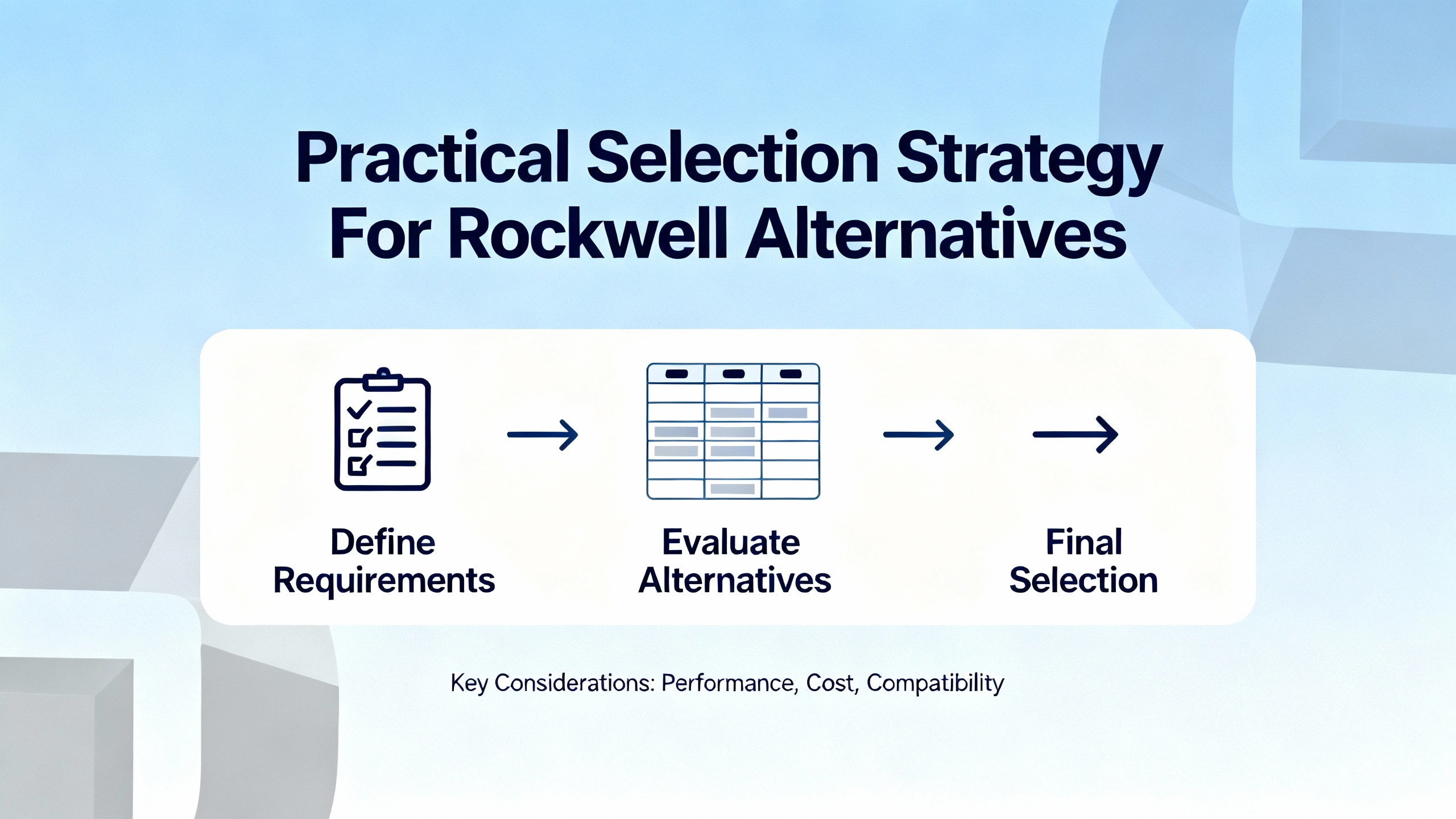
Practical Selection Strategy For Rockwell Alternatives
If you are planning a control refresh around UPS, inverters, and power‑protection equipment, it helps to approach Rockwell alternatives methodically rather than reactively.
Start by mapping your power‑critical scenarios. Identify which loads must ride through on UPS, which can tolerate short interruptions, and which can be shed early. That will reveal where you need fast, deterministic control logic and where simpler RTU‑style monitoring is sufficient. The DPS Telecom discussion of PLC, PLR, and RTU tradeoffs is a useful framework for deciding which technology belongs where.
Next, inventory your existing automation ecosystem. If your process DCS is already Emerson DeltaV or Yokogawa CENTUM, adding more Rockwell PLCs may not be as synergistic as increasing your use of the existing DCS vendor. If your organization has a strong Siemens or Schneider Electric skill base, those vendors may be more natural alternatives.
Then shortlist vendors based on the criteria outlined by sources such as eWeek and PLC Department: proven experience in your industry, clarity of services and pricing, strong support and training, and alignment with your cybersecurity and IIoT requirements. Use the ICS and automation company lists from RL Consulting, Plant Automation Technology, and Mordor Intelligence as a starting roster, then narrow to three or four realistic candidates.
Finally, design with integration in mind. Plan for how your alternative control platform will exchange data with MES solutions such as Solumina by iBaseT or quality platforms such as Averroes AI. Decide where RTUs, PLCs, and DCS components belong in your architecture. Ensure that your integrator can deliver rigorous testing around power events: automatic transfer from utility to UPS and generator, controlled brownouts, and recovery sequences.
FAQ
Is it risky to mix multiple control vendors in one facility?
Mixing control vendors introduces more engineering work up front but often reduces systemic risk over time. The key is to define clear boundaries: one vendor may own the process DCS, another the machine‑level PLCs, and a third the RTUs and monitoring. References from eWeek and PLC Department emphasize that success depends more on experience, support, and integration discipline than on using a single brand everywhere.
Can I keep my existing Allen‑Bradley PLCs and still adopt alternatives?
In most plants the answer is yes. The Gartner review of MES alternatives, for example, shows how Solumina by iBaseT can sit on top of existing controls and still deliver improved traceability and quality. Similarly, Averroes AI positions its inspection system as compatible with existing camera setups and control stacks. It is common to retain Rockwell PLCs for legacy lines while deploying Siemens, Schneider, or Mitsubishi controllers on new equipment and tying everything together at the MES or SCADA level.
Where do UPS and power‑quality systems fit into this decision?
UPS and power‑quality systems should be treated as part of the overall control and automation design, not as isolated hardware. Vendors like Schneider Electric explicitly integrate energy management with control through platforms such as EcoStruxure, and process‑focused vendors such as Emerson and Yokogawa tightly couple control and power behavior in process plants. When you evaluate Rockwell alternatives, always ask how their control platforms and tools represent UPS status, battery health, breaker state, and power events, and how easily that information flows to your MES and analytics layers.
In the end, the choice of Rockwell Automation alternatives is less about rejecting a brand and more about aligning your control architecture with the reliability and visibility your power systems require. When you treat the PLC or DCS as an integral part of your UPS and inverter strategy, and you select from the well‑documented global suppliers and architectures described above, you can raise both your uptime and your confidence in the system you are responsible for.
References
- https://controlsys.org/find-an-integrator/
- https://sourceforge.net/software/product/Industrial-Automation-AI/alternatives
- https://averroes.ai/blog/industrial-automation-companies
- https://www.ciocoverage.com/10-most-innovative-industrial-automation-companies-to-watch-in-2022/
- https://www.linkedin.com/pulse/7-best-industrial-automation-companies-integrators-2025-bh1cf
- https://www.plantautomation-technology.com/articles/top-industrial-automation-companies-in-the-world
- https://standardbots.com/blog/industrial-automation-companies
- https://www.tw-automation.com/top-industrial-robotics-companies/
- https://www.cbinsights.com/company/affordable-robotic-automation/alternatives-competitors
- https://www.d-tools.com/resource-center/industry-insights/best-building-automation-system-vendors


 Videos
 News
News Applications





Leave Your Comment