Replacing a Mitsubishi PLC is rarely just a control upgrade. In power-critical environments such as UPS-backed switchboards, generator plants, and industrial distribution systems, the PLC is tightly coupled with inverters, protective relays, and power quality monitoring. A careless swap can turn a planned modernization into an unplanned outage.
From a reliability advisor’s perspective, a Mitsubishi PLC replacement project succeeds when it preserves as much proven field wiring, code, and operator workflow as possible while positioning the plant for another decade of maintainable, supportable operation. That often means thinking in terms of migration paths rather than rip-and-replace, and being very deliberate about whether you stay within the Mitsubishi ecosystem or move to an alternative control platform.
This article walks through Mitsubishi PLC replacement options using lessons from field experience and published guidance from manufacturers, distributors, and practitioners. The focus is practical: how to make a change that improves reliability without blowing up your downtime budget.
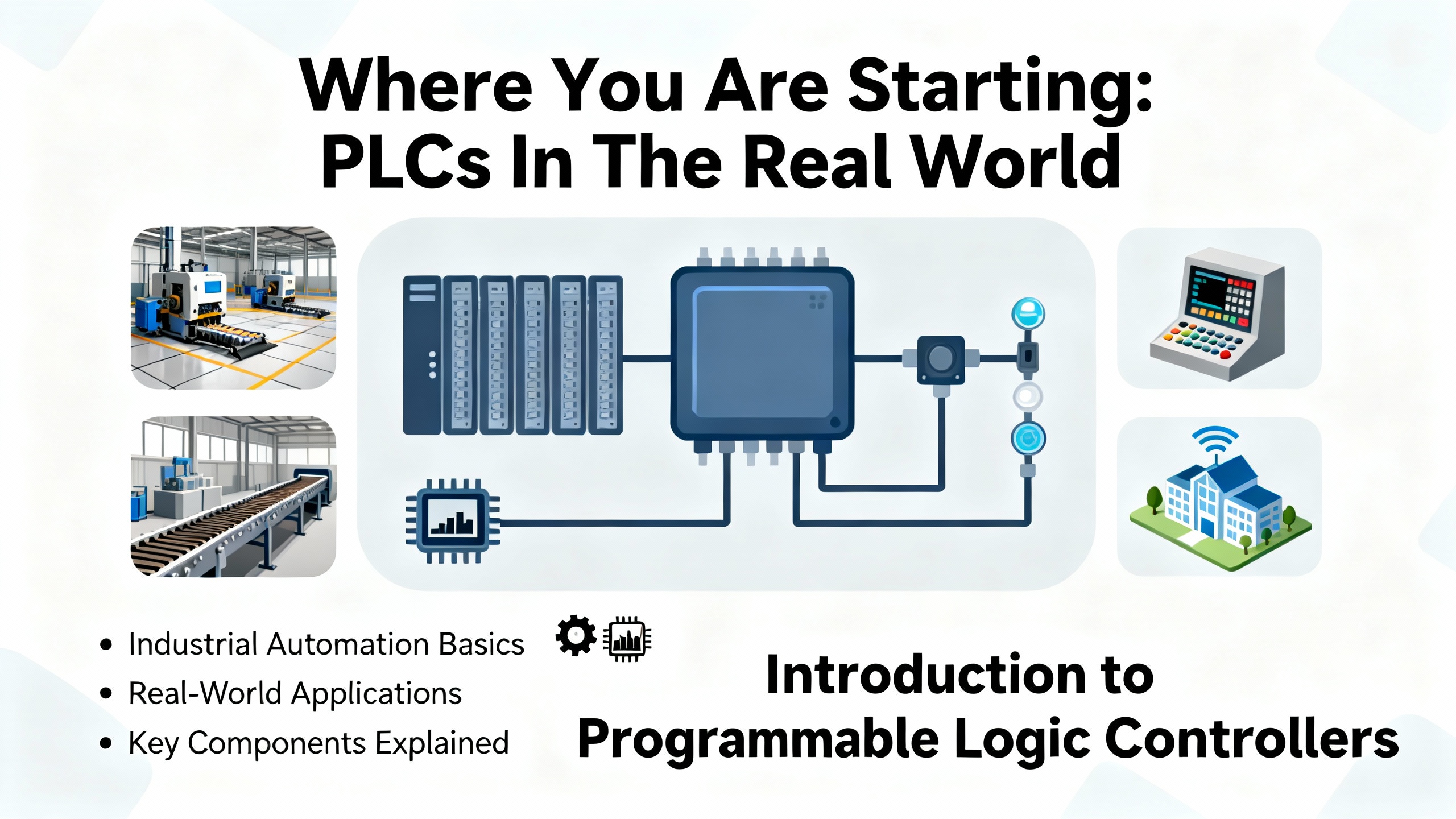
Where You Are Starting: Mitsubishi PLCs In The Real World
A Programmable Logic Controller, or PLC, is a rugged industrial computer that continuously reads inputs from sensors and protection devices, executes user logic, and drives outputs to breakers, contactors, drives, and alarms. Multiple sources describe this scan happening thousands of times per second so that processes and power systems can be controlled in real time.
Mitsubishi Electric has built a large global installed base with its MELSEC families. Summary data from industry overviews and Mitsubishi-centric manuals show a few main groups that show up again and again in brownfield power and industrial plants:
MELSEC FX-series controllers are compact PLCs used for small to medium automation tasks and are common in packaged equipment, including high-speed manufacturing and smaller power-related skids. Manuals for the FX family emphasize that they are general-purpose controllers designed to handle digital and analog I/O, expansion modules, and communication options within tight footprints.
MELSEC-A series systems are legacy rack-based controllers that once anchored many full-scale plants. A Mitsubishi Electric Engineering upgrade page explicitly frames A-series as a legacy platform and points to MELSEC iQ-R and Q as the natural successors.
MELSEC-Q and MELSEC iQ-R / iQ-F platforms are Mitsubishi’s modern, higher performance controllers. Industry analyses highlight their emphasis on speed and precision, with reported minimum communication cycles around tens of microseconds, significant processing speed improvements over earlier generations, and support for synchronized multi-axis motion. One report notes that Mitsubishi controllers such as MELSEC-Q, iQ-R, and iQ-F can coordinate up to roughly a few hundred axes with microsecond-level synchronization, allowing high-speed inspection and packaging lines to see double-digit output gains. Another overview identifies MELSEC-F family PLCs for high-speed manufacturing and MELSEC-Q modules for complex process control, with a strong focus on compatibility and easy network integration.
In practice, these PLCs are often wrapped around UPS systems, static transfer switches, generator breaker schemes, and power-factor correction banks. The PLC may be orchestrating logic for load shedding, interlocking parallel sources, or supervising inverters and drives, even if it was originally selected by an OEM rather than your in-house engineering team.
When these controllers age, you face a choice: repair, migrate within Mitsubishi, or move to a different control platform altogether.
Repair Or Replace: The First Decision
Before you design a replacement architecture, it is worth asking whether you actually need a new PLC right now.
Guidance from an industrial automation supplier that services drives, PLCs, and HMIs shows that repairing failed automation hardware typically costs about thirty to sixty percent less than buying new. For HMIs, repair can be roughly thirty to fifty percent cheaper than replacement. They also note that lead times for new PLC hardware can easily sit in the two to eight week range, especially in the current component market, while a good repair shop can often turn a unit around in a few days and back the work with a warranty of a year or more.
The same source suggests leaning toward repair when you are dealing with expensive or obsolete items that are hard to source, when replacement lead times are long, or when the issue is isolated and physical, such as damaged terminals or cosmetic HMI problems. Replacement is favored when the same part has failed multiple times in a year, when there is widespread board damage or corrosion, or when you are already planning a broader upgrade.
For Mitsubishi PLCs in power systems, that logic translates into a simple reality I see frequently. If an FX or Q-series CPU has its first failure in fifteen years and you are otherwise happy with the platform, a fast, warranted repair can be a good way to buy time while you plan a controlled migration. If you are seeing intermittent communication glitches, repeated module failures, or obsolete A-series hardware with no viable spare pool, it becomes dangerous to defer a replacement plan.
Once you decide that replacement is on the table, the next question is whether to stay with Mitsubishi or not.
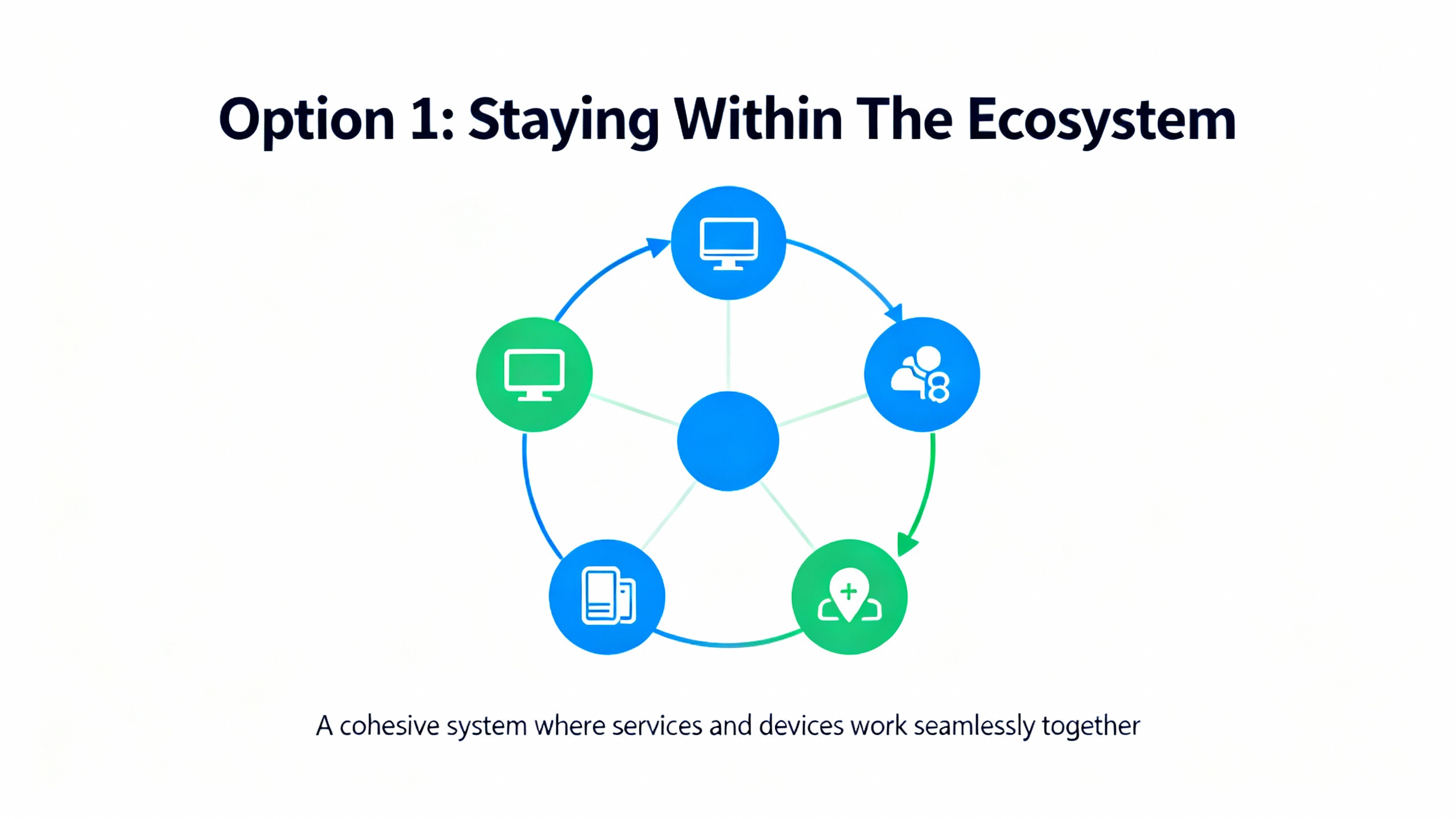
Option 1: Staying Inside The Mitsubishi Ecosystem
Staying with Mitsubishi is usually the lowest risk option when you prioritize reuse of programs, wiring, and technician skill sets.
Upgrading From MELSEC-A To MELSEC iQ-R Or Q
Mitsubishi Electric Engineering’s own upgrade-tool content is straightforward about the intended path for legacy MELSEC-A systems. They position MELSEC iQ-R as the primary replacement series, with MELSEC-Q also identified as a target in some mappings. In other words, the official story is to move from MELSEC-A to iQ-R or Q, not to a third-party rack.
A practitioner running a foundry with one hundred percent Mitsubishi A-series hardware describes the practical version of this decision. Their A-series PLCs use an aging coaxial loop gateway that is now beyond its service life and poorly supported. The plant does not need heavy math or ultra-fast processing, but it does need Ethernet-based communication, easy expansion, and manageable wiring. The engineers want to stay with Mitsubishi so they can reuse existing GX Developer code rather than port everything to a new vendor. They also care about simple wiring and maintenance, with a strong preference for screw terminals that electricians can handle easily.
That picture aligns with what I see when we retrofit legacy switchgear and generator controls. Upgrading from A-series to iQ-R or Q lets you take advantage of modern Ethernet and CC-Link IE networks, higher CPU performance, and integrated redundancy options, while still working within an ecosystem designed for backward compatibility. Mitsubishi’s process CPU and redundancy modules, described in technical comparisons, support large numbers of PID loops and dedicated tracking memory, and can be deployed in redundant configurations with redundant Ethernet and CC-Link IE networks. For plants with many analog loops and tight availability requirements, that is attractive.
The main advantages of this path are straightforward. You can leverage existing ladder logic and data structures. You can often reuse at least some terminal blocks or wiring strategies, particularly where Q-series compatibility was designed in. And your technicians do not have to learn an entirely new software environment.
The disadvantages are more strategic. You remain dependent on Mitsubishi’s ecosystem, networking standards such as CC-Link IE and SSCNET for motion, and their regional support footprint, which practitioners note is strongest in Asia. If your plant is in North America or Europe and already leans heavily on Siemens or Allen-Bradley elsewhere, staying isolated on a Mitsubishi island may not be ideal for long-term support.
Refreshing FX-Series Controllers
Many UPS, motor-control, and small power system skids rely on FX-series PLCs. Manuals for the FX family and third-party market overviews show FX as Mitsubishi’s compact line for small to mid-scale tasks, and more recent discussions highlight FX5U and related iQ-F models as modern successors with high-speed capabilities.
Industry analyses cite a case where a packaging company adopted a Mitsubishi FX5U PLC and achieved around a twenty percent output increase within six months thanks to higher speed and modularity. Another overview positions MELSEC-F series PLCs as suitable for high-speed manufacturing tasks with tight integration into broader Mitsubishi automation networks.
If you are sitting on FX or older MELSEC-F CPUs, migrating to modern FX5U or iQ-F hardware keeps you within the same conceptual family. You gain speed and communication options while preserving much of the programming model, especially if you remain in the Mitsubishi toolchain. It is still a significant project, but much less disruptive than cross-vendor migration.
Option 2: Moving To A Different PLC Brand
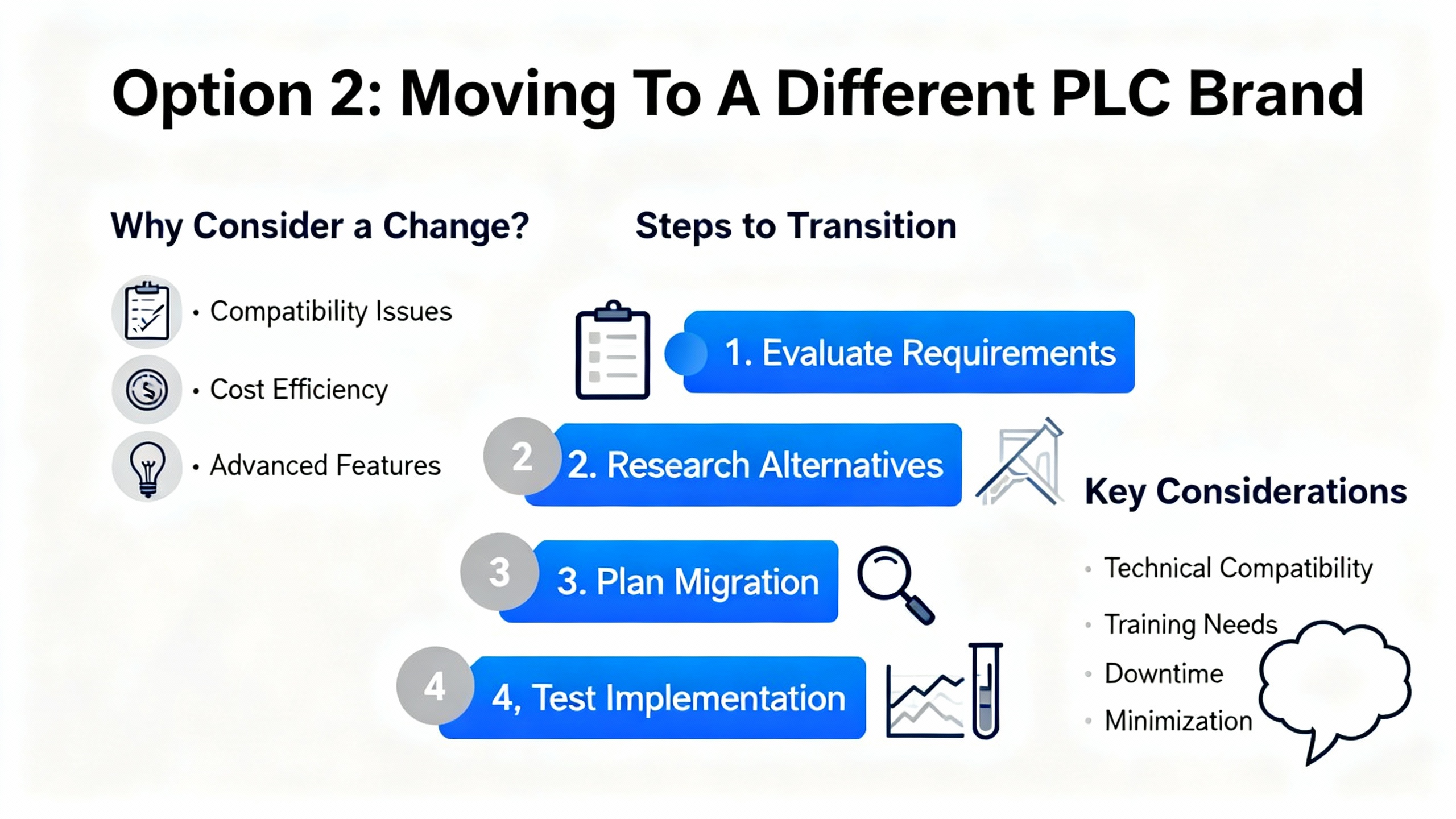
There are plenty of reasons to consider moving away from Mitsubishi: corporate standards that favor Siemens or Allen-Bradley, better local distributor coverage, or a strategy to diversify vendors. The important thing is to approach the move as a retrofit, not a greenfield design.
A retrofit-focused guide from Industrial Automation Co. makes the point clearly: the right PLC for a retrofit is the one that lets you reuse the most of what you already own. That includes wiring, I/O racks, motion devices, HMIs, and even tag structures. Their advice is to treat the upgrade as primarily a CPU change rather than a full system rewrite.
What Makes A Retrofit-Friendly PLC
The same guide and a separate selection article from LC Automation converge on a few critical themes.
Communication compatibility comes first. If your existing system uses CC-Link, proprietary serial links, or a mix of Ethernet protocols, you need to know whether the new PLC can talk natively to your drives, remote I/O, safety system, and HMI. The Industrial Automation Co. article warns that choosing a PLC with incompatible protocols can force you to replace drives, remote I/O, and HMIs at the same time, doubling your migration cost for very little functional gain.
I/O compatibility is the next barrier. You want to match input styles such as sinking versus sourcing, output styles such as transistor versus relay, voltage levels such as common DC control voltages versus AC control power, analog ranges such as common voltage and current standards, and specialty functions like high-speed counters or motion-linked I/O. Redesigning entire panels and field terminations to suit a new I/O style will burn far more time and money than changing a CPU.
Program structure matters more than most people expect. The Industrial Automation Co. retrofit guide recommends choosing a new PLC whose memory model, data types, timer and counter handling, and function blocks resemble your existing platform. That advice is echoed in an LC Automation piece that points out programming time, not hardware cost, is now the dominant cost in PLC-based systems. Paying a little more for a platform with strong programming tools and familiar concepts can save you a significant amount in engineering hours.
HMI migration is often an invisible cost. The retrofit guidance suggests keeping the HMI “unaware” of the PLC change by choosing a controller that supports the same protocol, tag layout, and register structure. If you can mimic the legacy register map or alias tags, you can avoid retagging dozens of screens and alarms.
Finally, lifecycle support and cybersecurity need to be front and center. LC Automation highlights system size, functionality, performance, connectivity, and security as the five big questions when choosing a controller. Modern compact PLCs often come with remote access and multiple network protocols, but internet-connected PLCs bring cybersecurity risk, so you should be asking hard questions about security features in both the hardware and the programming tools.
Brand Options And Regional Reality
When you leave the Mitsubishi ecosystem, you quickly enter a multi-vendor world where there is no single “best PLC.” Multiple articles and forum discussions point out that Siemens, Allen-Bradley, Mitsubishi, Schneider Electric, ABB, Omron, Honeywell, Emerson, Delta, Panasonic, and LS ELECTRIC all manufacture capable PLCs and that real-world choice depends heavily on geography, installed base, and available support personnel.
One comparative analysis notes that Siemens has roughly forty percent global PLC market share and dominates large process plants in many regions. Rockwell Automation’s Allen-Bradley line is especially strong in North America, with integrated ControlLogix and CompactLogix platforms. Mitsubishi Electric is recognized as another top-tier manufacturer, with one overview citing it as the second-largest PLC maker by industrial automation revenue and highlighting its MELSEC-F and MELSEC-Q families. Schneider Electric, Omron, ABB, and Delta fill out much of the remaining landscape.
Several brand-comparison guides and pricing snapshots describe typical price ranges as follows, with the emphasis that these are general bands rather than quotes for any specific model.
| Brand | Typical positioning and strengths | Common applications | Approximate price level per controller, excluding large systems |
| Siemens | High-performance, scalable SIMATIC S7-1200 and S7-1500 with strong engineering tools | Large plants, automotive, complex process control | Mid to high, roughly $500.00 to more than $2,000.00 |
| Allen-Bradley | Premium CompactLogix and ControlLogix tightly integrated with Studio 5000 and EtherNet/IP | Manufacturing, pharmaceuticals, high-end process | High, often around $1,000.00 to more than $5,000.00 |
| Mitsubishi | Fast, modular MELSEC families with strong motion capabilities | High-speed manufacturing, motion-centric applications | Medium, around $300.00 to $1,500.00 |
| Schneider | Modicon PLCs with EcoStruxure IIoT integration and energy efficiency focus | Infrastructure, energy, utilities | Mid-range, roughly $400.00 to more than $2,000.00 |
| ABB | Rugged AC500 family for harsh environments | Power, heavy industry, mining, oil and gas | Medium to high, roughly $800.00 to more than $3,000.00 |
| Omron | Compact controllers with strong robotics and vision integration | Robotics, packaging, quality inspection | Medium, around $200.00 to $1,000.00 |
| Delta, Panasonic | Cost-effective, compact PLCs suitable for OEMs and budget-sensitive projects | Small automation systems and cost-sensitive equipment | Low to medium |
A separate resource from LEADTIME notes that Siemens, Allen-Bradley, and ABB are typically the go-to choices for heavy industrial use, while Delta and Panasonic suit smaller or budget-restricted projects. Mitsubishi and Delta are framed as attractive for cost-sensitive jobs, especially where you need fast, modular controllers for electronics or packaging lines. Honeywell and Schneider are often recommended for advanced safety or redundancy systems.
Forum practitioners add another layer of nuance. One SWOT-style comparison by an engineer emphasizes that Mitsubishi support tends to be strongest in Asia, Siemens coverage is strongest in Europe, and Allen-Bradley dominates North American support and distributor networks. The same author notes that in their region, Allen-Bradley parts were often easier to source quickly than Mitsubishi or Siemens, and cautions that similar patterns likely hold for other brands when you move far from their “home” continent.
All of this reinforces a point that is easy to forget at the whiteboard. Once the core functionality is covered, the practical differentiators are product availability on your shelf, the quality of local support, and your team’s comfort with the programming environment. That matters more to reliability than an extra few percent of CPU performance on a datasheet.
Option 3: LS ELECTRIC XGT As A Mitsubishi iQ-R Alternative
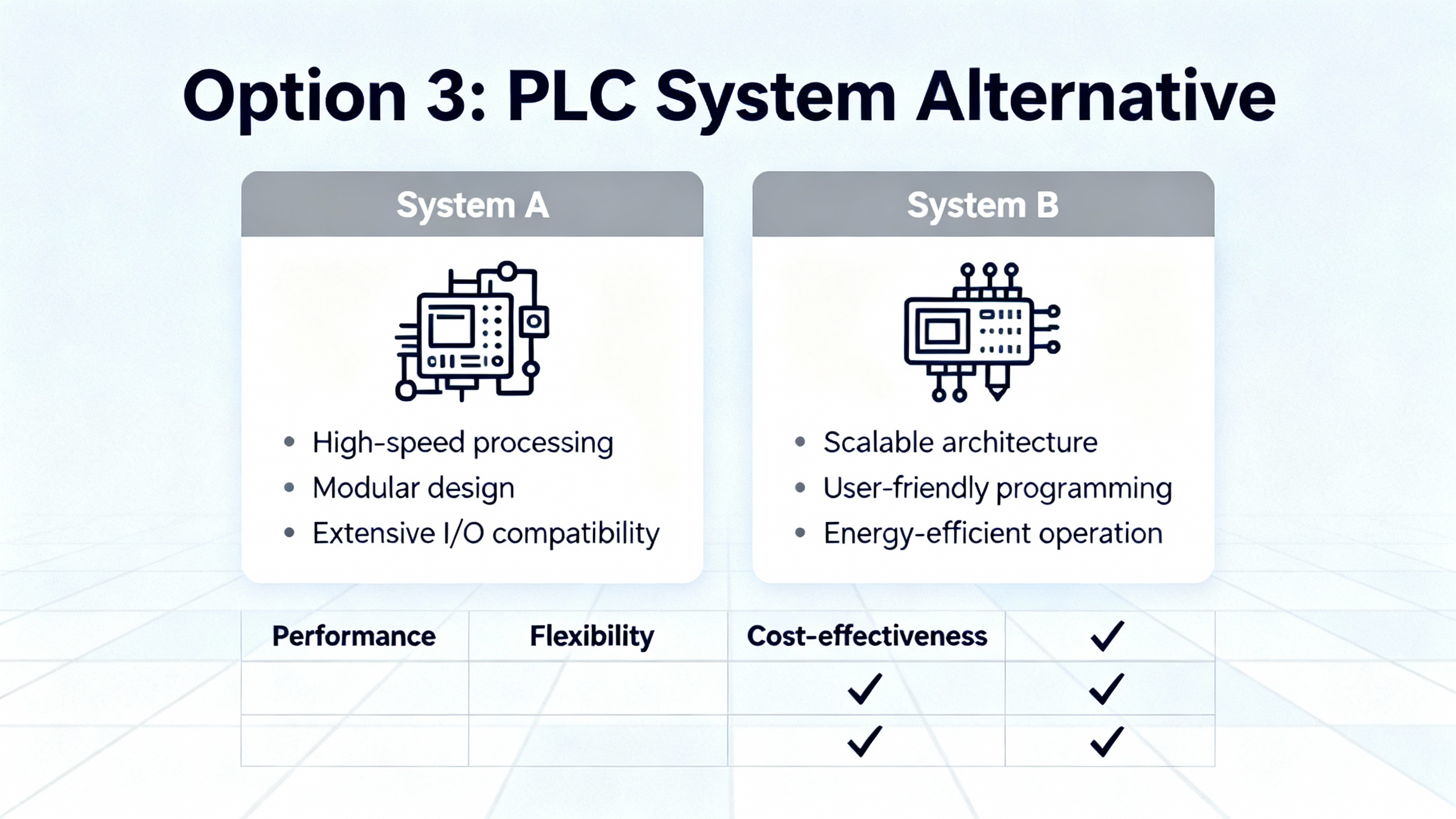
If you are specifically evaluating alternatives to Mitsubishi iQ-R in medium to large automation projects, a detailed comparison from LS ELECTRIC is worth noting. They position their XGT and XGR platforms directly against MELSEC iQ-R, comparing PLC CPU performance, I/O, redundancy, communication, and motion.
On the CPU and I/O side, LS ELECTRIC’s high-end XGI CPUs support several expansion bases and can handle up to roughly ninety-six I/O modules, while cost-focused variants handle smaller configurations. Mitsubishi’s MELSEC iQ-R CPUs support multiple base units and dozens of modules and feature a segmented memory model with dedicated areas for program, data, and device or label memory, with label-based programming designed to allow hardware changes without rewriting variable definitions.
Both vendors offer a range of digital I/O module densities and use front-panel indicators, but their wiring and mounting philosophies differ. Mitsubishi’s RX and RY modules can leverage Q-series compatible terminal blocks to reduce rewiring costs when upgrading from earlier platforms. LS ELECTRIC emphasizes one-touch mounting and terminal-block connections with clear differentiation between source and sink inputs and outputs, aiming to simplify installation and maintenance.
Redundancy is one of the most important considerations in power and process applications. Mitsubishi implements redundancy using specific process CPUs combined with R6RFM redundancy modules, targeting medium-to-large process control with high-speed PID and large tracking memory, and supporting redundant networks based on Ethernet and CC-Link IE. LS ELECTRIC’s XGR series goes somewhat broader in scope, implementing redundancy across the base, power supply, CPU, and network, with dual-port redundancy and multiple media combinations such as electrical and optical links. That can be attractive where you want more options for redundant network media.
Communication and expansion are another axis of differentiation. Mitsubishi’s communication modules provide Ethernet and CC-Link IE networking at common Ethernet data rates, with fiber-optic options for noise-resistant dual-loop topologies and flexible CC-Link IE Field topologies such as star, line, and ring. LS ELECTRIC uses its RAPIEnet plus family of master modules, which can carry multiple protocols simultaneously, including Modbus TCP/IP and EtherNet/IP, and incorporate relay functionality that allows ring and line topologies without external switches. They also offer Smart Expansion modules that extend the system from a handful of bases to several dozen over the network, and Smart I/O blocks that behave like small remote PLCs, simplifying large-scale expansion.
In motion control, Mitsubishi’s RD77 Simple Motion modules are tightly integrated with CC-Link IE Field and SSCNET networks and are designed to synchronize multiple servo axes with capabilities for complex motion such as cams and advanced synchronous control. LS ELECTRIC responds with EtherCAT-based motion modules that connect multiple servo drives and support multi-axis interpolation including linear, circular, helical, and elliptical motion, storing parameters and operation data in FRAM to avoid battery dependence.
LS ELECTRIC’s own recommendation from this comparison is nuanced. They suggest that if you prioritize cost-effective large-scale expansion, multi-protocol Ethernet networking, and easier configuration, the XGT and XGR platforms are attractive. If you are in process industries with a strong existing investment in CC-Link IE, SSCNET motion, and Mitsubishi’s process ecosystem, MELSEC iQ-R is likely a better fit. From a power-system reliability standpoint, that translates into a decision about how much you value open, multi-protocol Ethernet versus a very mature single-vendor ecosystem.
Option 4: Keeping The Mitsubishi PLC And Replacing Only The HMI
In many UPS and power distribution projects, the PLC hardware is still sound while the HMI is the weakest link. Obsolete touchscreens, dim displays, or dead function keys can drive operators to push for a full control system replacement when it might be enough to replace the operator interface.
Maple Systems presents an explicit alternative here. They position their HMIs as Mitsubishi-compatible operator panels and list a wide range of supported Mitsubishi PLC and controller families. Their compatibility spans legacy A1, A2, and A3 series PLCs, AJ7 and Alpha2 controllers, and extends through the FX family including FX, FX0, FX1, FX2, FX3, and FX5 models. It also covers MELSEC-Q and MELSEC-L PLCs and servo families such as MR-J3 and MR-J4, along with Q0, Qj, QnU, and R04 models.
This breadth means that, for many Mitsubishi-based systems, you can deploy a modern Maple Systems HMI as a drop-in or alternative panel without replacing the PLC. For a power system, that might look like retaining a proven FX or Q-series controller that interlocks breakers and UPS modules, while upgrading to a modern HMI that offers better diagnostics, higher resolution, or remote-access capabilities.
From a risk perspective, that can be an excellent intermediate step. You improve the operator experience and maintainability without touching control logic that has been proven in service for years. You also buy time to plan a controller migration on your terms rather than being forced into one by a failing HMI.
Practical Strategy For Mitsubishi PLC Replacement In Power Systems
Pulling these options together, a reliable replacement project for a Mitsubishi PLC in a power or UPS application usually follows a recognizable pattern.
The first step is to quantify the operational and financial risk of staying where you are. That means looking at part age, failure history, and spare availability. The repair-versus-replace guidance mentioned earlier gives useful benchmarks, such as repair typically costing significantly less than new and being attractive when dealing with expensive or obsolete items or long lead times. If your A-series backplane is corroded or your FX I/O modules have a history of intermittent faults, you already have your answer: it is time to replace, not repair.
The second step is to decide whether you will stay in the Mitsubishi ecosystem. If you have a large installed base of MELSEC hardware, existing GX Works or GX Developer expertise, and no corporate mandate pushing you toward a different vendor, the combination of MELSEC iQ-R or Q and modern FX or iQ-F controllers is hard to beat in terms of migration friction. Official mapping from A-series to iQ-R and Q gives you a supported path, and the emphasis Mitsubishi places on compatibility and network integration helps minimize rework.
If you are leaning toward another brand, you should apply the retrofit-friendly criteria described by Industrial Automation Co. and LC Automation. Start with communication: can the new PLC speak to your existing drives, remote I/O, safety systems, and HMIs without wholesale replacement? Then examine I/O style and voltage compatibility, program structure, HMI tag layouts, and long-term lifecycle support. Recognize that Siemens, Allen-Bradley, Schneider, ABB, Omron, Delta, Panasonic, LS ELECTRIC, and Mitsubishi all build world-class PLCs and that the differentiators are often regional support strength and your team’s familiarity with the ecosystem.
The third step is to consider architecture options beyond a simple one-for-one swap. In some cases, LS ELECTRIC’s XGT and XGR platforms might give you a more open, multi-protocol Ethernet backbone and flexible redundancy without locking you deeper into a single vendor. In others, the right answer might be to leave the PLC in place and replace only the HMI with something like a Maple Systems panel, especially if the HMI is the obvious reliability weak point.
Finally, you need to integrate the control system replacement with your power reliability strategy. During cutover, you may be operating on bypass, with UPS systems in manual or with automated transfer sequences disabled. That is precisely when a control misstep can cause an outage. It is critical to stage work so that you always have a safe state, to validate all interlocks and sequences in a test environment before energizing, and to have roll-back options such as a repaired original PLC or a pre-tested spare.
A few high-level trends from recent PLC market analyses are worth keeping in mind. The PLC software market is projected to grow significantly over the next several years, and newer controllers increasingly embed edge-computing and AI features for predictive maintenance and quality control. Some forecasts suggest that AI-enabled PLCs can reduce downtime and improve process quality by double-digit percentages, and that a substantial portion of new PLCs in the next few years will be virtual or software-defined rather than tied strictly to fixed hardware. If you are making a long-term platform decision now, it is reasonable to ask how your chosen vendor is approaching those trends.
FAQ: Mitsubishi PLC Replacement In Power Applications
Q: Is it safer to stay with Mitsubishi or switch to a platform like Siemens or Allen-Bradley? A: From a short-term risk perspective, staying with Mitsubishi usually means less disruption, especially if you are upgrading A-series to iQ-R or Q or moving FX applications to newer MELSEC-F or iQ-F controllers. You reuse more code and wiring, and your technicians stay in a familiar environment. Switching to Siemens, Allen-Bradley, or another brand can make sense if your organization already has strong standards, spares, and support for those platforms or if Mitsubishi support is weak in your region. The key is to evaluate communication compatibility, I/O, HMI integration, and local support rather than chasing a generic “best PLC” label.
Q: When should I replace a Mitsubishi PLC instead of repairing it? A: Repair is attractive when you have a single failure on otherwise reliable hardware, especially for expensive or hard-to-source modules, and when a repair shop can turn the unit around in a few days with a strong warranty. Replacement becomes the better choice when you see repeated failures, significant board damage or corrosion, obsolescence with no spare pool, or when the control platform is limiting your ability to implement needed features such as Ethernet networking, redundancy, or enhanced diagnostics.
Q: How should UPS and power-system considerations influence my PLC replacement plan? A: For UPS-backed switchgear and power distribution, the PLC replacement plan needs to be synchronized with your power protection strategy. That means planning cutovers when loads can tolerate risk, coordinating with UPS and generator vendors so bypass and protection schemes remain safe, and thoroughly testing all breaker interlocks, transfer sequences, and alarm logic before returning the system to automatic operation. The PLC vendor decision is important, but the real reliability gains come from disciplined staging, testing, and rollback planning.
Closing Thoughts From A Reliability Advisor
Control systems do not fail in a vacuum. When a Mitsubishi PLC is coordinating UPS modules, inverters, and protective devices, any replacement choice is also a power-system decision. Whether you repair for now, modernize within the Mitsubishi family, or move to an alternative platform such as Siemens, Allen-Bradley, LS ELECTRIC, or a mixed architecture with third-party HMIs, the goal is the same: preserve what is already working, reduce avoidable complexity, and buy your plant another decade of predictable, supportable operation.
References
- https://www.plctalk.net/forums/threads/best-plc.77348/
- https://www.ebay.com/itm/315225901194
- https://maplesystems.com/mitsubishi-hmi-alternative/?srsltid=AfmBOorMyYwrZNOBeGR9nyQ19h1l_OspQlB9JJRFn0bIIOHwbHEDhL7K
- https://control.com/forums/threads/4535
- https://www.eng-tips.com/threads/what-is-the-best-plc-you-recommend.420701/
- https://industrialautomationco.com/blogs/news/how-to-choose-the-right-plc-for-a-retrofit-project-without-rewriting-everything?srsltid=AfmBOorMKMPIDd2V3A3q3Hc5uCCnQ5N_pMw4_d4Kmt1lwFI3IBlK449m
- https://koeed.com/blogs/%E6%96%B0%E9%97%BB/5-key-differences-between-mitsubishi-and-siemens-plcs-an-in-depth-comparison?srsltid=AfmBOoq4MoxxRzkB1JAshK5MaWdnxTVqj2_E1rHldpMcE2TIVRzIL-qN
- https://www.lcautomation.com/Page/Tech_Support/five_tips_for_selecting_the_right_plc.aspx
- https://leadtime.ca/blogs/learning-center/top-plc-brands-compared-siemens-allen-bradley-mitsubishi
- https://www.origin-ic.com/blog/best-programmable-logic-controllers-brands/48230


 Videos
 News
News Applications





Leave Your Comment