Summary: Reliable terminal blocks are often the smallest parts in a power system, but they control whether your UPS, inverter, and protection gear run cool and trouble‑free or fail under load. The right supplier gives you a connection “ecosystem,” not just a block.
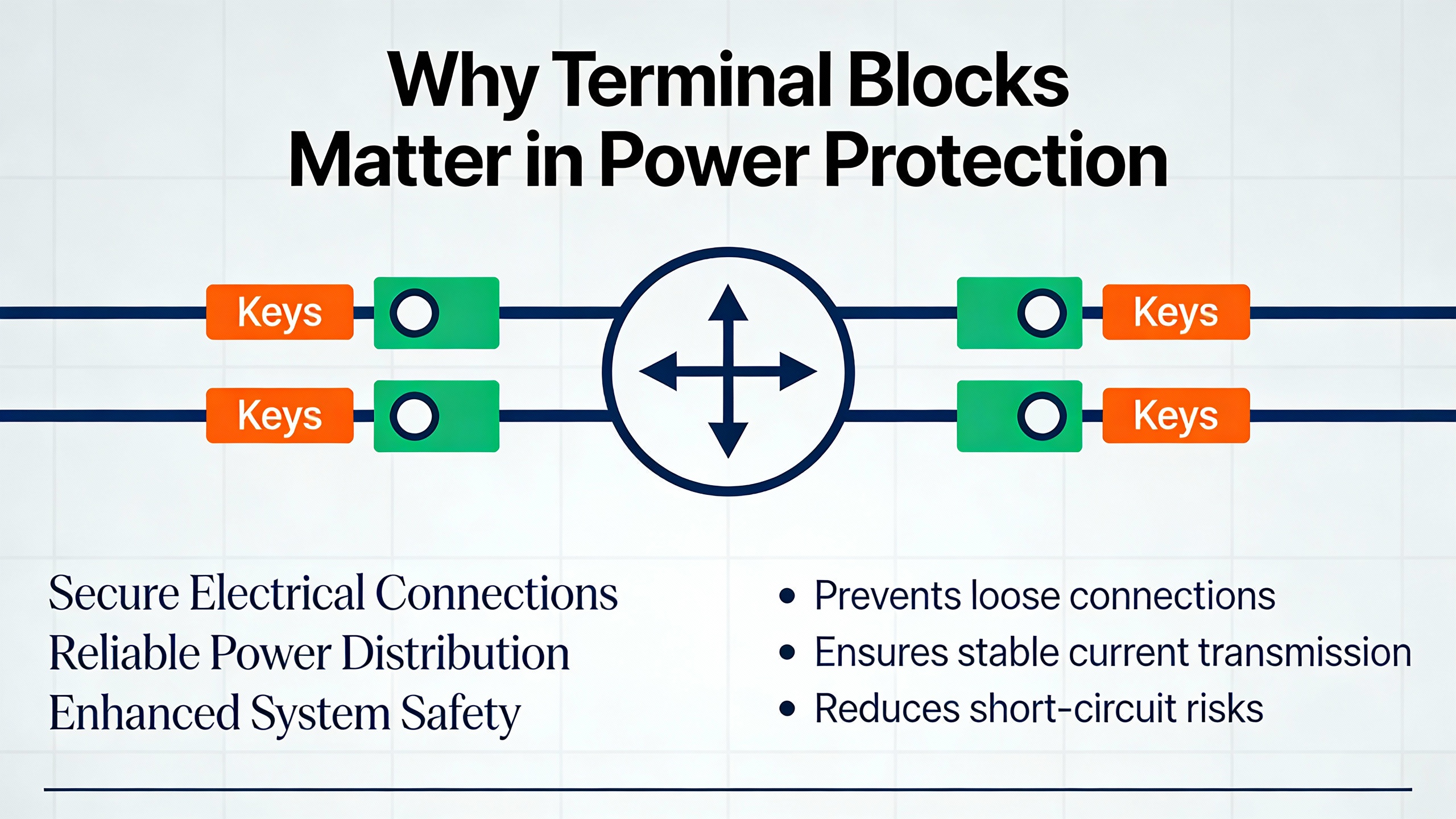
Why Terminal Blocks Matter in Power Protection
In industrial UPS rooms, inverter skids, and switchgear lineups, most failures I’m called to investigate do not start in the silicon—they start at the connections. Loose, undersized, or corroded terminal blocks are frequent hot spots.
Industry studies cited by Utility Electric and others suggest that about 30% of electrical service interruptions trace back to connector issues. For a critical UPS or power distribution unit, that means a $15.00 terminal block can jeopardize a $50,000.00 system.
Terminal blocks also shape how fast you can isolate faults, swap modules, or expand capacity. Multi‑level and pluggable designs highlighted by C3 Controls and RealPars routinely cut panel space by up to half and simplify field work.
Terminal Block Technologies That Fit Power Systems
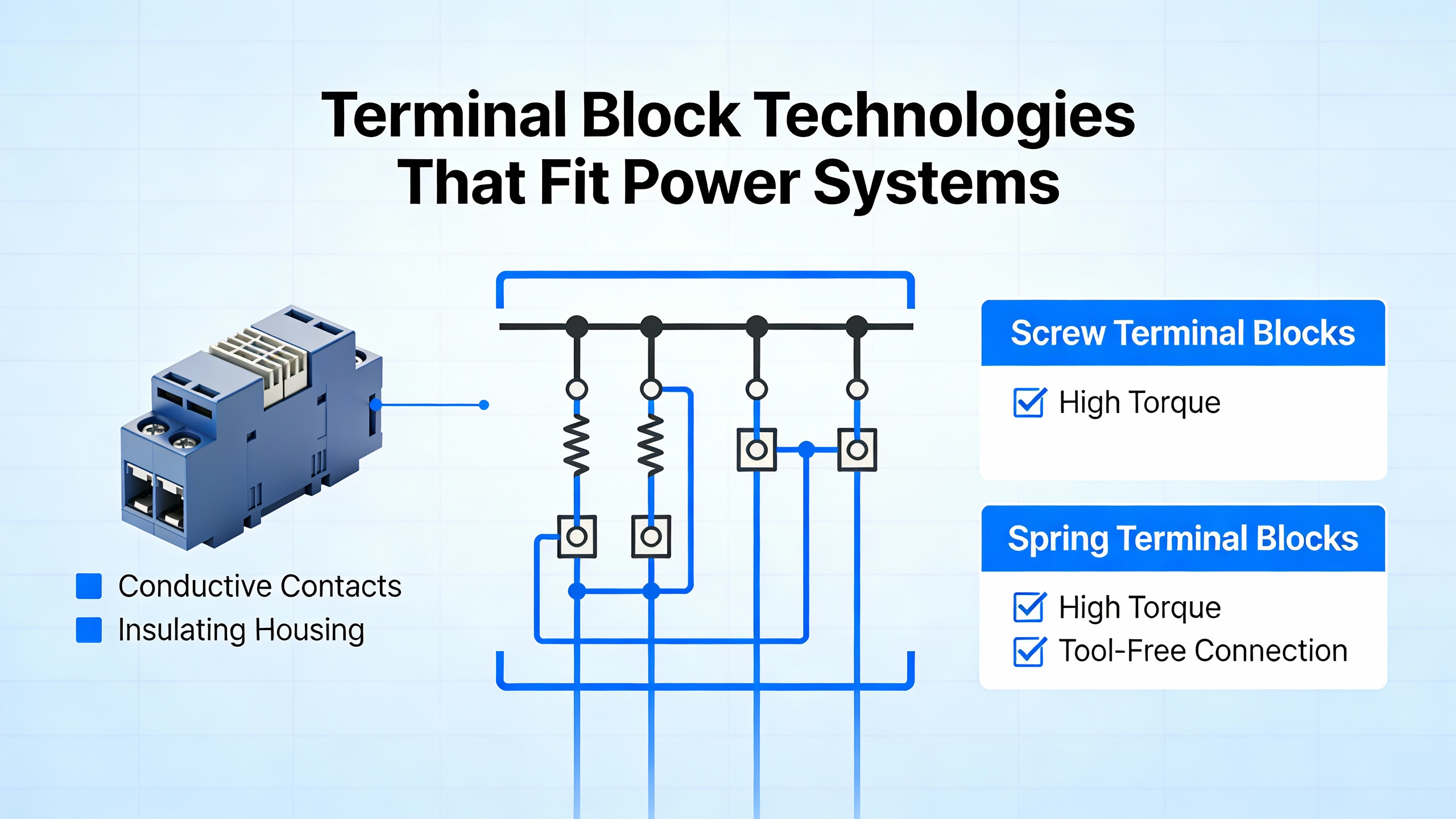
At the core, a terminal block is a modular, insulated connector that clamps two or more wires together safely, usually on a DIN rail. Barrier and screw‑clamp styles remain the workhorse for high‑current AC and DC power circuits. They accept heavy conductors and ring lugs and are widely available at 600 V ratings.
Spring‑cage and push‑in designs, emphasized by Simcona and Weidmüller, trade torque wrenches for preloaded springs. They keep constant contact pressure, run cooler, and are much less prone to loosening in vibration—ideal around generators, motor loads, and floor‑mounted UPS cabinets.
Function‑specific blocks add protection and organization: fused blocks for branch protection with LED blown‑fuse indication, ground blocks that bond reliably to the DIN rail, and high‑current power‑distribution blocks that fan one feeder into many loads. As DigiKey’s jumper guidance reminds us, do not assume jumpers share the same amp rating as the main block; for heavy UPS feeders, a dedicated distribution block is safer than daisy‑chained jumpers.
What to Expect from an Industrial Terminal Block Supplier
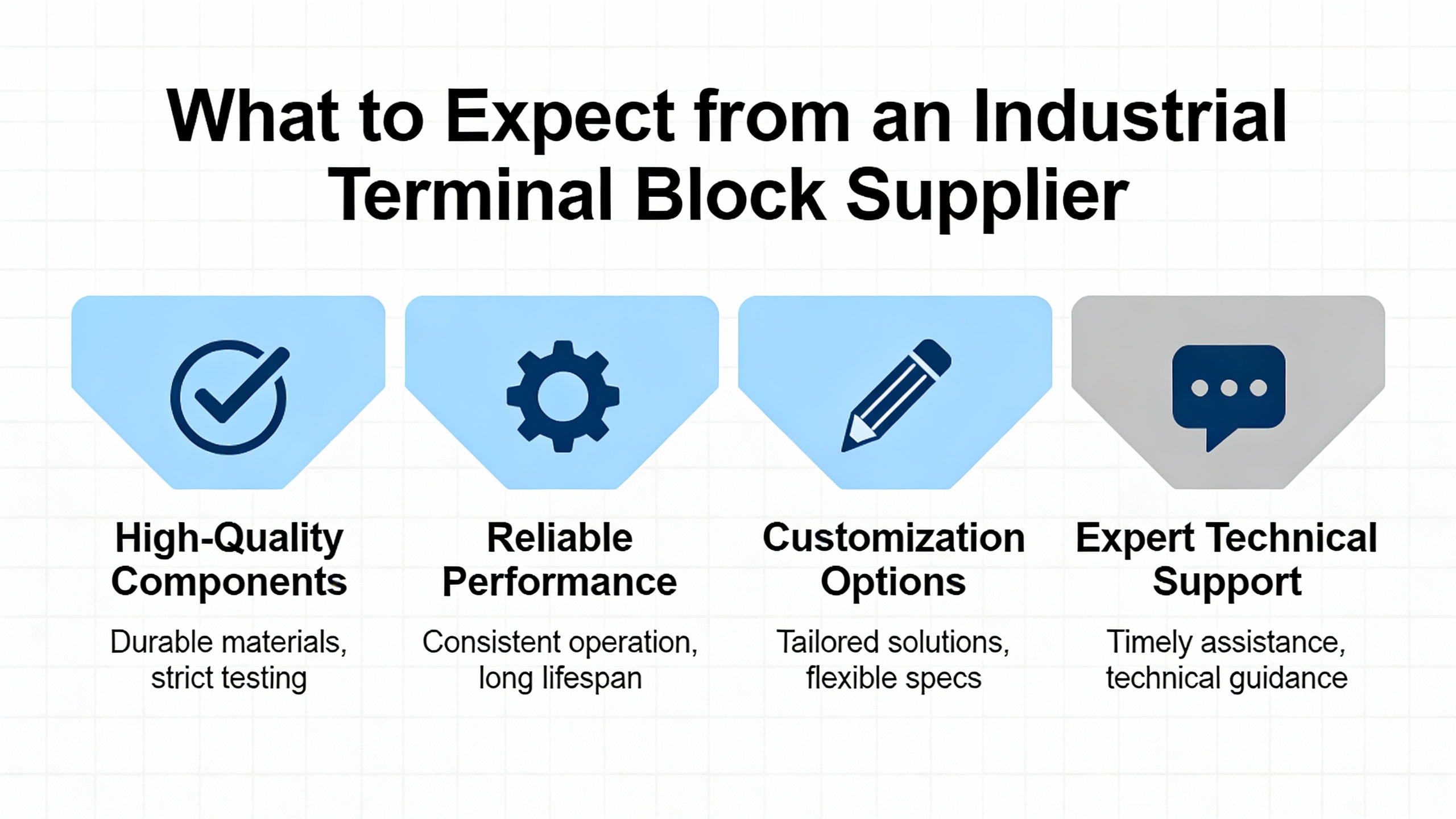
Serious suppliers sell complete “families,” not one‑off parts. As DigiKey and C3 Controls point out, you want matching end plates, partition plates, jumpers, test plugs, labels, and multi‑level variants so your power, control, and signal wiring all share a consistent platform.
On the standards side, Eaton stresses IEC 60947‑7‑1 and UL 1059 compliance, as well as pollution degree and impulse‑withstand ratings. For equipment rooms that may see condensation or dust, selecting the right pollution degree (typically 3 for industrial) is just as important as picking the right amp rating.
Quick supplier checklist:
- Confirm terminal, jumper, and accessory ratings; blocks should be sized for at least 150% of your maximum expected current.
- Verify certifications (UL, IEC, CSA) plus flammability rating (e.g., UL94V‑0) and operating temperature range.
- Ask for spring or push‑in options for vibrating or maintenance‑heavy applications, and high‑current blocks for main feeds.
- Check stocking depth, lead times, and the quality of datasheets, wiring diagrams, and torque guidance.
Designing for Reliability: Sizing and Installation Practices
Multiple sources, including Misumi, FerrulesDirect, and Samesky Devices, converge on one simple rule: size current at about 150% of expected load. If your DC bus can see 80 A, specify at least a 120 A terminal block and use a true power‑distribution block for further branching.
Voltage rating is usually straightforward in North American power systems: for 208–480 V applications, 600 V‑rated DIN‑rail blocks provide comfortable margin, assuming creepage and clearance suit the pollution degree in your enclosure. Eaton’s work on micro‑environments is a reminder that a sealed UPS cabinet in a clean room is very different from one near a loading dock.
Mechanical and material choices matter as much as nameplate ratings. Electron and GKoncy highlight the benefits of copper or nickel‑plated copper conductors, stainless hardware, and corrosion‑resistant housings in damp or chemical‑laden air. In battery rooms and inverter skids, that’s how you avoid the slow creep from “slightly dull” copper to a hot connection.
From an installation standpoint, follow the basics religiously: strip only the specified length (around 0.4 in for many blocks), fully insert the conductor, and tighten screws to the manufacturer’s torque. Where vibration is high or retorquing is unlikely, favor spring or push‑in blocks from vendors like WAGO, Phoenix Contact, or Weidmüller; in practice they hold up better than even well‑installed screw clamps.
A nuanced point: many panel builders still trust screw terminals out of habit, but modern spring and push‑in blocks deliver equal or better reliability when correctly specified. The real differentiator is not screw versus spring—it is choosing a reputable supplier, sizing with margin, and treating every terminal as a critical component in your power‑protection chain.
References
- https://www.marathonsp.com/motor-terminal-blocks.php
- https://www.c3controls.com/products/iec-terminal-blocks?srsltid=AfmBOoqxwD2f5y1Yd8IXA9nidVYehT0GA7NZfbr7YpQzTUzIt7oLDaV5
- https://www.gkoncy.com/how-to-choose-terminal-blocks-according-to-your-needs-five-key-points-to-help-you-choose-the-right-model/
- https://www.industrialcontroldirect.com/terminal-blocks-9/?srsltid=AfmBOoonmBhWsoa4buGeyDWXtOCPnfUBJHqAN_6SxVL5PT5U_yW3UfQa
- https://electron.northparkgroup.com/how-do-terminal-blocks-work/


 Videos
 News
News Applications






Leave Your Comment