Why Servo Motor Suppliers Matter To Power-Reliability Teams
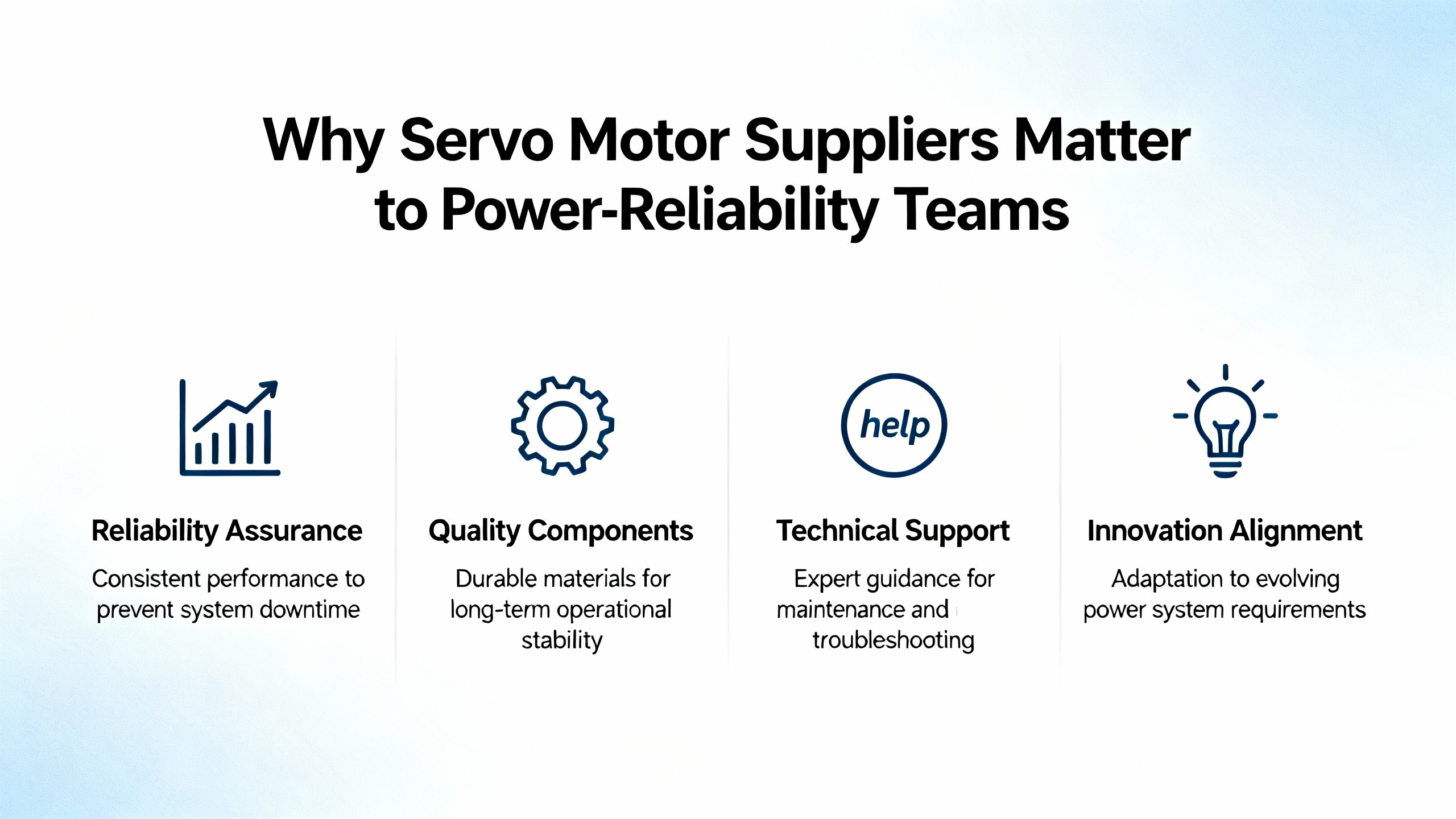
When you walk through a modern plant, the loads that stress your UPS systems, inverters, and power protection hardware rarely look like “simple” motors anymore. High-density servo motors now drive CNC axes, packaging lines, AGVs, and robot cells, all of them powered by fast servo drives with aggressive acceleration, tight position control, and short-cycle duty profiles. In that environment, the choice of servo motor supplier is as much a power-system decision as it is a motion-control decision.
Across the engineering guides from Anaheim Automation, Festo, Heidenhain, Omron, KEB, and others, a consistent picture emerges. A servo motor is not just a motor; it is a closed-loop system where the motor, drive, and feedback device work together to track position, speed, and torque commands with very little error. These systems are compact, power dense, and capable of holding load at zero speed, operating across a wide speed range, and delivering peak torque several times the continuous rating for short periods. That combination makes them ideal for high-throughput automation, but it also means their performance and their interaction with upstream power need to be specified carefully with the supplier.
In my own work on power reliability, the servo supplier that supports clean sizing, realistic duty-cycle modeling, and clear regenerative energy guidance is the one that tends to keep our UPS and inverter installations out of trouble. The technical differences between suppliers show up not only in catalog torque and speed, but also in how they help you manage overloads, voltage compatibility, communication interfaces, and environmental stress.
Servo Fundamentals Every Power Engineer Should Anchor On
Servo Versus Conventional And Stepper Drives
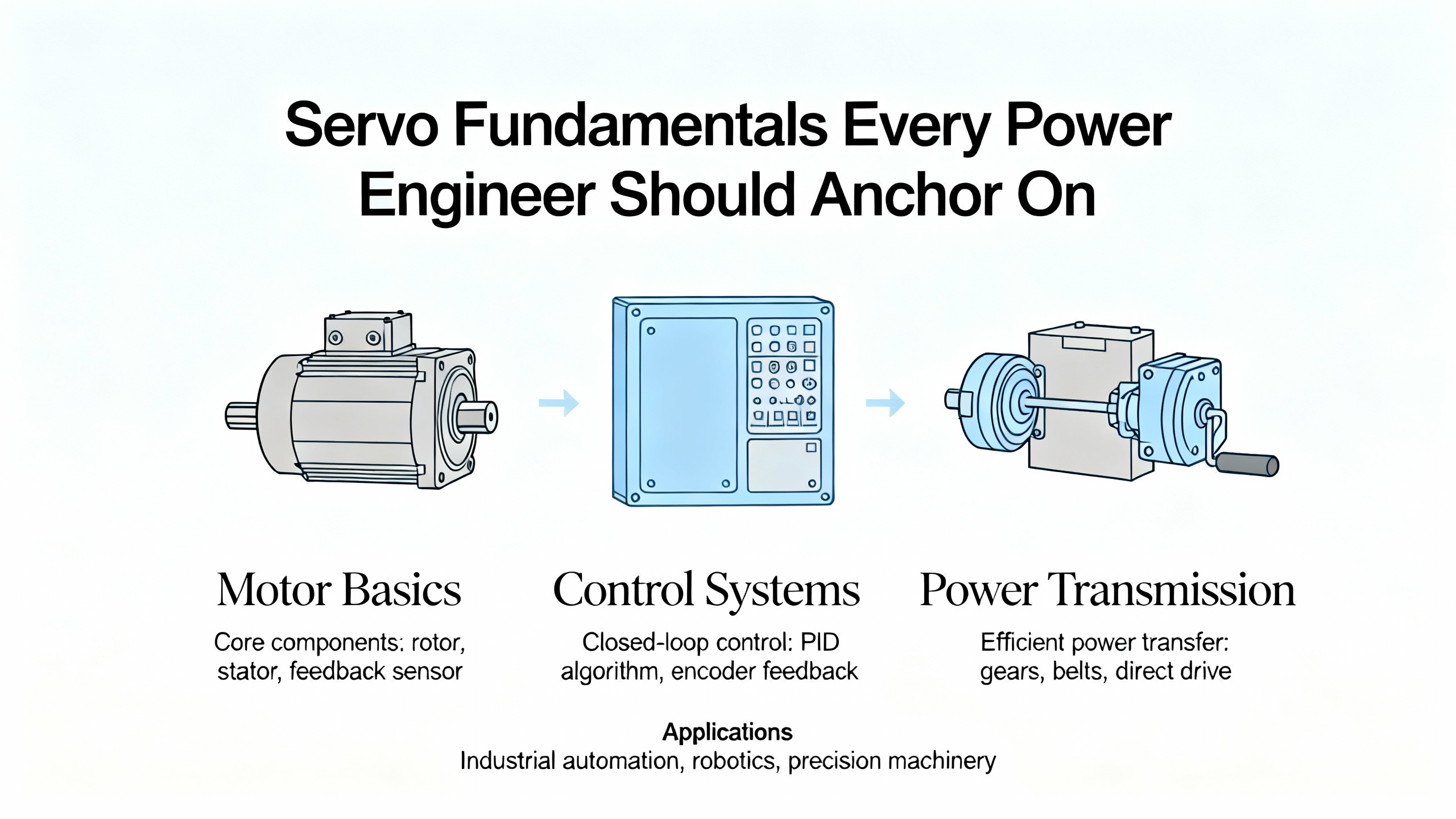
The research materials consistently define a servo motor as an AC, DC, or brushless DC motor combined with a position sensor in a closed-loop servomechanism. Anaheim Automation and Evelta both emphasize that what makes a servo a “servo” is the closed-loop feedback and error correction, not a particular motor topology. The controller issues motion commands; the encoder or other feedback device reports position, speed, or current back; the servo drive compares actual to commanded values and adjusts motor current using negative feedback and pulse-width modulation.
Compared with open-loop stepper systems, which simply assume each pulse produces motion, servos add feedback and therefore cost. The payoff, according to sources like Evelta and Wesco, is higher torque at speed, smoother motion, rapid acceleration and deceleration, and confidence that commanded position is actually achieved. Several sources contrast servo motors with standard induction motors as well. Induction designs win for simple, constant-speed, rugged duty; servo motors win where precise positioning, tight speed regulation, and frequent start–stop cycles are central to the process.
From a power-systems standpoint, that closed-loop behavior matters because current draw in a servo system tracks mechanical demand. Anaheim Automation notes that servo motors draw power roughly proportional to the mechanical load. That is beneficial for efficiency but also means you must understand worst-case motion profiles, not just nameplate current.
Feedback Devices And Control Loops
The notes highlight two main families of feedback: encoders and resolvers. Encoders, whether optical or magnetic and whether incremental or absolute, are described as more accurate and easier to implement, so they are the default choice in many industrial servo offerings. Anaheim Automation’s Kinco servos, for example, support encoder resolutions ranging from 2,500 pulses per revolution incremental to 20‑bit and 16‑bit single-turn or multi-turn absolute encoders. That range allows a supplier to align feedback resolution with the precision and cost targets of each application.
Resolvers, by contrast, are analog transformer-based devices. Multiple sources point out that they contain no onboard electronics, tolerate high temperature, and resist shock, which makes them attractive in harsh and long-life environments such as heavy industry. For plants where servo axes live near hot processes or high-vibration equipment and still sit behind critical UPS-fed panels, the suppliers willing to offer resolver options alongside encoders are often the ones better aligned with reliability goals.
Control-wise, many industrial servo systems use nested loops: an inner torque or current loop, a middle speed loop, and an outer position loop. The Anaheim and Heidenhain material both describe this multi-loop architecture as the way to achieve high stiffness and precision. Kinco drives from Anaheim use digital signal processors to execute these loops and can deliver overload capacity of up to three times rated power for instantaneous loads. When a supplier can show you those loops on a torque–speed plot and relate them to your duty cycle, you gain confidence that the servo behavior will coexist with your power infrastructure.
Rotary, Linear, And Size Classes
Servo motors appear in rotary and linear formats. Anaheim Automation describes rotary servos in AC, brushless DC, and related variants, with rotation often converted to linear motion via ball screws or belts. Linear servos essentially flatten the motor so that the moving element travels through a U-channel stator. Evelta points out that linear servos can provide smooth, backlash-free motion at high speed, which is powerful for compact X–Y tables and pick-and-place systems.
Gian Transmission offers a useful view of size classes. Micro servos under about 0.1 newton‑meter of torque serve small robots, drones, and hobby projects. Small servos from about 0.1 to 1 newton‑meter cover medical devices, 3D printers, and small CNC machines. Medium sizes from roughly 1 to 10 newton‑meters support industrial robots and packaging machines, while large models above about 10 newton‑meters focus on heavy machinery and conveyors. They further map these categories into NEMA frame sizes; NEMA 17, 23, and 34 families stretch from a fraction of a newton‑meter to several newton‑meters continuous torque, with peak values several times higher. A servo supplier that can cover these ranges with consistent control interfaces and documentation simplifies everything upstream, from cabling to breaker sizing.
Performance Dimensions To Review With A Servo Supplier
Torque, Speed, And Torque–Speed Curves
Almost every technical guide in the notes puts torque–speed curves at the center of servo selection. Festo, Heidenhain, and KEB all stress the difference between continuous (or RMS) torque and peak torque. Continuous torque is what the motor can sustain thermally over the full duty cycle; peak torque is available for short bursts during acceleration, deceleration, or disturbance rejection.
Omron’s selection guidance recommends keeping RMS torque beneath roughly 70 to 80 percent of the servo’s continuous rating and treating peak torque demands as short events below the motor’s allowable peak, which several sources place at up to about 300 percent of rated torque for some drives. KEB’s example of a servo delivering 4 newton‑meters RMS torque points out that the motor heats as if it delivered that torque continuously; as long as 4 newton‑meters lies in the continuous region of the curve, thermal limits are respected.
The Gian Transmission data illustrates the familiar trade-off between torque and speed. In their generic torque–speed example, torque falls from about 10 newton‑meters at 500 revolutions per minute to roughly 2 newton‑meters at 4,000 revolutions per minute. Festo and Heidenhain both emphasize that higher pole-count windings favor torque at lower speed, while other windings favor speed at the expense of torque. When you talk to suppliers, it is worth asking them to overlay your cycle’s torque demands on their speed–torque plots rather than relying on single “rated” numbers.
From a power-protection perspective, those curves tell you how much current will be drawn at various speeds. Because many drives, like the Kinco units from Anaheim Automation, permit short-term overload up to three times rated power, a group of axes accelerating simultaneously can present significant short bursts to an upstream UPS or inverter. The supplier who can quantify those bursts from real motion data is far more valuable than the one who quotes only nameplate amps.
Inertia Matching And Load Characterization
Load inertia receives consistent attention across the Omron, Charlotte, Festo, and KEB materials. Effective load inertia, often called equivalent inertia, is defined as the inertia of all moving elements converted to the motor shaft, including gears, belts, screws, and the load mass itself. Both the Charlotte selection guide and Omron’s servo selection notes explain that this value is fundamental to control stability and response.
The inertia ratio, defined as load inertia divided by motor inertia, is a practical index. Omron and KEB both highlight that ratios around three‑to‑one to five‑to‑one tend to offer good performance, while pushing beyond roughly ten‑to‑one usually requires careful tuning or mechanical reduction. KEB points out that some manufacturers provide motors with different inertias in the same torque class, allowing the vendor to “add” rotor inertia intentionally to improve the ratio without oversizing torque.
Suppliers also increasingly provide worksheets and tools to help with these calculations. The Masso community discussion of DMM’s DYN4 servos notes that DMM offers spreadsheets where users can enter gear reduction and pinion sizes to estimate maximum gantry weight. Festo and others describe dedicated motor-sizing software that ingests motion profiles and load data and outputs candidate motors and drives. In power-critical facilities, I look for servo suppliers who can share these tools and, more importantly, who will walk through the inertia and torque calculations with your mechanical and electrical teams on a real project.
Environment, Duty, And Mechanical Integration
Evelta and Heidenhain emphasize that environmental and duty conditions materially change the safe operating region of a servo. High ambient temperature reduces continuous torque, and applications in paper mills, oil environments, or steel processing may require sealed or specially hardened housings. Omron adds that mechanical design should minimize friction and backlash and that oversizing a servo in the name of “safety” can actually degrade dynamic response because of higher rotor inertia.
Several sources caution against selecting a motor so it runs continuously at its maximum speed or output. The Charlotte guidance frames this as a reliability issue: sustained maximum operation shortens life and increases maintenance. Instead, suppliers recommend allowing margin on torque, speed, and thermal limits and using reduction gearboxes where needed, as described by Festo and KEB.
On the integration side, many guides note that physical size, frame, shaft diameter, and mounting pattern can be limiting. Gian Transmission shows how micro, small, medium, and large classes map to different speed ranges and applications, while their NEMA chart ties frame sizes directly to typical torque and speed bands. A good servo supplier will not only quote the mechanical dimensions but also help you foresee issues with mounting, cabling, and clearance that affect panel layout and cooling—factors that power engineers care about when routing feeders and planning for heat.
A Practical View Of Supplier Performance Data
The table below reflects recurring performance parameters from the research sources and how they can be used during supplier evaluation.
| Parameter or aspect | What suppliers typically specify | What a reliability-focused buyer should confirm |
| Continuous and peak torque | Rated continuous torque, peak torque (often up to ~300% of rated) | RMS torque from your duty cycle within about 70–80% of continuous rating, with peaks below the allowable transient region |
| Speed and torque–speed curve | Rated speed and plotted torque–speed curve | Actual operating points for all moves stay in the appropriate continuous or intermittent regions over the available supply voltage |
| Inertia ratio | Motor inertia and sometimes recommended load-to-motor ratios | Effective load inertia calculations and load-to-motor inertia ratio near 3:1 to 5:1, and not far beyond about 10:1 without a reduction stage |
| Environment and duty cycle | Ambient temperature limits, enclosure rating, insulation class | Matching of ratings to real site conditions and duty (e.g., hot enclosures, contamination, vibration) as described in supplier guides |
| Feedback and resolution | Encoder or resolver types, resolution in bits or pulses | Feedback option compatible with the control system and rugged enough for the mechanical environment, including resolver options for harsh service |
| Overload capability and thermal | Overload factors (such as three times rated power) and thermal data | That upstream protection and power sources are coordinated with overload behavior, including trip curves and regenerative handling |
All of these details appear in some form in the vendor and technical guides summarized in the research notes. Strong servo suppliers can present them coherently for your specific load case rather than as generic catalog pages.
Delivery And Integration Options That Differentiate Servo Suppliers
Integrated Versus Modular Architectures
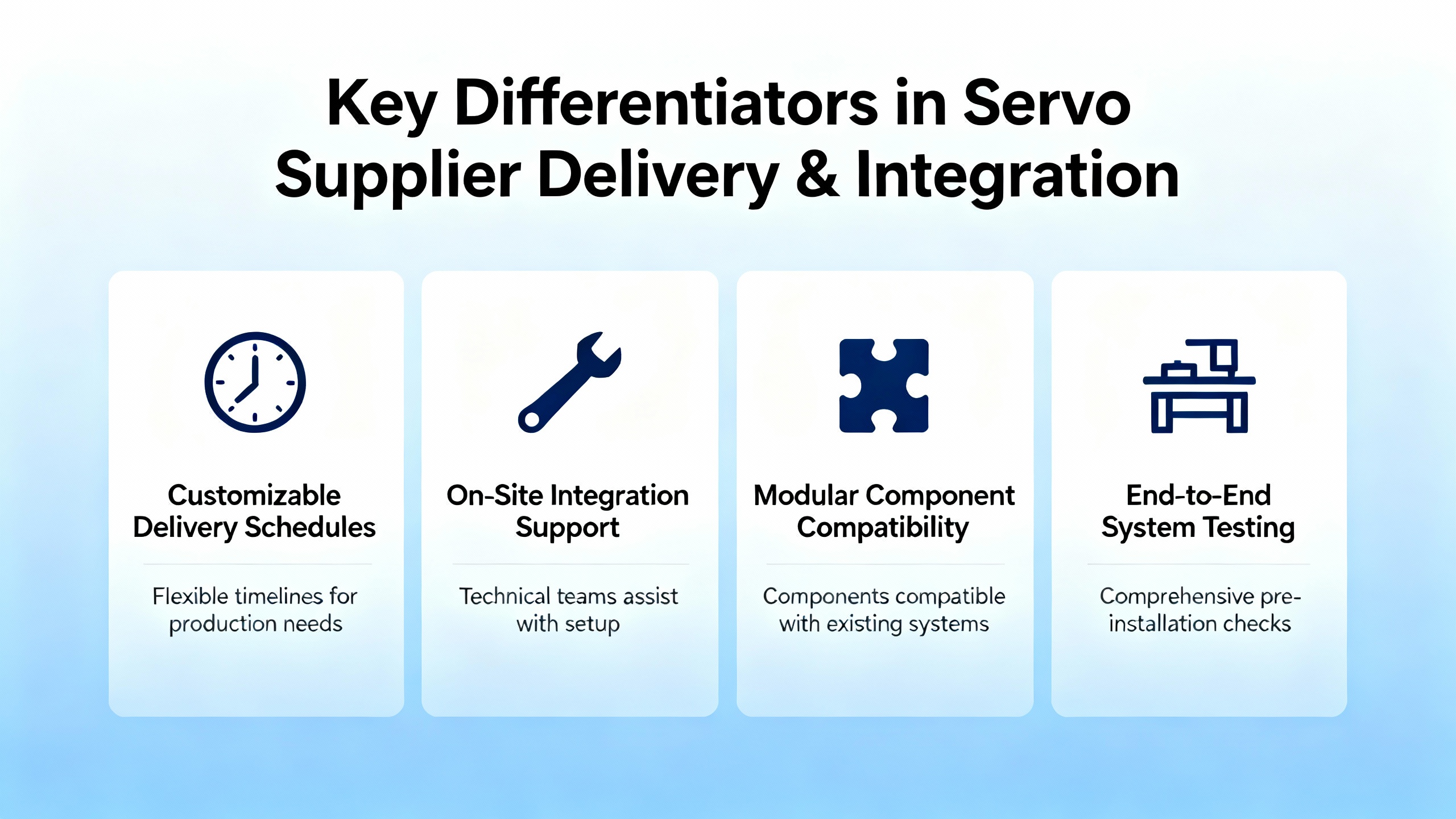
Servo offerings fall broadly into integrated packages and modular combinations. Anaheim Automation describes integrated solutions such as Kinco-based units that combine motor, drive, and encoder into a single assembly. The Masso forum discussion of Teknic ClearPath servos notes that these also integrate the drive into the motor body but rely on an external DC supply. DMM’s DYN4 family, by contrast, uses a separate motor with an AC-powered drive that incorporates the power supply.
Those architecture choices are not merely mechanical; they change how the servo interacts with your power system. An AC-input drive like the DYN4 ties directly into your AC distribution and converts it internally, simplifying power wiring but concentrating rectifier and overload behavior in one package. A DC-supplied integrated motor like ClearPath shifts that behavior into whatever DC bus or supply you provide. In plants where servos ride on inverter-fed buses or UPS-backed DC links, the supplier’s power architecture options directly affect how your protection and ride-through strategies will work.
Communication, Networks, And Software Tools
Communications and tools are another area where suppliers differ markedly. Anaheim Automation’s Kinco drives, for example, support CAN bus and Modbus over RS‑485, reportedly handling up to 31 servo motors over distances on the order of thousands of feet, with Fieldbus and EtherCAT options in some models. These drives can integrate with programmable logic controllers, variable-frequency drives, human–machine interfaces, and other drives, creating a common control network.
On the software side, Anaheim’s Servo+ software illustrates the type of tooling you should expect from a serious supplier. It supports parameter editing and management, downloading and comparing configurations, initialization, real-time monitoring of I/O and alarms, torque–speed sampling, and tuning of proportional–integral–derivative gains and target windows. Festo and other manufacturers indicate similar workflows, where sizing tools accept motion profiles and load data and propose motors, gearboxes, and drives that meet torque and inertia requirements.
From a reliability advisor’s perspective, those tools matter because they reduce the gap between “as-specified” and “as-tuned.” When you are trying to keep a UPS or inverter from nuisance tripping, being able to monitor torque, actual current, alarm history, and regeneration behavior through vendor software is far more powerful than relying solely on upstream metering.
Environmental And Reliability Options
Suppliers also differentiate themselves through environmental hardening. The Evelta guidance notes that high-temperature environments reduce a servo’s continuous torque and may require liquid cooling or special designs. Sites with contamination, such as paper or steel mills, call for sealed or hardened enclosures, and high-vibration locations call for rugged feedback devices and bearings.
Anaheim Automation’s description of resolvers underscores their suitability for harsh duty: there are no onboard electronics, and they tolerate high temperature and shock. Heidenhain, which focuses heavily on feedback technology, points out that positioning accuracy in direct-drive systems is largely a function of the encoder, not the motor itself, making the quality of feedback devices central to long-term precision.
When evaluating suppliers, I look for concrete documentation on allowable ambient temperatures, ingress protection ratings, and available resolver or rugged encoder options. I also pay attention to their guidance around duty cycles in hot environments, because several sources make it clear that continuous operation near rated limits in elevated temperatures shortens life and erodes reliability.
How Servo Supplier Choices Interact With UPS, Inverters, And Power Protection
Overload Behavior And Short-Term Demand
Servo drives are explicitly designed to handle dynamic events, and that shows up in their overload behavior. Anaheim’s Kinco drives can deliver up to three times rated power for instantaneous loads, and KEB’s servo-sizing guidance revolves around managing intermittent peak torque in the upper region of the speed–torque curve.
For a single axis on a lightly loaded panel, those peaks may not seem important. For a tightly synchronized multi-axis machine on a UPS-fed line or inverter-backed microgrid, they matter a great deal. If ten axes each have the ability to draw several times their continuous current during a coordinated acceleration, the short-term current seen by the upstream protection will be far above the sum of the continuous loads.
This is one reason I push suppliers to provide not only catalog overload ratios but also realistic current traces from motion profiles. The better guides, such as those from Omron and Festo, already encourage engineers to compute RMS torque and identify peak torque events; converting those into estimated RMS and peak current at the drive allows power-system designers to check margin in UPS, inverter, and breaker curves. A supplier that cannot provide that translation leaves you guessing.
Voltage, Phase, And Power Architecture
Evelta’s overview of AC servos notes common supply levels such as 100, 200, and 400 volts AC in single or three-phase configurations, and several sources emphasize matching motor and drive voltage to available supply. DMM’s DYN4 series, as discussed by users, shows how some drives integrate an AC-fed power supply, while ClearPath servos expect an external DC source. Anaheim Automation sells both AC and DC servo drives, again underscoring that the servo ecosystem may land on either side of your AC/DC boundary.
From the standpoint of power protection and UPS design, those distinctions drive questions you should ask suppliers. For AC-input servo drives, what is the operating voltage range and how do torque–speed curves shift at lower voltage, as KEB’s example shows? For DC-fed integrated servos, what is the ripple tolerance, and how will the drives behave during ride-through events on the DC bus fed by your inverter or UPS? The guides summarized in the notes make it clear that torque capability depends on voltage, but a good supplier will help you connect that fact to your specific power-protection topology.
Regenerative Energy And Braking
Omron’s further information on servo selection highlights regenerative energy during deceleration, especially for high-inertia or vertical loads. When a servo decelerates such a load, it returns energy into the drive. If the drive’s internal absorption capacity is exceeded, designers are advised to add an external regenerative resistor or unit to avoid overvoltage trips.
This is one of the most important conversations to have with servo suppliers when connecting their drives to UPS-backed circuits or to inverters. You should understand how much regenerative power each axis can produce, what the internal absorption limits are, and how external regeneration hardware is sized. The Omron guidance suggests a structured calculation of regenerative power and energy, and a supplier that follows a similar methodology makes it easier to coordinate with your power protection strategy so that regenerative events do not cause unexpected tripping or DC-bus overvoltage.
Evaluating Servo Suppliers: A Reliability-Focused Framework
When I review servo proposals for facilities with critical power, I read the servo motor and drive proposal the way I would read a UPS or inverter spec: not as a standalone product, but as a dynamic load and, in regenerative cases, as a conditional source. The research notes point to several concrete practices that distinguish strong suppliers.
First, I look for evidence that the supplier starts with the load and motion profile, not with a preferred motor frame. The Charlotte selection guide and multiple manufacturer white papers recommend defining load inertia, friction, external forces, travel distance, and the timing of acceleration, constant-speed, and deceleration segments before choosing motors. DMM’s worksheets and the various sizing tools mentioned by Festo, Omron, and others all embody that mindset.
Second, I want to see documented inertia calculations and ratios. Using the effective load inertia definitions from Omron and Gian Transmission, a credible supplier will compute equivalent inertia at the motor shaft, apply appropriate safety factors, and demonstrate that the load-to-motor inertia ratio lives in a reasonable band, often in the single digits. If the ratio is high, they should be prepared to justify gear ratios or different motor inertias to bring it down.
Third, I ask to see torque–speed plots with RMS and peak torque for the actual duty cycle highlighted, in the style described by Festo, Heidenhain, and KEB. I expect RMS torque to sit comfortably inside the continuous region and peaks to remain within the intermittent region. When a supplier can identify that RMS torque is on the order of three quarters of rated continuous torque and peaks are within the motor’s short-term capability, it builds confidence that thermal headroom exists, even in less-than-ideal environments.
Fourth, I examine how the supplier addresses environment and feedback. Evelta and Heidenhain both underscore that ambient temperature, contamination, and vibration change the game. A supplier who offers resolver options, sealed housings, and clear derating information for higher ambient temperatures is one I can integrate safely into a power system that already runs warm in tightly packed cabinets.
Finally, I pay attention to delivery and lifecycle support. Suppliers like Anaheim Automation that provide commissioning software, alarm monitoring, torque–speed sampling, and straightforward parameter management make it realistically possible to keep servo behavior aligned with original assumptions throughout the life of the system. DMM’s and other vendors’ willingness to supply sizing worksheets and to discuss how logic levels and isolation are handled, as highlighted in the Masso discussion, are signs that support will extend beyond the first shipment.
Short FAQ For Power And Reliability Teams
How much margin should I expect between calculated torque and rated torque?
Across the Omron and KEB guidance, there is a recurring recommendation to keep RMS torque for the actual duty cycle below roughly 70 to 80 percent of the motor’s continuous rating, while ensuring peak torque events remain within the drive’s intermittent capability, which some vendors quote as up to about three times rated torque for short durations. When a servo supplier validates those margins using your real motion profile, you can be more confident that the drive will not run thermally on the edge, especially in warm or semi-enclosed electrical rooms.
What questions link servo selection back to UPS and inverter design?
Based on the vendor documents summarized in the research notes, three questions stand out. First, how large are the short-term overload factors on the drives, and how do they translate into actual current during worst-case acceleration of all axes? Second, what is the expected regenerative power during deceleration or vertical load lowering, and how are regenerative resistors or units sized to absorb it, as Omron recommends? Third, how does torque capability change with supply voltage, particularly if the drives will see lower voltage during inverter ride-through events, as discussed in KEB’s voltage examples? Servo suppliers able to answer these clearly are easier to integrate into power-protection studies.
When is it worth paying for resolver feedback?
The Anaheim Automation and Evelta material draws a clear line between encoders and resolvers. Encoders deliver higher accuracy and easier integration in most environments and are generally the first choice. Resolvers, with their transformer-based construction and lack of onboard electronics, tolerate higher temperatures and more severe shock and vibration. In practice, that means resolver options are especially valuable in harsh or long-life environments, such as heavy industrial machinery or sites with high mechanical abuse, where the marginal cost of more robust feedback is small compared with the cost of downtime and maintenance.
In industrial facilities where servo-driven axes share buses with UPS systems, inverters, and other protected loads, a servo supplier is part motion partner and part power-system stakeholder. Choosing a supplier who understands torque–speed behavior, inertia, environment, and regeneration the way the best technical guides describe is one of the most effective ways to preserve both machine performance and power reliability over the long term.
References
- https://isl.charlotte.edu/servo-motors-product-selection-guide/
- https://mime.engineering.oregonstate.edu/research/drl/_documents/rezazadeh_2014.pdf
- https://wp.nyu.edu/mind/2023/10/18/how-to-choose-the-right-motor-for-your-industrial-automation-system/
- https://gm0.org/en/latest/docs/power-and-electronics/servo-guide/choosing-servo.html
- https://blog.seweurodrive.com/navigating-servomotor-selection-a-technical-guide
- https://www.solisplc.com/servo-motor
- https://www.a-m-c.com/servo-motor-buying-guide/
- https://www.gian-transmission.com/a-comprehensive-guide-to-servo-motor-sizes/
- https://aheinfo.com/news/how-to-select-the-correct-servo-motor/
- https://anaheimautomation.com/blog/post/servo-motor-guide?srsltid=AfmBOoqzwrnAskohQhXboZ5n33Y5xNg8JAWYYvtvN19WamntDss9OAVk


 Videos
 News
News Applications





Leave Your Comment