Summary: For critical UPS, inverter, and power protection systems, the “best” relay supplier is the one whose technology, testing, and support align with your load profile and duty cycle—not just the one with the lowest unit price.
How Relay Choices Shape Power Reliability
In industrial power rooms, relays sit in the most unforgiving spots: UPS bypass paths, inverter outputs, static transfer switches, battery disconnects, and control signaling. When one fails, you do not just lose a component—you risk dropping an entire critical bus.
Applied Industrial Controls and Industrial Automation Co. both emphasize that relay selection is not only about the switching device itself, but also about how well it matches system conditions: inrush current, switching frequency, environment, and protection philosophy. A relay that is “good enough” for HVAC fan control can be a liability on a 200 kW UPS bypass.
Functional Devices reports field failure rates below roughly 1 in 16,000 units for their building-automation relays, showing what rigorous testing and conservative ratings can achieve. For power protection projects, that kind of proven reliability is more important than shaving a few dollars off the bill of materials.
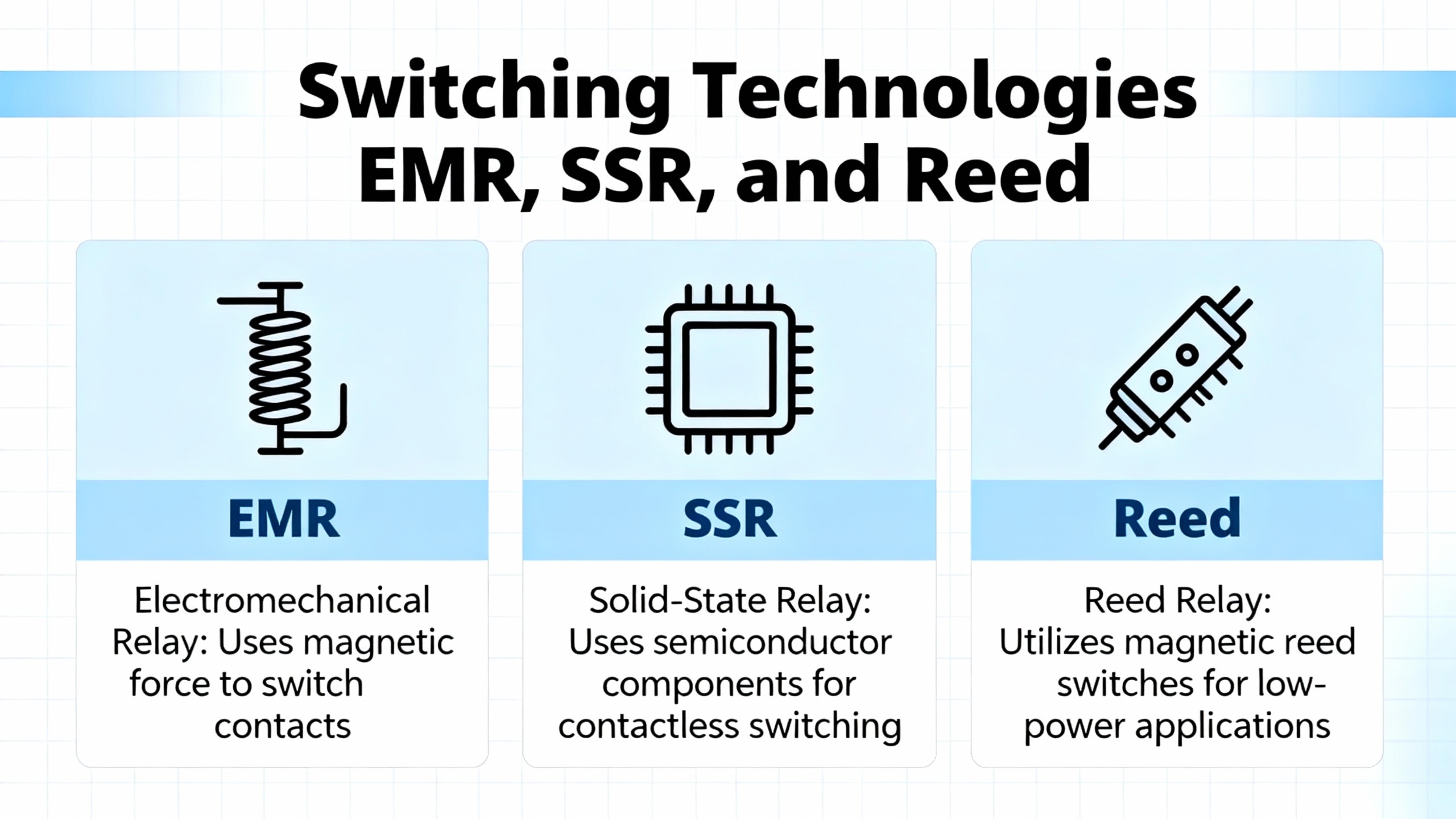
Switching Technologies: EMR, SSR, and Reed
Most suppliers will offer three families, each with a clear role in power systems: electromechanical relays (EMR), solid-state relays (SSR), and reed relays. Simcona, ONCCY, and Electrical Technology outline the tradeoffs clearly.
- Electromechanical (EMR) – Robust contacts, essentially zero leakage when open, high overload tolerance, and flexible multi-pole configurations. Ideal for high inrush loads such as transformer primaries, heater banks, and motorized breakers in UPS switchgear, but with contact wear, slower switching, and audible noise.
- Solid-state (SSR) – No moving parts, fast switching (up to about 100× faster), very long life (often quoted near 100–200× EMR cycles), and silent operation. Celduc, Crydom, and Dynamic Rep highlight their strength in high-frequency control—think inverter-side contactors, battery heaters, or precision thermal control. The tradeoff is heat and off-state leakage; you must design heatsinks and accept that “off” is never truly zero amps.
- Reed relays – Hermetically sealed, very fast, and extremely low leakage, but usually low current. Delcon and Pickering show them at their best in sensing and protection: interfacing to metering, fault indication, or ultra-low-level battery diagnostics where signal integrity is crucial.
Nuance: If your protection philosophy relies on a truly open circuit under fault (for example, fail-safe disconnection of a battery string), a well-rated EMR often remains the safer choice than an SSR that always leaks a small current.
Supplier Archetypes: Who Excels Where
Relay comparison is less about picking a single “winner” and more about understanding supplier roles. Research from LETOP, GEYA, Shenler, CNC Electric, and others points to a few clear archetypes.
- Global broad-line manufacturers – Siemens, Omron, TE Connectivity, ABB, Schneider, Panasonic, Phoenix Contact, and Fuji Electric offer deep portfolios backed by accredited labs and global certifications (ISO 9001, UL, CE, RoHS). They are strong default choices for utility-scale UPS, data center switchgear, and OEM inverters.
- Solid-state and power specialists – Crydom, celduc, Delcon, GEYA, and Shenler focus on SSRs and high-capacity power relays with high shock and vibration resistance, wide temperature ranges, and long mechanical life, well suited to harsh-industry UPS and renewable inverters.
- Application-focused brands – Functional Devices, Finder, IDEC, SELEC, Salzer, and CNC Electric deliver relay modules, time relays, and “relay-in-a-box” solutions that simplify control panel wiring, ideal for commercial UPS rooms, building microgrids, and retrofit projects.
- Distributors and platforms – DigiKey, MISUMI, Mouser, and Metoree act as multi-brand hubs, helping engineers quickly cross-reference coil voltages, contact forms, sockets, and surge-suppression accessories so interposing relay chains stay compatible from PLC output to power circuit.
A Shortlist Method for UPS and Inverter Projects
To turn supplier catalogs into a confident bill of materials, apply a simple, repeatable filter:
- Define the worst-case load and duty cycle. For example, a 30 A AC bypass contactor that sees 10 starts an hour with motor-type inrush requires a very different relay than a rarely operated static transfer. Include surge and fault current, not just steady-state amps.
- Choose the switching technology. Use EMR where you need zero leakage and high inrush tolerance (transformer primaries, battery contactors); use SSR where high cycle counts, silence, or vibration resistance dominate (inverter-side control, heater strings); use reed relays for delicate sensing and isolation.
- Screen suppliers by reliability evidence. Favor those, like Functional Devices or Delcon, that publish test data, life ratings in cycles at specific load types, and environmental qualifications, not just catalog current ratings.
- Compare lifecycle cost, not just price. Crydom’s total-cost-of-ownership modeling shows that once you factor maintenance, downtime, and access labor in cramped UPS rooms, a higher-priced SSR can beat a cheaper EMR over a few years of high-frequency switching.
- Check ecosystem and support. Ensure sockets, surge suppressors, DIN-rail modules, and time relays exist as a coherent family, and that the supplier or distributor offers quick application support when you have to derate for ambient temperature or harmonics.
Industrial relays look like small parts, but they carry big reliability decisions. Treat supplier choice with the same rigor you apply to your rectifiers and batteries, and your UPS and inverter systems will thank you the first time a fault hits and the lights stay on.
References
- https://www.electricaltechnology.org/2023/01/difference-between-solid-state-electromechanical-relay-ssr-emr.html
- https://www.geya.net/relay-manufacturers-list/
- https://aic-controls.com/relays-applied-industrial-controls/
- https://delcon.fi/best-relays-for-industrial-automation/
- https://www.directindustry.com/industrial-manufacturer/switching-relay-133400-_4.html


 Videos
 News
News Applications





Leave Your Comment