In every serious power-protection project I work on—whether it is a UPS-backed data hall, a process plant with ride-through inverters, or a hospital with complex transfer schemes—the humble contactor is one of the most consequential components in the single-line diagram. It is also one of the most underestimated. A contactor that is poorly specified, installed, or supported by the wrong supplier can quietly undermine the reliability of a multi‑million‑dollar power system.
This article looks at industrial contactor suppliers through the lens of power reliability. Drawing on manufacturer guidance from sources such as c3controls, Kent Store, Proax (ABB), Schneider Electric distributors, Schaltbau, Chint, and Contactor Depot, it explains what you are really buying when you choose a contactor, how to match the technology and ratings to your loads, and what to expect from a competent supplier over the lifecycle of your equipment.
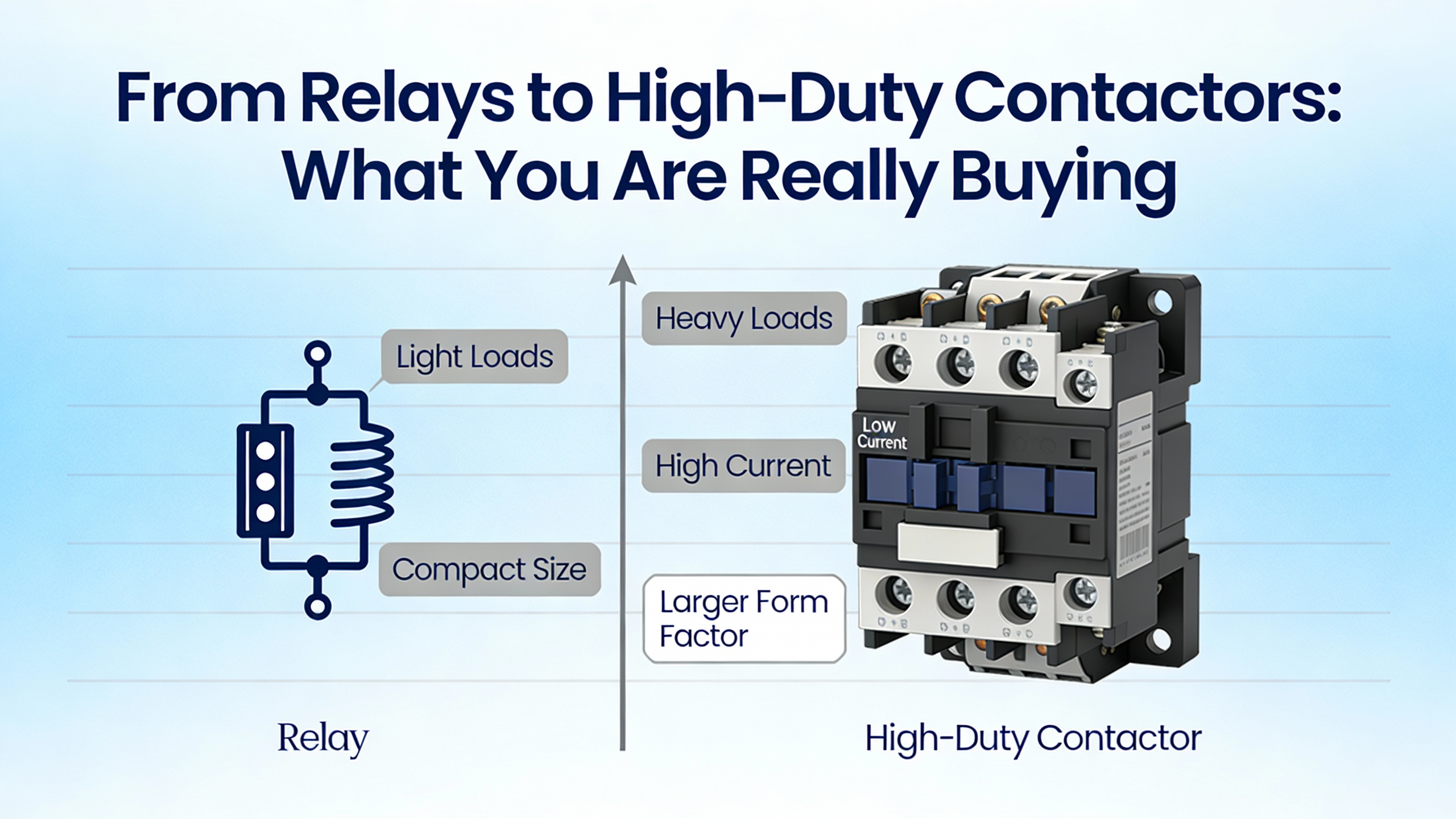
From Relays to High‑Duty Contactors: What You Are Really Buying
Before you judge a supplier, it helps to be clear about the component itself.
A contactor is an electrically controlled, high‑current switch that uses an electromagnetic coil to pull in heavy‑duty power contacts inside an insulated enclosure. Manufacturer briefs from Kent Store and c3controls describe the core elements the same way. There is a coil or electromagnet that produces the force, one or more main contacts that carry the load current, auxiliary contacts for signaling and interlocks, and an enclosure with an arc chute to manage the arc every time the circuit opens.
Compared with relays, which typically handle low currents in the range of roughly 5 to 15 amperes, c3controls notes that contactors cover everything from a few amperes up to well over 5,000 amperes and more than 100 kilowatts at voltages from 24 VDC into the thousands of volts. That makes them the right tool for motors, large lighting banks, heavy heating loads, and the feeders that power your UPS, inverters, and distribution gear. Kent Store highlights that modern industrial contactors, as of 2025, can reach more than ten million mechanical operations, which is exactly what you need in applications with frequent switching.
It is also important to separate contactors from motor starters. A motor starter is essentially a contactor bundled with overload protection and control elements. Kent Store and c3controls both emphasize that a bare contactor on its own does not provide motor overload protection; that duty belongs to separate overload relays or electronic protection units that must be specified and coordinated.
From a reliability perspective, you are not just buying copper and plastic. You are buying a tested mechanism for repeatedly making and breaking high‑energy circuits at distance, on command, in a controlled way. The quality of that mechanism, its contact materials, its arc control, and its thermal design are what differentiate commodity devices from industrial‑grade solutions.
Electromagnetic, Solid‑State, and Specialized Designs
Almost all industrial contactors in the field today are magnetic contactors. As RS and Kent Store explain, they operate entirely via electromagnetism and require only a small control power to open and close, enabling remote operation without manual intervention. This basic design has proven efficient and reliable over decades.
However, it is not the only option. Kent Store and RS outline several important variants:
| Contactor type | How it works and where it fits | Key pros | Key considerations |
| Electromagnetic (mechanical) | Coil pulls a mechanical armature that closes metal contacts; standard for motors, heating, and lighting. | Very high current capacity, low on‑state resistance, relatively low cost, well understood. | Contacts wear over time from arcing; requires periodic inspection, cleaning, and replacement. |
| Solid‑state | Uses semiconductor devices to switch the load instead of mechanical contacts. | Fast, silent, no contact wear, long switching life, good for precision control and inaccessible locations. | Higher voltage drop and heat, higher initial cost, temperature‑sensitive; needs careful thermal management. |
| Vacuum | Arc is contained in a sealed vacuum chamber. | Very effective arc suppression, suitable for demanding high‑voltage or capacitor switching applications. | More specialized and typically higher cost; must be matched carefully to application. |
| Latching (bistable) | Holds its state mechanically and only needs power for state changes. | Very low holding energy; useful where control power is limited or energy efficiency is a priority. | Control logic is more complex; must ensure safe behavior after power loss. |
| Definite‑purpose | Compact units tailored for HVAC, refrigeration, and pump or compressor duty. | Space‑efficient, accessory‑ready, optimized for specific load types. | Ratings and life are tuned to a narrow duty profile; less flexible outside intended applications. |
Kent Store also points to emerging research into low‑ or zero‑holding‑energy magnetic designs that dramatically cut control‑circuit power once the contactor is closed. In large UPS, inverter, or EV‑charging installations with thousands of coils energized, this can translate into material efficiency gains over the system life.
When you evaluate a supplier, one practical question is whether they can cover all of these technologies—especially if your site mixes classic motor loads with high‑duty cycling, low‑noise building services, and energy‑storage DC strings. Suppliers aligned with large portfolios from brands such as Schneider Electric, ABB, Eaton, and Siemens are often better positioned to do that.
Matching Contactor Architecture to Your Industrial Loads
For a power‑protection project, the heart of the specification exercise is matching the architecture of the contactor to the load: AC versus DC, single‑phase versus three‑phase, pole count, and ratings.
AC vs DC and Single‑ vs Three‑Phase
Kent Store and RS both emphasize that contactors are always designed for one power type: AC or DC. AC contactors use AC coils and rely on the natural voltage zero‑crossings of alternating current to help extinguish arcs. They dominate applications like standard motors, lighting, and resistance heaters.
By contrast, DC contactors use DC coils and require much stronger arc suppression, with features like magnetic blow‑outs and specialized arc chutes. Kent Store and Proax note that DC contactors are favored in battery systems, EV charging, DC drives, PV arrays, and DC‑coupled energy storage. Proax specifically highlights ABB’s GF, GAF, and GA families, engineered for switching DC circuits up to about 1,500 volts, and explicitly aimed at systems such as PV solar, EV charging, UPS, and storage.
Power system architecture also determines whether you need single‑phase or three‑phase devices. RS describes single‑phase contactors for smaller, single‑phase installations, usually switching the live conductor while leaving the neutral intact. Three‑phase contactors, with three main contact sets, are the industrial workhorses for large motors, heavy machinery, and any high‑power equipment in typical plant and data center environments. In practice, that means most UPS input and bypass paths, as well as many inverter feeders, will be managed through three‑phase contactors.
Using Pole Count Strategically: Beyond Three Poles
Once you know the phases, the next decision is how many poles you actually need. Standard motor contactors are usually three‑ or four‑pole devices. However, Contactor Depot’s guidance on six‑ and eight‑pole designs is particularly relevant for complex facilities.
Six‑pole contactors are designed for applications where several moderate‑load circuits, such as multiple motors, HVAC units, or lighting groups, can be controlled from a single point. Eight‑pole units extend that concept further, offering additional connection points and greater flexibility for large, power‑heavy installations. Contactor Depot points to sectors like manufacturing automation, data centers, transportation infrastructure, power plants, and healthcare facilities with critical and backup power as typical users.
Space in your panels matters as well. Six‑pole devices can be a compact way to aggregate multiple circuits where you might otherwise install several smaller contactors. Eight‑pole models consume more space but allow more circuits and, importantly, leave room for future connection of added motors or loads. As Contactor Depot suggests, choosing an eight‑pole contactor with spare poles up front can significantly reduce future rewiring and associated downtime when you expand.
A simple example illustrates the point. Imagine a chilled‑water system with four pumps today and likely expansion to six pumps as load grows. A single eight‑pole contactor with six poles reserved for the pumps and two for auxiliaries can centralize control, simplify interlocking, and avoid adding a second contactor and field wiring when the extra pumps are installed later. Over the life of the plant, that design decision and the supplier’s ability to support it will often matter more than a small upfront price difference.
Sizing for Voltage, Current, and Inrush
Every reputable manufacturer and distributor in the notes gives the same fundamental advice: start with the load. Kent Store, c3controls, Long‑term industrial guides, and Proax all recommend that you first determine the type of load, its voltage, its running current, and the inrush or starting current, as well as the duty cycle. Then you select a contactor whose ratings meet or exceed those requirements.
c3controls highlights that power ratings represent the maximum voltage and current the contactor can safely switch. Kent Store adds that you must align three parameters: the contactor’s voltage rating (the maximum line voltage that can be safely interrupted), the current rating under the relevant utilization category, and the coil voltage that matches your control supply. Kent Store and RS both stress that the coil voltage does not need to match the load voltage; you can, for example, use a 24 VDC coil to switch a high‑voltage AC motor, which is standard practice in UPS and PLC‑based control panels.
Utilization categories are another subtle but important dimension. Kent Store references common IEC categories such as AC‑1 for resistive loads and AC‑3 for motor starting. Long‑duration resistive loads like heating elements impose relatively gentle electrical stress; inductive loads like motors generate high inrush and strong arcs when switching. c3controls advises that for inductive loads you should ensure the contactor’s inductive rating accounts for both the starting surge and the steady running current.
A simple calculation makes the reason obvious. LongBeach‑style guidance notes that motor inrush can be roughly six to eight times the running current. If a motor nameplate shows 80 amperes full‑load current and your application involves frequent starting, the contactor may see 480 to 640 amperes during each start. It would be a mistake to size the contactor purely on the 80‑ampere running current. Instead, you need a contactor whose AC‑3 rating and mechanical endurance are appropriate for that level of stress.
As system voltages climb, these choices become more critical. ABB contactors presented by Proax, for example, span motor ratings from about 9 to 800 amperes and installation contactors from about 16 to 100 amperes, while Chint’s NC1 and NC2 contactors are rated up to about 690 volts AC with currents up to around 800 amperes. At DC, ABB’s GF, GAF, and GA contactors reach about 1,500 volts. Combining these capabilities intelligently for your UPS feeders, inverter outputs, and DC strings is precisely where a knowledgeable supplier earns their keep.
DC Contactor Selection for UPS, PV, and Storage
DC contactors deserve special attention in power‑protection work because they often sit between high‑energy battery strings and the rest of the system. Schaltbau’s guidance on DC contactor selection is particularly explicit and aligns well with best practice.
The two starting parameters are the rated insulation voltage and the rated operational current, which Schaltbau calls the thermal continuous current. The thermal current determines how hot the contactor runs in normal service; it depends heavily on the resistance of the main contacts, which in turn is driven by the contact material and contact force. Manufacturers specify this rating under very specific environmental and installation conditions. If your cabinet differs in ventilation, ambient temperature, or mounting, the actual safe current may change.
Schaltbau notes that in some practical cases, a certain overload above the rated operational current is permissible, citing an example of about twenty‑five percent overcurrent in a well‑ventilated control cabinet. For instance, a DC contactor with a 200‑ampere rated operational current might tolerate 250 amperes in those favorable conditions. However, Schaltbau is clear that any planned overload or deviation from ratings must be explicitly clarified and agreed with the manufacturer. That is exactly the kind of coordination an experienced supplier should facilitate.
Crucially, DC contactors must be able to interrupt not just continuous current but also transient peak currents. Many applications show short‑term peaks at specific operating points; from a purely thermal perspective these may be harmless, but from a switching and safety standpoint they can be decisive. Schaltbau recommends that engineering assessments consider worst‑case fault scenarios and that system developers work closely with contactor manufacturers to interpret ratings against real application conditions.
For a UPS battery or DC‑coupled storage project, a strong supplier will therefore do more than pull a catalog part. They will help you interpret the ABB or Schaltbau curves, confirm that insulation voltage and breaking capacity cover your highest normal and fault‑level voltages, and, where needed, engage the manufacturer to validate any overload or derating assumptions.
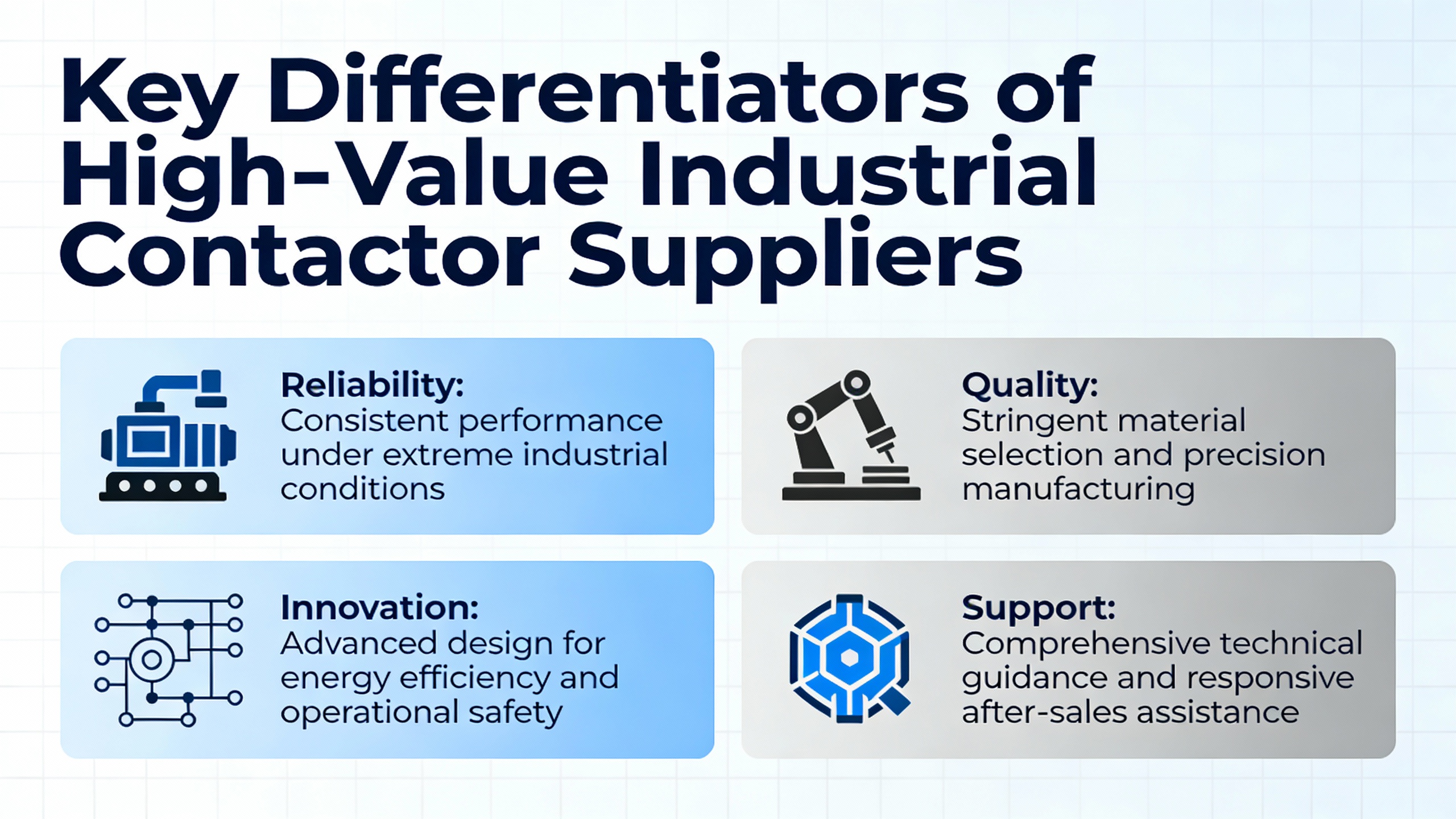
What Distinguishes a High‑Value Industrial Contactor Supplier
Once the technical fundamentals are clear, the question becomes: what makes a supplier a true reliability partner rather than just an order‑taker?
Portfolio Depth, Standards, and Certifications
A first marker is the breadth and depth of the supplier’s portfolio and its alignment with recognized standards. Kent Store points to major brands such as Schneider Electric, ABB, Eaton, and Siemens as examples of manufacturers with broad contactor families, international certifications, and global support networks. Distributors aligned with those ecosystems typically offer better coverage across AC and DC, general‑purpose, definite‑purpose, safety, and specialized contactors.
Proax, for example, acts as an ABB authorized distributor and highlights a wide range of contactors: standard three‑phase motor contactors from roughly 9 to 800 amperes, installation contactors optimized for low‑noise building services, specialized capacitor‑switching contactors with damping resistors to manage high inrush, lighting contactors in electrically held and mechanically held variants, definite‑purpose contactors for compressors and resistive heating, and high‑voltage DC contactors for PV, EV, UPS, and storage.
c3controls underlines another aspect, the choice between NEMA and IEC designs. NEMA contactors, used largely in North America, are organized into standardized frame sizes such as 00, 0, 1, and higher, and are deliberately oversized with safety margins that can be around twenty‑five percent. IEC contactors, by contrast, are more compact, fine‑tuned to specific application ratings, and often incorporate “finger‑safe” terminal designs and faster response to overloads. A supplier that understands both standards and can steer you between them based on load certainty, space, and maintenance philosophy provides clear value.
Certifications are non‑negotiable. Contactor Depot explicitly recommends UL or IEC‑certified products engineered for industrial use, and Proax stresses CSA and UL compliance for their ABB solutions. In a power system that must meet codes and insurance requirements, working with a supplier that treats certifications as table stakes, not an afterthought, is essential.
Engineering Support and Application Guidance
The second differentiator is engineering depth. In practice, many of the failure modes that c3controls and Chint describe—welded contacts from high inrush, coils burned by over‑ or undervoltage, excessive heating from poor ventilation—are rooted in misapplication more than inherent product flaws.
Proax highlights that its in‑house engineers across numerous locations in Canada support customers in selecting, installing, and maintaining ABB contactors. Contactor Depot positions its free technical support as a resource for installation and maintenance questions. Balaji Switchgears, focusing on Schneider contactors, emphasizes the value of working with authorized suppliers for standards‑compliant service and technician training. KINO Electrical underscores its ability to support selection and supply of replacement and application‑specific AC contactors.
Schaltbau’s recommendation for early, collaborative definition of DC contactor requirements and explicit manufacturer sign‑off on any overload or nonstandard condition is a good benchmark. A supplier that habitually involves the manufacturer’s engineering team, rather than guessing at derating, will help you avoid unpleasant surprises later in factory acceptance testing or commissioning.
Logistics, Spares, and Lifecycle Cost
Contactor Depot introduces another angle that system owners sometimes overlook: logistics as a reliability strategy. They emphasize next‑day shipping for urgent replacements in industrial settings and free shipping across the United States, backed by a quality guarantee and industrial‑rated, certified products. The message is that rapid component availability is as much a part of reliability as the nameplate on the device.
Modern contactors may have mechanical lives in the millions of operations, as Kent Store notes, but actual electrical life depends heavily on load type and duty cycle. In a plant where a motor contactor cycles once per minute around the clock, even a ten‑million‑operation mechanical rating can be consumed over years rather than decades. Thoughtful suppliers help you plan strategic spares based on your switching profile and the consequences of failure, not just on the procurement budget.
Long‑term guidance from business‑oriented sources stresses evaluating total cost of ownership rather than purchase price alone. That perspective aligns well with what we see in the contactor domain: a slightly more expensive IEC or NEMA contactor from a mainstream industrial brand, backed by fast availability, manufacturer support, and known failure behavior, usually costs less over the life of a UPS, inverter, or plant electrical system than a bargain device that fails unpredictably and is hard to replace.
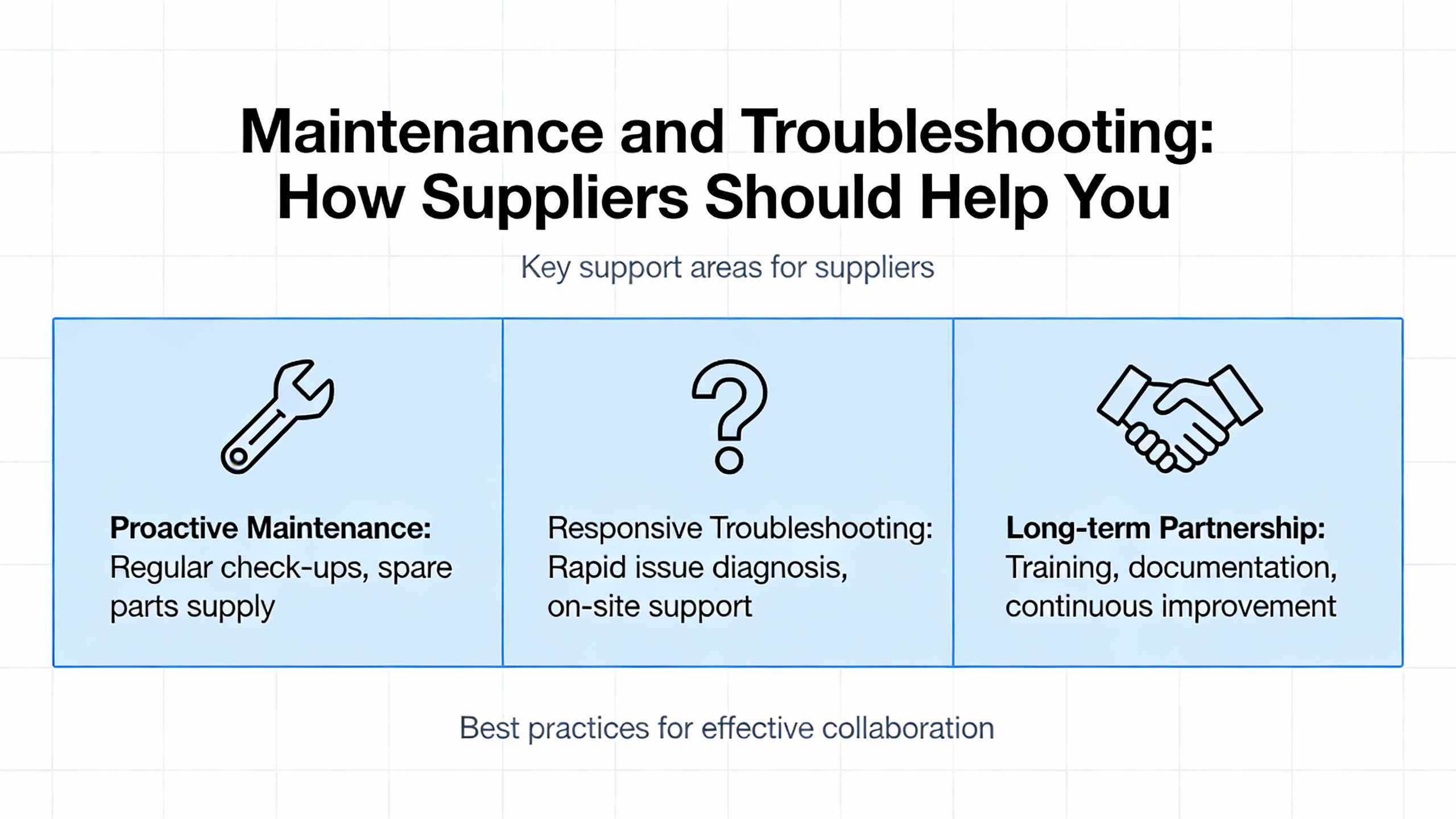
Maintenance and Troubleshooting: How Suppliers Should Help You
Specifying the right contactor is only half the reliability story. Keeping it healthy over time demands a maintenance program, and your supplier should be able to support that as well.
Preventive Maintenance Fundamentals
Balaji Switchgears, Contactor Depot, KINO, Chint, and other manufacturers converge on a set of preventive actions that significantly extend contactor life. Regular visual inspections are first. Technicians should look for burn marks, discoloration, cracked housings, loose terminals or mounting screws, and dust or debris buildup. Catching these symptoms early allows intervention before they escalate into overheating, short circuits, or outright failure.
Contact surfaces deserve particular attention. Balaji recommends cleaning to remove carbon deposits and dirt caused by arcing, using only soft cloths or manufacturer‑approved cleaners to avoid damaging conductive surfaces. Contactor Depot’s maintenance guidance adds that uneven wear, damaged surfaces, corrosion, or exposed copper are all signs that the contact set should be replaced as a unit to maintain balance and performance.
Coil health is equally important. Balaji and KINO both advise regular checks with a multimeter to verify that coil resistance falls within the manufacturer’s specified range. Coils that are open, shorted, or far out of tolerance can cause chattering, failure to close, or overheating. Chint’s troubleshooting instructions include tests where technicians measure both coil voltage and contact resistance and interpret out‑of‑range readings as indicators of faulty coils or contacts.
Terminals and mounting hardware must be tightened periodically. Both Balaji and Contactor Depot note that vibration and thermal cycling can loosen connections, increasing contact resistance, creating hot spots, and reducing efficiency. In my experience, many “mysterious” hot contactors in UPS rooms trace back to a terminal that was never properly torqued.
Auxiliary contacts and overload relays, where present, should be inspected and tested. Balaji points out that misaligned or worn auxiliary contacts can disrupt feedback to the control system, while Contactor Depot recommends verifying overload relays by checking torque, matching full‑load amperage dials to motor ratings, and manually tripping and resetting relays to ensure they operate correctly.
A robust preventive program also uses structured maintenance logs. Balaji encourages tracking inspection dates, observations, repairs, and replacements. With that data, you and your supplier can spot patterns, such as a specific contactor family wearing out faster under certain loads, and adjust product selection or maintenance intervals accordingly.
Diagnosing Overheating, Noise, and Nuisance Trips
Even with good maintenance, issues will occur, and your supplier’s troubleshooting playbook matters.
Chint’s articles on noisy contactors and selection troubleshooting, together with c3controls’ failure analysis, describe several common symptoms. Overheating can result from high ambient temperature, contactors being energized for prolonged periods, overvoltage on the coil, undervoltage that prevents full armature pull‑in, overloading, or poor ventilation. Discoloration of terminals and insulation is an early warning sign. Measuring the actual current and comparing it to the contactor’s ratings, as well as checking coil voltage against the nameplate, are the first checks.
Unusual humming or buzzing is another frequent complaint. Chint explains that all AC contactors generate some noise, but a loud or sudden hum often indicates that coil voltage is outside the rated range, loosening the magnetic coupling. Undervoltage, poor connections, or overloaded circuits can cause the magnetic field to pulse unevenly, creating 50 to 60 Hz vibrations. Mechanical wear or misalignment of the armature, as well as dust, oil, or other contaminants on the pole faces, also introduce air gaps that reduce magnetic attraction and encourage vibration. In AC designs that use shading coils to stabilize the magnetic field at zero‑crossings, a degraded shading coil can dramatically amplify humming.
KINO and Chint both recommend methodical testing with a volt‑ohmmeter. With power removed, you label and disconnect wires, then measure contact resistance; a healthy closed contact should read near zero ohms, while higher values indicate contamination or wear. If all contacts appear bad, Chint suggests energizing the coil and confirming with a voltmeter whether the correct voltage is present at each contact; if it is and the contact still fails, the coil itself is suspect.
A specific caution appears in Chint’s maintenance tips: avoid blasting the panel with compressed air, which can drive dust and debris directly into contactors. Instead, vacuum around electrical components and clean pole faces and contacts with appropriate tools and solvents.
Suppliers that stock low‑noise or hum‑free contactors, such as ABB’s installation contactors that Proax describes, or Chint’s NC2 series engineered for minimal vibration, can sometimes resolve persistent noise problems by design rather than continuous troubleshooting, especially in noise‑sensitive areas like offices and classrooms fed from central UPS systems.
Maintenance‑Friendly Designs and Supplier Services
Contactor Depot points out that robust enclosures and durable construction can reduce cleaning frequency and mitigate loosening from vibration. Kent Store emphasizes that selecting units with appropriate enclosure ratings, high‑temperature coils, and corrosion‑resistant contacts lowers unscheduled downtime and total ownership cost. KINO highlights the importance of correct installation in clean, dry, well‑ventilated areas, proper mounting torque, and adherence to wiring diagrams.
Balaji and KINO both stress technician training, and Balaji links that explicitly to authorized suppliers who can deliver factory‑aligned guidance. Contactor Depot and Proax supplement this with free or bundled technical support. That ecosystem—maintainable products, correct application, and support when things go wrong—is what separates a reliability‑focused contactor supplier from a simple catalog house.
Application Snapshots for Power‑Protection Projects
To connect these principles to day‑to‑day decisions in UPS and power‑protection work, it helps to look at a few typical scenarios.
UPS and Energy‑Storage DC Switching
In battery‑centric systems, DC contactors sit between high‑energy DC strings and the rest of the power system. Proax describes ABB DC contactors in the GF, GAF, and GA series engineered to switch DC up to about 1,500 volts in applications such as PV solar fields, EV charging infrastructure, UPS, and storage. These devices are designed specifically to break DC circuits safely, which is more demanding than AC interruption at the same voltage.
Schaltbau’s selection criteria push users to treat these devices as engineered components rather than simple catalog items. Rated insulation voltage must exceed the highest DC voltage in your system, including transients. Rated operational current must cover the highest average current under realistic ambient and ventilation conditions. Transient peaks during charge, discharge, and fault must also be within the contactor’s breaking capacity at your chosen operating point.
Consider a DC‑coupled storage rack designed to operate at 1,200 volts and 200 amperes nominal, with short‑term peaks to 300 amperes during fault clearing. The supplier’s role is to match this profile to an ABB or Schaltbau contactor whose insulation and breaking curve cover that operating window, verify with the manufacturer whether any overload or derating is required, and confirm that mounting and ventilation match the assumptions used in the ratings. That level of support is markedly different from simply providing a “1,500‑volt DC contactor” by part number.
Multi‑Motor and Facility Loads with Six‑ and Eight‑Pole Contactors
In automation lines and chilled‑water plants feeding inverter‑backed loads, you often see multiple motors that must be started, stopped, or transferred together. Contactor Depot’s description of six‑ and eight‑pole contactors shows how these devices can simplify the design.
Six‑pole contactors handle several moderate‑load circuits controlled from a central point. They are well suited for grouped motor control, multi‑zone HVAC, or sectionalized lighting. Eight‑pole devices extend that capacity and allow a designer to combine motor control with additional tasks such as bypasses, interlocks, and status circuits.
For example, in a data center mechanical room with multiple CRAH or CRAC units served from a UPS‑backed bus, a single eight‑pole contactor might be used to shed or transfer several fan and pump motors during certain operating modes, while still reserving poles for feedback and auxiliary functions. The supplier’s contribution is to help calculate aggregate current, verify utilization categories, check space and heat dissipation in the panel, and ensure that UL or IEC certifications cover the combined application.
Building Services and Lighting under Power Protection
ABB’s installation and lighting contactors, as presented by Proax, illustrate another dimension of supplier value for power‑protected facilities. Noise‑optimized installation contactors with ratings roughly from 16 to 100 amperes can control lighting, heating, ventilation, motors, and pumps in noise‑sensitive spaces fed from central UPS or generator systems. Hum‑free operation is particularly important in hotels, offices, hospitals, and classrooms.
For heavier lighting loads, Proax describes CR‑series lighting contactors with modular designs, electrically held and mechanically held variants, and ratings from about 30 to 300 amperes. A supplier that understands how these devices behave with fluorescent, mercury arc, tungsten, and sodium lamp loads, and how they interact with UPS output waveforms and transfer behavior, can help avoid nuisance trips and compatibility issues.
FAQ: Working with Industrial Contactor Suppliers
How is a contactor different from a relay, and why does that matter for UPS and inverter systems?
According to c3controls and Kent Store, a contactor is essentially a high‑power version of a relay. Relays generally handle control‑level currents, often around 10 amperes or less, whereas contactors are rated from a few amperes into the thousands, including large motor and feeder currents. Contactors also incorporate arc‑management features, robust mechanical structures, and enclosures designed for repeated high‑energy switching. In UPS and inverter systems where you are switching feeders, bypass paths, and large motor loads, you need the capabilities of a contactor rather than a relay. Using relays outside their intended current range is a recipe for welded contacts, overheating, and unreliable transfer.
When does it make sense to specify a solid‑state contactor instead of a traditional electromagnetic unit?
Kent Store and RS note that solid‑state contactors use semiconductors rather than mechanical contacts, giving them very fast, silent operation and essentially unlimited switching life in terms of mechanical wear. They are particularly attractive in applications that involve extremely frequent switching, where noise is unacceptable, or where equipment is hard to access for maintenance. However, they introduce a higher voltage drop and more continuous heat than electromagnetic contactors and generally cost more. In a UPS‑fed process where a heater bank is being duty‑cycled many times per minute and is located in a space that is difficult or risky to access, paying extra for a solid‑state contactor can be justified. For conventional motors and feeders that cycle less often and where periodic maintenance is routine, an electromagnetic contactor is usually more economical and efficient.
How often should industrial contactors be inspected?
Manufacturers and distributors such as Balaji Switchgears, Contactor Depot, KINO, and Chint all recommend regular inspections, but none prescribe a single universal interval, because it depends on duty and environment. In heavily cycled applications, harsh environments, or critical paths in UPS and inverter systems, inspections may need to be performed on a schedule aligned with other preventive maintenance, such as quarterly or semi‑annually. In lighter‑duty, clean environments, annual inspections may suffice. What matters most is that inspections are structured, documented, and include checks of contacts, coils, terminals, mechanical operation, thermal condition, and, where present, overload relays. A good supplier will help you tailor inspection frequency to your operating profile and risk tolerance.
In well‑engineered power systems, industrial contactors are not commodities; they are safety‑critical actuators that stand between your loads and every abnormal condition the grid can throw at you. Partnering with a supplier who understands the nuances of contactor technology, has direct access to major manufacturers, and stays engaged through selection, installation, and maintenance is one of the most cost‑effective reliability investments you can make.
References
- https://www.greatertorontoeca.org/files/Best%20Practices%20for%20Electrical%20Contractors%20(2018).pdf
- https://www.electri.org/product/establishing-a-best-practices-program-for-electrical-contractors/
- https://balajiswitchgears.com/maintenance-tips-for-schneider-contactors/
- https://www.c3controls.com/white-paper/basics-of-contactors?srsltid=AfmBOopiRvq-1ZacLgZatexJPJs04BkVgStzocjuwOfAt-D8cxDYlvTm
- https://groundbreakcarolinas.com/5-strategies-for-superior-industrial-construction-projects/
- https://www.kinoelectrical.com/blog/how-to-maintain-an-ac-contactor-315581.html
- https://www.ntactoperations.com/post/energyindustryconstructioncontractor
- https://www.powermag.com/strategies-for-operating-safely-within-power-construction-zones/
- https://www.rhumbix.com/blog/10-ways-electrical-contractors-can-boost-productivity
- https://contactordepot.com/blogs/news/electrical-contactors-for-industrial-operations-why-6-pole-and-8-pole-options-are-essential-6?srsltid=AfmBOoo-6H4cDx2hvQIWgkbAF9UPzP36wQ-sIj024vwp2M4B0COYhZbB


 Videos
 News
News Applications






Leave Your Comment