In industrial and commercial power systems, most teams obsess over kilowatts, short-circuit ratings, and backup runtimes. In my reliability audits, the unplanned outage rarely starts with the UPS or inverter silicon; it usually starts with a cable or connector that was treated as a commodity. Once you put power electronics, PLCs, and SCADA onto the same Ethernet backbone, your cabling and cable suppliers become part of your protection system, not just your bill of materials.
Research from Fortune Business Insights estimates the global wires and cables market at about $208.89 billion in 2023, growing to $220.28 billion in 2024 and a projected $357.34 billion by 2032 with a roughly 6.23 percent compound annual growth rate from 2024 to 2032. That growth is driven by renewables, electric vehicles, and smarter infrastructure, all of which depend on specialized power and data cables. BCC Research points to leading manufacturers investing in high‑voltage direct current (HVDC) transmission, industrial Ethernet, submarine power links, and advanced fiber systems as the backbone of this transition.
This guide looks at industrial cable suppliers through a reliability lens. The focus is simple: how to choose connectivity partners that will keep UPS, inverter, and power protection systems online in harsh, data‑rich environments.
Start With What You Are Really Powering and Protecting
Before comparing suppliers, you need a clear picture of what functions your cables must perform. For critical power systems, that usually breaks into three families: power conductors, data and control links, and specialty cables for unusual environments.
Marsh Cable & Connectors describes electrical cables as insulated conductors that safely deliver power from sources to loads. Quality depends on correct wire gauge, high‑conductivity metals, robust insulation, and compliance with safety standards. In the same portfolio, networking cables such as twisted pair, coaxial, and fiber optic form the backbone for digital communication. Marsh emphasizes that insulation and shielding quality directly influence energy efficiency, signal integrity, and lifespan, especially when heat, moisture, and electromagnetic interference are present.
In a typical UPS‑backed facility, a power outage can originate from any of those three families. A mis‑sized feeder between switchboard and UPS can overheat. A marginal Ethernet patch cord between the UPS network card and the monitoring server can drop alarms. A poorly chosen specialty cable near a rooftop inverter can crack under ultraviolet exposure and temperature swings.
Imagine a commercial building adding a new inverter‑based emergency power system. Electrical engineers specify the main power feeders and battery strings. At the same time, controls engineers need Ethernet to the inverter, Modbus to meters, and possibly fiber links back to a central control room. If you treat all those cables as interchangeable commodities, you invite trouble later. If you treat them as differentiated components and select suppliers accordingly, you build a more resilient system.
Power Conductors: Where Global Giants Usually Matter
At the medium‑voltage and high‑power end of your system, large global wire and cable manufacturers tend to dominate. Fortune Business Insights highlights Prysmian Group and Nexans for extensive submarine and underground transmission and distribution systems plus optical fiber and copper telecom cables. BCC Research notes that LS Cable & System supplies HVDC cables for long‑distance power transfer, while Furukawa Electric provides submarine power cables that connect offshore wind farms to shore. Southwire is recognized as one of North America’s largest wire and cable manufacturers, with its Simpull technology designed to simplify installation, cut labor costs, and improve jobsite safety.
For facility‑scale projects, these capabilities matter when you are tying into utility infrastructure, bringing in higher voltage feeders, or supporting renewable plants and large‑scale energy storage. Sumitomo Electric, for example, is cited for its underwater power cable facility supporting renewables and for electric vehicle cables aimed at the rapidly growing EV market. NKT is involved in HVDC and AC grid expansion projects that directly support modernized, resilient power networks.
If your project involves long runs from a substation, integration of a wind or solar farm, or critical feeders that run outdoors in harsh climates, your cable supplier comparison should include these global players. They bring proven product lines, extensive testing, and project experience in the same environments your cables will see.
Consider a large industrial campus connecting a new UPS‑backed data hall to an on‑site substation. Using a supplier with experience in high‑voltage and grid‑integration projects means your medium‑voltage cables, terminations, and accessories come from a portfolio that has already passed through utility‑grade scrutiny. That reduces project risk compared with a purely commodity approach at the same current and voltage levels.
Data and Control Cables: Where Industrial Ethernet and Fiber Take Over
As soon as you look at UPS monitoring, battery management, protective relaying, or automation networks, the spotlight shifts to data cables. DynamicRep explains that industrial Ethernet cables are engineered to maintain reliable, secure data transmission in harsh environments, including extreme temperatures, moisture, vibration, and electromagnetic interference. Copper categories such as Cat 5e and Cat 6 are widely used, supporting up to about 1 gigabit per second and 10 gigabits per second respectively, while fiber optic cables push bandwidth much higher, up to roughly 100 gigabits per second, and remain immune to electromagnetic interference.
Marsh Cable & Connectors points out that coaxial cables with a central conductor, insulation, and metallic shield support high‑frequency signals over long distances with reduced interference, and that fiber optic cables transmit data as light, offering very high bandwidth and long‑distance performance with minimal loss. Those characteristics are exactly what you want when UPS alarms, power quality logs, and breaker status must flow reliably into your SCADA or building management systems.
A simple example illustrates the impact. If your control network is built on Cat 5e at 1 gigabit per second and you upgrade key backbone runs to Cat 6 at 10 gigabits per second, you multiply theoretical bandwidth by ten. For a modern substation or UPS plant with hundreds of intelligent devices and time‑series data streaming into analytics platforms, that extra headroom can be the difference between smooth operation and a monitoring system that falls behind under peak load. TE Connectivity captures this shift when it describes bandwidth as the new horsepower in heavy‑duty vehicles: digital capacity now shapes performance as much as mechanical capability.
Belden provides a concrete industrial example. In a case described by the company, a plant transformed operations from a “black box” to a “glass box” by using near‑real‑time data. The improved visibility enabled faster troubleshooting, with the potential to lift revenue by about $1 million if the plant reached planned capacity. For a UPS and power protection environment, the same concept applies: better data cabling and connectivity translate directly into clearer insight, faster fault isolation, and more stable production.
Industrial Ethernet and Network Cable Choices: How Suppliers Differ
Once you know which parts of your system depend on Ethernet and other data cables, you can compare suppliers in that segment more intelligently. The key is to evaluate not only the cable category but also environmental ratings, shielding, connectors, and the depth of each supplier’s industrial portfolio.
Copper, Fiber, and Shielding for Harsh Environments
DynamicRep’s guidance on industrial Ethernet selection is a useful reference. It stresses that choosing the right cables requires looking at environmental requirements, transmission speed and bandwidth, shielding needs, connector types, and installation and maintenance practices.
For environment, industrial cables may be rated to operate from about minus 40°F up to around 185°F, and must resist moisture, chemical exposure, vibration, bending, and crushing. That aligns with Molex’s focus on industrial cable assemblies designed to withstand mechanical stress, continuous torsion, exposure to fluids and chemicals, and elevated temperatures. If your UPS room is adjacent to a hot mechanical space, or if your Ethernet runs pass through areas with cleaning chemicals or lubricants, generic office Ethernet cable is unlikely to survive gracefully.
Shielding must match interference levels. DynamicRep describes unshielded twisted pair for low‑interference environments, foil‑shielded designs for moderate interference, and more heavily shielded constructions with both foil and braided shields for high‑interference zones. Marsh emphasizes that superior shielding helps preserve signal integrity in electrically noisy environments, which is exactly the case near switchgear, inverters, and variable‑frequency drives.
Connectors are another differentiator. RJ45 is common for copper Ethernet, but DynamicRep notes that M12 connectors are often used in industrial applications for their robustness and resistance to moisture and vibration. For fiber, LC and SC connectors support reliable, low‑loss connections over long distances; LC’s smaller size makes it useful where panel space is tight.
Consider a packaging line where PLCs and drives sit right beside variable‑frequency drive cabinets and contactors. Running unshielded Cat 5e in the same cable tray as motor leads can result in intermittent communication issues and lost I/O signals. By switching to a supplier that offers shielded Cat 6 with proper industrial jackets and M12 connectors at the machine end, you align cable construction with electromagnetic and mechanical realities and significantly reduce nuisance faults.
Comparing Ethernet‑Focused Suppliers
Several suppliers in the research notes focus heavily on industrial Ethernet, structured cabling, and field connectivity. They play different roles, from backbone cable specialists to assembly and connector experts to factory‑direct low‑voltage stores.
Here is a high‑level view based on the available information.
| Supplier | Segment focus in connectivity | Where they typically fit | Notable points from sources |
| Belden | Industrial Ethernet, network cabling, connectivity and cable management products | Plant‑wide networks, mission‑critical data links, smart factory deployments | Known for industrial Ethernet cables that enable robust, real‑time data communication on factory floors and in network infrastructures; ISO 9001 certified; long history since 1902; case study showing near‑real‑time data project with projected $1 million revenue upside. |
| trueCABLE | Ethernet, fiber optic, coaxial cables plus connectors and tools | Low‑voltage structured cabling, both indoor and outdoor, where factory‑direct supply and bulk purchasing are useful | Designs and manufactures its own Cat 5e, Cat 6, and Cat 6A cables and related hardware; positions itself as a one‑stop, factory‑direct low‑voltage supplier with tested, end‑to‑end solutions and bulk options. |
| Marsh Cable & Connectors | Premium cable supplies for power and networking | One‑stop sourcing for electrical, coaxial, fiber, and specialty cables, especially where quality and documentation matter | Emphasizes that high‑quality cables reduce malfunctions, improve energy efficiency, and support seamless data transmission; highlights insulation, shielding, specialty cable properties, and the importance of compliance, certifications, and support. |
| Weidmuller | Connection cables, patch cords, heavy‑duty and circular connectors, photovoltaic connectors | Industrial field‑to‑cabinet connectivity, especially sensors, actuators, machinery, and PV arrays | Provides plug‑in connectors and connection solutions to transmit power, signals, and data between the field and control cabinet; offers heavy‑duty and circular connectors suitable for harsh environments and photovoltaic connectors for solar installations. |
| Molex | Industrial cable assemblies that integrate cable and connector | Harsh industrial environments with sensors, actuators, valves, distribution boxes, and PLCs | Engineers assemblies to handle mechanical stress, torsion, chemicals, and heat; supports organized, modular field wiring through connectivity to distribution boxes and I/O modules. |
| TE Connectivity | Connectors, sensors, and ruggedized cables for harsh applications, including vehicles and industry | High‑vibration, high‑reliability applications such as trucks, heavy‑duty vehicles, and demanding industrial environments | Provides ruggedized cables designed to withstand extreme conditions such as underwater and aerospace environments; emphasizes that bandwidth has become as critical as traditional mechanical performance in connected systems. |
For a UPS and power protection project, you might combine these strengths. One common pattern is to use an industrial networking specialist such as Belden for backbone Ethernet and fiber in electrical rooms, combine that with Molex or Weidmuller assemblies for field‑level sensors, actuators, and PV strings, and rely on a factory‑direct supplier such as trueCABLE for structured cabling in office areas and less harsh spaces. Marsh’s perspective on quality and certifications helps evaluate whether each supplier’s products meet your safety and reliability expectations.
As a practical example, consider a facility refreshing the network that monitors dozens of UPS modules and power distribution units. The existing network uses office‑grade patch cords daisy‑chained through unmanaged switches. Applying the guidance from DynamicRep and Marsh, the team selects shielded Cat 6 cables rated for the room’s temperature and EMI levels, RJ45 for rack‑level connections, and M12 assemblies near vibrating equipment. They standardize on a supplier whose products are tested as an end‑to‑end solution, as described by trueCABLE, and whose broader portfolio is built for industrial environments, as in Belden’s offerings. The result is a monitoring network that behaves more like a designed protection system and less like an afterthought.
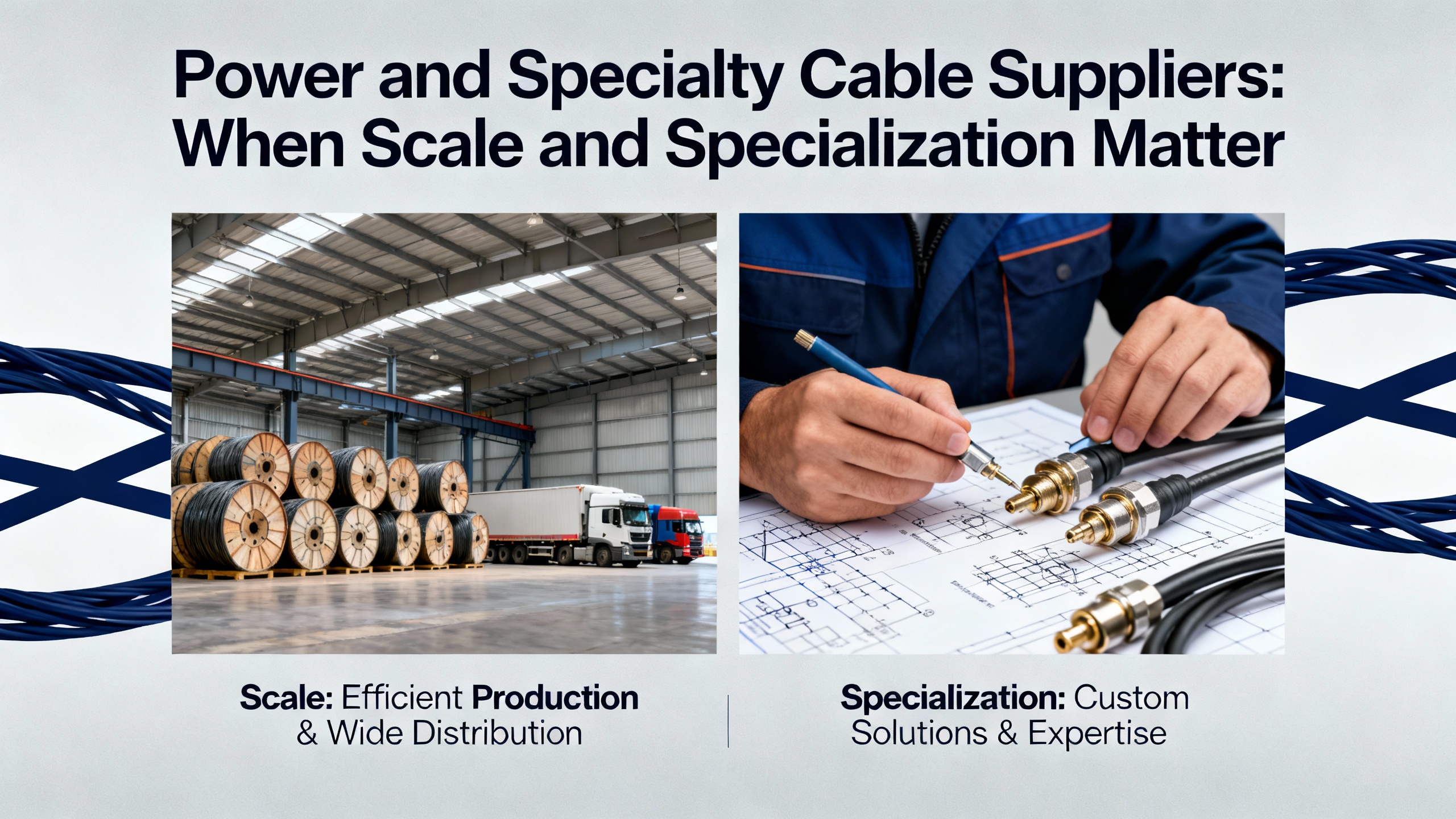
Power and Specialty Cable Suppliers: When Scale and Specialization Matter
On the power side, the decision is not only about conductor size and jacket material; it is also about supplier capability in your specific application, whether that is HVDC export to a grid, medium‑voltage feeders in ducts, or specialized cables in corrosive or high‑temperature environments.
Global Brands Driving High‑Voltage and Renewable Projects
Fortune Business Insights profiles Prysmian Group and Nexans as leaders in submarine and underground transmission projects, as well as optical fiber and copper telecom cables. It notes that Prysmian recently moved to acquire Encore Wire to strengthen its position in building and power cables. Nexans won the submarine cable contract for PacWave South, a grid‑connected wave energy test facility in the United States, illustrating its role at the intersection of marine renewables and grid integration.
BCC Research adds further industrial heavyweights. LS Cable & System in South Korea provides HVDC cables essential for long‑distance electricity transmission, particularly for large‑scale renewable projects. Sumitomo Electric is active across automotive, energy, and telecommunications sectors and develops specialized electric vehicle cables in support of sustainability goals. Fujikura focuses on high‑density fiber optic cables for high‑speed internet and heavily loaded networks, and Furukawa Electric supplies submarine power cables for offshore wind connections. Amphenol brings expertise in high‑speed cabling for digital systems, such as PCI Express, demonstrating the connection between industrial cables and high‑performance computing.
For large infrastructure linked to UPS and inverter systems, such as utility‑scale battery energy storage, microgrids, or offshore wind tie‑ins, these global brands are often the default suppliers. Their products have been proven in similar projects, and their investments in sustainable materials and grid innovations, highlighted by BCC Research, align with long‑term decarbonization and resilience objectives.
Picture a company building a new microgrid with rooftop solar, a battery energy storage system, and UPS‑protected critical loads. The high‑voltage export cables from the battery containers to the main switchgear, and any submarine segments serving offshore generation, are likely specified from manufacturers like Prysmian, Nexans, LS Cable, or Furukawa. At the same time, the fiber feeding SCADA, the Ethernet connecting container controllers, and the internal power and control wiring inside cabinets may come from more specialized or regional suppliers. Understanding this division of roles helps you compare suppliers correctly: you are not asking a local low‑voltage house to do what a high‑voltage submarine specialist does, and vice versa.
Specialty Cables and Regional Suppliers for Project‑Level Needs
Not every project calls for HVDC cables or submarine systems. Many UPS and inverter installations live in tight rooms, corrosive industrial halls, or outdoor enclosures where specialty cables matter more than global megaproject experience.
Marsh Cable & Connectors describes specialty cables designed for high temperature, marine, aerospace, healthcare, and rugged outdoor use, with properties such as flame retardancy, waterproofing, abrasion resistance, or non‑toxicity. It emphasizes that eco‑friendly and biodegradable cable options are emerging for organizations focused on sustainability. These capabilities show up at the project level when you choose low‑smoke, halogen‑free cable for evacuation routes, chemical‑resistant jackets for process areas, or flexible cables for moving machinery.
Regional and specialized suppliers, such as Marsh and factory‑direct brands like trueCABLE, often excel at serving these project‑level needs. They provide diverse catalogs, responsive technical support, and the ability to match products to your specific environment, rather than only to a transmission corridor or offshore wind farm.
Imagine a retrofit in a hospital where new UPS systems support imaging suites and critical care floors. The main feeders may come from a global manufacturer, but within the building, you need data cables with strong shielding for MRI rooms, low‑smoke power cables in escape routes, and fiber runs to a data center. A regional supplier with strong documentation and familiarity with hospital requirements can help you select appropriate cables and, crucially, maintain spares and replacements over the system’s life.
Quality, Compliance, and Lifecycle Support: How to Evaluate Suppliers
Regardless of whether you work with a global giant or a regional specialist, the ultimate test is whether a supplier supports your reliability and compliance goals over decades, not just through the initial purchase.
Certifications, Standards, and Design Discipline
Marsh Cable & Connectors characterizes reliable cable suppliers as those with rigorous quality assurance, adherence to international standards, and third‑party certifications such as UL and IEC, along with strong documentation and after‑sales support. Gcabling’s profile of Belden underscores this point by highlighting Belden’s ISO 9001 certification and strict design and manufacturing processes.
In practical terms, evaluating suppliers means looking for evidence that they treat cable as a controlled, engineered product rather than a commodity. That includes consistent markings and datasheets, clear compliance claims with recognized standards, and a stable product line rather than frequent substitutions. For power cables feeding UPS systems, you want assurance that insulation systems and conductor materials match the thermal and electrical stresses they will see. For Ethernet, you want verification that the cable meets its claimed category performance across the full temperature range.
A simple practice drawn from reliability reviews is to request representative datasheets and, where appropriate, test reports for just a few critical cables: the incoming feeder to a UPS, the main Ethernet backbone to your monitoring system, and any specialty cables in the most demanding environment. Suppliers that respond quickly and clearly are usually better candidates for long‑term partnerships than those that treat these requests as unusual.
Reliability, Maintenance, and Total Cost of Ownership
Marsh notes that cable quality directly affects total cost of ownership: high‑conductivity materials and robust designs lower energy losses, reduce maintenance and replacement frequency, and extend system life, especially in harsh conditions involving moisture, heat, or mechanical stress. DynamicRep highlights common issues such as signal degradation from excessive cable length, improper terminations, or electromagnetic interference, and recommends regular inspections, testing, and preventive maintenance. It also recommends maintaining spare cables and connectors to shorten downtime when failures occur.
The Belden case study that projects about $1 million in additional revenue from a near‑real‑time data initiative is a powerful reminder that connectivity projects are not only cost centers. When better cables and connectors enable clearer operational insight and faster decisions, they contribute directly to revenue and uptime. TE Connectivity’s emphasis on treating vehicle data systems as dynamic assets that must be regularly updated applies equally to industrial plants: connectivity infrastructure is not a one‑time installation but something you maintain and upgrade over time.
For power protection systems, this suggests three reliability‑oriented habits. First, design cable routes, cable management, and bend radii with maintenance access in mind, using cable tray and protection systems as DynamicRep recommends, so replacements do not require invasive work. Second, treat connectors and jumpers as consumables, and stock spares for the specific part numbers used in critical circuits. Third, periodically test key Ethernet segments, especially those near high‑noise equipment, and upgrade shielding or routing if error rates begin to climb.
Installation, Maintainability, and Human Factors
DynamicRep’s article warns that installation and maintenance requirements can make or break an Ethernet deployment. Some cables require specialized tools and expertise; others offer plug‑and‑play termination. It advises planning cable lengths with extra slack for future modifications and aligning cable choices with your installation capabilities. Molex’s focus on modular assemblies and distribution boxes, and Weidmuller’s emphasis on custom assemblies and plug‑in connectors between field and cabinet, both reflect a recognition that practical maintainability matters as much as raw performance.
From a reliability advisor’s perspective, the human factors are central. If your maintenance team is comfortable terminating RJ45 but not M12, you may choose suppliers that provide pre‑assembled M12 cables and concentrate field terminations on RJ45 in protected areas. If your electricians are experienced with a particular brand’s compression lugs and tooling, choosing feeders from the same ecosystem can reduce installation errors.
An example from industrial practice is a plant where unstructured patching grew over years around a UPS‑backed server room. By replacing a tangle of undocumented patch cords with labeled, factory‑terminated assemblies from a consistent supplier, aligned with cable trays and patch panels designed for industrial use, the facility reduced mean time to repair when network issues occurred and improved safety around power and data cabling.
Turning Research Into a Supplier Shortlist
Translating all this into a concrete selection process means viewing cable suppliers through three lenses: connectivity type, environment and criticality, and quality culture.
The first lens is connectivity type. For high‑voltage feeders and grid‑level projects, research from Fortune Business Insights and BCC Research points toward global brands such as Prysmian, Nexans, LS Cable, NKT, Southwire, and similar groups that invest heavily in HVDC, submarine, and grid‑integration systems. For industrial Ethernet, fiber, and structured cabling, sources such as Belden, DynamicRep, trueCABLE, and Marsh emphasize industrial‑grade cables, shielding, and connectors. For field‑level connectivity in harsh environments, Molex and Weidmuller’s portfolios of cable assemblies and connectors, along with TE Connectivity’s ruggedized solutions, are particularly relevant.
The second lens is environment and criticality. DynamicRep and Marsh are consistent in stressing the importance of temperature range, moisture and chemical exposure, mechanical stress, and electromagnetic interference. Molex adds torsion and continuous movement as critical factors. By mapping each cable run in your UPS and power protection systems against those factors, you can decide where premium industrial cable is essential and where standard building cable may suffice. Critical runs, such as Ethernet to breaker protection relays or feeders to emergency distribution boards, usually justify higher‑grade solutions.
The third lens is quality culture and support. Marsh’s focus on third‑party certifications and documentation, Gcabling’s description of Belden’s ISO 9001 quality system, and Fortune Business Insights’ emphasis on innovation and sustainable materials all point to suppliers that invest for the long term. Asking for datasheets, certification evidence, and maintenance guidance, then observing how each supplier responds, is a practical way to differentiate them.
A simple way to organize your thinking is summarized below.
| Decision aspect | What to examine | Supporting insights from sources |
| Connectivity type | Whether the application is high‑voltage power, low‑voltage power, industrial Ethernet, fiber backbones, coaxial, or specialty cable | Marsh distinguishes electrical, networking, coaxial, fiber, and specialty cables; DynamicRep details industrial Ethernet categories and fiber; BCC Research and Fortune Business Insights profile power‑focused and data‑focused manufacturers. |
| Environment and duty | Temperature extremes, presence of moisture or chemicals, mechanical stress, and EMI or RFI near power electronics | DynamicRep highlights temperature ranges down to about minus 40°F and up to around 185°F, plus moisture, chemicals, vibration, and crushing; Molex emphasizes stress, torsion, fluids, and heat; Marsh stresses insulation and shielding quality in noisy environments. |
| System criticality | Consequences of failure for each cable (safety, uptime, data integrity, revenue) | Belden’s near‑real‑time data project shows revenue impact; Marsh underlines that cable quality affects malfunctions and total cost of ownership; TE Connectivity argues that bandwidth and connectivity are now central to performance. |
| Quality culture and support | Certifications, documentation, testing, and responsiveness to technical questions | Marsh highlights UL, IEC, and third‑party certifications; Gcabling notes Belden’s ISO 9001 certification and strict design controls; Fortune Business Insights and BCC Research describe strategic innovation and sustainability investments by top brands. |
Using this structure, you can build a supplier shortlist that matches each category of cable and environment to a supplier or small group of suppliers whose strengths align with that need, rather than attempting to force a single vendor to cover every scenario.
FAQ
How do industrial Ethernet cables differ from office‑grade patch cords?
DynamicRep explains that industrial Ethernet cables are purpose‑built for harsh environments, including extreme temperatures, moisture, vibration, and electromagnetic interference. They often have tougher jackets, tighter twist and impedance control, and shielding options tailored to EMI levels. Marsh notes that better insulation and shielding improve heat resistance and signal integrity, which becomes critical near inverters, drives, and switchgear. Office‑grade patch cords may meet bandwidth requirements in climate‑controlled, low‑noise spaces but often lack the mechanical and environmental resilience required on a plant floor or in an electrical room.
When is it worth stepping up from copper to fiber?
According to DynamicRep, fiber optic cables are ideal for long‑distance data transmission and environments with high electromagnetic interference, supporting data rates up to roughly 100 gigabits per second and being immune to EMI. Marsh reinforces that fiber’s long‑distance performance and immunity to electrical noise make it indispensable for data centers and telecom environments. In power protection applications, fiber is especially valuable when linking remote substations, spanning long runs between buildings, or running through high‑noise areas where copper shielding would be difficult or bulky.
How many cable suppliers should a critical facility rely on?
The research does not specify a number, but it does highlight the benefits of both global and specialized suppliers. Fortune Business Insights and BCC Research show that global players lead in high‑voltage and grid‑integration projects, while Marsh, trueCABLE, Molex, and Weidmuller illustrate the strengths of specialized and regional providers in project‑level and field‑level connectivity. In practice, many resilient facilities standardize on a small set of complementary suppliers: perhaps one or two for power conductors and several for data and field connectivity. The goal is to balance supply chain resilience, technical fit, and maintainability rather than to minimize the number of logos on your cables.
In critical power systems, cables and connectors are not afterthoughts; they are active elements of your reliability strategy. By aligning your choice of suppliers with the specific electrical, environmental, and data demands of your UPS, inverter, and protection systems, and by favoring partners who demonstrate quality and long‑term support, you turn your connectivity infrastructure into an asset that quietly protects your uptime instead of a weakness that waits to fail at the worst possible moment.
References
- https://dspace.mit.edu/bitstream/handle/1721.1/151227/esposito-nesposit-mba-mgt-2023-thesis%5B72%5D.pdf?sequence=1&isAllowed=y
- https://blog.bccresearch.com/top-10-wire-cable-giants-transforming-global-industries
- https://www.belden.com/
- https://store.cablesplususa.com/?srsltid=AfmBOoriGdSmcAfjZFQy9BHWl0kFzVfOt8Jb8tNqeZ8JDntfqtWjlfBP
- https://www.marshcable.com/reliable-cable-supplies-for-efficient-electrical-and-networking-projects
- https://www.omnicable.com/industrial-automation
- https://www.topcable.com/
- https://www.truecable.com/?srsltid=AfmBOop3w4F6poY1t1gqHPD5hwU6Zyxks7skpdSjnoqlAXIH676d1SGO
- https://connectorsupplier.com/how-to-source-connectors-and-cabling-for-industrial-applications/
- https://datacentremagazine.com/top10/top-10-data-centre-cabling-experts


 Videos
 News
News Applications





Leave Your Comment