Industrial plants that rely on ICS Triplex–based safety systems are entering a new phase. Hardware ages, corporate standards shift, and modern safety expectations keep rising. For many operators, the question is no longer whether ICS Triplex worked in the past, but which alternative suppliers can be trusted to keep people and assets safe over the next 10 to 20 years—and how to integrate those platforms with resilient power, UPS, and protection equipment.
As someone who spends most days in substations, MCC rooms, and control-panel galleries, I see the same pattern again and again. The safety PLC decision is made in a vacuum, and only later does the team discover that power quality, panel design, and maintenance culture are what really determine whether the new safety system behaves when the line trips or the UPS switches over. In this article, I will focus on safety PLC ecosystems that are credible alternatives to ICS Triplex, and on how to evaluate them from both a functional safety and power reliability perspective.
What A Safety PLC Really Is (And Why It Matters)
Before you can sensibly compare ICS Triplex to alternative suppliers, you need a clear view of what a safety PLC is and what it is not.
A safety PLC is a programmable controller designed specifically to protect people, equipment, and the environment in hazardous applications. According to industry overviews such as those from ensun and Rabwell, safety PLCs differ from standard automation PLCs in a few critical ways. They use redundant hardware and software architectures, advanced self-diagnostics, and fail-safe behaviors so that, when something goes wrong, the system moves to or holds a safe state instead of simply stopping wherever it is.
These devices are explicitly built and certified to functional safety standards such as IEC 61508, ISO 13849, and IEC 62061. They are designed to help you implement safety functions with defined Safety Integrity Levels (SIL) and Performance Levels (PL), such as SIL 2 or SIL 3 and PL e. In practice, that means a safety PLC monitors inputs like emergency stops, light curtains, safety door switches, and gas detectors, processes safety logic in a certified way, and drives outputs to de-energize motors, close valves, or trip breakers so that the process returns to a safe condition.
A crucial point raised by experienced practitioners in the control.com community is that SIL is not a “PLC badge.” SIL applies to the entire safety loop—from the sensor, through the logic solver, to the final element. Replacing an ICS Triplex logic solver with another brand does not automatically preserve your SIL target. Sensors, actuators, wiring, diagnostics, and even test intervals must be considered end to end.
Another important distinction is between safety PLCs and general-purpose PLCs. Classic controllers such as Allen‑Bradley PLC‑5 or SLC families, for example, are not safety PLCs and are not acceptable when the specification explicitly calls for a safety-rated controller and SIL compliance. That same logic applies if someone suggests replacing a safety PLC with a low-cost programmable relay, an RTU, or a generic PC‑based platform. Those devices may work for non-safety control, but they are not designed or certified to perform safety functions at defined SIL/PL levels.
Why ICS Triplex Users Are Evaluating Alternatives
There are many reasons a plant built around ICS Triplex safety PLCs might evaluate alternative suppliers. Some organizations want a second qualified platform to reduce single-vendor dependency. Others are standardizing on a broader automation ecosystem that combines machine safety, process safety, and general control under a smaller set of vendors. Still others are dealing with aging hardware, changing support contracts, or the need to add new production lines where the original platform is not the corporate standard.
Regardless of the business driver, the technical drivers are remarkably consistent across industries.
First, regulatory and standards pressure is increasing. Functional safety standards like IEC 61508, ISO 13849, and IEC 62061 are being enforced more rigorously, and regulators expect clear documentation of SIL/PL assumptions and validation. Safety is no longer seen as a bolt-on relay panel next to a PLC; it is a system-level design discipline that runs from field device selection through panel construction and software lifecycle.
Second, safety and automation are converging. As Power Safe Automation points out, factories that treat safety and automation as separate streams end up with silos, conflicting upgrades, and more difficult OSHA and ANSI documentation. Integrated safety and automation platforms allow safety circuits, PLC/HMI programming, and SCADA/MES diagnostics to work together. If ICS Triplex sits largely isolated from your main automation strategy, that is a strong reason to consider a unified platform.
Third, power quality and uptime expectations are rising. High-risk industries cannot tolerate safety systems that drop out during a power disturbance or transfer event. Modern machine-safety practice, as highlighted by Industrial Automation Co., emphasizes redundancy not only in logic solvers but also in power supplies, so that a single failure does not compromise safe operation. That naturally pulls UPS systems, redundant DC supplies, and surge protection into the conversation.
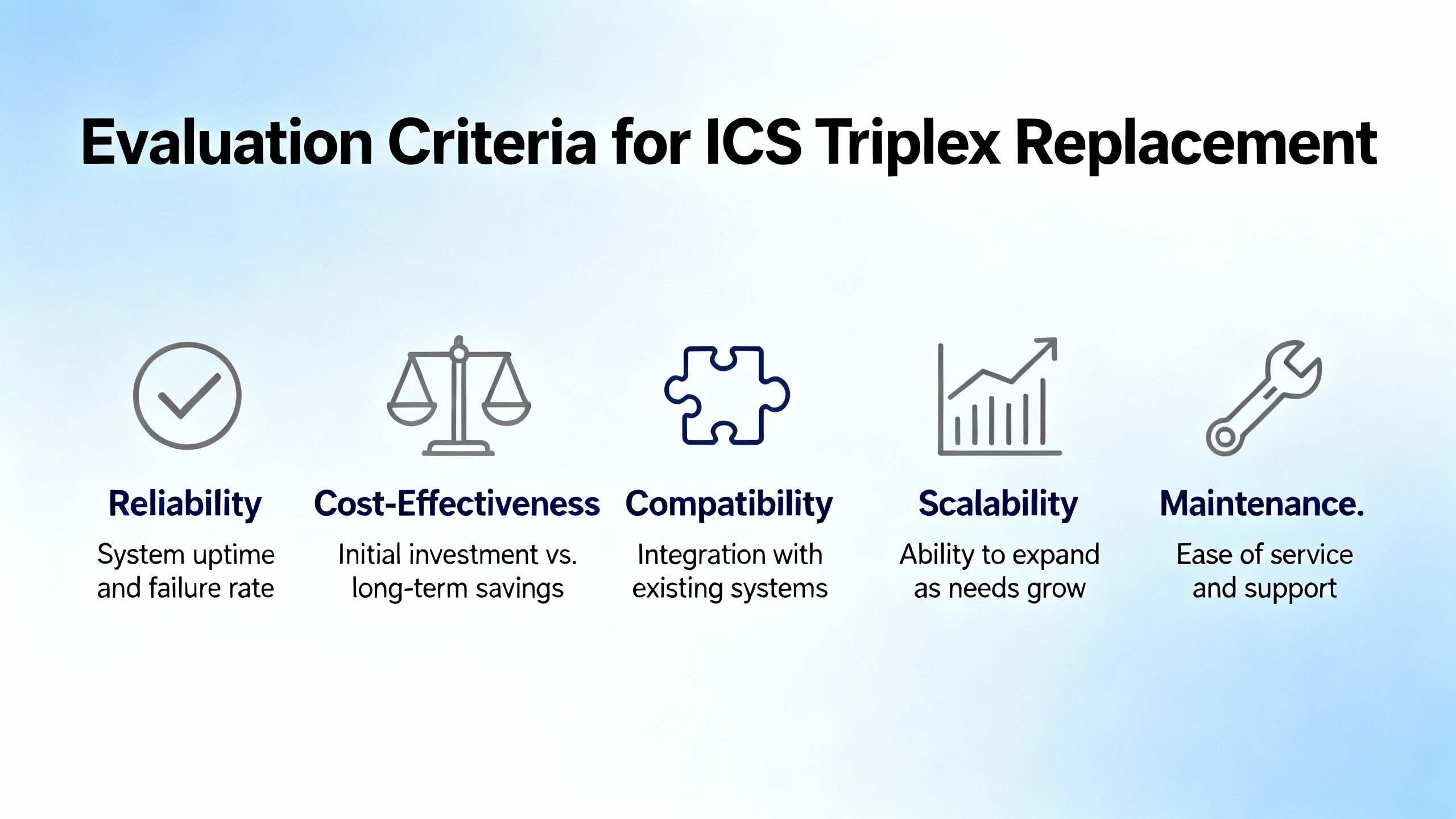
Evaluation Criteria For An ICS Triplex Replacement
Choosing an alternative safety PLC supplier should follow a structured process. The most reliable projects I see treat this as a safety lifecycle decision, not a brand swap.
Define and Confirm SIL / PL Requirements
Start by reading your project and plant specifications carefully for SIL or PL requirements. Practitioners on control.com warn that missing a SIL clause early in design can create enormous problems later during factory acceptance tests or third‑party audits. Confirm whether each safety function targets SIL 1, SIL 2, SIL 3, or a corresponding performance level such as PL d or PL e.
Remember that SIL is loop‑based. Even if your ICS Triplex system had a SIL 2 or SIL 3 capable logic solver, each safety function must be re-evaluated with the new platform’s hardware, diagnostic coverage, and test intervals. When the control.com contributors note that HIMA systems can achieve SIL 2 with simplex I/O, they are describing a specific combination of certified hardware and safety design, not a generic promise that any simplex configuration will do.
Confirm Compliance With Functional Safety Standards
Any credible alternative must be certified to the relevant functional safety standards. Across the research sources, IEC 61508 and ISO 13849 appear again and again as the core frameworks for machine and process safety. IEC 62061 is also important for machine safety using safety PLCs.
Certification is not a paperwork exercise. Nemko, a well-known testing and certification body, emphasizes that functional safety means that automated systems stay safe even when components fail. That requires testing of safety functions and failure modes under realistic conditions, not just a simulation.
Verify System-Level Architecture And Diagnostics
Modern safety automation favors integrated safety controllers with dedicated safety I/O and extensive diagnostics. Rabwell’s comparison of safety PLC ecosystems describes core features such as redundant architectures, dedicated safety modules, and integrated standard plus safety logic in one environment. Features like dual-channel inputs with pulse testing help detect short circuits or wire breaks, and dedicated safety processors run safety tasks separately from standard logic.
Industrial Automation Co. goes further, recommending redundancy in both controllers and power paths and stressing real-time monitoring and predictive maintenance. These capabilities matter because they let you detect problems early, log faults for analysis, and maintain safety functions even when individual components fail.
Panel Design, UL508A, And Power Protection
From a power systems perspective, your safety PLC is only as reliable as the control panel and power system feeding it. Automation Electric points out that UL508A certification for control panels is a de facto industry standard in North America for panels up to 1,000 V. UL508A panel shops build and label panels so that all components—drives, switches, contactors, terminal blocks, transformers, and more—are tested as a system for overcurrent protection, safety, and reliability.
For an ICS Triplex replacement, insist that the new safety logic solver be housed in a UL508A‑certified panel where practical, and that the design integrates clean, conditioned power. Redundant power supplies, appropriate surge protection, and UPS coverage for safety PLCs, network switches, and safety I/O racks ensure that short power disturbances do not disable your safety system at exactly the wrong moment. Industrial Automation Co. explicitly lists backup power supplies as part of a robust safety architecture.
In practice, this often means pairing the safety PLC with industrial UPS systems and DC distribution that can ride through utility sags, generator transfers, or inverter switching events. As a UPS and power-protection specialist, I recommend designing the safety PLC power chain so that it can tolerate at least several minutes of power disturbance without losing the ability to detect hazards and drive final elements to a safe state.
Lifecycle Support, Training, And Safety Culture
Technology alone does not keep people safe. Multiple sources—including E Tech Group, FBL Group, and Automation Electric—stress that safety performance depends on structured risk assessments, ongoing safety training, and continuous monitoring of real-world behavior. E Tech Group, for instance, highlights the value of being a TÜV Rheinland–certified provider and a Rockwell Automation partner, not as a label but as evidence of competence in designing and supporting complex safety systems.
When you evaluate alternative suppliers, look beyond catalogs and datasheets. Ask who will perform the risk assessment, who will program and validate safety logic to IEC 61508 or ISO 13849, and who will train your technicians and operators. For long‑term reliability, pick vendors and integrators that can provide structured refresher training, safety drills, and clear documentation, and that are prepared to adapt safety protocols when real-world use shows that some procedures are impractical.
Trusted Alternative Safety PLC Suppliers
There is no single “drop‑in” replacement for ICS Triplex that fits every plant. However, several suppliers stand out in the research as credible safety PLC sources with strong functional safety credentials. The table below summarizes key points from the cited materials.
| Supplier / Platform | Noted strengths in the sources | Typical fit as an ICS Triplex alternative |
| HIMA safety systems | Proven safety PLC supplier with strong practical field experience; can meet SIL 2 with simplex I/O in some designs as noted by practitioners on control.com. | High-integrity safety for process industries where field-proven reliability is a priority. |
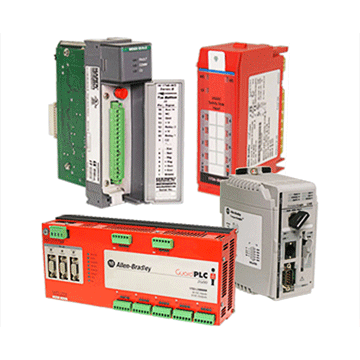
| Rockwell GuardPLC / GuardLogix | Dedicated GuardPLC 1200/2000 lines plus GuardLogix and Compact GuardLogix with CIP Safety; integrated safety and standard control within Rockwell ecosystem. | Plants standardizing on Rockwell Automation for control and safety. |
| Omron NX‑SL and G9SP safety PLCs | Certified up to SIL 3 and PL e; tight integration with Sysmac Studio; strong CIP Safety integration; robust hardware and short response times highlighted by Rabwell. | Facilities with existing Omron/Sysmac infrastructure or CIP Safety networks. |
| Siemens SIMATIC S7‑1200F / 1500F | Safety PLC variants integrated into TIA Portal and PROFIsafe; Siemens noted by MarketsandMarkets as a machine-safety market leader with advanced controllers. | Large, data-driven manufacturing plants and users heavily invested in Siemens. |
| Pilz PSSuniversal / PNOZmulti | Deep safety specialization; support for PROFIsafe, CIP Safety, FSoE; some configurations with low-cost or free tools; positioned by Rabwell as a safety-focused vendor. | Dedicated machine-safety projects or plants wanting a safety specialist ecosystem. |
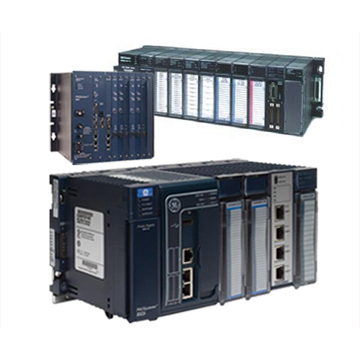
| Emerson PACSystems RX3i CPS400 and others | SIL-certified controllers with emphasis on redundancy and reliability, highlighted by MarketsandMarkets in the machine-safety market context. | Process industries where Emerson is already a control or DCS standard. |
These platforms are not interchangeable; each has its own programming environment, network standards, and I/O portfolios. Rabwell’s analysis emphasizes that across leading vendors, generic safety certifications up to SIL 3 or PL e are common. What differentiates them is how well their safety I/O types, safety networks (CIP Safety, PROFIsafe, FSoE), and tools align with your existing infrastructure and staff skills.
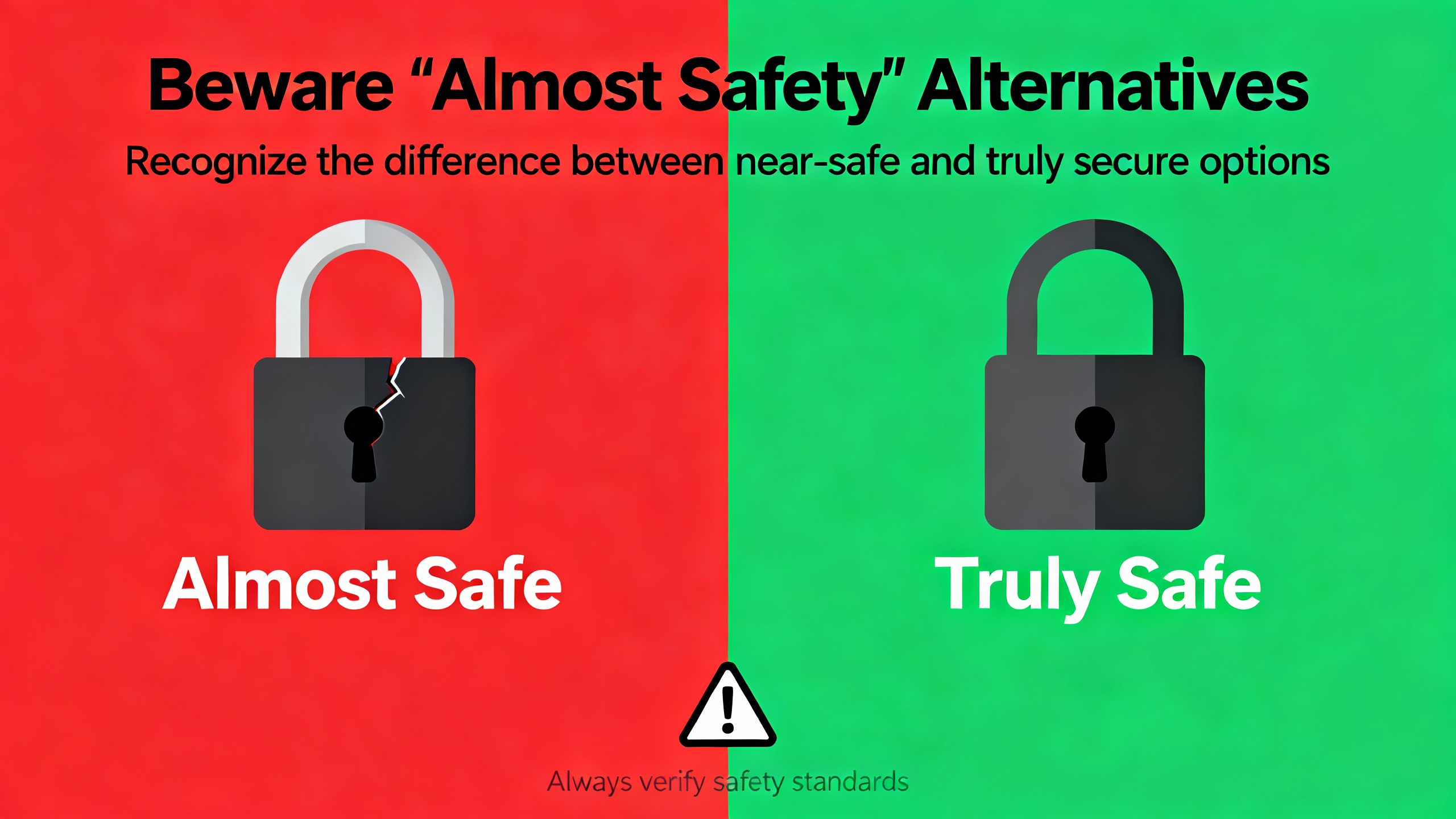
Beware “Almost Safety” Alternatives
In some migration projects, I still see proposals to replace a safety PLC with something that looks similar from a distance but does not actually meet safety requirements.
One example is the use of PC‑based control boards like the Tri‑M Engineering IR 104. Industrial Automation Co. describes that board as a compact PC/104 module with optically isolated inputs and high-capacity relay outputs, designed to replace older PLC-based control in some applications. It is efficient and convenient, and its relay outputs can drive external loads directly. However, nothing in the research describes it as a safety PLC or as certified to IEC 61508 or ISO 13849. It may be appropriate for non-safety control or monitoring, but it is not a functional safety replacement for an ICS Triplex safety logic solver.
Another tempting path is to use RTUs or monitoring devices as control platforms. DPS Telecom explains that its NetGuardian RTUs provide extensive monitoring, alarms, and even voice alerts. RTUs like these are rugged and excellent at supervising facility and network infrastructure, but they are not described as SIL-rated safety PLCs. They are best used alongside safety PLCs, not instead of them, in safety-critical applications.
Finally, low-cost programmable relays or compact PLCs can be extremely useful for light-duty control in non-critical areas. DPS Telecom notes, however, that these devices lack the scalability, diagnostic depth, and often the safety certification required for high-risk processes. For any application where ICS Triplex is currently performing safety functions, any replacement must be a certified safety device with appropriate SIL/PL ratings—not just a generic controller with some safety-like features.
Integrators, Certification Bodies, And Safety Culture
A safety PLC migration does not succeed on hardware selection alone. The research paints a consistent picture: manufacturing safety is a lifecycle discipline that spans risk assessment, design, implementation, training, and continuous improvement.
E Tech Group, a TÜV Rheinland–certified provider and Rockwell Automation partner, frames safety systems as integrated combinations of emergency stops, interlocks, gas detection, safety instrumented systems, fire and explosion protection, and more. Their perspective aligns with FBL Group’s emphasis on thorough pre‑implementation risk assessments with multidisciplinary teams. That means bringing together process engineers, safety professionals, operations, and maintenance to identify mechanical, electrical, human, environmental, and cybersecurity hazards before the first cable is pulled.
Nemko highlights the importance of independent testing and certification against standards such as IEC 62061 and ISO 13849. Their work shows how third‑party verification helps manufacturers demonstrate compliance to regulators and customers, while ongoing surveillance and advisory support help keep safety performance consistent as equipment ages and standards evolve.
Automation Electric and FBL Group both underline the role of structured audits and checklists. Regular compliance checks against OSHA guidelines, internal standards, and applicable UL and IEC requirements help reveal gaps. The output of these audits—formal reports, findings, and recommendations—should feed directly into your safety system roadmap, including any plans to phase out or supplement ICS Triplex platforms.
Critically, every one of these sources converges on the need for continuous training. Safety training is not a one‑time presentation but a continuous process with refreshers, update sessions, and drills. With automation and robotics evolving quickly, and with labor markets tight, plants cannot assume that a one-time vendor training on the new safety PLC will be enough. Ongoing engagement keeps people aware of new hazards and new mitigation strategies.
Power Reliability, UPS, And Panel Design For Safety Systems
From a power systems standpoint, replacing an ICS Triplex safety PLC is a perfect moment to strengthen the underlying power infrastructure. Industrial Automation Co. calls out redundancy mechanisms, including dual PLCs and backup power supplies, as essential for maintaining safe operation under failure conditions. In the field, I see three power-related themes that make or break safety migrations.
First, design the control panel as a system, not a box of parts. Automation Electric explains that UL508A-certified control panels are evaluated as a whole for overcurrent protection, safety, and reliability. For safety PLC projects, that mindset should extend to DC distribution, grounding, surge protection, and coordination with upstream breakers and fuses. The objective is to ensure that a fault in one circuit does not take down your entire safety system.
Second, treat the safety PLC and its safety I/O network as critical loads for UPS sizing and selection. In many plants, the production PLCs and HMIs ride on UPS power, while safety circuits are left on “raw” utility or plant power. That approach assumes that safety trips can be tolerated whenever the power flickers, which is not always true. For example, in batch chemical processes, an uncontrolled trip can create hazards. By pairing the safety PLC and critical safety communications equipment with suitably rated UPS systems and robust inverters, you keep the safety logic alive long enough to bring the process to a controlled safe state during a disturbance.
Third, think about maintenance and testing under real conditions. Safety PLCs and their UPS systems must be tested together. Too often, a plant installs new safety controllers and assumes that the existing UPS and panel infrastructure are adequate. Then, on the first real voltage sag, both the logic and the power support infrastructure respond in unexpected ways. Periodic integrated testing—carefully planned and documented—helps identify these weaknesses when the risk is controlled, not during a genuine incident.
In short, a safety PLC migration is an opportunity to align your safety logic with high-integrity power protection. When you design the control panel, UPS, and wiring as a unified safety infrastructure, you reduce nuisance trips and increase the odds that the system performs as intended on the worst day of its life.
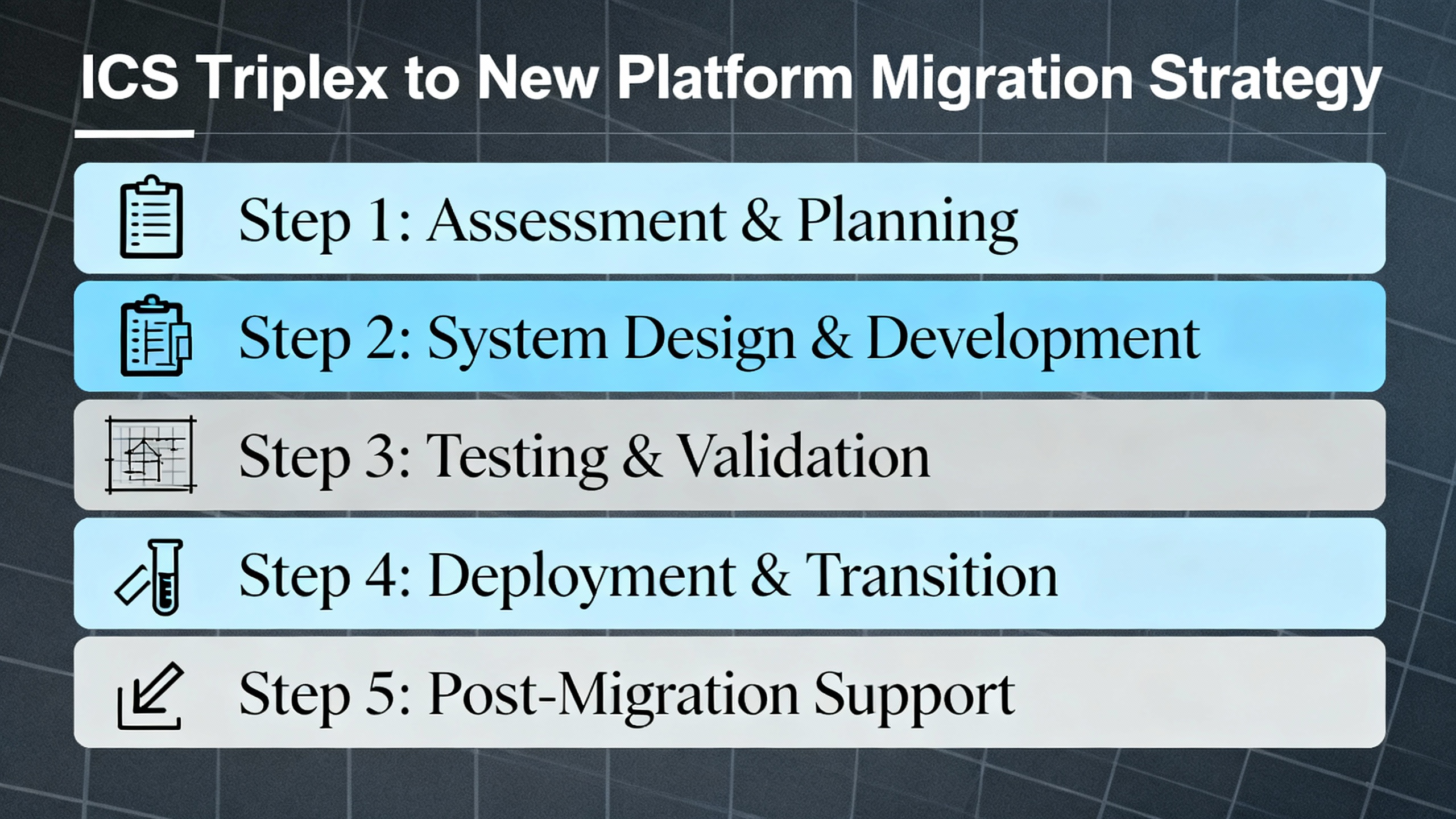
Strategy For Migrating From ICS Triplex To A New Platform
The most successful ICS Triplex migration projects that I have seen follow a disciplined approach rather than a quick one-for-one replacement. Several themes from the research can be combined into a practical roadmap.
Start with a structured risk assessment. FBL Group recommends identifying hazards, estimating likelihood and consequence, and using multidisciplinary teams to design mitigation measures. Apply that mindset specifically to your existing ICS Triplex safety functions. Document what each function does today, what SIL or PL level it targets, how it is tested, and where the main risk drivers are.
Next, define requirements for the new safety platform in terms of functions, SIL/PL levels, environmental conditions, and integration needs. Rabwell suggests standardizing on one safety PLC ecosystem where possible, such as Omron plus Sysmac, Siemens plus TIA Portal, Rockwell plus Studio 5000, or Pilz, to simplify integration, training, and support. Use that logic while keeping an eye on network standards such as CIP Safety, PROFIsafe, and FSoE, and align them with your existing plant networks.
Then, engage both the safety PLC vendor and a qualified integrator. E Tech Group and Power Safe Automation show how combining safety and automation expertise under one umbrella reduces integration errors, speeds startups, and simplifies documentation for OSHA, ANSI, and ISO audits. Ask specifically how their engineering teams approach ISO 13849 and IEC 62061 validation, and how they handle documentation of safety functions down to the circuit level.
During design, treat the safety PLC, control panel, and power system as a package. Apply UL508A panel practices, design for redundancy in power supplies, and allocate UPS coverage to the safety controllers. Integrate diagnostics so that safety faults and power anomalies are logged in plant-wide systems, allowing you to correlate safety trips with power events or equipment failures.
Finally, plan for testing, training, and continuous improvement. Use structured commissioning and validation plans that cover both safety logic and power behavior. Train operators and maintenance staff not only on the new safety PLC interface but also on safe work practices, lockout/tagout expectations, and emergency response procedures. Automation Electric recommends continuous monitoring of real-world behavior to verify that safety protocols are actually being followed and to adapt them when they prove impractical, while still maintaining certified hardware and compliant practices.
Short FAQ
Can I replace ICS Triplex with a standard PLC if I keep the same interlocks?
If your safety functions are specified with SIL or PL requirements, the answer is effectively no. As discussed by experienced engineers on control.com, general-purpose PLCs such as legacy Allen‑Bradley PLC‑5 and SLC families do not qualify as safety PLCs and cannot be used where a safety PLC is specified. You need a controller certified to relevant functional safety standards, combined with a system-level design that meets your SIL/PL targets.
Do I have to match the original ICS Triplex SIL level exactly?
You need to meet or exceed the safety performance requirements of each safety function, as defined by your risk assessment and applicable standards. That does not always mean replicating the exact hardware architecture, but it does mean that the complete safety loop—sensors, logic, final elements, diagnostics, and test intervals—must be analyzed against standards such as IEC 61508 and ISO 13849. Simply installing a higher-rated safety PLC without revisiting the safety design is not sufficient.
How do I factor power reliability into my safety PLC migration?
Treat the safety PLC and its safety I/O network as critical loads during UPS and panel design. As Industrial Automation Co. notes, redundancy and backup power supplies are central to safe operation. Use UL508A panel practices, robust UPS systems, and coordinated protection devices so that voltage sags, swells, and transfers do not compromise your ability to detect hazards and move the plant to a safe state.
When you move beyond ICS Triplex to a new safety PLC supplier, you are not just changing a controller; you are resetting the foundation of your plant’s protection philosophy. If you pair a certified safety platform with disciplined risk assessment, UL508A-grade panels, and well-engineered UPS and power protection, you build a safety system that will still be doing its job years from now, long after the latest PLC catalog has changed again.
References
- https://www.plctalk.net/forums/threads/guardlogix-safety-plc.112732/
- https://automationelectric.com/best-practices-for-safe-and-compliant-industrial-automation/
- https://www.controleng.com/alternative-to-plc/
- https://www.eclipseautomation.com/industry-4-0-industrial-automation-safety/
- https://ensun.io/search/safety-plc
- https://fblgroupglobal.com/safety-in-automation-best-practices-for-industry/
- https://www.marketsandmarkets.com/ResearchInsight/machine-safety-market.asp
- https://www.nemko.com/blog/functional-safety-for-industrial-automation-robots-machines-and-intelligent-factories
- https://www.powergearx.com/choosing-the-best-plc-a-guide-to-industrial-automation-control-systems/
- https://hub.seegrid.com/blog/automation-in-the-workplace-best-practices-for-safety


 Videos
 News
News Applications





Leave Your Comment