In industrial and commercial facilities with critical power infrastructure, controls are the nervous system that keeps everything in balance. Whether you are protecting a bank of UPS units in a telecom hut or conditioning a data room fed by static inverters, your HVAC and building controls determine how stable the environment is, how efficiently energy is used, and how much time your team spends fighting nuisance alarms instead of managing risk.
Honeywell has long been a default choice for thermostats, zone controllers, and building control hardware. But the control landscape has widened dramatically. Independent testing from organizations such as PCMag, CNET, Consumer Reports, Wirecutter at The New York Times, and technical guidance from the U.S. Department of Energy, as well as engineering forums like Eng‑Tips and HVAC‑Talk, shows a broad field of credible alternatives. These range from smart thermostats and stand‑alone HVAC controllers to full building automation platforms and remote telemetry units.
This article looks at Honeywell controller equivalent systems through a critical‑power lens. The focus is not on brands for their own sake, but on control strategies that protect equipment, reduce operating cost, and are supportable in the field.
Where Controllers Sit In A Power‑Backed Facility
In facilities with UPS systems, inverters, and sensitive electronics, HVAC controls are part of the protection stack. Stand‑alone controllers, as described in ControlsTraders’ technical guides, manage temperature, humidity, and sometimes air quality locally without requiring a full building management system. Smart thermostats add connectivity and analytics so equipment can be adjusted automatically based on usage and occupancy, improving comfort and reducing energy use compared with traditional devices.
Compatibility between controller and plant is not optional. Environment Masters emphasizes that thermostat–HVAC compatibility determines whether your controller can correctly manage the specific heating and cooling equipment. A mismatch can cause inconsistent temperatures, frequent malfunctions, higher energy bills, and accelerated wear that shortens system life. Their guidance begins with the basics: verify whether the system is single‑stage, multi‑stage, heat pump, or dual‑fuel; confirm whether it is low‑voltage or high‑voltage; and check wiring, especially the presence of a common (C) wire required by many modern controls.
In remote or lights‑out locations, the controller is also your remote hand. DPS Telecom notes that controllers for telecom huts must not only monitor environmental conditions but also remotely reset “stuck” air conditioners to avoid expensive truck or helicopter rolls. In those cases, the controller is not a convenience; it is a reliability tool.
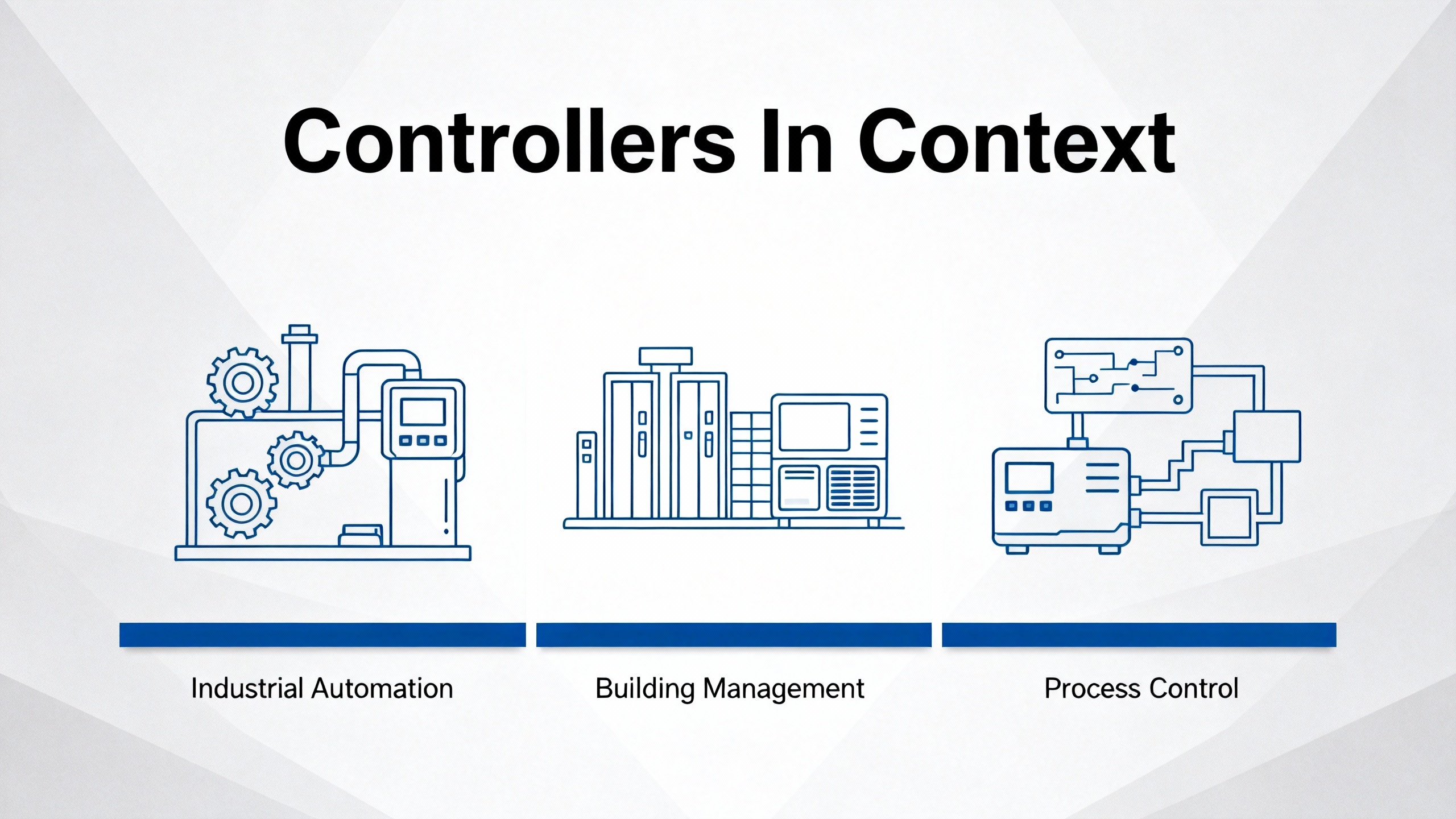
Honeywell Controllers In Context
Honeywell shows up repeatedly across the research as a major player in both basic and smart HVAC control. Total Comfort’s overview of zone controllers lists Honeywell as a brand known for a wide range of reliable, feature‑rich controllers. ControlsTraders cites Honeywell Pro non‑programmable digital thermostats as examples of basic on/off devices that simply switch systems at a set point. On the smart side, Honeywell’s T‑series appears in both ControlsTraders and PCMag’s testing; the Honeywell Home T9 WiFi Smart Thermostat is described as a multi‑zone thermostat that uses room sensors, and the T10 Pro Smart Thermostat with sensor kit is cited in the Total Comfort article as a zoned solution that integrates with smart home systems.
PCMag’s review of smart thermostats describes the Honeywell Home T9 as a feature‑rich model with a remote room sensor in the box, support for multiple remote sensors, and broad compatibility with standard HVAC systems. It is positioned as a strong option for larger homes that need more uniform temperatures across many rooms. ControlsTraders places it in the “multi‑zone smart thermostat” category: devices that manage multiple areas with room sensors and rely on connectivity and analytics to coordinate setpoints.
These sources collectively paint Honeywell as a versatile controls vendor, with offerings that range from simple, local thermostats up to connected, sensor‑driven multi‑zone controls. When you look for “Honeywell equivalents,” you are typically comparing against these roles rather than against a single specific model.
Alternative Smart Thermostat Platforms
Independent tests and reviews show several non‑Honeywell brands that cover similar roles with different trade‑offs. The key question in a power‑sensitive facility is whether a given platform delivers the controllability, reliability, and integration you need.
CNET explains that smart thermostats add app‑based control, geofencing, external room sensors, and integration with smart home ecosystems. They highlight that many smart thermostats can use geofencing to track whether occupants are home and adjust temperatures accordingly, as well as external room sensors to target temperature in specific rooms rather than only at the thermostat location. Their guidance also underscores compatibility issues: many smart models require a C‑wire for continuous power, and not all support high‑voltage systems such as older electric furnaces or baseboard heaters.
Wirecutter’s long‑term testing identifies the Ecobee Smart Thermostat Premium as a top pick. It operates as a thermostat, a smart speaker, and an indoor air‑quality monitor, works with major platforms including Amazon Alexa, Apple Home, Google Home, and Samsung SmartThings, and uses a remote temperature and presence sensor to better control hot or cold rooms. Features such as Schedule Assistant, Smart Recovery, and Eco+ are designed to fine‑tune schedules and slightly relax setpoints based on humidity and comfort perception, tightening energy use without a noticeable comfort hit. Their extended testing over roughly a year and a half found the thermostat reliable once over‑aggressive energy‑saving behavior was tuned, but also noted drawbacks such as occasionally unreliable voice commands and slow customer support.
PCMag’s test bench covers a wider field and confirms Ecobee’s position at the premium end, while also noting that Ecobee’s more affordable models still retain core functions like app and voice control, energy usage reports, and optional remote sensors. The same testing names several Nest models: an entry‑level Nest Thermostat focused on budget‑conscious users who want remote control and basic scheduling, and a fourth‑generation Nest Learning Thermostat that uses AI to learn behavior and create personalized schedules, includes a remote room sensor, and supports the cross‑platform Matter standard for integration with multiple ecosystems. The Learning model is described as expensive but very capable in terms of scheduling detail and adaptive control.
TechGearLab brings an engineering perspective by scoring thermostats against weighted metrics: ease of use, DIY installation, scheduling, smart capabilities, and energy saving. In their 2025 tests, the Google Nest Thermostat (non‑learning) is rated best overall for most users, with particular praise for installation guidance, intuitive app, scheduling, and design, though they note limitations such as lack of support for two‑stage systems and restricted platform compatibility. The Ecobee Smart Thermostat Premium is singled out as the best choice for multi‑stage HVAC systems, with strong support for multi‑stage equipment, vacation modes, occupancy detection, and broad smart‑home compatibility, albeit at a high price.
Delco’s overview of smart thermostats compares Nest, Ecobee, and Honeywell Lyric T5, emphasizing the trade‑off between price, learning behavior, and multi‑room sensing. They cite potential annual energy savings of up to about $180 from smart thermostat technology and note that many models can qualify for utility rebates, although equipment prices listed exclude installation.
Together, these sources indicate that for applications where you might otherwise install a Honeywell smart thermostat or zone controller, Ecobee, Nest, and Amazon’s own smart thermostat can serve as equivalent platforms. The differences are mostly in ecosystem alignment, feature set, depth of analytics, and support for complex HVAC configurations such as multi‑stage systems and line‑voltage heating.
Stand‑Alone Controllers And Industrial‑Grade Alternatives
In many power‑critical environments, an ordinary thermostat is not the only or even the primary controller. ControlsTraders describes stand‑alone controllers as HVAC devices that manage temperature, humidity, and air quality without a full building management system. They are especially suited to smaller buildings or remote sites where centralized control is impractical. Key features include programmable schedules, occupancy‑based adjustments, optional remote access, broad HVAC compatibility, and built‑in security such as user authorization and encrypted access.
The same source outlines a spectrum of stand‑alone thermostat types. Basic on/off thermostats, represented by models like the Honeywell Pro non‑programmable digital thermostat, simply switch equipment when a set point is reached. Proportional thermostats, such as the Ecobee Smart Thermostat Premium or Google Nest Learning Thermostat, modulate output more finely using algorithms and sensor feedback. Multi‑zone thermostats, exemplified by the Honeywell Home T9, coordinate several areas using room sensors.
ControlsTraders also discusses stand‑alone hydronic controls including temperature control valves, pressure‑independent control valves, and automatic balancing valves, all of which influence heating and cooling efficiency by regulating water flow in hydronic systems. These are more common in large commercial and industrial settings, and the controllers that manage them often need to integrate with wider building control strategies.
For remote telecom sites and other unmanned facilities, DPS Telecom’s guidance shows how industrial‑grade HVAC controllers differ from consumer smart thermostats. Legacy HVAC units at such sites often use discrete RYWG wiring that represents blower, compressor, and heater signals. Newer units may communicate via protocols like Modbus over Ethernet or RS‑485. Industrial controllers in this space are expected to handle both discrete and protocol interfaces and in some cases exchange thousands of data points. DPS notes that industrial‑class controllers often cost roughly $1,500 to $3,000 per site, compared with about $100 to $300 for consumer smart thermostats. The higher hardware cost reflects support for multiple HVAC units, higher build quality, and enterprise‑grade features such as SNMP for integration with central monitoring systems.
DPS also stresses total cost of ownership. Installation and configuration can be more labor‑intensive than a simple thermostat swap; some controllers require specialized configuration software or custom programming. However, “all‑in‑one” controllers that combine HVAC monitoring and control with functions like PDU power switching and door or site access control can reduce hardware counts and wiring complexity. Their own HVAC controller is positioned as a remote telemetry unit with a touchscreen and specialized lead‑lag firmware, consolidating site monitoring and control into a single device.
These stand‑alone and industrial controllers are best viewed as equivalents to higher‑end Honeywell controls in applications where reliability, multi‑device integration, and remote operability are more important than the consumer experience of an app or voice assistant.
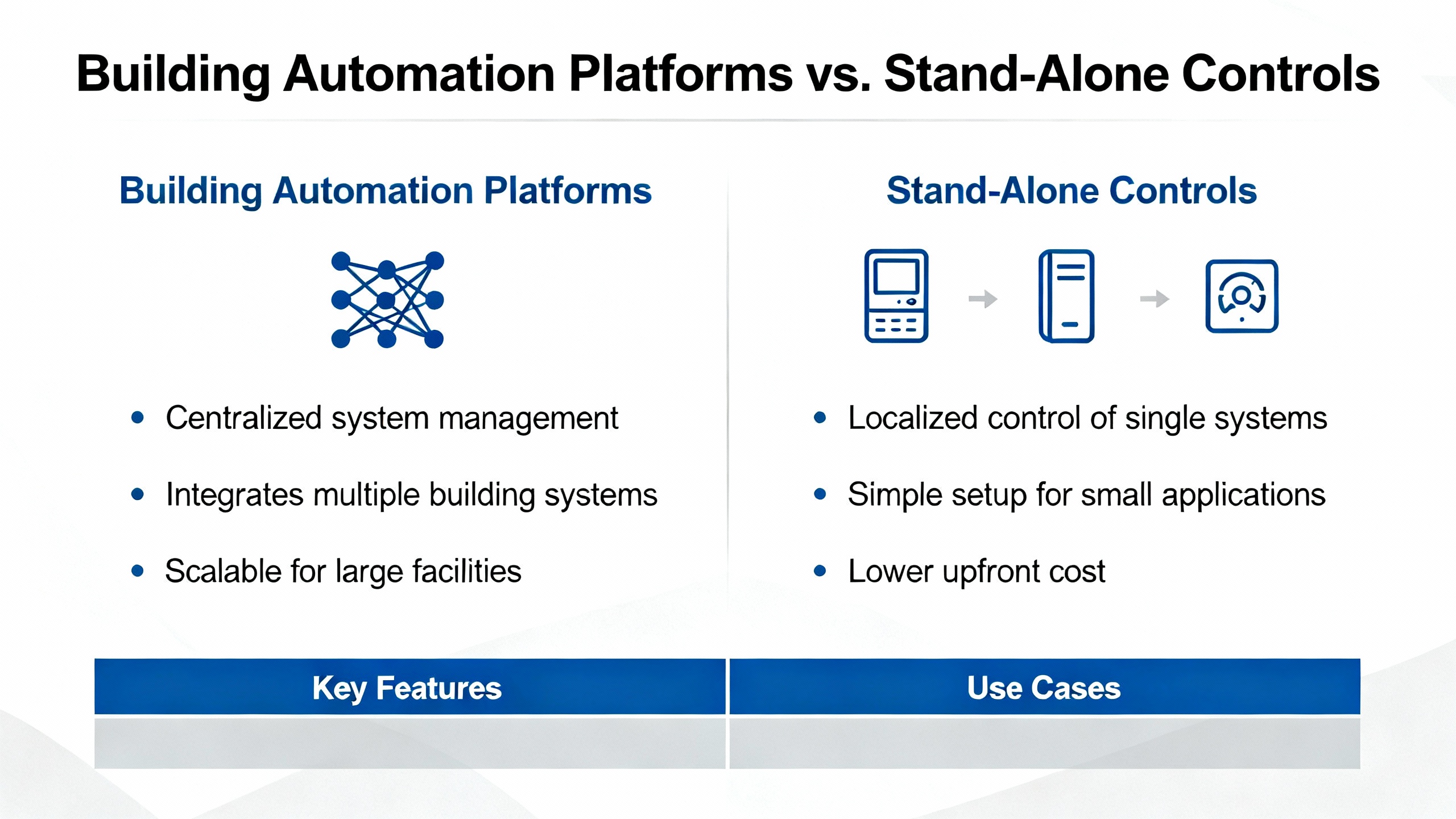
Building Automation Platforms Versus Stand‑Alone Controls
When you move from a single panel or equipment room to a full campus, controller equivalence is less about thermostat features and more about system architecture. On engineering forums such as Eng‑Tips and HVAC‑Talk, practitioners compare building automation systems from large vendors to more open platforms.
One Eng‑Tips discussion describes an evolution of preferred vendors from Andover Controls to TAC and later to Schneider Electric, but notes that some large vendors, including Siemens, have become “bloated” in practice. The critique is not about the core products themselves, but about how BACnet‑heavy implementations end up with thousands of BAS points where hundreds would have sufficed. The result can be sluggish systems and even graphical interfaces that fail to function properly under standby power conditions. The same thread cites the Niagara platform as a simpler, web‑based alternative that practitioners find easier to work with.
HVAC‑Talk discussions reinforce that brand names such as Johnson Controls, Trane, Siemens, and TAC all have solid product lines. Problems often arise from how systems are engineered, installed, and maintained rather than from the hardware. Contributors emphasize that success depends heavily on the local controls contractor and on disciplined project management by the owner: insisting on proper materials and workmanship, adequate passwords, operator training, and as‑built documentation before final payment. They also recommend choosing systems that are as open as practical; one experienced contributor notes, somewhat tongue‑in‑cheek, that traditional pneumatic controls are the most “open” because they are inherently non‑proprietary.
When you compare these platforms to Honeywell solutions, the most honest conclusion from these practitioner sources is that the “better” control system is less about the manufacturer and more about local support, openness, and engineering quality. For a power‑critical site, this means that a well‑engineered Niagara‑based or other open platform deployed by a responsive local contractor may be a safer choice than any big‑name system deployed by a team that is not committed to long‑term support.
Smart HVAC Controllers In Commercial Buildings
ControlsTraders’ guide on smart HVAC controllers for commercial buildings extends the focus from individual thermostats to systems that govern heating, cooling, and ventilation across larger spaces. They define a smart HVAC controller as an intelligent device that connects to existing HVAC systems and allows remote management via smartphones or tablets. These controllers use advanced algorithms and real‑time sensor data to maintain comfort while minimizing energy consumption.
According to that guide and U.S. Department of Energy commentary, smart HVAC controllers can cut HVAC‑related energy use by roughly 10 to 40 percent through real‑time optimization and scheduling, reducing both operating costs and carbon footprint. They can also improve indoor air quality by tracking temperature, humidity, and pollutants, and automatically adjusting ventilation and conditioning to lower allergens and contaminants. For commercial environments where power quality, IT loads, and human occupancy overlap, this combination of energy efficiency and air‑quality control has direct implications for both operating risk and staff productivity.
ControlsTraders notes that common options include Wi‑Fi adapters that retrofit legacy HVAC units for remote control, smart thermostats with learning capabilities, and more comprehensive systems that coordinate heating, cooling, and ventilation across large spaces. Recommended features include remote control via mobile apps, robust scheduling and automation tools, built‑in air‑quality monitoring, smart platform integration, and compatibility with multiple HVAC system types. Typical setup costs for smart HVAC systems are described as around $10,000, with simpler or smaller installations starting near $5,000 and more complex systems approaching about $15,000, excluding building‑specific work.
From a power reliability perspective, these smart controllers can be viewed as functional equivalents to advanced Honeywell building controllers if they provide the same core capabilities: robust support for the site’s HVAC configurations, reliable remote access, integration with upper‑level monitoring, and energy‑efficiency gains without compromising comfort.
Consumer Smart AC Controllers As Retrofit Options
Consumer Reports points out another category of controllers that can occasionally fill gaps: smart AC controllers. These devices act as enhanced remote controls for window units, portable units, mini‑splits, or in‑wall heat pumps that already use infrared remotes. They plug into a nearby outlet, sit within line of sight of the AC unit, and provide smartphone‑based control over power, temperature, fan speed, and modes. The devices highlighted by Consumer Reports cost less than about $50 and are positioned as “handy thermostats” for room units rather than whole‑building systems.
For power‑critical rooms cooled by ductless units or window air conditioners, these controllers can offer a low‑cost way to add remote visibility and scheduling. However, they lack the robust multi‑system integration and industrial I/O that DPS and similar industrial controllers provide, and they are not substitutes for full Honeywell or industrial controllers in complex or mission‑critical spaces.
Comparing Controller Families
The following table summarizes controller families and where they tend to line up against Honeywell offerings based on the research.
| Controller family | Typical Honeywell role | Non‑Honeywell equivalents from research | Where they fit best |
| Basic on/off thermostats | Simple local temperature control with devices such as Honeywell Pro non‑programmable thermostats | Orbit Clear Comfort and similar non‑smart programmable models reviewed by TechGearLab | Small rooms or equipment spaces where remote access is not required and the HVAC system is simple |
| Smart thermostats with app control | Smart Honeywell models such as the Lyric T5 or T‑series including the T9 and T10 Pro with room sensors | Ecobee Smart Thermostat Premium, Ecobee Essential, Nest Thermostat, Nest Learning Thermostat, Amazon Smart Thermostat, Sensi models as tested by PCMag, CNET, Wirecutter, and TechGearLab | Offices, light commercial zones, or ancillary rooms where app control, scheduling, and energy analytics are useful but industrial I/O is not required |
| Multi‑zone smart thermostats | Honeywell Home T9 managing multiple areas with room sensors | Ecobee thermostats with remote sensors and Nest Learning thermostats with included remote sensor, as documented in Wirecutter and PCMag testing | Larger suites or floors where multiple zones share air handlers and a sensor‑driven thermostat can balance comfort |
| Stand‑alone HVAC controllers | Honeywell stand‑alone controllers or zone control panels in small commercial projects | Generic stand‑alone controllers and hydronic control valves described by ControlsTraders | Small commercial or industrial areas where localized control without a full BAS is adequate |
| Industrial HVAC and site controllers | Honeywell or third‑party industrial controllers that supervise multiple units and I/O | DPS Telecom HVAC controllers and similar RTUs that integrate HVAC, PDU power switching, and site access control | Telecom huts, remote shelters, or critical rooms where remote reset, protocol support, and integration with monitoring systems are essential |
| Building automation systems | Honeywell building controllers within a proprietary BAS architecture | Systems from Johnson Controls, Trane, Siemens, TAC/Schneider, and open‑platform Niagara solutions referenced in Eng‑Tips and HVAC‑Talk discussions | Large commercial buildings and campuses where centralized control of HVAC, lighting, and other systems is required |
| Smart commercial HVAC controllers | Honeywell building controllers used with smart algorithms and IAQ monitoring | Smart HVAC controllers profiled by ControlsTraders, with energy savings in the 10 to 40 percent range | Commercial buildings where energy optimization, IAQ, and remote management of existing ducted systems are priorities |
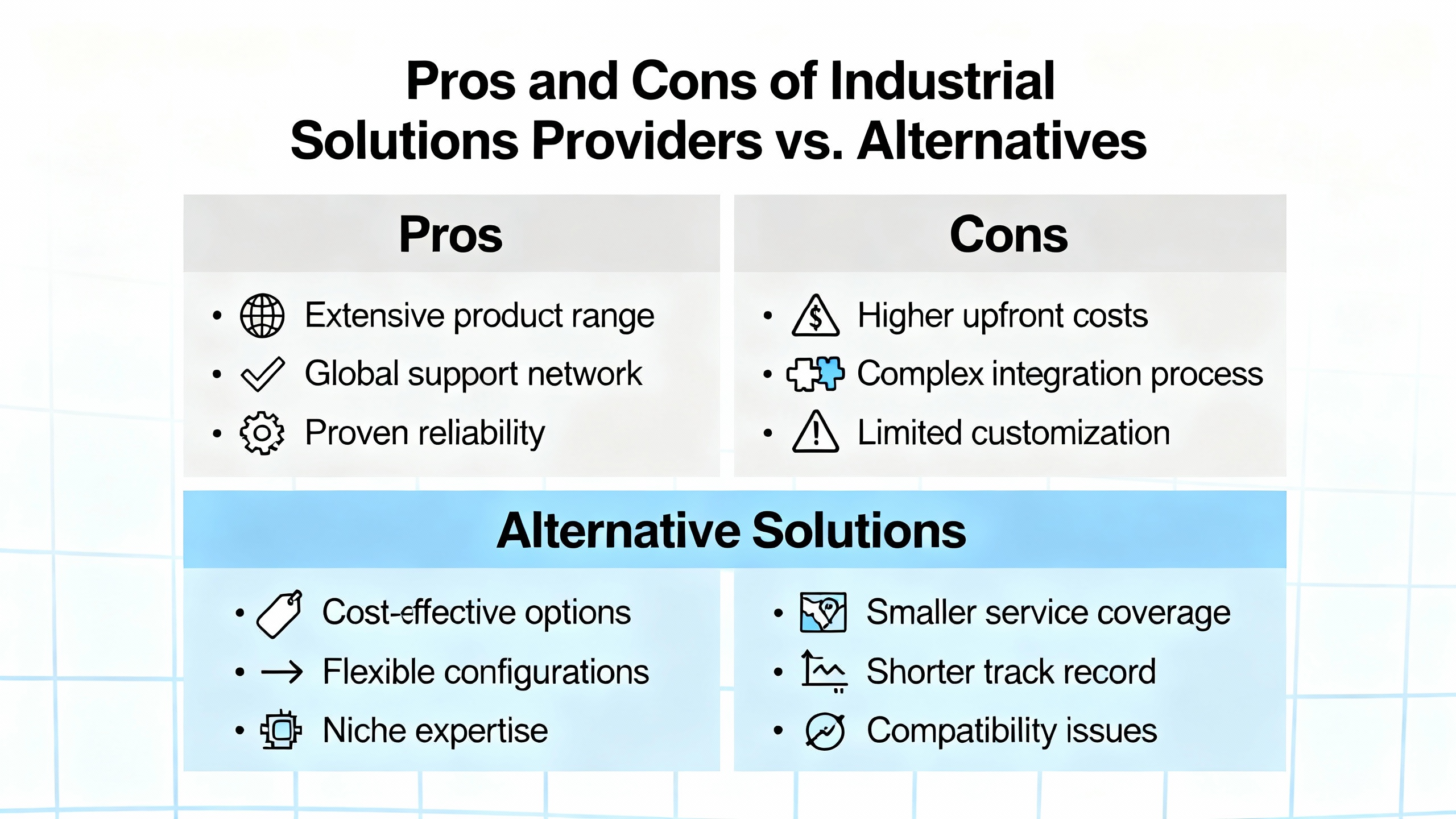
Pros And Cons Of Honeywell And Alternative Solutions
From the research, Honeywell’s strengths lie in breadth of product and familiarity among technicians. Their basic thermostats are simple and predictable. Models like the T9 and T10 Pro introduce multi‑zone capability with room sensors while still aligning with conventional installation practices. Honeywell’s long history in controls means many contractors can service these devices without a learning curve.
The main limitations are not unique to Honeywell but apply to similar smart thermostats. CNET notes that many smart thermostats need a C‑wire, and not all are compatible with high‑voltage systems. Environment Masters’ guidance shows that even a well‑known brand can cause issues if paired with the wrong system type or voltage. PCMag, CNET, and TechGearLab all report ecosystem constraints across brands: some models support Amazon Alexa but not Apple Home; others support Google Assistant and Matter but not certain proprietary platforms. That means a Honeywell solution chosen for its hardware merits might still be a poor fit if it does not integrate with the rest of your monitoring stack.
Alternative smart thermostat platforms like Ecobee and Nest bring rich analytics, Air‑quality monitoring, and in some cases better cross‑platform integration. Wirecutter highlights Ecobee’s ability to consider humidity and comfort perception rather than temperature alone, along with strong privacy controls. PCMag emphasizes Nest’s learning behavior and Matter support, which can help integrate with mixed ecosystems. The trade‑offs include higher cost for premium models, occasional quirks such as finicky geofencing or aggressive auto‑adjustment, and varying support experiences.
Industrial controllers and RTUs, as described by DPS and ControlsTraders, offer robust hardware, protocol support, and integrated site control at a much higher price point but with capabilities that consumer thermostats cannot match. They are designed for Ethernet and RS‑485 networks rather than Wi‑Fi, support Modbus and SNMP, and can coordinate multiple HVAC units, PDU outputs, and door contacts from one box. The downside is higher upfront cost, potential need for professional installation and custom programming, and more complex configuration workflows.
Full building automation platforms, whether vendor‑specific or Niagara‑based, provide the greatest integration but also introduce complexity. Eng‑Tips contributors warn that BACnet‑heavy implementations can become unmanageable if point counts explode, especially under standby power conditions. The practical pros are unified graphics, centralized control, and the ability to coordinate HVAC with lighting and other systems. The cons are potential bloat, performance issues, and deep dependence on one contractor’s engineering and support practices.
Practical Selection Guide For Honeywell Equivalents
Selecting an alternative to a Honeywell controller in a power‑sensitive facility begins with the fundamentals laid out by Environment Masters and reinforced across multiple sources: start with the system, not the thermostat.
First identify the HVAC system type and configuration. Determine whether the equipment is single‑stage, multi‑stage, a heat pump, or a dual‑fuel combination. TechGearLab’s scoring and PCMag’s reviews make it clear that not all thermostats or controllers support multi‑stage systems, and some models such as the non‑learning Nest are limited in that regard. For heat pump and dual‑fuel systems, Environment Masters stresses the importance of a controller that can correctly manage both heating and cooling modes and automatically select between heat pump and fossil fuel sources.
Next verify voltage and wiring. Most residential and light commercial systems are low‑voltage, often around 24 volts, while some electric furnaces and baseboard heaters use high‑voltage circuits. CNET highlights that many smart thermostats assume the presence of a C‑wire for continuous power. If the C‑wire is absent, options include choosing devices such as certain Nest models that trickle‑charge from existing wires or installing a power extender kit where supported, as PCMag notes with Ecobee’s accessories. For line‑voltage systems, PCMag’s discussion of the Sinope TH1123WF shows that specialized thermostats exist specifically for electric baseboard heating; these are not interchangeable with low‑voltage models and do not support gas or oil equipment.
Assess the environment’s criticality and access constraints. DPS advises that remote telecom sites benefit from industrial controllers with secure wired network connections, protocol support, and the ability to reset stuck air conditioners without rolling a truck. In contrast, a small office near the main electrical room might be adequately served by a smart thermostat whose main job is to respect setpoints and provide usage reports, as highlighted in TechGearLab and Wirecutter reviews. ControlsTraders recommends stand‑alone controllers where a full building management system would be overkill and where local personnel can easily operate the interface.
Energy performance is the next dimension. ControlsTraders and the U.S. Department of Energy both emphasize that smart controls can reduce HVAC energy consumption significantly when used correctly. ControlsTraders cites savings in the range of roughly 10 to 40 percent for smart HVAC controllers that optimize schedules, setpoints, and ventilation based on real‑time data. Delco references potential annual savings on the order of about $180 from smart thermostats, and Cielo’s research on ductless systems notes that avoiding duct losses can save around $1,000 to $2,000 per year in operating costs for some households. While these figures are specific to HVAC and not to UPS loads directly, they demonstrate the magnitude of energy shifts that control strategies can unlock.
Evaluation should also be evidence‑based. Aswani’s work on quantitative methods for comparing HVAC control schemes proposes defining metrics for energy usage and occupant comfort and applying statistical tests to determine whether observed differences between controllers are significant despite weather and occupancy variability. Applied to a Honeywell replacement project, this suggests that instead of relying on anecdotes, you should log energy and comfort data before and after a controller swap and use formal analysis to decide whether the new controller actually delivers better performance.
Finally, vendor and contractor selection play a decisive role. HVAC‑Talk and Eng‑Tips contributors repeatedly stress that the best hardware cannot compensate for poor engineering or lack of post‑installation support. They recommend checking a contractor’s prior projects, insisting on adequate training and documentation, and avoiding overly proprietary systems that make it hard to switch service providers later. For industrial controllers, DPS recommends working directly with engineering vendors who can tailor a semi‑custom controller configuration to project goals. For smart thermostats and mid‑scale controllers, sources like Wirecutter and PCMag underscore the importance of clear installation guides and responsive technical support, especially when dealing with older wiring or unusual system configurations.
Reliability Considerations For Power‑Sensitive Sites
When the primary risk is equipment downtime rather than purely comfort, several themes emerge from the research.
Consumer smart thermostats, even high‑end ones, are built around Wi‑Fi connectivity and consumer cloud services. CNET observes that geofencing and presence detection rely on cell phones and sometimes on occupancy sensors, and Delco notes that different models vary in how fully they automate schedules versus relying on user programming. Wirecutter’s experience with Ecobee shows that default energy‑saving behaviors can be over‑aggressive until tuned. All of this is manageable in an office or apartment but may be less acceptable in a remote equipment hut where connectivity is intermittent and comfort setpoints are tied directly to equipment survival.
Industrial controllers and RTUs, by contrast, are designed to sit on wired LANs, speak protocols like Modbus and SNMP, and integrate with central monitoring servers. DPS highlights that enterprise‑class controllers offer web interfaces similar to consumer devices but also provide command‑level protocol support and the ability to aggregate environmental monitoring and control in a single appliance. They also emphasize long‑term maintainability through robust hardware, solid warranties, regular firmware updates, and strong technical support from a domestic headquarters.
Building automation systems sit somewhere in between. They can centralize control of HVAC and sometimes electrical systems, but Eng‑Tips contributors warn that poorly scoped BACnet point counts can slow down interfaces, which can become a problem during power events when responsiveness is most needed. Niagara and other open platforms are cited as more streamlined alternatives to some large‑vendor implementations, especially when supported by a responsive local contractor.
Taken together, these sources suggest a tiered approach. For lightly loaded spaces whose primary concern is comfort and moderate energy use, Honeywell or equivalent smart thermostats from Ecobee, Nest, or similar brands are appropriate. For equipment rooms inside staffed buildings, stand‑alone controllers or multi‑zone thermostats with room sensors can balance comfort and energy without the overhead of a full BAS. For unmanned huts and truly critical spaces, industrial controllers or RTUs that integrate HVAC control, site monitoring, and power functions are more appropriate equivalents, even if the initial cost is several times that of a consumer smart thermostat.
Brief FAQ
Q: When is a consumer smart thermostat a reasonable alternative to a Honeywell controller in a critical power environment?
A: Based on CNET, TechGearLab, PCMag, and Wirecutter testing, platforms like Ecobee and Nest work well when the HVAC system is low‑voltage, the controller does not need industrial I/O, and staff can access the site easily if something fails. They are appropriate equivalents for offices, control rooms adjacent to staffed areas, and ancillary spaces where energy analytics and remote access are more important than protocol integration or hardened hardware.
Q: When should I step up to an industrial or site controller rather than a Honeywell‑class thermostat?
A: DPS’s guidance on remote HVAC controllers suggests that you should move to industrial‑grade controllers when site access is difficult, when the HVAC must interface with protocol‑based equipment, or when you want to consolidate HVAC, power, and access control into a single unit. In such cases, the additional cost of an RTU‑class controller is justified by the ability to perform remote resets, integrate with central monitoring, and support more complex logical control of multiple systems.
Q: How do building automation platforms compare to stand‑alone Honeywell controllers and their equivalents?
A: Engineering forum discussions indicate that full BAS platforms from vendors such as Johnson Controls, Trane, Siemens, and TAC, as well as open platforms like Niagara, provide a level of integration that stand‑alone controllers cannot match. They become attractive when you have multiple critical spaces across a facility and want unified graphics, scheduling, and alarm management. However, these systems require careful engineering to avoid excessive BACnet point counts and performance issues, and their success depends heavily on local contractor competence and ongoing support.
A resilient power system relies on more than sturdy UPS cabinets and well‑sized inverters; it also depends on the intelligence of the controls surrounding them. Honeywell controllers occupy an important part of that ecosystem, but the research shows a spectrum of credible alternatives. By matching controller type to HVAC configuration, site criticality, energy goals, and support capabilities, you can treat Honeywell not as the only option but as one benchmark among several, and select the control strategy that best protects both your loads and your operating budget.
References
- https://www.energy.gov/energysaver/heat-pump-systems
- https://docs.lib.purdue.edu/cgi/viewcontent.cgi?article=1406&context=ihpbc
- https://ui.adsabs.harvard.edu/abs/2012arXiv1205.6114A/abstract
- https://eta-publications.lbl.gov/sites/default/files/comparison-hvac-system-modeling.pdf
- https://www.consumerreports.org/appliances/thermostats/best-smart-ac-controllers-of-the-year-a1349637034/
- https://www.cedengineering.com/userfiles/M06-016%20-%20Alternatives%20to%20Active%20HVAC%20Systems%20-%20US.pdf
- https://www.controlstraders.com/blog/comprehensive-guide-smart-hvac-controllers
- https://www.dpstele.com/blog/best-remote-hvac-controllers.php
- https://environmentmasters.com/how-to-know-if-your-thermostat-and-hvac-system-are-compatible/
- https://www.pcmag.com/picks/the-best-smart-thermostats


 Videos
 News
News Applications





Leave Your Comment