Refineries live and die on the quality of their measurements. Just as an industrial UPS or inverter system protects critical electrical loads from disturbances, the refinery’s flow measurement network protects process stability, environmental performance, and profitability. When a flow meter drifts, the impact is not only a skewed number on a screen. It can mean an overfired furnace, a mis‑trimmed flare, a marginal relief system, or off‑spec product that ripples through the power, steam, and process balance of the entire site.
Across the industry, vendors like Emerson, Endress+Hauser, Baker Hughes Panametrics, Flowmetrics, and others consistently stress the same theme: accurate, application‑appropriate flow measurement is foundational for safe, efficient refinery operation and for meeting tightening air‑emissions and greenhouse‑gas rules. In this article, viewed through a reliability and power‑system lens, I will walk through how to think about flow measurement in refineries, where each technology fits, and how to design a metering strategy that is robust enough for real‑world conditions rather than ideal test stands.
Why Accurate Flow Metering Is Strategic In Refinery Operations
In refinery operations, a flow meter is not just an accounting device. As Fluido Sense notes in its refinery guidance, flow meters provide real‑time measurement of liquids and gases so operators can monitor complex processes, reduce waste, and enhance safety. That means they sit at the center of several business‑critical functions.
They drive process control. Whether you are controlling crude charge to a distillation column, reflux on a splitter, hydrogen feed to a hydrotreater, or quench water to a flare header, the control loop assumes the flow reading is trustworthy. If a meter reads five percent low, an otherwise well‑tuned controller will consistently move the valve to the wrong position. Articles from ICON Process Controls and BJSS Industrial emphasize that poor flow accuracy leads directly to wasted chemicals, unstable temperatures, and out‑of‑spec product, all of which increase energy use and cycling on drives, motors, and the power distribution system that feeds them.
They underpin safety and environmental performance. Baker Hughes Panametrics points out that companies measure flow for safety, product integrity, efficiency, and process control. In flare systems, for example, Emerson’s Refinery Sector Rule analysis highlights that the U.S. EPA requires accurate flow measurement of steam, flare gas, and supplemental gases under 40 CFR Part 63, with additional greenhouse‑gas reporting requirements under 40 CFR Part 98 and state rules such as California’s AB32. Fox Thermal’s work on natural‑gas metering shows how accurate fuel‑flow measurement is now a regulatory expectation for emissions tracking rather than a nice‑to‑have.
They enable production accounting and custody transfer. Across crude receipts, product loading racks, pipeline transfers, and internal allocation, refineries must demonstrate that barrels and Btus are correctly measured. Multiple vendors, including Silver Instruments, Metlan, and Turbines Incorporated, stress that even small percentage errors in flow measurement can translate into disputes and losses worth millions of dollars per year in oil and gas applications.
Finally, they support reliability and energy efficiency. From a power‑system perspective, an over‑pumped cooling‑water loop or a mis‑metered natural‑gas line to a furnace does not just waste utilities. It also causes swing in motor currents, drives, and transformers, raising thermal and mechanical stress. Accurate flow meters, especially those integrated digitally into DCS, PLC, and energy‑management systems as Endress+Hauser describes, make it possible to tune pumps, fans, and fired equipment so that electrical and thermal loads run in a predictable, protected envelope.
A simple calculation illustrates why accuracy matters. Imagine a large unit moving 100,000 barrels a day of product. If you rely on a meter and control strategy with a three percent systematic error, you are potentially mis‑accounting around 3,000 barrels per day. At typical margin levels, that can easily overshadow the premium you would pay for higher‑accuracy meters on those lines, especially when you factor in the cost of reblending, reprocessing, or explaining variances to auditors.
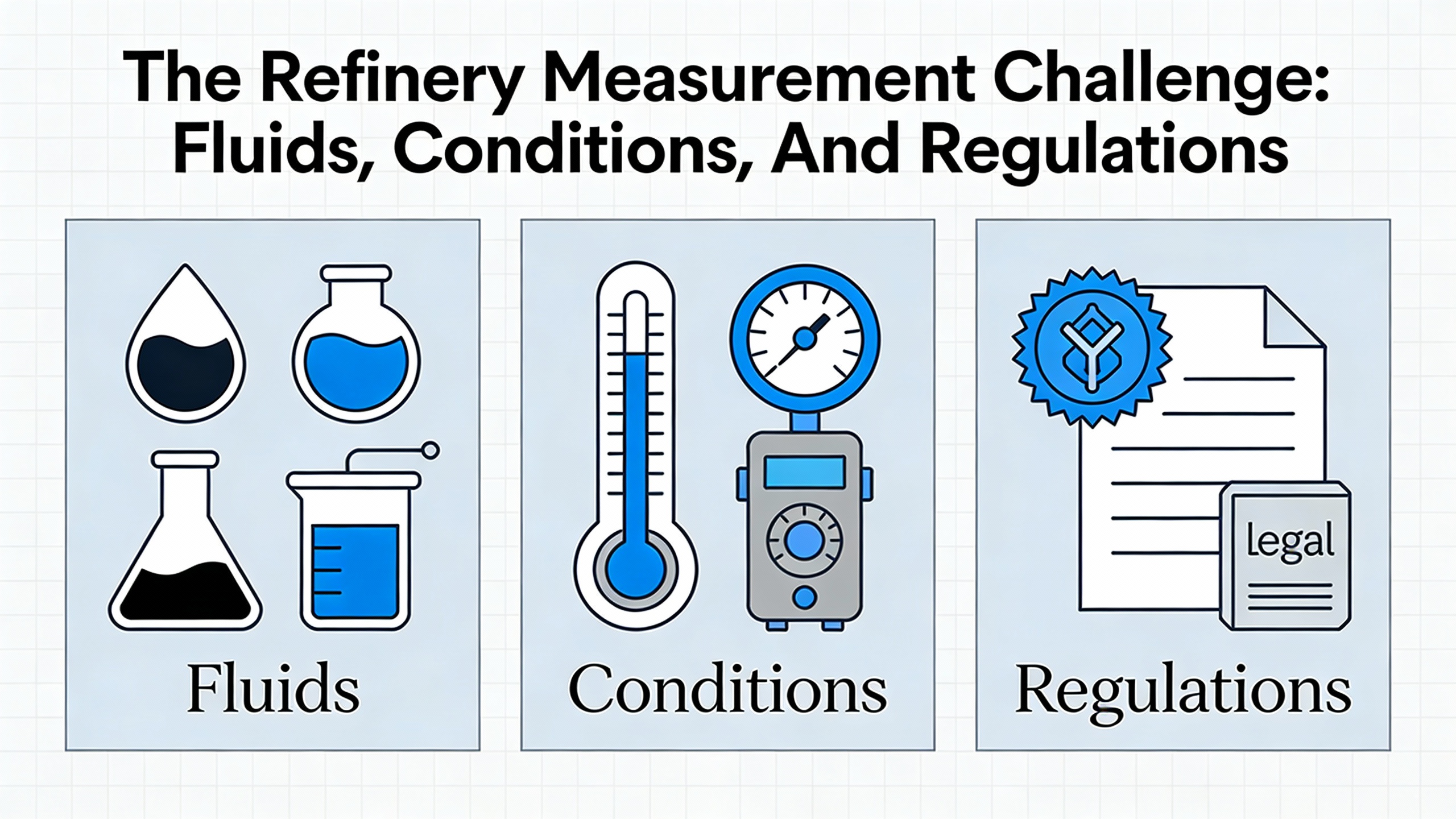
The Refinery Measurement Challenge: Fluids, Conditions, And Regulations
Refineries present one of the most demanding environments for flow measurement. Unlike a single‑fluid utility loop, a refinery handles everything from abrasive slurries to dry gas, and from ice‑cold LPG to superheated steam, often on the same unit.
On the liquid side, Fluido Sense highlights that electromagnetic meters are used for crude transport, emulsions, and wastewater, while turbine meters handle clean refined products and lube oils. Flowmetrics describes turbine meters measuring condensate and aromatic BTX (benzene, toluene, xylene) streams in refineries. These examples illustrate a broad spectrum: conductive, sometimes dirty liquids that suit electromagnetic meters, and clean, lower‑viscosity hydrocarbons where turbine or positive‑displacement technologies shine.
On the gas and vapor side, you have fuel‑gas networks, hydrogen, instrument air, flare systems, and high‑pressure steam. Emerson’s refinery flare case shows that steam injection to flares can require turndown ratios of around one hundred to one while still meeting accuracy targets of roughly five percent of mass flow. Standard differential‑pressure (DP) systems might only deliver turndown on the order of three to one without clever design, while vortex meters can push that beyond thirty to one in a single device, and Coriolis meters can deliver wide turndown on purge and supplemental gases, though not on steam itself.
Operating conditions compound the challenge. Turbines Incorporated notes that oil and gas meters often face thousands of pounds per square inch of pressure, elevated temperatures that alter materials and calibration, and corrosive media such as sour gas. JSG Industrial and Endress+Hauser both point out that some applications involve dirty or particulate‑laden fluids, slurries, and aggressive chemicals that can quickly foul or erode mechanical internals. In practical terms, that means the meter choices you make must tolerate not only the “normal” design point but also upset conditions, dirty piping, and imperfect maintenance.
Regulation adds another constraint layer. Emerson’s overview of the Refinery Sector Rule makes clear that refineries must monitor and report flows to flares, with biennial calibrations or equivalent verification. Fox Thermal’s guidance on natural‑gas metering under AB32 and the EPA’s greenhouse‑gas program shows similar expectations for fuel‑gas monitoring. The implication is that you cannot simply pick a technology for low installed cost. You must be able to document accuracy, turndown, and calibration or verification plans over many years, often in applications where taking a flare or major fuel header out of service routinely is unrealistic.
Against this backdrop, choosing the right meter technology for each service becomes a multi‑variable reliability problem, not a catalog exercise.
Core Flow Meter Technologies Refineries Rely On
Several meter families dominate refinery service. Each has strengths and weaknesses that matter differently on a crude unit, in a hydrogen plant, or at the wastewater outfall. The following sections describe where the main technologies fit, based on guidance from Flowmetrics, Fluido Sense, Silver Instruments, Metlan, Turbines Incorporated, Endress+Hauser, Analog Devices, and others.
Turbine And Variable Area Meters For Clean Hydrocarbons
Turbine meters have long been a workhorse for cleaner hydrocarbons. Flowmetrics reports more than 8,000 turbine meters installed across hydrocarbon processing, with line sizes from half an inch to twelve inches and liquid flows from roughly a few thousandths of a gallon per minute up to about 15,000 gallons per minute. Turbines Incorporated notes that these meters commonly deliver accuracy better than about a quarter of a percent with excellent repeatability when properly filtered and maintained.
The principle is straightforward. A rotor spins proportionally to flow velocity and an electronic pickup converts that rotational speed into a flow signal. Because the geometry is fixed and well characterized, these meters can be calibrated tightly for specific refined products, condensate, or BTX streams. Flowmetrics describes ConocoPhillips using variable area meters for condensate and Chinese Petroleum using turbine meters with intrinsically safe pickups for BTX aromatics, where accurate measurement is essential both for yield and for safety due to toxicity and flammability.
The trade‑offs are equally clear. Silver Instruments, Metlan, ICON, and Turbines Incorporated all emphasize that turbine meters dislike dirty or highly viscous fluids. Solids and debris cause wear and measurement error, viscosity swings affect calibration, and the requirement for straight pipe runs upstream and downstream can complicate installation in crowded racks. As a result, turbine and variable area meters are excellent choices for clean fuels, lube oils, and some condensate services where you can ensure filtration and steady conditions, but they are a poor match for fouling slurries or multiphase crude streams.
Electromagnetic Meters For Conductive Liquids And Slurries
Electromagnetic (mag) flow meters are increasingly prominent in refinery liquids, particularly on water, wastewater, slurries, and conductive emulsions. Fluido Sense notes that they measure conductive liquids without moving parts and are used for crude transport, slurries, emulsions, and wastewater discharge in refinery environments. Analog Devices explains that mag meters operate on Faraday’s law: a conductive liquid flowing through a magnetic field induces a voltage proportional to velocity, which can be measured between electrodes.
The performance envelope is attractive. Analog Devices cites typical system accuracies around 0.2 percent over a wide dynamic range at hardware costs similar to differential‑pressure or ultrasonic systems, often in the roughly $300.00 to $1,000.00 range for the flow element excluding installation. Endress+Hauser reports that industrial mag meters cover flows from about 1 gallon per minute up to well over 1,600 million gallons per day, with standard volume‑flow errors around half a percent and high‑accuracy options around 0.2 percent of reading, depending on calibration. They handle pipe velocities from roughly a few hundredths of a foot per second up to about fifty feet per second, and with appropriate liners and electrodes can run from cryogenic conditions to temperatures well over 350°F at pressures comparable to common Class 300 or Class 600 piping.
Several reliability features are worth attention. There are no moving parts, so apart from occasional cleaning and verification, mag meters are essentially maintenance‑free. They introduce no pressure drop, tolerate dirty or particle‑laden fluids, and with modern excitation and analog front ends, as Analog Devices details, they achieve very low noise at low flows. For a plant reliability engineer, these characteristics look a lot like a solid‑state UPS compared to an electromechanical relay panel: fewer wear points and more predictable life.
The limitations are just as important. Mag meters require a conductive fluid; they are not suitable for most refined hydrocarbons or gases. They also require appropriate grounding and careful material selection for aggressive chemicals, as ICON and JSG stress. For a refinery, that translates into a simple rule: use mag meters aggressively on water, wastewater, slurries, and conductive process streams, but do not attempt to force them into non‑conductive product applications where other technologies are more suitable.
Coriolis Mass Flow Meters For High‑Value Streams And Gases
Coriolis meters are the precision instruments of the flow‑metering world. Silver Instruments, Metlan, JSG, Endress+Hauser, and the Baker Hughes and Emerson materials all highlight their key advantage: they measure mass flow directly by detecting the Coriolis‑induced twisting of vibrating tubes as fluid moves through them. Many designs also output density and temperature simultaneously.
In terms of accuracy, Silver Instruments describes Coriolis meters as typically achieving about one‑tenth to two‑tenths of a percent error on liquids, while Endress+Hauser reports premium designs at around a tenth of a percent error for liquid mass flow and roughly a quarter of a percent for gas. This is why Coriolis meters are widely adopted for custody transfer and high‑value streams, from crude oil and refined products to chemical injection and specialty hydrocarbon services. They also handle a very broad range of viscosities, including heavy or abrasive oils, because there are no sliding mechanical parts in the measurement section.
The downside is cost and, in larger sizes, weight. Analog Devices notes that while mag, differential‑pressure, and ultrasonic meters might run in the few hundred to about one thousand dollar range for flow elements, Coriolis systems can easily run from around $3,000.00 to $10,000.00. Turbines Incorporated and Silver Instruments both position Coriolis meters as justified for high‑value or challenging applications rather than general utility service. They also introduce some pressure drop and can be bulky on large lines, which affects piping design in congested refinery pipeways.
In refinery flare and emissions measurement, Emerson’s Refinery Sector Rule analysis shows a different strength of Coriolis meters: diagnostics and verification. Their Smart Meter Verification approach allows operators to run automated tests that compare meter behavior to factory baselines. The EPA has accepted this as an alternative method for validating performance in lieu of physically removing and recalibrating meters every two years, and Emerson notes that, combined with manufacturer test data, this can support extending calibration intervals into a seven‑ to ten‑year range for some services. For a reliability team trying to avoid repeated shutdowns of critical flare headers or purge‑gas lines, this kind of built‑in verification is invaluable.
Ultrasonic Meters, Including Clamp‑On, For Large Pipes And Retrofits
Ultrasonic meters infer flow from the behavior of sound waves in the fluid. Baker Hughes Panametrics explains that transit‑time ultrasonic meters use two transducers that send pulses both upstream and downstream; when fluid is flowing, the downstream pulse arrives sooner than the upstream one, and the time difference is proportional to flow. Doppler ultrasonic meters instead look at the frequency shift of sound reflected from particles or bubbles in the fluid, which makes them useful when the liquid is not perfectly clean.
ICON Process Controls and JSG Industrial describe clamp‑on ultrasonic meters that strap to the outside of existing pipes. These create no pressure drop, require no pipe cutting, and are especially useful for retrofits, temporary measurements, or lines where shutting down for a tie‑in is difficult. Accuracy for clamp‑on transit‑time meters is commonly quoted around one to two percent in good conditions, while Doppler types might be around one to three percent, depending on particle content and installation, as Silver Instruments and ICON note.
Panametrics highlights a case from the food and beverage sector that carries over well to refineries. A customer had repeated failures of inline flow meters in water treatment due to a changed cleaning regime; portable clamp‑on ultrasonic meters were deployed to validate flows without being exposed to the aggressive cleaning medium, and after a longer trial of permanent clamp‑on devices, the plant standardized on that technology for water measurement. Refineries face similar challenges with corrosion, cleaning chemicals, and limited outage windows, so the ability to add or replace metering without opening the pipe is attractive for many utility, water, and some hydrocarbon services where clamp‑on signals remain strong.
The caveats are equally important. Ultrasonic meters are sensitive to installation: ICON, JSG, and Turbines Incorporated all note that poor straight‑run piping, bubbles, solids, or scale on the pipe wall can degrade accuracy. For custody‑transfer‑grade accuracy on hydrocarbons, turbine or Coriolis meters are still typically preferred, while ultrasonic excels where non‑intrusive installation, large diameters, or temporary measurement is the priority.
Vortex And Differential‑Pressure Meters For Steam And Utility Services
Vortex and differential‑pressure meters dominate refinery steam and many utility gas applications. Emerson describes vortex technology as using a bluff body or shedder bar in the flow. As fluid passes the bar, vortices shed alternately from each side, just as a flag flaps behind a flagpole. The frequency of vortex shedding is proportional to flow velocity, and an internal sensor converts that vibration into an electrical signal.
For steam, vortex meters offer several advantages. Emerson notes that they are cost‑effective, provide turndown beyond thirty to one in a single device with advanced signal filtering, and are less sensitive to shedder‑bar wear than some other technologies are to primary‑element erosion. They have few leak paths and allow technicians to change the sensor while the meter body remains in‑line, which avoids shutting down the flare header or associated units.
Differential‑pressure meters, using orifice plates or Venturi elements, create a pressure drop across a restriction and infer flow from that drop. Emerson reports that standard DP transmitters often have turndown limits roughly around three to one, but specialized transmitters such as the Rosemount 3051S Ultra for Flow can extend turndown to around fourteen to one with roughly half‑percent accuracy in steam service. In their flare example, they combine DP and vortex meters with smart valving and control to cover a hundred‑to‑one range while meeting accuracy requirements.
The net lesson from these cases and from JSG’s broader overview is that DP and vortex remain the primary tools for high‑pressure steam and many utility gases in refineries. Vortex offers higher single‑meter turndown and reduced maintenance, while DP is simple, rugged, and familiar, but may require parallel runs or specialized transmitters to cover very wide ranges.
Positive Displacement And Related Technologies For Viscous Oils
Positive‑displacement (PD) technologies such as oval‑gear meters trap discrete volumes of fluid and count cycles. Silver Instruments and Metlan describe PD meters achieving volumetric accuracies around two‑tenths to half a percent and being largely viscosity‑independent, which makes them well suited for high‑viscosity oils, heavy fuels, and low‑flow applications. They do not require long straight pipe runs and can be installed conveniently in tight spaces.
The drawback is mechanical wear and sensitivity to abrasive or dirty fluids. As a result, PD meters fit best where you have relatively clean but viscous oils and need high accuracy at lower flows, such as lubrication systems, specialty oil injections, or certain custody‑transfer points.
Comparing Technologies At A Glance
The following table summarizes where the major technologies tend to fit in refinery service, based on the industry sources cited.
| Technology | Typical Accuracy (qualitative) | Best For | Key Limitations |
| Turbine / VA | High for clean fluids (around ±0.25–1% in many designs) | Clean refined products, condensate, lube oils | Sensitive to dirt and viscosity; needs straight runs |
| Electromagnetic | High for conductive liquids (around ±0.2–0.5% for many designs) | Water, wastewater, slurries, conductive emulsions | Requires conductivity; not for most hydrocarbons or gases |
| Coriolis | Very high for mass flow (around ±0.1–0.2% for premium designs) | Custody transfer, high‑value liquids, purge and supplemental gases | Higher capital cost and pressure drop; bulkier in large lines |
| Ultrasonic | Moderate to high (about ±1–3% depending on type and installation) | Large pipes, retrofits, clean liquids, some dirty services with Doppler | Sensitive to installation, bubbles, solids, and pipe condition |
| Vortex | Moderate to high for steam and gases | Steam, some liquids and gases, especially where turndown is important | Needs stable flow; not ideal for very dirty or multiphase flows |
| Differential Pressure | Moderate when well engineered | Steam, gases, some liquids, especially where simplicity and ruggedness matter | Limited turndown unless using advanced transmitters or multi‑range schemes |
| Positive Displacement | High volumetric accuracy at low flows | Viscous oils, low‑flow custody transfer | Mechanical wear; poor for dirty or abrasive fluids |
The values in this table are qualitative summaries pulled from vendors such as Silver Instruments, Metlan, Turbines Incorporated, Endress+Hauser, Analog Devices, and others. Exact performance depends on specific models and calibration, but the relative positioning holds across the industry.
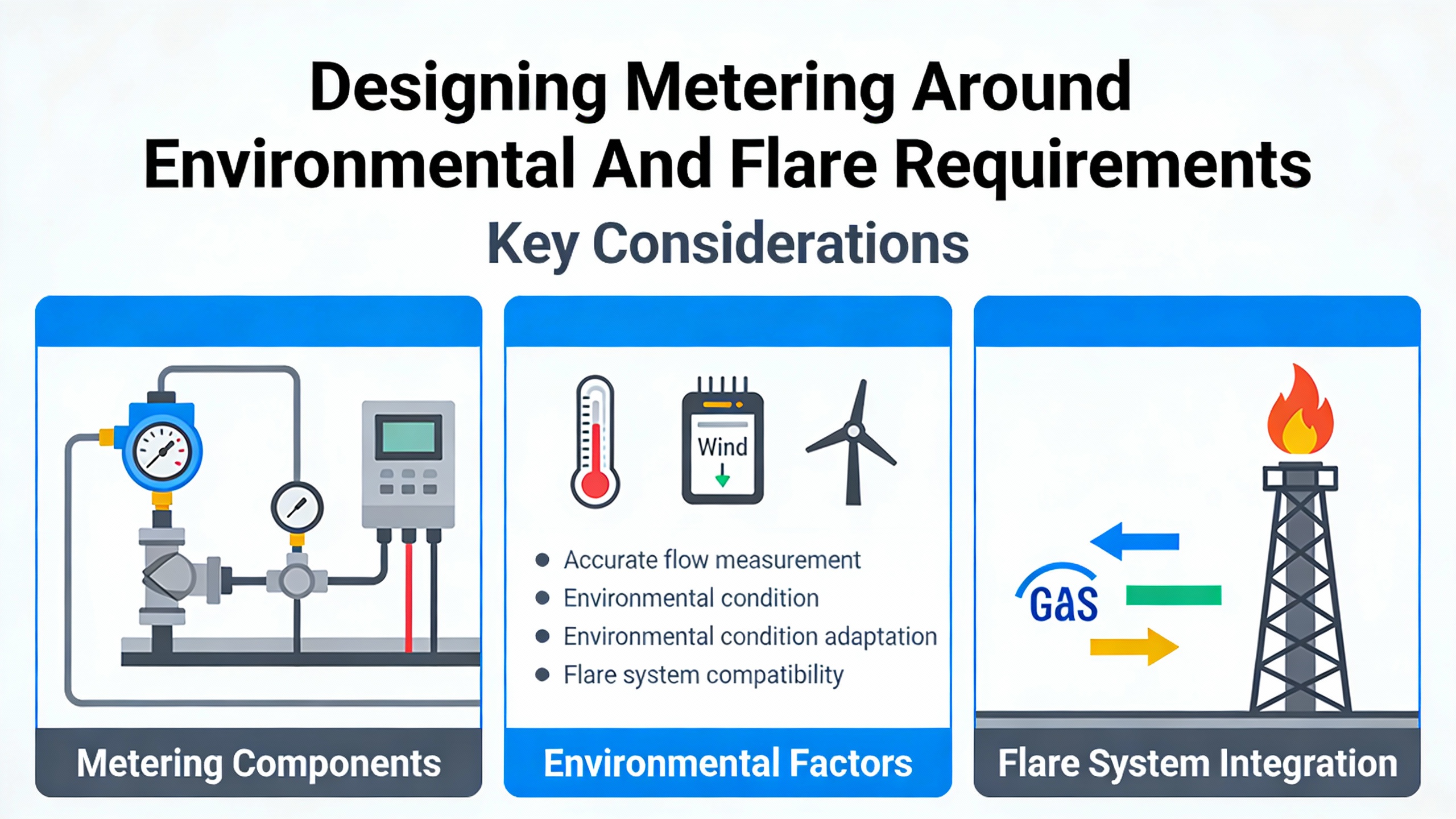
Designing Metering Around Environmental And Flare Requirements
For flares and emission‑related services, the measurement question becomes: how do you meet regulatory accuracy and reporting requirements without imposing unmanageable outage and calibration burdens?
Emerson’s analysis of the EPA Petroleum Refinery Sector Rule is instructive. The rule requires accurate flow measurement of flare steam, purge gas, and supplemental gas, with biennial calibration or equivalent verification. Emerson notes that, in practice, the formal accuracy requirements in the rule are not the hardest part; achieving the very high turndown required, especially on steam, and doing so with acceptable maintenance is the real challenge.
Their solution involves combining technologies rather than betting on a single meter. For steam to a flare, they describe a case where a refinery needed a hundred‑to‑one mass‑flow range with approximately five percent accuracy. For high‑flow atomizing steam, they used a DP flow meter, specifically a high‑performance transmitter paired with a conditioning orifice plate, to measure mass flow at the upper end. For low‑flow atomizing steam, they deployed a vortex meter with temperature compensation. For center steam used to maintain flame shape and stability, they installed another vortex meter. Together, this arrangement provided coverage across the full range while staying within regulatory performance bounds.
For purge and supplemental gases, where steam is not involved, Coriolis meters became the preferred choice. Emerson highlights that Coriolis meters deliver the necessary turndown, accuracy, and ease of calibration. Their Smart Meter Verification feature allows operators to run in‑situ checks that confirm the meter is still within factory baseline performance. The EPA has accepted this verification method as a means of validating meter performance instead of shutting down flare systems every two years for conventional calibration. Emerson further notes that, with manufacturer test data and good practices, refineries can in some cases extend the calibration interval to roughly seven to ten years.
Panametrics adds another tool to this environmental and flare toolkit with clamp‑on ultrasonic meters. When process or chemical conditions make inline meter survival difficult, clamp‑on ultrasonic devices can provide reliable volumetric flow readings and diagnostics from outside the pipe. Their built‑in diagnostics around signal strength and sound speed offer a way to detect fluid changes or fouling without invasive work, which is significant for flare headers and remote lines where access is limited.
From a reliability advisor’s standpoint, the pattern is clear. For compliance‑critical flows, you should:
Choose meter technologies that inherently support the required turndown in the fluid you have, rather than forcing a marginal technology into the application.
Leverage meters with built‑in verification (such as Coriolis with Smart Meter Verification or mag and ultrasonic meters with self‑diagnostics) to reduce the need for intrusive calibration.
Design measurement schemes that combine meters across ranges where necessary, as Emerson does with DP and vortex for steam, and ensure your control logic manages the transitions robustly.
Those design decisions directly impact how often you must disturb flare systems and other critical services, which in turn affects both safety risk and power‑system stability during maintenance.
Building A Reliable, Maintainable Metering Strategy
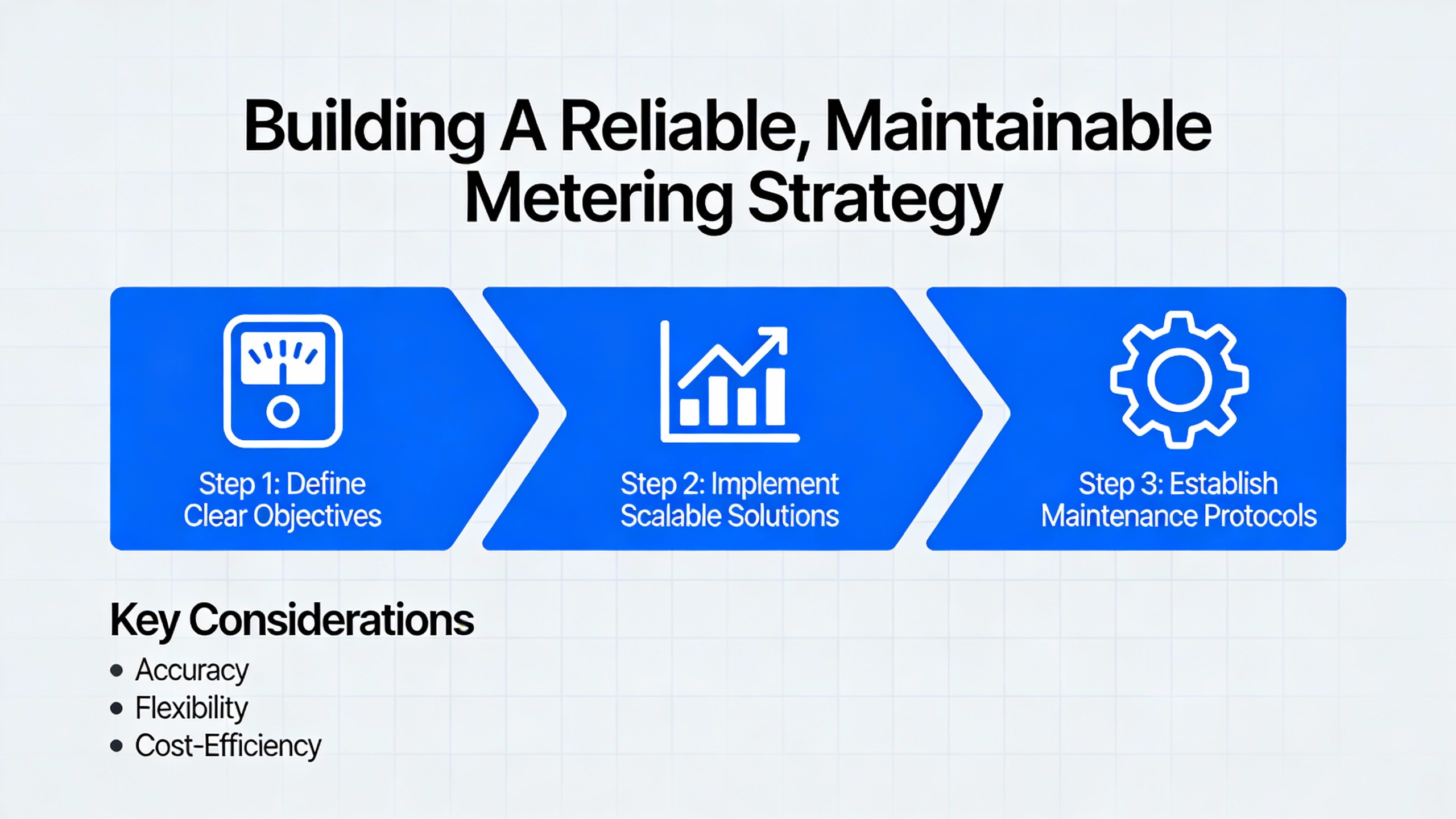
Choosing meter technologies is only half the battle. The other half is integrating them into a coherent strategy that balances accuracy, maintenance, and lifecycle cost.
Industry guidance from ICON Process Controls, JSG Industrial, BJSS Industrial, and Endress+Hauser converges on a set of questions refinery teams should answer before committing to a meter. They recommend clarifying the fluid type, including cleanliness, viscosity, and whether it is conductive or corrosive. They advise defining the required flow range and accuracy, pipe size and material, and the operating pressure and temperature envelope. They also stress the importance of considering installation constraints, such as whether you can cut into the pipe, and integration requirements, including whether you need analog outputs like 4–20 mA, pulse totalizing, or digital protocols such as Modbus, HART, or IO‑Link.
For example, ICON notes that mag and ultrasonic meters with no moving parts are largely maintenance‑free apart from occasional verification, while turbine and paddle‑wheel meters require regular cleaning and inspection. Silver Instruments and Turbines Incorporated point out that while low‑cost turbine or PD meters look attractive at purchase, their long‑term cost may exceed that of a more expensive Coriolis or mag meter when you factor in calibration frequency, spare parts, downtime, and the risk of unplanned failures.
Endress+Hauser’s portfolio philosophy also has a reliability message. They segment flow products into tiers from basic “Fundamental” through “Lean” and “Extended,” up to “Xpert” for the most challenging applications, and distinguish between simple, standard, high‑end, and specialized devices. That structure acknowledges that not every flow point needs custody‑transfer‑grade metering. Some loops can tolerate a standard mag or vortex meter, while others justify a high‑end Coriolis with extensive diagnostics. From a power and reliability standpoint, it makes sense to concentrate your budget and maintenance attention where a measurement failure would trip a major unit, affect environmental compliance, or overload critical drives and UPS systems.
Calibration and maintenance practices matter just as much as technology selection. BJSS Industrial defines calibration as comparing the device output against a known standard to adjust and confirm accuracy, and stresses that regular calibration and targeted maintenance, such as cleaning and replacement of worn parts, are essential to prevent measurement drift and process upsets. Emerson’s Refinery Sector Rule work shows how diagnostics such as Smart Meter Verification can reduce the frequency of invasive calibrations on certain Coriolis and vortex installations, but they do not eliminate the need for a structured program.
A simple reliability‑oriented exercise is to map flow meters to consequence categories. For each meter, ask what happens if it fails low, fails high, or drifts slowly. On a minor wash‑water line, the consequence may be limited to chemical waste. On a furnace fuel‑gas line or a flare steam header, an undetected drift could raise tube metal temperatures, affect emissions compliance, or cause repeated burner trips, which in turn can cause cycling loads on power distribution and backup systems. Those higher‑consequence points should receive the most robust technologies, the tightest calibration and verification routines, and the most attention to installation quality.
From an energy perspective, meters also enable optimization. Fox Thermal’s natural‑gas application notes show how sub‑metering combustion equipment, smelters, kilns, dryers, and gas‑fired generators can identify abnormal usage and support tuning of air‑to‑fuel ratios. That tuning reduces fuel consumption and emissions while flattening thermal and electrical loads. The same logic applies inside a refinery. When you measure steam, fuel gas, air, and cooling‑water flows accurately into major energy consumers, you have the data required to baseline, benchmark, and improve both process and power‑system efficiency.
Short FAQ: Practical Decisions For Refinery Flow Metering
When should I prioritize mass flow over volumetric flow in refinery applications? Silver Instruments, Metlan, JSG, and Turbines Incorporated all draw a clear distinction between volumetric and mass flow. Volumetric meters, such as turbine and PD devices, measure volume per unit time and are influenced by density changes due to temperature and pressure. Mass flow meters, such as Coriolis and thermal gas meters, report mass per unit time and are largely insensitive to these changes. In refinery service, mass flow is usually preferred for custody transfer, blending where composition varies, and emissions‑related fuel or flare measurements, because it more directly reflects material and energy balances. Volumetric meters remain appropriate where the fluid density is stable and where legacy standards or simplicity make volumetric measurement adequate.
Is clamp‑on ultrasonic accurate enough for critical refinery measurements? ICON, JSG, Silver Instruments, and Baker Hughes Panametrics position clamp‑on ultrasonic meters as excellent tools for retrofit, temporary measurements, and large lines where cutting into the pipe is undesirable. In good conditions, transit‑time clamp‑on meters can approach one to two percent accuracy, which is often sufficient for energy‑monitoring, utility balancing, and many process‑control loops. However, Turbines Incorporated cautions that for custody‑transfer‑grade hydrocarbon measurement, turbine and Coriolis meters are still the standard, partly because ultrasonic performance is more sensitive to installation, flow profile, and fluid condition. In practice, clamp‑on ultrasonic is a powerful complement rather than a universal replacement: ideal for diagnostics, verification against inline meters, and many utility services, but not always the first choice for fiscal metering.
How often should refinery flow meters be calibrated or verified? BJSS emphasizes that regular calibration is necessary to maintain accuracy, but the right interval depends on technology and criticality. Emerson’s experience with the Refinery Sector Rule suggests that for certain Coriolis meters equipped with Smart Meter Verification, and for some vortex and DP meters with strong manufacturer support, verification data can justify extending calibration intervals from the baseline two years out toward seven to ten years in specific applications. Mechanical meters such as turbine and PD designs generally require more frequent inspection and calibration due to wear and fouling. A practical approach is to set calibration or verification intervals based on risk: more frequent for high‑consequence points and technologies prone to drift or wear, less frequent where diagnostics and stable designs provide a strong safety margin.
In refinery work, the most resilient measurement strategies look very much like well‑designed power‑protection architectures. They use the right technology for each role, build in redundancy and diagnostics where failure would be costly, and balance up‑front investment against lifecycle risk. Treating flow metering with that same rigor pays off in steadier operations, easier compliance, and fewer late‑night calls about trips and unplanned outages.
References
- https://www.bjssae.com/a-the-science-of-flow-measurement-techniques-and-tools.html
- https://www.fluidosense.com/use-of-flow-meter-in-oil-refinery
- https://www.foxthermal.com/applications/natural-gas.php
- https://hiigroupasia.com/oil-gas-refinery-flow-measurement-flowmeter/
- https://jsgindustrial.com/types-of-flow-meters/
- https://metlaninst.com/top-5-recommended-oil-flow-meters/
- https://www.nature.com/articles/s41598-025-11063-1
- https://www.silverinstruments.com/blog/4-core-technologies-for-oil-flow-measurement-a-2025-guide.html
- https://zeroinstrument.com/multiphase-flow-measurement-methods-an-in-depth-overview/
- https://www.bakerhughes.com/panametrics/blog/choosing-flow-measurement-device


 Videos
 News
News Applications






Leave Your Comment