Industrial and commercial power systems live or die on reliability. In a data center UPS, an industrial inverter, or a power conditioning cabinet, the controller is the brain that keeps everything synchronized, protected, and within spec. Yet when those systems fail in the field, the root cause is often surprisingly mechanical: a poorly machined controller housing that distorts a PCB, a misaligned busbar that concentrates heat, or a mounting bracket that lets vibration fatigue solder joints.
That is why the choice of CNC controller parts supplier is not a purchasing footnote. It is a reliability decision. As a power systems specialist, I have seen multi‑million‑dollar facilities riding on the quality of parts that started life as a machining RFQ. In a global CNC market that surpassed about $95.29 billion in 2024 and is projected to reach roughly $195.59 billion by 2032, according to XC Machining, buyers face more choice than ever. The challenge is how to sift through the noise and select a precision machining partner who can consistently deliver controller parts that uphold, rather than undermine, your power protection strategy.
This article unpacks what you should demand from a CNC controller parts supplier, how to evaluate their precision and quality systems, and how to balance cost, geography, and risk when your end product is a UPS, inverter, or power protection assembly that simply cannot afford to go down.
How CNC Controller Parts Influence Power System Reliability
When we talk about “CNC controller parts” in the context of power systems, we are usually referring to machined components that directly interact with the control electronics and power path. Typical examples include aluminum or copper heat‑sink bases and cold plates for IGBT modules, machined busbars and terminal blocks, housing and chassis components for controller boards, precision mounting brackets and standoffs, and covers, shields, and interface panels for operator and communication modules.
These parts determine how heat flows away from high‑density power devices, how creepage and clearance distances are maintained under real‑world tolerances, how well sensitive control boards resist vibration, and how reliably field wiring connects to power and signal points. Any sloppiness in machining can turn into hot spots, intermittent signals, nuisance trips, or catastrophic failure when the system is under stress, for example, riding through a utility fault or transferring to generator power.
CNC machining, as summarized by sources such as RevPart and Binho, is a process in which pre‑programmed software controls tools and motion to produce parts with much higher precision, speed, and repeatability than manual methods. For controller parts in power systems, this means you can specify tight tolerances down into the few ten‑thousandths of an inch, complex geometries, and consistent surface finishes across repeated builds. The promise is straightforward: if your supplier’s process is robust, you get predictable mechanical behavior that supports predictable electrical behavior.
The catch is that CNC capability on a brochure does not automatically translate into reliable controller parts. You need to understand the supplier’s equipment, their quality systems, and how they think about high‑consequence applications like power protection.
What Precision CNC Machining Brings To Controller Components
Guides from JLCCNC, JBC Machine, and others converge on a few essential attributes of CNC machining that matter directly to controller parts. First, precision. Well‑run CNC shops can hold very tight tolerances; JLCCNC recommends suppliers capable of around ±0.005 millimeter or better, which is approximately ±0.0002 inch, for demanding applications. That level of control is highly relevant when you are aligning power modules to a heat sink, maintaining consistent clamp forces on busbars, or ensuring that mounting hole patterns do not induce mechanical stress into a PCB.
Second, repeatability. The same program and tooling, run on a stable CNC process, will produce the same part over and over. For power electronics, that repeatability translates into predictable thermal paths, consistent torque windows for fasteners, and uniform creepage distances that support your dielectric withstand design. When you are building thousands of UPS controller assemblies per year, variability quickly shows up as yield loss, rework, or field returns.
Third, flexibility. CNC milling, turning, grinding, and multi‑axis machining allow you to consolidate complex geometries into a single setup, as XC Machining illustrates with aerospace brackets that moved from four setups on a three‑axis machine to one on a five‑axis machine, cutting production time by around forty percent. For controller components, consolidation can mean fewer interfaces, fewer stack‑up errors, and fewer opportunities for assembly mistakes.
Those capabilities only help you if your supplier’s equipment, people, and quality systems are fit for your particular application. That is where a more structured evaluation becomes essential.
Technical Capabilities You Should Expect From A CNC Controller Parts Supplier
Multi‑Axis Equipment And Process Scope
A serious CNC controller parts supplier will be able to explain, in concrete terms, which machines they will use for your parts and why. Articles from CNCWMT and 3ERP emphasize that the raw count of machines is less important than their type and condition. For controller housings, heat sinks, and mounting brackets, the most relevant capabilities typically include modern three‑ and five‑axis mills for complex prismatic parts, CNC lathes and possibly Swiss‑type machines for precision turned hardware and small connectors, and surface or cylindrical grinding for ultra‑flat interfaces or tight diameter control where needed.
Five‑axis capability is particularly valuable when your controller components have features on multiple faces, for example, a single block that combines power device mounting, control board standoffs, and cable tie points. Being able to machine those in a single setup improves positional accuracy and reduces the risk of misalignment that can translate into strained solder joints or misfitted connectors.
The age and maintenance status of equipment matter just as much as its nominal specifications. XC Machining notes that machines manufactured after about 2018 tend to incorporate better thermal management and control systems. That is not a hard cutoff, but it is a useful indicator to ask about. Well‑run suppliers can produce maintenance and calibration records showing that spindle runout, axis accuracy, and probing systems are monitored and corrected before they drift enough to threaten your tolerances.
Beyond the machines themselves, look at whether the supplier can support upstream and downstream processes in‑house. Sources like JBC Machine and American Micro highlight the value of having a single partner who can handle machining, basic assembly, and packaging, rather than pushing parts through a chain of subcontractors. For controller parts, in‑house secondary operations such as deburring, heat treatment, and common surface finishes (for example, anodizing or conductive coatings) reduce handling damage and give you a single accountable owner for the final geometry and finish.
The table below summarizes how different technical capabilities map directly to controller part performance.
| Capability | What it means for CNC controller parts in power systems |
| Five‑axis machining | Single‑setup housings and brackets with accurate relationships across multiple faces |
| Modern mills and lathes with probing | Better dimensional control on mating features and threaded interfaces |
| Grinding and fine finishing | Flatness and surface quality on heat‑sink bases and busbars for predictable thermal paths |
| Integrated secondary operations and assembly | Fewer handoffs, lower risk of damage, and clearer responsibility for finished assemblies |
Material And Surface‑Finish Expertise For Power Electronics
Choosing the right material for a part that lives near high voltage and high current is not trivial. XC Machining documents a case where a medical supplier specified only “stainless steel” and received parts in grade 303, which is easier to machine but not appropriate for the required biocompatibility; the batch failed inspection when it really needed grade 316L. The same pattern applies in power systems: vague or incorrect material selections can undermine corrosion performance, thermal behavior, or mechanical strength.
Research from JLCCNC, Kal Manufacturing, and others emphasizes that a capable CNC supplier will work comfortably across a wide range of metals and engineering plastics, including aluminum alloys, stainless and carbon steels, brass and copper, titanium, and polymers such as PEEK or Delrin. For controller parts, that material toolbox might translate into copper or brass for busbars and terminals, aluminum for heat sinks and chassis elements where weight matters, stainless steel for structural brackets in harsh environments, and engineering plastics for insulating standoffs and covers.
Equally important is the supplier’s understanding of how those materials behave. A shop that routinely questions ambiguous specifications, suggests switching from a general‑purpose grade like 6061 aluminum to a stronger alloy when a part is load‑critical, or warns you about galling risks in certain stainless fastener combinations is demonstrating the kind of application literacy that protects your design.
Surface finish also plays a role in power reliability. Roughness affects thermal interface resistance and can influence corona and partial discharge behavior at high voltage. Articles from Baker Industries and Penta Precision stress the need for metrology tools such as surface profilometers and microscopes to quantify and inspect finishes, rather than relying on “looks good” visual checks. For your controller parts, you should expect your supplier to hold and verify specified finishes on heat‑transfer surfaces and sealing interfaces, not treat them as optional cosmetics.
Metrology, Inspection, And Process Control
Every source in the research set agrees on one point: without robust metrology and quality control, the nicest machines in the world will still ship bad parts. CNC24, JUPAICNC, IPQCCO, and MakerVerse all describe layered inspection strategies as a hallmark of professional shops.
For CNC controller parts, you want to see three things in particular. First, modern inspection equipment. Coordinate Measuring Machines (CMMs) provide three‑dimensional accuracy at the scale required for tight controller housings and alignment features. Optical comparators and microscopes help verify profiles and small details. Surface roughness testers quantify Ra values on thermal and sealing surfaces. If a supplier claims they can hold ±0.0005 inch on a mating feature but cannot show calibrated equipment capable of measuring that, you have a gap.
Second, a structured inspection process. Penta Precision and Neway Machining describe best practice as including review of drawings and specifications before machining begins, first‑article inspection on initial parts against the full drawing, defined in‑process checks on critical features during the run, and final inspection with documented sampling plans and reports. For high‑consequence assemblies, Neway Machining stresses the role of First Article Inspection reports and full traceability packages that link material certificates, inspection results, and any process certifications to each part.
Third, data‑driven process control. Baker Industries and CNC24 discuss the use of Statistical Process Control, process capability indices, and machine calibration to keep variation under control. For controller parts, this translates into stable hole positions for connector patterns, repeatable flatness on heat sinks, and reliable thread quality that does not tear insulation or loosen under vibration. When you ask a supplier how they know their process is stable, you are looking for answers that reference control charts, capability studies, and continuous improvement, not just “our operators are very experienced.”
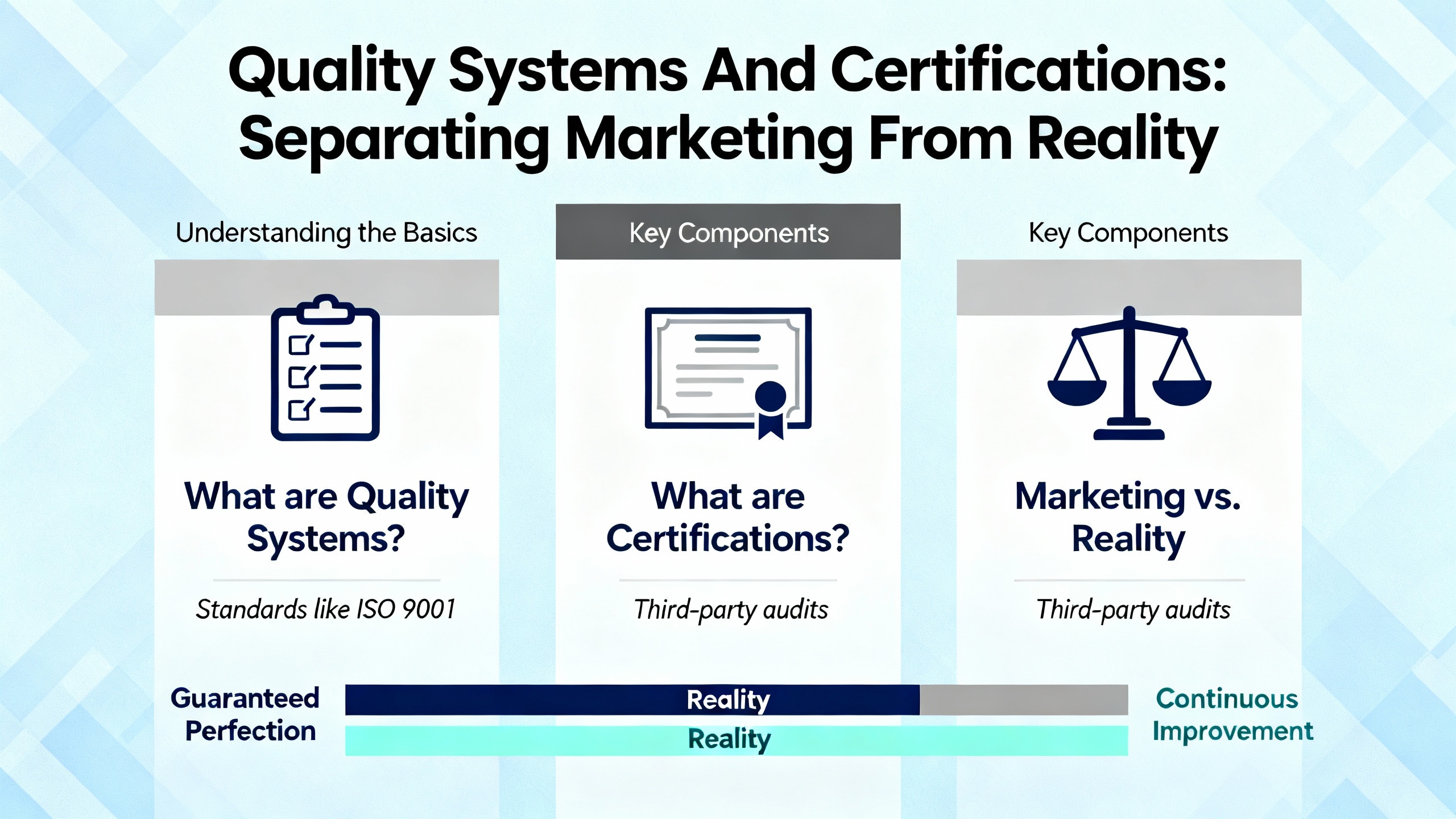
Quality Systems And Certifications: Separating Marketing From Reality
ISO 9001 And Sector‑Specific Standards
Purchasing managers and engineers often treat ISO logos as table stakes, and they are right to do so. Penta Precision and IPQCCO both highlight ISO 9001:2015 as the globally recognized baseline for a quality management system. A CNC supplier without ISO 9001 should raise serious concerns, because the certification attests to documented processes, traceability, internal audits, and a structured approach to corrective action.
Beyond ISO 9001, specialized certifications can signal readiness for demanding applications. Articles from CNCWMT, Fisher Barton, Neway Machining, and CNC24 point to AS9100 for aerospace and defense, ISO 13485 for medical devices, and IATF 16949 for automotive work. While your UPS cabinet or industrial inverter controller may not sit in a certified aerospace system, a supplier with AS9100 or similar credentials has demonstrated they can manage configuration control, first‑article inspections, and risk‑based thinking at a very high standard.
The key is to verify, not just observe. XC Machining recommends requesting current certificates that show the scope of approval, issue and expiration dates, and the accredited body such as BSI, TUV, or ANAB. This simple check filters out shops that treat certification as a static marketing badge rather than a living system subject to annual surveillance audits.
Inspection Infrastructure And Documentation
Quality control is more than machines and certificates; it is a discipline of documentation and traceability. CNC24 describes a model in which every critical part has a digital twin and audit‑ready measurement records. Neway Machining underscores the importance of inspection plans that identify critical dimensions, sampling methods, required equipment, and record‑keeping rules.
For CNC controller components, the practical question is straightforward: when a field issue arises, can your supplier prove what they delivered? A mature shop will provide inspection reports tied to batch or serial numbers, material test reports for metals used in busbars and heat sinks, certificates for any heat treatment or coating processes, and non‑conformance reports that document how deviations were handled. These artifacts are what allow you to distinguish between a design problem and a manufacturing escape, and to close the loop with regulators or customers when needed.
Process Capability And Supplier KPIs
Procurement‑focused guidance from CNC24 encourages buyers to treat quality in quantitative terms. Several key performance indicators are especially relevant to controller parts and other high‑reliability components. Parts‑per‑million defect rates below about five hundred are generally considered good, while rates below roughly fifty are world‑class. First Pass Yield, the percentage of parts that pass through manufacturing without rework, should be above ninety‑nine percent if you want to minimize hidden labor and schedule risk. On‑Time Delivery rates above around ninety‑five percent indicate a supplier that can keep your production plan intact. Complaint rates below approximately 0.2 percent suggest that quality escapes are rare and managed.
The table below summarizes how to interpret these metrics when reviewing a CNC supplier for controller parts.
| Metric | Benchmark from CNC24 research | What it tells you for controller parts |
| PPM defect rate | Under 500 good; under 50 world‑class | Likelihood that machined parts will meet drawing without incoming sorting |
| First Pass Yield | Above 99% | How often parts flow through the shop without rework or adjustment |
| On‑Time Delivery | Above 95% | Reliability of supply for scheduled UPS and inverter builds |
| Complaint rate | Below 0.2% | Frequency of quality issues severe enough to trigger formal complaints |
When a supplier cannot articulate these numbers, or seems surprised by the questions, you are likely dealing with an operation that runs on intuition rather than data. For power protection equipment, that should make you cautious.
Operational Factors: Capacity, Lead Time, And Flexibility
Matching Supplier Capacity To Your Demand Profile
Technical quality is essential, but even the most precise parts are useless if they arrive late. Multiple sources, including CNCWMT and Kal Manufacturing, point out that typical CNC machining lead times range from about one to three weeks, depending on part complexity, order size, and material availability. XC Machining provides an illustrative breakdown in which one to ten prototype pieces might ship in one to two weeks, batches of twenty‑five to one hundred in about two to three weeks, and runs of five hundred to one thousand in roughly three to four weeks, with larger volumes requiring project‑specific commitments.
For power‑electronics controller parts, the right supplier is one whose capacity profile matches your load. A shop running perpetually at ninety‑plus percent utilization may quote attractive lead times but struggle to absorb rush orders when a field failure forces immediate replacements. On the other hand, a shop with too much idle capacity may signal deeper problems with quality, service, or financial health.
A pragmatic approach is to discuss your demand scenarios openly. Share your expected annual volume, typical order sizes, and worst‑case surge requirements, such as recovery from a major outage or a large retrofit project. Ask the supplier how they would handle an urgent order, what expedite options exist, and what premium you would pay for those. XC Machining notes that rush services often command fifty to one hundred percent surcharges; building that into your contingency planning keeps you from being surprised when the inevitable urgent need arises.
Communication, Engineering Support, And DFM
Several sources, including JUPAICNC, RevPart, Stecker Machine, and Fisher Barton, emphasize that communication quality and engineering support often make or break CNC partnerships. For controller parts, good communication shows up early in the quoting process. A strong supplier will ask clarifying questions about tolerances that truly matter, thermal interface requirements, dielectric creepage paths, and how the part will be assembled and serviced. They will not blindly quote every dimension to the tightest tolerance on the drawing, because they know that unnecessary precision wastes money without improving reliability.
Design for Manufacturability, or DFM, is particularly valuable in power systems where controller components bridge electrical, thermal, and mechanical requirements. JLCCNC and RevPart recommend suppliers who can suggest small design changes that ease machining and reduce scrap, such as relaxing non‑critical tolerances, simplifying unnecessary surface features, or combining parts when it does not compromise serviceability. In my experience, a good DFM conversation can eliminate stress‑concentration points around mounting holes, improve airflow paths around controllers, and standardize hardware across assemblies, all of which drive down lifecycle cost.
Time zones and language considerations also matter. XC Machining recounts cases where ambiguous tolerance interpretations with overseas suppliers caused weeks of delay. If your engineering team is based in the United States and your CNC supplier is twelve time zones away, you need clear processes for resolving technical questions rapidly and unambiguously. That is not a reason to avoid international sourcing, but it is a reason to qualify communication practices as thoroughly as machining capability.
Cost, Geography, And Risk: Building A Resilient CNC Supply Base
Total Cost Of Ownership, Not Piece Price
Almost every source in the research set warns against choosing a CNC supplier on unit price alone. CNC24 uses the Prevention–Appraisal–Failure model to show that poor quality costs far more in rework, scrap, expedited shipments, and lost customers than you save by underinvesting in quality. XC Machining provides a concrete example in which a buyer chose a supplier with parts about fifteen percent cheaper, only to incur increased scrap, longer lead times, repeated expedited freight, and extra engineering time, ultimately driving total cost roughly twelve percent higher and adding tens of thousands of dollars in losses.
For CNC controller parts in UPS and inverter systems, the stakes are even higher. A single out‑of‑tolerance busbar or distorted controller plate can ground a high‑power system and force emergency replacement, on‑site diagnostics, and damage to your reputation with customers who measure your performance in uptime, not pennies per part. When you evaluate pricing, factor in the cost of line stops, field failures, warranty claims, and service crew overtime, not just the bill for machined metal.
Practically, this means you should ask suppliers to break down quotes into material, machining, finishing, and logistics components, as recommended by CNCWMT and XC Machining. Compare not only the numbers but also the assumptions behind them: batch sizes, inspection levels, packaging methods, and shipping modes. A slightly higher piece price that includes robust quality control, better packaging, and faster standard lead times may well be the more economical choice over the life of a power system program.
Local Versus International CNC Controller Parts Suppliers
Geography introduces trade‑offs that are especially visible in power projects where both lead time and cost matter. Guidance from Kal Manufacturing, XC Machining, and CNC24 highlights the differences between regional and international CNC supply.
Regional suppliers, typically in the same country or continent as your plant, offer real‑time communication in your business hours, easier facility visits, shorter shipping distances, and generally stronger intellectual property protection and legal recourse. For controller parts, this makes them ideal partners for early development, high‑mix prototyping, and complex designs that will likely iterate several times before stabilizing. It also simplifies coordination when your power systems are safety‑critical or heavily regulated, because you can more easily audit processes and walk through non‑conformance investigations in person.
International suppliers, particularly in established manufacturing regions, can deliver significant unit cost advantages. XC Machining cites customer reports of thirty to fifty percent savings through international sourcing, largely due to labor cost differences and scale. These partners shine when your controller designs are mature, your annual volumes are high, and your specifications are crystal‑clear. The downsides are longer logistics legs, often adding two to four weeks via ocean freight, more complex communication patterns due to time zone differences, and a need for more formalized quality and inspection agreements, including incoming inspection criteria and perhaps third‑party audits.
Many power manufacturers adopt a hybrid approach. They rely on regional CNC suppliers for prototyping, validation builds, and early serial production of controller parts, then transfer stable part families to qualified international partners for cost‑optimized, high‑volume runs. XC Machining describes this model explicitly, noting that a single CNC provider can sometimes coordinate both regional rapid support and offshore volume production. For buyers of power protection equipment, the question is not whether local or international is “better,” but how to blend them to achieve the right balance of responsiveness, cost, and risk.
The table below contrasts typical roles for each geography in a controller‑part strategy.
| Supplier location | Where it fits best for CNC controller parts |
| Regional/local | New designs, frequent design changes, tight launch schedules, complex assemblies |
| International | Stable designs, high volumes, cost‑sensitive programs with predictable schedules |
| Hybrid model | Local for development and urgent needs, international for mature, repeatable work |
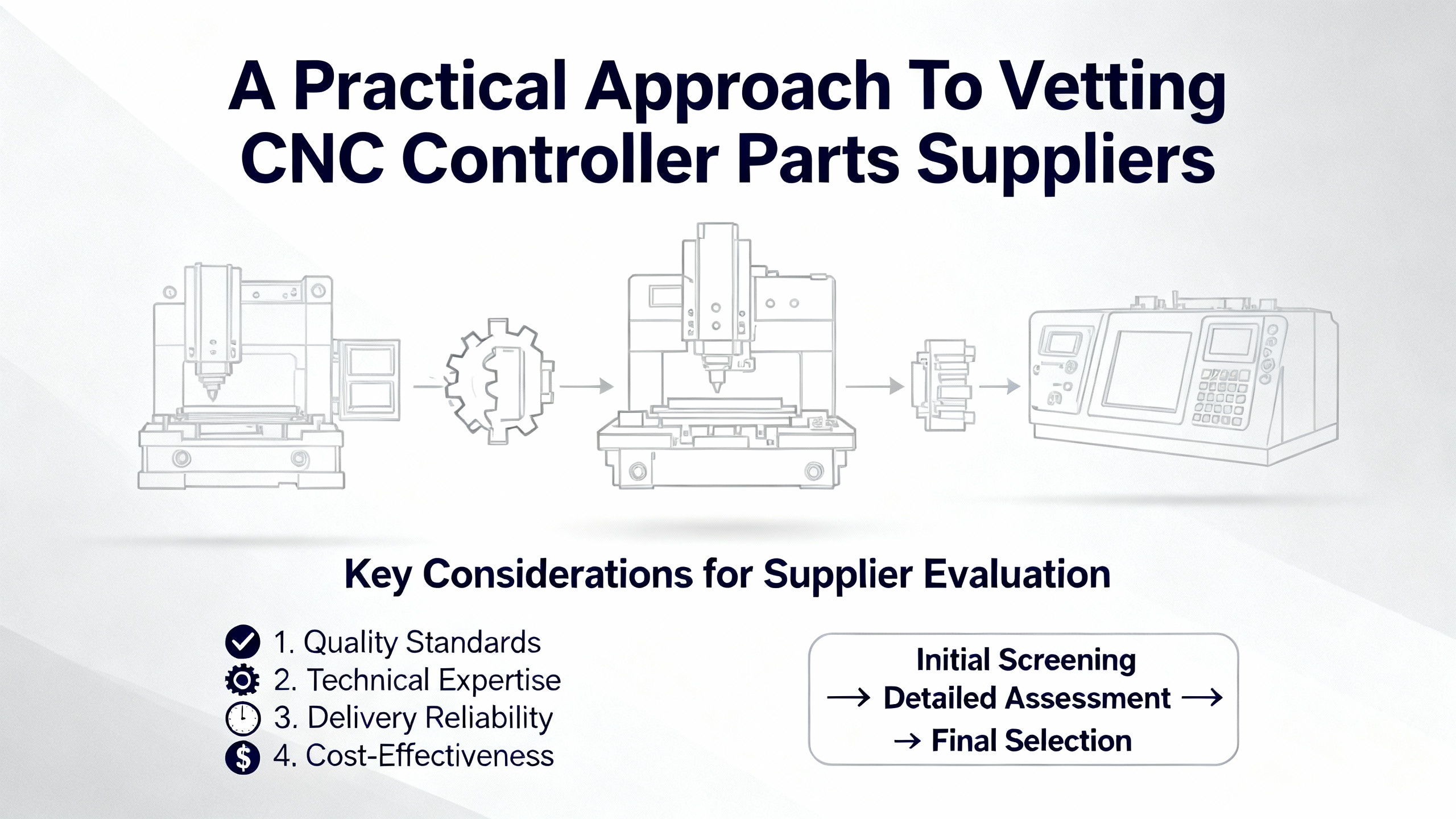
A Practical Approach To Vetting CNC Controller Parts Suppliers
Pulling these threads together, what does a practical selection process look like for a team responsible for UPS, inverter, or power protection hardware?
The most effective programs begin by defining controller‑part requirements clearly. That includes material grades rather than generic descriptions, realistic but appropriate tolerances for critical and non‑critical features, thermal interface expectations, insulation and clearance requirements, and expected annual volumes and mix. Research from Hogge Precision and Kal Manufacturing stresses that this internal clarity is the foundation for any meaningful supplier evaluation.
With those requirements in hand, you can shortlist suppliers who demonstrate the right blend of technical capability, quality systems, and industry experience. Guides from Stecker Machine and Fisher Barton recommend paying particular attention to shops that focus on precision CNC machining as a core competence, provide evidence of working in high‑criticality sectors like aerospace, medical devices, or defense, and maintain transparent, responsive communication.
Before making a long‑term commitment, several authors, including CNCWMT and JLCCNC, suggest starting with a prototype or pilot project. This gives you a low‑risk way to test actual dimensional performance, documentation quality, responsiveness to engineering changes, and schedule adherence. It also lets your quality team validate incoming inspection plans and your engineers see how the supplier handles DFM discussions in real time.
Finally, it is wise to treat supplier development as an ongoing process rather than a one‑time decision. CNC24 and Neway Machining emphasize the value of regular performance reviews based on KPIs such as defect rates, on‑time delivery, and responsiveness to non‑conformances. For power‑system controller parts, where designs may evolve with new silicon generations or standards changes, a supplier who is willing to invest in continuous improvement and transparent root‑cause analysis is worth more than one who only shines when everything goes right.
FAQ: CNC Machining For Power System Controller Parts
How tight should tolerances be on CNC controller parts for UPS and inverter systems?
Research from JLCCNC suggests that suppliers capable of about ±0.005 millimeter, roughly ±0.0002 inch, are well suited to high‑precision work such as aerospace and medical components. For controller parts in power systems, you should reserve that level of precision for truly critical features, such as dowel locations that align power modules to heat sinks or holes that control creepage and clearance distances. Less critical features, like non‑mating covers, can often tolerate looser limits without affecting performance. A good CNC partner will help you categorize dimensions so you pay for tight tolerances only where they add real value.
Do I need aerospace‑grade certifications for controller parts in industrial power equipment?
Guides from CNCWMT and Neway Machining depict AS9100 and similar standards as indicators of a very mature quality system, especially with respect to configuration management, first‑article inspection, and risk control. For many industrial power applications, ISO 9001:2015 with a robust, well‑implemented quality management system is sufficient, particularly if your own organization has strong incoming inspection and engineering controls. That said, if your power equipment feeds critical infrastructure or must meet stringent regulatory requirements, selecting a supplier with sector‑specific certifications can reduce risk and simplify audits, even if those standards are not strictly mandated.
When should I consider dual‑sourcing CNC controller parts?
Research from CNC24 and XC Machining does not prescribe a single rule but suggests thinking in terms of both risk and economics. For high‑volume, high‑impact controller parts where a single supplier disruption would threaten customer commitments, dual‑sourcing or at least having a fully qualified backup is prudent. You might keep a regional supplier in reserve for surge and emergency needs while relying on an international supplier for routine volume, or split volumes between two capable shops. For low‑volume, highly customized parts with complex tooling or fixturing, the overhead of dual‑sourcing may outweigh the risk reduction, especially if your primary supplier has strong performance metrics and financial stability.
In the end, CNC controller parts are not just pieces of metal and plastic; they are structural elements of your power protection strategy. When you select a precision machining partner who treats your controller components with the same seriousness you apply to switchgear ratings and battery autonomy, you give your UPS and inverter systems a mechanical foundation worthy of their electrical design. As a power system reliability advisor, that is the kind of quiet decision I see making the difference between equipment that runs for years and equipment that leaves you answering angry calls at midnight.
References
- https://www.sme.org/technologies/articles/2020/april/tips-for-choosing-a-cnc/
- https://www.ruixing-mfg.com/a-how-to-evaluate-cnc-machined-parts-suppliers-for-quality-and-reliability.html
- https://www.pentaprecision.co.uk/resources/quality-assurance-in-cnc-machining-a-guide-for-purchasing-managers
- https://www.fisherbarton.com/factors-to-consider-when-choosing-a-cnc-machining-partner/
- https://www.hoggeprecision.com/eight-tips-on-finding-the-right-precision-cnc-machining-company/
- https://jbcmachine.com/factors-to-consider-when-choosing-the-right-cnc-machining-manufacturer/
- https://jlccnc.com/blog/10-key-factors-to-consider-when-choosing-a-cnc-machining-company
- https://jupaicnc.com/how-to-verify-the-accuracy-of-your-cnc-machining-parts-supplier/
- https://www.newaymachining.com/blogs/ensuring-quality-how-reliable-cnc-machining-shops-manage-inspection-and-compliance
- https://www.pinnaclemetal.com/how-to-choose-the-right-oem-cnc-machining-manufacturer-for-your-project/


 Videos
 News
News Applications





Leave Your Comment