Machinery protection involves listening to the mechanical story your equipment tries to tell. Selecting a sensor for a critical asset is akin to choosing a stethoscope; pick the wrong one, and the heartbeat remains inaudible. When staring at a catalog or scrolling through a supplier inventory like Apter Power, distinguishing between a 330400 and a 330425 might seem trivial.
Does that extra 25g of amplitude range truly matter? And what happens when a "non-accelerometer" part number like the 330180 appears in the mix? Deciding correctly requires understanding the machine's physics, the environment, and the expected failure modes.
The Overview of Critical Vibration Monitoring
Industrial vibration analysis often feels like a labyrinth of part numbers and technical jargon. It’s easy to get lost. You aren't just buying sensors; you are purchasing the ability to sleep at night knowing a turbine won't disintegrate. The Bently Nevada product line, now under Baker Hughes, represents the gold standard for many reliability engineers, yet the sheer variety of options can paralyze decision-making.
At the core of reliable machinery protection lies a fundamental question: What are we actually measuring? Is it the casing shaking due to a rolling element bearing defect? Or is it the shaft dancing inside a fluid film bearing? The answer to that single question dictates whether you need an accelerometer, like the 330400, or a proximity system involving the 330180.
We will dissect these components not just as catalog items, but as engineering solutions to specific physical problems. We will explore why Apter Power’s inventory of discontinued parts becomes a lifeline for legacy plants, and how to navigate the treacherous waters of signal compatibility.
The API 670 Heavyweights: 330400 vs. 330425
Let’s tackle the workhorses first. The 330400 and 330425 models serve as the backbone for many casing vibration monitoring programs. Both units function as 3-pin, piezoelectric accelerometers designed to meet the rigorous demands of the American Petroleum Institute (API) Standard 670.
Visually, they appear identical. They utilize the same 316L stainless steel housing and mount via the same 1/4-28 or M8 studs. Yet, swapping one for the other could blind a monitoring system to the very fault you hope to detect.
The Physics of the 330400: The Standard Bearer
The 330400 is optimized for general-purpose API 670 applications. Its defining characteristic is sensitivity: 100 mV/g.
Why does 100 mV/g matter? It provides a strong signal-to-noise ratio for typical vibration levels found on gearboxes, motors, and fans. If a machine runs smoothly and vibration spikes remain subtle—say, early-stage bearing wear or minor misalignment—the 330400 amplifies those tiny signals enough for a monitor to read them clearly.
The trade-off involves the ceiling. With a range of 50 g peak, the 330400 functions perfectly for most machinery. But what if you monitor a gearbox with intense gear mesh frequencies?
The 330425: Handling the Noise
Enter the 330425. It functions identically to the 330400 but trades sensitivity for headroom. It offers a 25 mV/g sensitivity, effectively quartering the signal strength compared to the 330400.
Why would an engineer want less signal? To prevent "clipping."
In high-speed gearboxes, the gear mesh frequency can generate incredibly high amplitude acceleration, even if the displacement (actual movement) is tiny. A 100 mV/g sensor might saturate (hit its maximum voltage output) at 50 g. Once a sensor saturates, the data becomes garbage. The 330425 extends that range to 75 g peak.
Comparative Analysis: Sensitivity vs. Range
To visualize the difference, consider the following comparison of technical specifications extracted from the datasheets.
| Feature |
330400 Accelerometer |
330425 Accelerometer |
| Primary Application |
General Casing Vibration |
High Amplitude / Gear Mesh |
| Sensitivity |
100 mV/g (10.2 mV/m/s²) |
25 mV/g (2.5 mV/m/s²) |
| Amplitude Range |
50 g peak (490 m/s²) |
75 g peak (735 m/s²) |
| Frequency Response |
10 Hz to 15 kHz |
10 Hz to 15 kHz |
| Broadband Noise Floor |
0.004 g rms |
0.01 g rms |
| Mounting Torque |
4.1 N·m (3.0 ft·lb) |
4.1 N·m (3.0 ft·lb) |
The data suggests a clear demarcation in use cases. If the machine generates "normal" vibration levels, the 330400 provides superior resolution due to its lower noise floor (0.004 g rms versus 0.01 g rms for the 330425). Using a 330425 on a standard motor might mask very fine bearing faults because the noise floor is higher and the signal strength is lower. Conversely, using a 330400 on a high-speed compressor gearbox invites signal saturation, rendering the protection system useless during a high-vibration event.
Deep Dive: The Piezoelectric Mechanism
Both sensors rely on the piezoelectric effect. Inside the stainless steel housing, a ceramic crystal element is compressed by a seismic mass. When the casing shakes, the mass exerts a force on the crystal ($F=ma$). The crystal generates an electrical charge proportional to that force.
Internal electronics then convert this high-impedance charge into a low-impedance voltage output (IEPE - Integrated Electronics Piezoelectric). It is crucial to remember that these sensors require power—specifically, a constant current source (usually provided by the monitor) typically between 2 mA and 10 mA, often riding on a -24 Vdc bias.
If you connect a 330400 directly to a multimeter expecting to see a voltage generation without supplying power, you will see nothing. The internal amplifier needs juice.
When the Heat is On: 330450 HTAS
Standard piezoelectric crystals hate heat. Get the unit too hot, and the output drifts; get it extremely hot, and it fails entirely. Most standard accelerometers, including the 330400, tap out around 121°C (250°F). The internal electronics—the charge amplifier discussed above—simply cook.
Gas turbines and steam turbine casings don't care about sensor limitations. They routinely exceed these temperatures. Installing a standard 330400 directly on a gas turbine casing is a recipe for immediate sensor death.
The 330450 High-Temperature Accelerometer Sensor (HTAS) solves the thermal problem through segregation. It permanently separates the sensing element from the electronics.
The Segregated Architecture
The 330450 isn't just a tougher sensor; it’s a deconstructed one.
- The Sensing Head: A ceramic element sitting inside a stainless steel housing. It contains no active electronics. It can withstand surface temperatures up to 400°C (752°F).
- The Hardline Cable: Two hard-wired, mineral-insulated cables connect the head to the electronics. These cables are robust, heat-resistant, and integral to the sensor. You cannot simply replace the cable if it gets damaged; it is hard-wired to the head.
- The Electronics: The signal conditioning circuitry sits in a separate box, which you mount in a "cooler" location (safe zone), typically meters away from the scorching turbine casing.
Application: The Gas Turbine Casing
Why measure casing vibration on a turbine? While shaft vibration (proximity) is critical, casing vibration warns of blade passage issues, combustor hum, and structural looseness. The 330450 is the mandatory choice here. Using a standard accelerometer with a thermal boot or heat shield is often a fool's errand; heat soak eventually wins.
Selection Rule:
If the mounting surface exceeds 125°C, do not risk a standard sensor. The 330450 HTAS is the only viable option for high-temperature gas and steam turbine casing measurements within this product family.
The "Not-Accelerometers": 330180 and 330130
Here lies the most common trap for procurement teams and junior reliability engineers.
You might see the 330180 and 330130 listed alongside accelerometers in a Request for Quote (RFQ), perhaps because they are all "Bently Nevada vibration parts" found on sites like Apter Power. Grouping them creates a category error.
These components belong to the 3300 XL Proximity Transducer System. They do not measure acceleration (g's). They measure displacement (mils or microns).
The 330180 Proximitor Sensor: The Brain
The 330180 is the signal conditioning module of the eddy current system. It generates a radio frequency (RF) signal sent to a probe tip and converts the feedback into a voltage proportional to the gap distance.
It does not sense vibration itself. It senses the change in impedance of the probe coil as a conductive target (the machine shaft) moves closer or further away.
The 330130 Extension Cable: The Nervous System
The 330130 is the critical link connecting the probe to the Proximitor. It isn't just wire; it is a tuned coaxial cable with specific capacitance and inductance properties.
Crucial Insight: The 3300 XL system relies on a "tuned tank" circuit. The electrical length of the probe plus the extension cable must perfectly match the requirement of the Proximitor (usually 5 meters or 9 meters total electrical length).
If you have a 1-meter probe and a 5-meter Proximitor, you must use a 4-meter extension cable (330130-040). If you use an 8-meter cable (330130-080), the system will not calibrate. The linear range will shift, and scale factor errors will corrupt your data. You cannot cut the 330130 cable to fit. Shortening it changes the electrical characteristics, destroying the calibration.
Why the Distinction Matters: Bearing Types
You cannot choose between a 330400 accelerometer and a 330180 Proximitor based on price or availability. You choose based on bearing type.
- Rolling Element Bearings: The balls or rollers transfer vibration directly to the casing. An accelerometer (330400/330425) is the correct tool.
- Fluid Film (Sleeve) Bearings: The shaft floats on a wedge of oil. The casing might be motionless while the shaft is thrashing wildly inside due to unbalance or oil whirl. An accelerometer on the casing will miss the problem entirely until it is catastrophic. You need a proximity system (330180 + Probe + 330130 Cable) to look through the casing and measure the shaft's relative movement.
Selection Rule:
If the machine rides on oil film bearings (turbines, large compressors), you need the 330180/330130 system. If it rides on ball bearings (pumps, motors), you need accelerometers like the 330400.
Quasi-Continuous Monitoring: The 200150
Not every machine justifies a dedicated, continuous monitoring channel costing thousands of dollars. What about the "Balance of Plant" assets—the hundreds of smaller pumps and fans that support the main process?
If such a pump fails, it’s annoying, but not a plant-wide shutdown. Yet, manual data collection is labor-intensive and dangerous.
The 200150 accelerometer is designed for the Trendmaster Pro system. Unlike the 330400 which feeds a dedicated monitor (like a 3500 rack) providing millisecond-level protection, the 200150 operates on a quasi-continuous scanning architecture.
The Trendmaster Architecture
Hundreds of 200150 sensors can be daisy-chained on a single cable run. A Dynamic Scanning Module (DSM) polls them sequentially. You get data every few minutes rather than continuously.
The 200150 itself is a piezoelectric accelerometer, but its electrical interface differs. It is designed to work with Transducer Interface Modules (TIMs) that digitize the signal on the bus.
Comparison:
- 200150: Lower cost per point, shared cabling, suitable for general purpose assets (pumps, fans).
- 330400: Continuous, real-time protection. Essential for critical machines that can destroy themselves in seconds (Tier 1 assets).
Where the 3500 Machinery Protection System Fits In
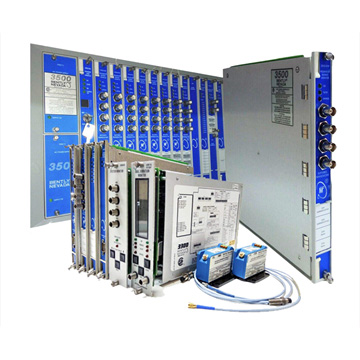
So where do all these sensors finally go? For most critical turbomachinery, the answer is the Bently Nevada 3500 Machinery Protection System. The 3500 rack is essentially the machine’s nervous system. It takes in raw vibration and position signals from 330400/330425/330450 accelerometers and 330180/330130 proximity systems, applies filtering and alarm logic, and then decides when to trip the machine before it destroys itself. When any channel crosses its alert or danger setpoints, the 3500 can drive relays to shut down the turbine, close valves, or send hardwired signals to the DCS.
This is where sensor selection becomes more than a catalog decision. The 3500 only knows what you feed it. If you put a 330400 on a high-speed gearbox and the signal clips at 50 g, the 3500 will still report “normal” vibration right up to failure. Choosing a 330425 instead gives the same 3500 channel enough headroom to see the true amplitude and trip correctly. The same principle applies to shaft measurements: a 330180 Proximitor feeding a 3500 Proximitor/Seismic channel provides both dynamic vibration (AC) and static position (DC) for shaft position, thrust position, and rod drop. If the 330130 extension cable length is wrong and the system is out of calibration, every number on the 3500 for that bearing becomes suspect—the protection is only as good as the transducer chain in front of it.
It also matters economically and diagnostically. Keeping an existing 3500 Machinery Protection System in service and replacing a failed 330400 or 330180 like-for-like through a surplus supplier such as Apter Power avoids triggering a full system upgrade—the rack, wiring, logic, and trip circuits remain untouched. From a project standpoint, a few thousand dollars in compatible sensors can avoid a multi-year capital project. Meanwhile, the 3500 provides a clean split between protection and diagnostics: it runs simple, robust alarm/trip logic while mirroring the same high-quality signals to a condition monitoring system or historian, so analysts can still perform deeper spectral analysis and diagnose root causes instead of just reacting to trips.
Sourcing in a Legacy Market: The Apter Power
Finding these specific part numbers can be a headache. Manufacturers often update product lines, like moving from the 3300 series to the Orbit 60 platform, leaving legacy systems in a lurch.
Are you supposed to rip out an entire monitoring rack just because one accelerometer failed?
Ideally, no. Suppliers like Apter Power specialize in exactly this gap. They stock discontinued and surplus automation parts, including Bently Nevada sensors. Their business model focuses on keeping legacy systems alive.
Apter Power maintains an inventory of over 30,000 parts, including the 3300 XL series and various accelerometers. Finding a "new from surplus" 330400 or a hard-to-find 330130 cable length often makes more financial sense than a total system retrofit.
When sourcing from the surplus market, verifying the specific dash numbers (e.g., 330400-01-00) becomes critical. The suffix dictates mounting threading and certifications (CSA/ATEX). A sensor with the wrong mounting stud (1/4-28 vs M8) turns a ten-minute replacement job into a machining nightmare.
Common Pitfalls and Installation Nuances
Even after selecting the correct sensor, installation errors can negate the investment.
Mounting Resonance
Every accelerometer has a mounted resonant frequency. For the 330400, this is typically above 30 kHz. However, this assumes a perfect, stiff mounting.
Using a magnetic base drastically lowers the resonant frequency, often down to 2-3 kHz. If you are monitoring a gearbox with mesh frequencies at 5 kHz, a magnet mount will act like a low-pass filter, effectively hiding the data. The 330400 and 330425 must be stud-mounted for accurate high-frequency data.
Cable Routing and Triboelectric Noise
For the 330450 HTAS, the hardline cable is stiff. If allowed to vibrate against a casing, it can generate "triboelectric" noise—false signals caused by friction and charge generation within the cable insulation. The cable must be clamped down securely at regular intervals.
Ground Loops in Proximity Systems
For the 330180 system, the Proximitor usually isolates the common (ground) from the DIN rail. However, if the probe shield grounds at the machine casing and the monitor grounds at the rack, a ground loop forms. This introduces 50Hz/60Hz hum into the signal. Proper isolation of the 330130 extension cable connectors using connector protectors (silicone boots) is mandatory to prevent the brass connectors from grounding against the machine conduit.
Comprehensive Decision Matrix
To synthesize the selection process, we can utilize a decision matrix based on machine type and failure mode.
| Scenario |
Recommended Model |
Reasoning |
| Standard Motor / Pump |
330400 |
100 mV/g sensitivity catches early bearing faults. Rolling element bearings transfer energy to casing. |
| Compressor Gearbox |
330425 |
75g range prevents signal clipping during high-energy gear mesh events. |
| Gas Turbine Casing |
330450 HTAS |
400°C temp rating withstands turbine heat. Separated electronics ensure longevity. |
| Steam Turbine Rotor |
330180 + 330130 |
Fluid film bearings require relative shaft displacement measurement. Casing vibration is insufficient. |
| Cooling Tower Fan |
200150 |
Non-critical asset. Quasi-continuous scanning (Trendmaster) reduces cabling and monitoring costs. |
The Interchangeability Factor
One of the strongest selling points of the Bently Nevada 3300 XL series (including the 330180 and 330130) is "Interchangeability".
In older systems, probes and drivers were matched sets. You had to calibrate them together. If a driver failed, you had to replace the probe too, which often meant shutting down the machine to access the bearing housing.
The 3300 XL standard guarantees that any 3300 XL 8mm probe works with any 3300 XL extension cable and any 3300 XL Proximitor, provided the lengths match (e.g., 5-meter system). This modularity reduces spare parts inventory—a key consideration for Apter Power customers looking to maintain stock of critical spares.
The Signal Chain and Integration
To fully appreciate the nuance of these sensors, we must look downstream at how the signal is processed. The 330400 and 330425 output a voltage signal. But what does the monitor do with it?
Integration to Velocity
Most vibration analysts prefer to view data in units of velocity (inches per second or mm/s), as velocity provides the best indicator of fatigue energy in the frequency range of 10 Hz to 1 kHz.
Since the 330400 is an accelerometer, the monitor must mathematically integrate the signal to convert acceleration to velocity. This process acts as a filter. Integration amplifies low-frequency noise.
This is where the 200150 differs. Some versions of the 200150 (and its cousins in the Velomitor line) have internal integration, outputting velocity directly. However, the 330400 outputs pure acceleration. This requires a high-quality monitor to perform the integration without introducing noise. If using a 330425 (with its higher noise floor) and integrating to velocity to measure low-speed vibration, the result might be a "noisy" signal that masks true machine behavior.
Insight: If the primary measurement goal is low-frequency velocity (e.g., on a slow-speed fan), and you are forced to use an accelerometer, the 330400 is vastly superior to the 330425 due to its lower noise floor. The 330425’s noise becomes problematic when integrated at low frequencies.
The Economics of Reliability
Why do companies like Apter Power exist? Why buy a 330180 Proximitor that was designed twenty years ago?
The lifecycle of industrial machinery is measured in decades. A steam turbine commissioned in 1985 might still run today. The control system (DCS) might have been upgraded three times, but the vibration rack might still be a Bently Nevada 3300 (pre-3500) or an early 3500 system.
OEMs eventually stop manufacturing legacy sensors. They push customers to upgrade to the newest wireless or digital systems. But upgrading the vibration system often triggers a cascade of costs:
- New Cabling: New sensors might use digital bus cables instead of shielded twisted pairs.
- New Rack: The old rack won't accept the new cards.
- DCS Integration: The new rack speaks a different Modbus dialect.
- Cybersecurity: New digital sensors introduce new attack vectors.
For a plant manager, buying a "surplus new" 330180 from Apter Power for $500 is infinitely more attractive than a $50,000 system upgrade. It keeps the machine protected and the plant running without triggering a capital project.
This economic reality drives the market for these specific part numbers. The 330400, 330130, and 330180 are not just sensors; they are the legacy infrastructure of global industry.
Advanced Diagnostics with the 330180
While we established that the 330180 measures displacement, its utility goes beyond simple vibration.
Gap Voltage: The DC component of the 330180 signal tells you the average distance to the shaft. This allows for:
- Thrust Position Monitoring: Detecting if the rotor is moving axially and grinding into the thrust bearing.
- Hydrostatic Lift: Verifying that the shaft has lifted off the bearing shells before starting a heavy turbine (jacking oil pressure).
- Rod Drop: In reciprocating compressors, measuring the vertical drop of the piston rod to determine rider band wear.
An accelerometer like the 330400 cannot provide any of these static measurements. It only sees dynamic change (AC). It is blind to position. This reinforces why the 330180 is indispensable for fluid film bearing machines.
Hazardous Area Considerations
Refineries and chemical plants are hazardous areas (Class 1 Div 1 or Zone 0/1). Sparks cause explosions.
The 330400 and 330425 are available with hazardous area approvals (ATEX, CSA, IECEx). However, the approval often dictates the installation method.
- Intrinsic Safety (IS): Limiting the energy available to the sensor. Requires zener barriers or galvanic isolators in the control cabinet.
- Explosion Proof: Containing any explosion within the conduit/housing.
The 330180 Proximitor is an active device powering a probe. In hazardous areas, the match between the barrier and the Proximitor is strict. Using a non-approved extension cable (330130) or a Proximitor without the correct "05" suffix (Agency Approval option) can violate the safety certification of the entire machine train.
When browsing Apter Power, checking the suffix (e.g., 330400-01-05) is vital. The "05" usually denotes the multi-approval (CSA/ATEX). A "00" unit might be identical functionally but illegal to install in a Zone 1 area.
Choosing the Right Bently Nevada Probe for Your Bearing
Choosing between the 330400, 330425, or the proximity-based 330180 isn't a matter of preference; physics dictates the choice. High heat demands the 330450. Fluid film bearings demand the 330180. Gear mesh frequencies demand the 330425. Before clicking "buy" on a site like Apter Power, examine the bearing housing. What occurs inside? The answer to that question reveals exactly which part number belongs on the requisition list.


 Videos
 News
News Applications






Leave Your Comment