When a Bently Nevada 3500 rack “stops working” in a power or industrial plant, the impact is immediate and uncomfortable. Turbines and compressors are still spinning, but protection and vibration data are suddenly in doubt. Operators lose confidence, alarm screens light up, and the temptation is to blame the rack and start swapping modules. From a power system reliability perspective, that is the shortest path to higher risk and longer outages.
The 3500 is not a simple sensor panel; it is a safety‑critical machinery protection and condition monitoring system that sits alongside turbine controls, fire and gas systems, and, in many stations, the same UPS and inverter infrastructure that protects DCS and SCADA. When it does not behave, the right response is a structured diagnosis grounded in how the system actually works, not ad‑hoc guesswork.
This article walks through how the Bently Nevada 3500 is built, what “not working” usually looks like in the field, and how to diagnose and repair failures in a way that protects both the machine train and the plant’s reliability targets.
Where the 3500 Fits in the Reliability Chain
According to the Bently Nevada 3500 datasheet and operating guidance from the manufacturer, the 3500 series is a modular, rack‑based machinery protection and condition monitoring platform designed for critical rotating and reciprocating equipment such as steam and gas turbines, compressors, pumps, generators, and large motors. The system continuously monitors vibration, shaft position, speed, and key process parameters around the clock and provides trip and alarm outputs that protect high‑value equipment from damage.
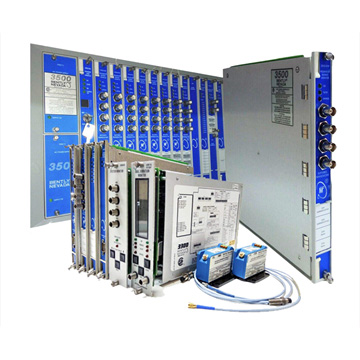
The rack uses a standard 19‑inch architecture with plug‑in modules: power supplies, rack interface modules, monitor channels, relay cards, and communication interfaces. Monitor modules accept inputs from proximity probes (via Proximitor units), seismic vibration transducers, Keyphasor probes, and temperature sensors. The 3500 is commonly configured to meet API 670 requirements for machinery protection, including redundancy, self‑diagnostics, and robust alarm handling.
For a power system specialist, the 3500 sits in the same risk category as protection relays or a high‑reliability UPS. It is designed with dual power supplies and redundant communication paths, and it is deeply integrated with turbine controls and plant DCS using protocols such as Modbus or, in some configurations, Ethernet Global Data gateways. When it fails, you are not just losing a trend; you may be losing the last line of defense between a mechanical fault and a major outage.
What “Not Working” Actually Looks Like
In practice, “the Bently 3500 is not working” can describe several very different failure modes. The diagnostic path depends heavily on the symptom, so it is worth being precise.
Loss of Vibration Data at the HMI or DCS
A field case shared on an automation and control engineering forum describes a gas turbine installation with four trains upgraded to Speedtronic Mark VIe controls. Each unit had a Bently Nevada 3500 vibration monitoring system and a separate fire and gas system as part of the overall control package. There were eight HMIs in total, one local and one remote per unit, configured to display vibration data from the turbine, low‑pressure and high‑pressure compressors, and gearboxes.
The operators observed a frequent communication failure between the Mark VIe and the Bently Nevada 3500 system. The symptom was that no vibration data appeared on the HMI screens, while turbine, auxiliaries, process monitoring, and control parameters were all present and healthy on both local and remote HMIs. The failure cycled through all four machines within less than an hour.
On the Bently side, the Ethernet communication gateway module, a 3500/92, showed its communication LED off and the OK LED flickering on one unit, while on the other three units the communication LED was on and the OK LED was solid green. On the Mark VIe workstation, the Ethernet server service appeared normal, and ethernet cabling looked intact. Critically, when technicians connected a Bently rack configurator utility from a separate engineering laptop, they confirmed that all vibration readings were available, channels were healthy, and modules were in OK condition. Only the communication gateway status reported “NOT OK.”
In that scenario, the 3500 was performing its protection and measurement role correctly. The failure was in the communication path between the rack and the control system, not in the vibration monitoring itself. Yet for the operator looking at an HMI with blank vibration values, the experienced symptom was “Bently 3500 not working.”
Misleading or Erratic Vibration Readings
Another common complaint is that 3500 readings do not match portable analyzer data or jump in ways that do not match machine behavior. A forum post describing an upgrade from a Bently Nevada 7200 system to a 3500 rack noted that vibration readings previously matched a CSI 2115 portable analyzer, but after the changeover, the 3500 readings no longer aligned with the analyzer’s values. No specific numbers were given, but the concern was clear: can the new rack be trusted?
A practical troubleshooting guide on vibration monitoring systems underscores that such mismatches often trace back not to the rack core, but to the probe chain and configuration details. Typical issues include non‑responsive proximity probes, mismatched readings between dual probes on the same shaft, and nuisance trips on high vibration. Problems at the probe, cable, extension, or Proximitor level can all corrupt the signal long before it reaches a 3500 monitor module.
Configuration errors can worsen the situation. Wrong sensor type selection, incorrect input ranges, scaling factors, or engineering units inside the 3500 can make correct sensor signals look wrong at the HMI or historian. The result is again experienced as “the 3500 is not working,” even though the malfunction is in the configuration rather than the hardware.
FAIL LEDs and Module‑Level Faults
The 3500 makes heavy use of front‑panel diagnostic LEDs as a first‑line indication of health. Guidance from Bently Nevada and third‑party reliability advisors explains that these LEDs are not cosmetic; they form a real‑time diagnostic dashboard for power and instrumentation teams.
On many monitor modules, a steady OK LED indicates normal operation, while a blinking OK LED can signal a bypass condition or a software or configuration mismatch that should not be ignored. A solid FAIL LED almost always indicates a significant hardware problem in the module. TX (transmit) LEDs on communication‑related modules indicate data traffic; a silent TX LED where traffic should be present is a strong clue to communication issues.
Power supply modules typically include green AC OK and DC OK LEDs. Loss of DC OK can bring down large portions of the rack, impacting every other module. Vibration monitor modules often have channel‑specific indicators for individual channel alarms, danger states, and sensor OK status. This means a single bad channel or sensor may not trigger an overall module FAIL, but it will still compromise that specific measurement and possibly the associated trip logic.
A reported field example described a gas turbine with a 3500/42M Proximitor/Seismic monitor showing intermittent FAIL indications. Visual inspection and reseating the module did not clear the problem. Replacing the monitor with a compatible unit restored stable operation, after which the suspect module was sent for repair. In that case, the LED behavior correctly pointed to a module‑level fault.
Rack or Card Damage
In some plants, technicians encounter more dramatic symptoms, such as burnt I/O cards or modules. A forum thread title referring to “Bently Nevada 3500 vibration monitoring panel I/O cards burnt – probable causes” suggests a discussion of repeated card failures, although the detailed content was not accessible in the captured material.
Even without that specific thread, engineering practice around rack‑based systems like the 3500 points to recognizable causes: overvoltage conditions, incorrect field wiring, transient surges, ground faults, and inadequate shielding are all known to damage signal and I/O cards. Environmental stress, such as high heat, dust, or moisture and poor enclosure ventilation, can also shorten module life.
While such failures are relatively rare compared with configuration and sensor issues, they are serious. A burnt card indicates an underlying electrical or environmental problem that must be corrected, not just a one‑off component replacement.

How the 3500 Architecture Shapes Your Troubleshooting
The design of the 3500 system and the documented operating manual strongly influence how diagnosis and repair should be done.
The rack is modular. Power supplies, monitor modules, communication gateways, and relay output cards can be added or removed to match the machine train. The manufacturer’s operating manual targets engineers and technicians and is structured around the lifecycle of deployment: introduction and safety, system overview, installation, configuration, operation, maintenance, and troubleshooting. It emphasizes proper mounting, wiring, grounding, noise control, and controlled initial power‑up with verification via indicator LEDs.
Configuration software is used to initialize the system, calibrate probes and accelerometers, define alarm thresholds and trip settings, and set up communication protocols and data logging. The manual and datasheet both stress management of change: configurations should be documented, baselined when the installation is new, and modified only under formal procedures.
The troubleshooting sections describe flowcharts and step‑by‑step checks for power supplies, grounding, sensors, communications, and module errors using front‑panel LEDs and diagnostic logs. Built‑in self‑tests play a central role in identifying failing modules. Above all, safety guidance is explicit: de‑energize and lockout/tagout equipment before installing or servicing modules, use appropriate personal protective equipment, and avoid exposure to high voltage and moving machinery.
Taken together, the architecture and documentation point toward a layered diagnostic approach rather than a single quick fix.
A Structured Diagnostic Workflow When the 3500 Is “Down”
When operators report that the Bently 3500 is not working, a disciplined workflow protects both the machine and the people working on it.
Start with Safety and the Manual
Before opening doors, pulling modules, or moving probes, the operating manual’s safety instructions should be followed. The manual recommends de‑energizing equipment where required, applying lockout/tagout, using appropriate PPE, and respecting the electrical and mechanical safety precautions for the host machine. For industrial and power plants, this aligns with broader safety regimes already in place for switchgear, UPS, and inverter maintenance.
At the same time, locate the current configuration file and ensure it is backed up. This makes it possible to later confirm whether any configuration drift occurred and to restore known‑good settings if needed.
Verify Rack Power and Overall Health
Power supply issues are a documented, common source of rack instability. Diagnostic guidance from Bently Nevada and third‑party troubleshooting resources recommend verifying the rack input voltage and inspecting the power supply modules. Check for AC OK and DC OK LED indications; a red fault LED or loss of DC OK is a clear problem. Because the 3500 supports redundant power supplies, it is possible for one failed supply to be masked until the second one experiences stress.
If the rack is cycling, shutting down unexpectedly, or showing multiple module alarms, power quality should be suspect. Confirm that supply voltage is within the specified range and that any upstream UPS, inverter, or auxiliary power system feeding the rack is stable. If a power module shows a fault indication or fails to meet its output requirements, replacement with a known‑good unit is recommended.
Read the Front‑Panel LEDs Carefully
Front‑panel LEDs are the fastest path from “something is wrong” to “which part of the system is involved.” Reference material on 3500 modules highlights several patterns.
A steady OK LED on a monitor module suggests that the module’s internal diagnostics see no fault. A blinking OK LED often indicates a bypass or configuration condition; for example, a channel may be inhibited or in configuration mismatch. Ignoring a blinking OK LED is unwise; instead, consult the specific module manual to interpret the pattern.
A solid FAIL LED on any module indicates a critical hardware problem that should be investigated immediately. On a communication or Transient Data Interface module, this may mean the card cannot reliably move data. On a monitor module, it may mean the measurement chain or processing is compromised. Power modules with fault LEDs are of particular concern because they affect the entire rack.
Channel‑specific LEDs help differentiate between a module‑level fault and a sensor or process issue. A single channel showing alarm or danger while others remain OK points toward a local sensor or wiring problem. When an entire module shows FAIL, and swapping it with an identical spare causes the fault to move with the module, the evidence favors replacing the module.
Confirm Communications with DCS, PLC, or Turbine Control
If the primary symptom is missing vibration data at HMIs or the DCS, while the turbines and auxiliaries otherwise appear healthy in the control system, the communications leg between the 3500 and the control system should be checked.
Troubleshooting guidance for 3500 communication issues recommends inspecting the network cabling and connectors, checking protocol settings and IP addresses in the configuration software, and ensuring the correct modules are installed and enabled. In the Mark VIe gas turbine case, the Bently 3500 rack showed healthy vibration channels, but the 3500/92 EGD communication gateway module reported “NOT OK” in the Bently configuration utility. The communication LED was off and the OK LED flickered on one unit, even though the Mark VIe EGD server service appeared normal.
That kind of discrepancy is a strong indication that the communication module, its configuration, or its network link is the root cause. Similar patterns have been reported where data between a 3500 system and an Allen‑Bradley PLC dropped repeatedly until a faulty network switch was replaced and firmware was updated, restoring stable data flow.
By comparing what the Bently configuration software sees, what the DCS or turbine control workstation sees, and what the front‑panel LEDs indicate, you can separate “rack measuring correctly but not communicating” from “rack truly not measuring.”
Investigate Sensor and Proximitor Chains
When data is present but wrong, noisy, or inconsistent with portable instruments, the next layer is the sensor chain: probe, cable, extension, Proximitor, and the monitor channel.
A step‑by‑step guide for vibration monitoring troubleshooting focuses first on physical inspection. Visually inspect the probe body, its cable, the extension cable, and the Proximitor for damage, wear, loose fittings, or contamination. All electrical connections must be tight and secure, including probe connectors, extension cable joints, and Proximitor terminals.
An important practical detail is the choice of tape at probe–extension junctions. Bently Nevada’s guidance is to use a specific insulating tape rather than generic Teflon tape, which can introduce noise. If Teflon tape or other non‑recommended materials are found, replacing them can materially improve signal quality.
Gap voltage, the DC bias voltage between the probe tip and shaft, should be checked and observed for at least ten to fifteen seconds. Typical systems are set to values such as around minus seven and a half or minus ten volts, depending on machine and system requirements. The value should be stable. A practical continuity and noise test is to gently move or jerk the probe cable while watching the gap voltage. Any fluctuation during this test indicates a problem in the probe or cable assembly.
If initial checks are satisfactory, the probe can be carefully removed after marking or counting the exposed threads so it can be reinstalled in the same position. The probe tip should be examined for foreign material or damage. Contamination suggests an environmental or mechanical issue that should be discussed with mechanical maintenance. Physical damage typically calls for probe replacement.
Resistance of the probe and extension cable should be measured and compared to model‑specific values in the manufacturer’s documentation. Out‑of‑tolerance resistance indicates a component that must be replaced. System linearity can be verified with a micrometer setup, moving the probe through a known displacement range and checking the response. A linear response indicates a healthy system; non‑linearity suggests that at least one element of the probe–extension–Proximitor chain is defective.
A structured substitution test is then recommended. Combine existing components with known‑good ones in different combinations such as existing probe with new extension and Proximitor, existing extension with new probe and Proximitor, and existing Proximitor with new probe and extension. The combination that restores correct behavior reveals which original component is faulty. After any replacement, linearity is rechecked, the chain is reassembled, and gap voltage is reset to the specified value.
Address Noise, Grounding, and Configuration Problems
Even with good hardware, grounding and configuration can make a healthy 3500 appear unreliable. Guidance on 3500 troubleshooting highlights that ground loops introduce electrical noise, causing erratic vibration readings and false alarms. Mitigation includes the use of isolated signal conditioners where appropriate and ensuring that all grounds terminate at a single common point rather than multiple, competing ground paths.
Configuration errors are another frequent source of operational problems. Wrong setpoints, alarm limits, logic voting configurations, or sensor type assignments can all cause behavior that operators experience as “not working,” including nuisance trips or the absence of expected alarms. Best practice is to back up the current configuration, carefully verify key parameters against design documents and machine dynamics, and reload a known‑good configuration if inconsistencies appear.
The 3500’s configuration software and documentation support a deliberate approach: baseline the initial installation, document changes under a management‑of‑change process, and periodically review settings against API and OEM guidance.
Isolate and Replace Faulty Modules
When evidence points to a module or card, the safest and most accurate confirmation method described in troubleshooting guidance is substitution with an identical spare. If swapping a suspect monitor module with a spare causes the problem to move with the module, the module itself is at fault. If the fault remains on the same rack slot or channel after the swap, attention should shift back to wiring, sensors, or rack backplane.
Any module with a solid FAIL LED that does not clear after reseating and power cycling, and which is confirmed by swap tests, should be replaced with a compatible unit. Reliability‑focused suppliers emphasize the importance of using high‑quality, compatible 3500 modules from trusted sources to ensure long‑term reliability and seamless integration with existing PLC and DCS infrastructure. For safety‑critical racks, defective modules should typically be returned for repair or disposal rather than kept in spares stock.
For burnt I/O cards or repeated card failures, generic reliability practice suggests verifying field wiring against drawings, checking power supply quality and grounding, confirming surge protection and bonding, and reviewing cable segregation between signal and power circuits. The goal is to eliminate the underlying stressors so that replacement hardware does not suffer the same fate.
Symptom, Cause, Action: A Quick Reference
The following table summarizes typical symptom patterns, their likely technical focus, and example diagnostic actions based on the guidance discussed above.
| Symptom at site | Likely focus area | Example diagnostic actions |
| No vibration data on HMI or DCS, but machine runs normally | Communications between 3500 and control | Check 3500 communication module LEDs and status in configuration software, verify network cabling and protocol settings |
| Intermittent or mismatched vibration readings vs portable unit | Probe and Proximitor chain, configuration | Inspect probes and cables, check gap voltage stability, verify sensor configuration and scaling in the 3500 |
| Channel alarm or danger with others OK | Specific sensor or channel | Use channel LEDs, perform continuity and resistance checks, apply linearity and substitution tests on the chain |
| Module FAIL LED active | Module hardware or rack backplane | Reseat module, consult manual for LED codes, swap with identical spare to see if fault follows module |
| Rack or multiple modules cycling or tripping unexpectedly | Power supplies and grounding | Verify rack input voltage, check AC OK and DC OK LEDs, inspect grounding and upstream power quality |
| Persistent noise or unstable readings without clear mechanical cause | Ground loops and wiring practices | Review grounding scheme for single point, use isolated signal conditioners, check cable routing and shielding |
This is not a complete troubleshooting matrix, but it reflects the patterns most consistently highlighted in manufacturer and practitioner material.
Repair and Return‑to‑Service Checks
After diagnosing and repairing a 3500 issue, the work is not complete until the system’s protective function has been proven back in service.
The operating manual and troubleshooting guides emphasize verifying that all relevant LEDs indicate OK status, that power supplies are stable, and that communication with DCS or turbine control is re‑established and robust. For vibration and position channels, technicians should repeat gap voltage and linearity checks as needed, confirm that sensor readings look reasonable under known steady operating conditions, and ensure that alarms and trips are configured to agreed setpoints.
Because the 3500 is integrated into wider plant systems, it is prudent to perform a functional test of alarm and trip paths where safe and allowed by plant procedures. This may include stimulating inputs to just below and just above alarm thresholds, confirming annunciation on HMIs, and where feasible, confirming relay actions in a controlled setting. All configuration changes should be documented and, ideally, reviewed with both mechanical and electrical discipline owners.
Configuration and data should be backed up once the system is stable. Trend data from before and after the incident can be useful for future root‑cause analysis and for adjusting alarm setpoints if the incident revealed weaknesses in previous settings.
Preventing Recurrence: Maintenance and Design Practices
From a reliability advisor’s perspective, the best 3500 failure is the one prevented by design and disciplined maintenance. Several preventive practices emerge consistently from the datasheet, the operating manual, and troubleshooting guides.
Routine visual inspections of racks, wiring, connectors, and enclosures help catch early signs of wear, contamination, or damage. Cleaning modules and cooling paths, maintaining good ventilation, and keeping the rack environment within specified temperature and humidity ranges support long module life.
Scheduled sensor calibration using reference sources ensures that proximity probes, accelerometers, and other sensors remain within specified performance. Proactive review and improvement of grounding and shielding reduces noise and the risk of ground loops.
Configuration management is equally important. Backing up configurations, reviewing alarm limits against machine behavior and relevant standards, and handling changes under formal management‑of‑change procedures reduces accidental misconfiguration. Baselining new installations and periodically confirming that live settings match documented configurations can prevent “mystery” behavior years after commissioning.
Network and communication infrastructure must be treated as part of the protection system, not an afterthought. Switches, routers, and gateways connecting the 3500 to DCS, PLC, turbine control, or higher‑level condition monitoring platforms such as System 1 should be maintained, monitored, and periodically refreshed. The documented case where communication drops disappeared after replacing a network switch and updating firmware is a reminder that sometimes the weakest link is outside the rack.
Finally, spare parts and support strategies matter. Keeping a small set of critical spares, such as power supply modules and key monitor or communication cards, reduces repair time. Working with qualified service providers for diagnostics and module replacement, and keeping the latest edition of the operating manual accessible, ensures that local teams are not improvising under pressure.

Closing Thoughts
When a Bently Nevada 3500 “is not working,” the real challenge is not replacing a card; it is restoring reliable protection and trustworthy data without introducing new risks. By treating the 3500 as a critical part of the power system protection chain, using its own diagnostics intelligently, and following structured sensor, configuration, communication, and hardware checks, maintenance teams can turn unplanned failures into controlled, well‑understood events. That mindset—focusing more on robust solutions than on the moment of failure itself—is at the heart of resilient industrial and power system design.

References
- https://www.academia.edu/26710190/BENTLY_NEVADA_SYSTEM_1_TIPS_and_TRICKS_Versions_All_Applies_to_System_1_Configuration_User_Level_Power_User_Diagnostic_User_IT_Group_Mid_Level_User_Occasional_User_New_User_How_to_do_file_based_configuration_in_System_1
- https://do-server1.sfs.uwm.edu/key/16B521L788/science/20B873L/bently_nevada_3500-42-vibration-monitoring_system__manual.pdf
- https://assetmanagementprofessionals.org/discussion/bentley-nevada-3500-tdi-3500-22m-problem
- https://www.machineryanalysis.org/post/communication-loss-between-bently-nevada-system-1-and-3500-racks-13723763
- https://studylib.net/doc/27017185/bently-nevada-3500-proximitor
- http://www.mchip.net/browse/u14BBH/242498/bently_nevada_3500-operating-manual.pdf
- https://www.plctalk.net/forums/threads/bently-3500-92-prosoft-mvi56e-mnet-comm-woes.120249/
- https://www.artisantg.com/info/GE_Bently_Nevada_3500_33_01_Manual_20184271141.pdf?srsltid=AfmBOopusNmXdXfnbIDmF2Q6oIiEIhE_-nn1gj7_xqAcYXq1e-PSpcxZ
- https://instrumentationtools.com/vibration-monitoring-system-step-by-step-troubleshooting-guide/
- https://cordanttraining.com/course/3500-monitoring-system-troubleshooting/


 Videos
 News
News Applications






Leave Your Comment