Replacing Allen-Bradley 1756 modules is no longer just a procurement problem. In power‑critical facilities that depend on UPS systems, inverters, static transfer switches, and intelligent switchgear, a poorly chosen “equivalent” module can ripple through protection schemes, load transfers, and automation networks. As someone who spends most of my time troubleshooting reliability issues around control and power, I see the same pattern: the hardware swap itself is simple; the subtle incompatibilities are what cause the unplanned outage six months later.
This article walks through how to think about equivalent Allen-Bradley 1756 modules, grounded in published material from Rockwell Automation and independent controls resources. The focus is on ControlLogix controllers, communication modules, I/O, and redundancy components, and how to select compatible replacements that protect both uptime and safety in power applications.
The 1756 Platform in Power and UPS Environments
Rockwell Automation’s ControlLogix (1756) platform is a modular, chassis‑based controller family designed for discrete, process, motion, and safety applications. The ControlLogix System Selection Guide describes a typical system as a 1756 chassis and power supply populated with controllers, communications, and I/O modules, scaled from small machines up to plant‑wide architectures. In practice, those same building blocks sit at the heart of power automation: switchgear automation, generator controls, uninterruptible power systems, and energy management.
A separate system selection guide and independent technical articles highlight how the platform has evolved. Early 5550 controllers such as the L1 and L60 were followed by higher‑speed, higher‑memory 5570 controllers, and then by the current 5580 series. The 5580 controllers (catalog numbers from 1756‑L81E to L85E) offer roughly 3 to 40 MB of user memory compared with about 2 to 32 MB for the 5570 family; both support up to 32 tasks and up to 1,000 programs per task, and both integrate EtherNet/IP, legacy networks, and motion control. Rockwell Automation explicitly recommends the 5580 family as the first choice for new designs because of configuration simplicity and cost effectiveness.
At the platform level, engineers can choose standard, extended temperature, conformal‑coated, redundant, and safety variants. There are extended‑temperature “XT” controllers rated from about −13 to 158°F with conformal coating, GuardLogix safety CPUs rated up to SIL3 and PLe/Cat.4, and Armor ControlLogix controllers in IP67 housings for harsh environments. Around the controller, the ecosystem includes 1756 digital and analog I/O, safety I/O, motion modules, communication adapters for EtherNet/IP, ControlNet, DeviceNet, and redundant power and controller modules.
For power system engineers, the takeaway is simple: the 1756 platform is both broad and mature. When a module reaches end of life or is no longer available in your region, there is almost always a newer 1756‑series module that can serve as a functional equivalent—if you respect the constraints on firmware, isolation, and performance.
What “Equivalent Module” Really Means
In the context of 1756 ControlLogix, equivalence is multidimensional. Two modules may share a catalog number and differ in series and firmware; or they may be from different generations with compatible functions but different electrical behavior. For power and UPS applications, it is useful to think in terms of several dimensions at once.
| Equivalence dimension | What it covers | Why it matters in power systems |
| Electrical and isolation | Working voltage, insulation type, channel‑to‑channel isolation | Mis‑matched isolation can compromise protection coordination and safety barriers. |
| Functional behavior | I/O type, network protocol, safety rating, motion capability | Subtle differences change how the power system responds under fault or transfer. |
| Performance and capacity | I/O count, memory, task performance, network connections | Under‑sized replacements cause latent overload and nuisance trips or stalls. |
| Firmware and features | Major revision, functional changes, anomalies, security notes | A “compatible” module can behave differently if firmware changes logic or timing. |
| Lifecycle and support | Active, active mature, end‑of‑life, or retired status | Choosing an obsolete equivalent just defers the migration problem and risk. |
An engineer selecting a drop‑in replacement for a 1756 module should aim for a module that is electrically safe, functionally compatible, has sufficient performance headroom, and is supported by Rockwell Automation for the expected life of the asset. That sounds straightforward, but achieving it consistently requires paying attention to lifecycle guidance and to Rockwell’s own compatibility tools.

Lifecycle Context: From SLC and PLC‑5 to ControlLogix
A long‑term view of 17xx‑series hardware is essential when you talk about “equivalents.” A technical encyclopedia of Rockwell/Allen‑Bradley hardware categorizes products by lifecycle status: active, active mature, end‑of‑life, or retired. Classic SLC and PLC platforms—such as the SLC 500 family and PLC‑2/3/4/5 hardware—are now retired. The same article recommends planning phased migrations off these platforms toward CompactLogix or ControlLogix.
A separate comparison of SLC 500 versus ControlLogix notes that SLC 500 is a mid‑range, chassis‑based PLC with direct addressing and a broad range of 1746 I/O modules. ControlLogix, by contrast, is a newer Logix 5000 architecture that scales from a single chassis to large distributed systems, supports discrete, process, drive, motion, and safety control in one platform, and adds advanced I/O features such as removable modules under power, diagnostics, precise data time‑stamping, and module‑level fault reporting.
In a power system context, this lifecycle story shows up when a legacy SLC or PLC‑5 is still running a critical UPS or generator plant. The functional equivalent today is not a like‑for‑like module; it is a migration to a ControlLogix or CompactLogix platform, often with 1756 I/O. An “equivalent” 1756 module in that case is the migratory endpoint that preserves required functions while improving diagnostics, network capability, and safety compliance.
Controller Equivalents inside the 1756 Family
When the module in question is the controller itself, you are usually moving between generations rather than swapping a single catalog number for the same number.
Early 5550/L1 and 5560 Controllers
Independent selection guides describe the earliest ControlLogix processors as 5550 and 5560 controllers, including devices such as the L1 and L60. These controllers introduced tag‑based programming and integrated with the 1756 backplane, but they predate today’s performance expectations and cybersecurity norms. In most power plants that still run them, the controllers are bottlenecks compared with the rest of the electrical infrastructure.
Rockwell’s Compatibility & Downloads Center still catalogs these controllers alongside newer ones. In a multi‑product comparison, you see catalog numbers such as 1756‑L1, 1756‑L53, and 1756‑L55Mxx listed alongside 1756‑L61 to L65, 1756‑L71 to L75, and 1756‑L85. The matrix shows firmware revisions spanning a wide range of versions and includes per‑revision release note topics for features, anomalies, functional changes, application notes, and security considerations. For example, one comparison highlights firmware revision 16.022 as important for several 1756‑L55Mxx modules and 21.011 as central for the 1756‑L71 controller.
From a replacement standpoint, the presence of these controllers in the compatibility matrix does not mean they are the right way forward. It tells you that any equivalent controller choice needs to be mapped carefully against firmware behavior, documented anomalies, and security changes.
Migrating Toward 5570 and 5580 Controllers
The same selection guidance and independent ControlLogix design articles describe the current mainstream path: move from early 5550 and 5560 controllers toward the 5570 and then 5580 families. The 5570 controllers (examples include 1756‑L71 through L75) increase user memory up to roughly 32 MB and support integrated Ethernet, multiple tasks, and large program counts. The newer 5580 controllers (from 1756‑L81E through L85E) further increase user memory to a range of approximately 3 to 40 MB while offering the same 32‑task and 1,000‑program structure, along with improved cost‑performance and configuration experience. Rockwell Automation recommends 5580 as the preferred choice for new designs.
From a power system perspective, an “equivalent” controller for an early L1 or L60 is typically a 5570 or 5580 controller that can handle the same discrete, process, motion, and safety workload with additional headroom. This equivalence is not just about memory size; it is about ensuring the new controller can support your required number of axes, network connections, and safety functions while aligning on a common firmware major revision with the rest of the system.
When planning such a migration, Rockwell’s Compatibility & Downloads Center becomes critical. The multi‑product comparison allows you to select a group of controllers and identify a firmware revision that is simultaneously supported across them. The same tool then links to release notes where you can review documented anomalies and intentional functional changes. Topic areas such as General, Add‑On Instructions, Alarms and Events, Integrated Motion on EtherNet/IP, Sequential Function Charts, and Security highlight where the new firmware behaves differently. On a power system, even a subtle timing change in an interlock can be significant, so those sections are not optional reading.
Safety and Harsh‑Environment Controller Equivalents
GuardLogix and XT controllers are especially relevant when equivalence questions intersect with safety or harsh environments. GuardLogix systems pair a primary controller with a safety partner, and independent selection guides note that this architecture meets SIL3 and PLe/Cat.4 safety requirements with separate standard and safety memory regions. For example, one GuardLogix model combines around 3 MB of standard memory with 1.5 MB of safety memory. When replacing an older safety controller, the equivalent must maintain or improve the safety integrity level and the separation of safety memory from standard logic.
For harsh rooms, outdoor switchyards, or corrosive battery spaces, conformal‑coated and extended‑temperature controllers labeled with suffixes such as “K” or “XT” are the natural equivalents to standard controllers. XT controllers are rated for ambient temperatures around −13 to 158°F and conform to industry standards for corrosive environments and salt‑mist exposure. In practice, that means a standard controller used in a mild indoor MCC may have an XT equivalent that can sit in an outdoor or coastal enclosure without undermining reliability.

Communication Module Equivalents for EtherNet/IP
Communication modules are where many ControlLogix “equivalent” decisions become urgent, especially after a failure on an overloaded network card. EtherNet/IP modules are a good example, because Rockwell has explicitly defined replacements for some catalog numbers.
A detailed training article on Allen‑Bradley EtherNet/IP modules explains that in a traditional ControlLogix system, Ethernet communication is provided by 1756‑ENxx modules: EN3T(R), EN2T(R), ENBT, and older ENET products. Among these, the EN3T is characterized as the newest and ENBT as the oldest. This same source notes that 1756‑L8x controllers now integrate Ethernet directly and no longer require external ENxx cards.
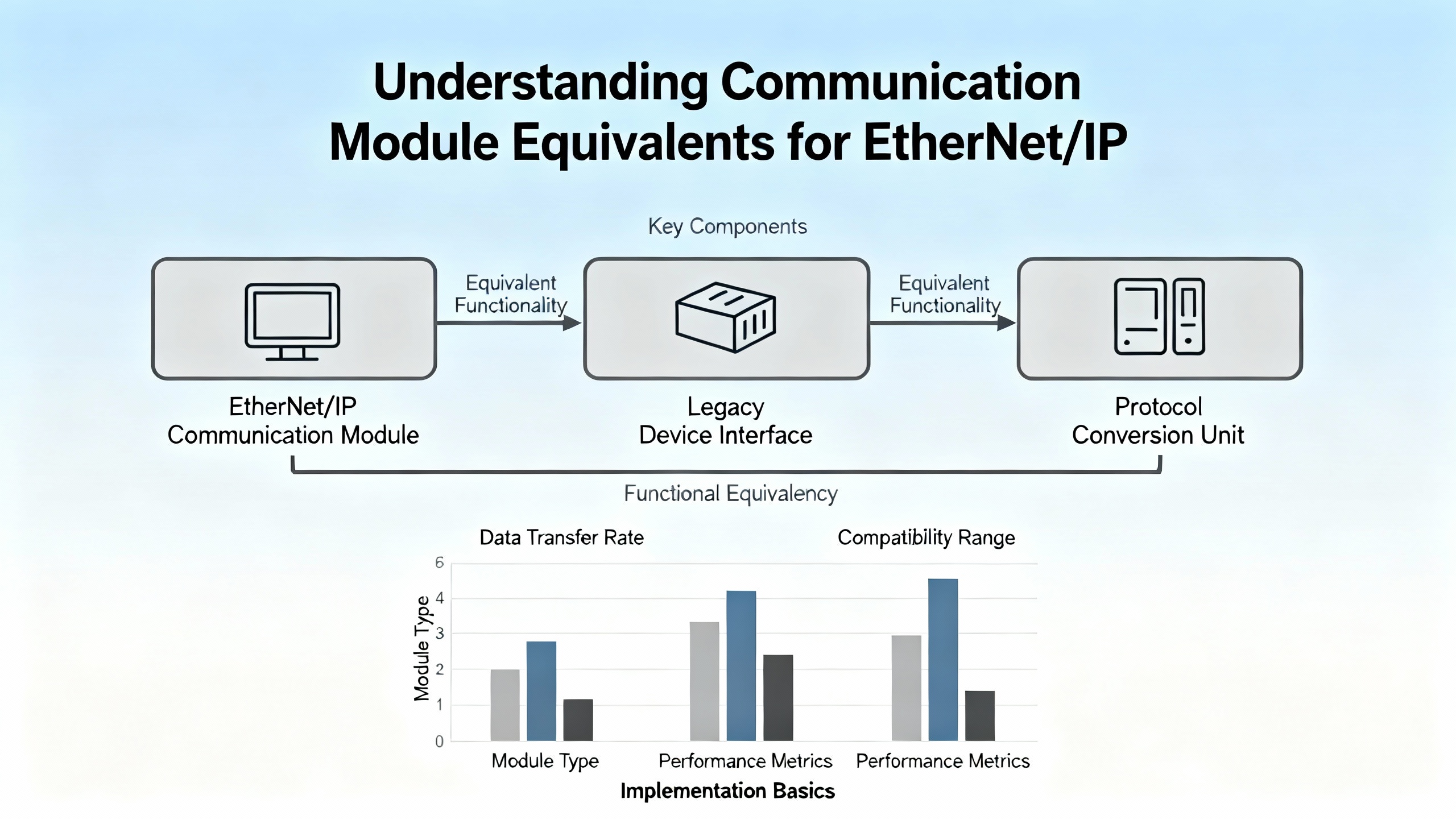
One key fact is that the 1756‑ENBT EtherNet/IP module is discontinued as of December 31, 2021, and Rockwell Automation recommends the 1756‑EN2T as the current replacement. Both are single‑slot EtherNet/IP communication modules with one RJ45 port and support network speeds in the 10 to 100 Mbps range. The official specification for the 1756‑ENBT lists a maximum of 128 Common Industrial Protocol connections. A separate ControlLogix system selection guide indicates that EN2x modules support up to about 256 EtherNet/IP connections, while the ENBT remains limited to roughly 128. For high‑density networks, that increase in connection capacity is often more important than the raw catalog number match.
The same selection guidance shows per‑module connection limits at the system level. Armor and standard ControlLogix controllers can support up to roughly 500 controller connections, but each communication module has its own limit. Some EtherNet/IP modules (1756‑EN2x) are listed with 256 EtherNet/IP connections, while the 1756‑ENBT remains at 128. ControlNet modules show limits in the 40 to 128 connection range depending on the model.
In a power system, where a single card may fan out to UPS systems, protective relays, intelligent MCC buckets, and power meters, that difference between 128 and 256 connections can be the difference between a clean replacement and a chronic overload condition.
A concise way to think about EtherNet/IP module equivalence is summarized in the following comparison.
| Scenario | Original module | Replacement path from published sources | Key considerations for power systems |
| Existing 1756‑ENBT at end of life | 1756‑ENBT | 1756‑EN2T recommended by Rockwell as replacement | EN2T doubles connection capacity compared with ENBT; verify network design, subnet, and controller connection limits. |
| Need for redundant Ethernet network | 1756‑ENBT or 1756‑EN2T | 1756‑EN2TR or 1756‑EN3TR, which provide dual Ethernet ports | Redundant paths are valuable for UPS, generator, and switchgear networks; size connections against limits and consider ring topologies. |
| Migration to newer controller with integrated Ethernet | 1756‑ENBT or EN2T in chassis | 1756‑L8x controller with built‑in Ethernet, no separate ENxx card | Simplifies hardware; verify that integrated Ethernet meets network segmentation and isolation needs for power protection. |
In practice, choosing an equivalent Ethernet card is only part of the story. Configuration details matter. The EtherNet/IP tutorial explains how ENBT modules use rotary switches to set IP addresses in the 192.168.1.xxx range, how setting the switches to a particular code resets the module and re‑enables BOOTP, and how Rockwell BOOTP and RSLinx are used to assign IP addresses and discover devices. When you replace an ENBT with an EN2T, those same operational practices apply, but it becomes even more important to document MAC addresses, network segments, and reserved IP schemes to avoid accidental misconfiguration during a maintenance window.
Redundancy and High‑Availability Module Equivalents
Controller and power redundancy are cornerstones of reliability in critical power rooms. Within the 1756 ecosystem, redundancy is implemented with specialized modules and carefully matched chassis layouts.
A ControlLogix system selection guide describes redundant controller systems that are supported on 5570 and XT controllers. These architectures require two 1756 chassis with identical slot counts and identical module layouts, 1756‑RM2 or 1756‑RM2XT redundancy modules in each chassis, and EtherNet/IP connectivity through a 1756‑EN2TR module to 1715 redundant I/O modules. In effect, these redundancy modules and I/O form the core of a modern hot‑standby ControlLogix system.
At the same time, independent suppliers list 1756‑RM or 1756‑RM/B redundancy modules in various condition grades, from used and refurbished to factory new. These modules are described as enabling redundant controllers and improved availability in ControlLogix systems and are often offered with repair services and varying levels of included accessories. The fact that 1756‑RM/B modules appear primarily on surplus and repair sites while Rockwell’s own recent guidance calls out 1756‑RM2 and RM2XT for new redundant systems tells you a lot about lifecycle position.
In practical terms, if you are maintaining an existing redundant system around 1756‑RM/B modules, an “equivalent” module may be another 1756‑RM/B sourced through repair or surplus, provided you validate series, firmware, and environmental ratings. If you are designing or re‑architecting a redundant system on 5570 or XT controllers, the functional equivalent is a design based on 1756‑RM2 or RM2XT and 1715 redundant I/O, as described in the current system selection guide.
Power redundancy goes beyond the controller. The same selection guidance describes redundant power supply solutions that use redundant power supply modules and chassis adapters to provide dual‑feed backup power to the Series B chassis backplane. In addition, Energy Storage Modules (such as 1756‑ESMCAP and related variants) replace conventional batteries on 5570 and GuardLogix controllers. Some ESMs are designed to limit stored energy or to disable USB and SD support for higher security, and the documentation notes that ESMs are not used on 5580 controllers.
From a power system reliability standpoint, an equivalent redundancy solution should be looked at as a complete stack: redundant controllers, redundant I/O paths, redundant power supplies, and appropriate energy‑storage devices. Merely swapping a redundancy module without confirming that the power and I/O architecture follows Rockwell’s current patterns is a common source of hidden risk.
I/O and Safety Module Equivalents in Power Applications
I/O modules are where electrical details and safety requirements intersect most directly with UPS and power distribution equipment. Equivalence here requires close attention to isolation ratings and safety functions.
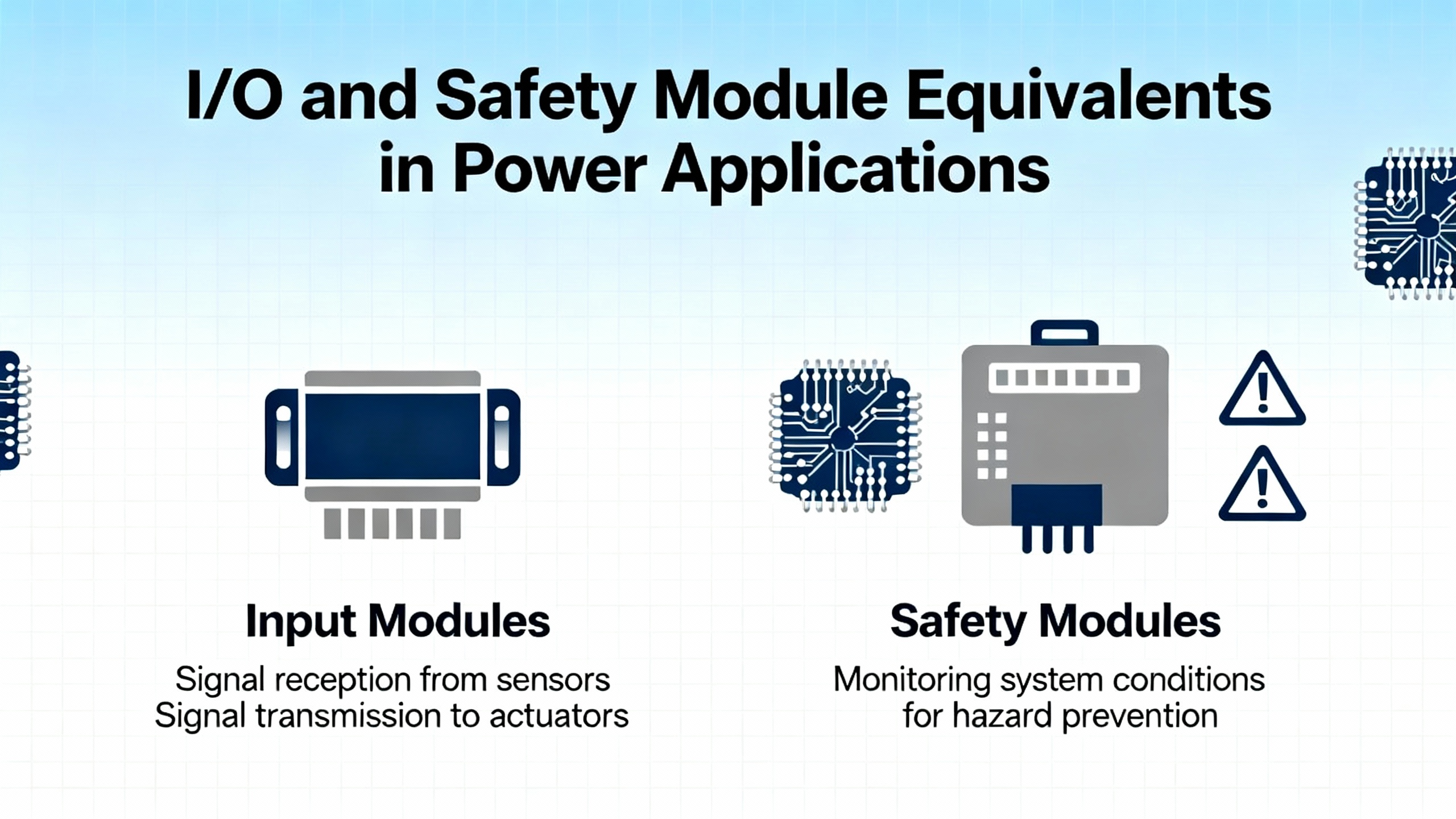
The ControlLogix System Selection Guide and related literature describe a broad range of 1756 digital and analog I/O, specialty modules, motion modules, and safety modules. For ControlLogix I/O, the selection content emphasizes support for high‑speed motion, safety functions, and integration with drives and smart field devices. Compared with older SLC 500 I/O, 1756 I/O adds features such as hot‑swap capability, richer diagnostics, data time‑stamping, and detailed module‑level fault reporting. In a power system, those capabilities translate to better insight into which breaker or feeder tripped and why.
A separate Rockwell document on ControlLogix I/O focuses on electrical isolation and insulation ratings. It defines isolation voltage as the continuous working voltage between networks, I/O groups, resolver circuits, and the backplane or between channels. Many digital output modules provide roughly 250 V continuous basic insulation between outputs and the backplane and between output channels. Some digital input modules provide approximately 250 V continuous reinforced insulation between inputs and the backplane, while maintaining basic insulation between input channels. Certain mixed I/O modules have reinforced insulation from both inputs and outputs to the backplane but explicitly state there is no isolation between individual inputs or outputs.
Other digital input modules are rated around 125 V continuous basic insulation from an input group to the backplane and around 30 V basic insulation between input groups. EtherNet/IP communication modules such as 1756‑EN2T, 1756‑EN2TR, and 1756‑EN3TR provide about 30 V continuous basic insulation between Ethernet, USB, and the backplane and are type‑tested at approximately 980 V AC for 60 seconds. ControlNet interfaces show similar basic insulation to the backplane and between redundant channels, type‑tested at about 500 V AC for 60 seconds. DeviceNet interfaces use roughly 50 V continuous basic insulation between the DeviceNet network and the backplane and are type‑tested around 853 V AC for 60 seconds, while some output modules use 50 V basic insulation from outputs to backplane with type tests up to about 1,500 V AC and specify no isolation between individual outputs.
The same isolation guide consistently distinguishes basic versus reinforced insulation. Basic insulation represents a single protective layer; reinforced insulation is a higher‑grade barrier roughly equivalent to double insulation in common safety standards. In power panels, where ControlLogix modules may interface with high‑energy circuits and control protective relays, replacing a module with one that has lower or different insulation ratings can undermine creepage and clearance assumptions, jeopardize personnel safety, and interfere with coordination studies.
Hazardous‑area I/O adds another layer. The 17xx hardware encyclopedia describes intrinsically safe I/O families such as 1718 and 1719, which are active Ethernet/IP distributed I/O platforms for Zone 1 and Zone 2 hazardous areas. These families offer digital, HART, and temperature I/O, integrate with Studio 5000 Logix Designer, and are positioned as effective replacements for older 1797 FLEX Ex intrinsically safe I/O. In a facility where ControlLogix controllers supervise hazardous‑area equipment, an equivalent intrinsically safe I/O solution is not another 1797 module but a 1718 or 1719 module set that maintains or improves hazardous‑area approvals while integrating seamlessly with Logix.
Firmware, Security, and Rockwell’s Compatibility Tools
Selecting a hardware equivalent without confirming firmware and security behavior is a recipe for subtle failures. Rockwell Automation’s Compatibility & Downloads Center exists precisely to bridge that gap.
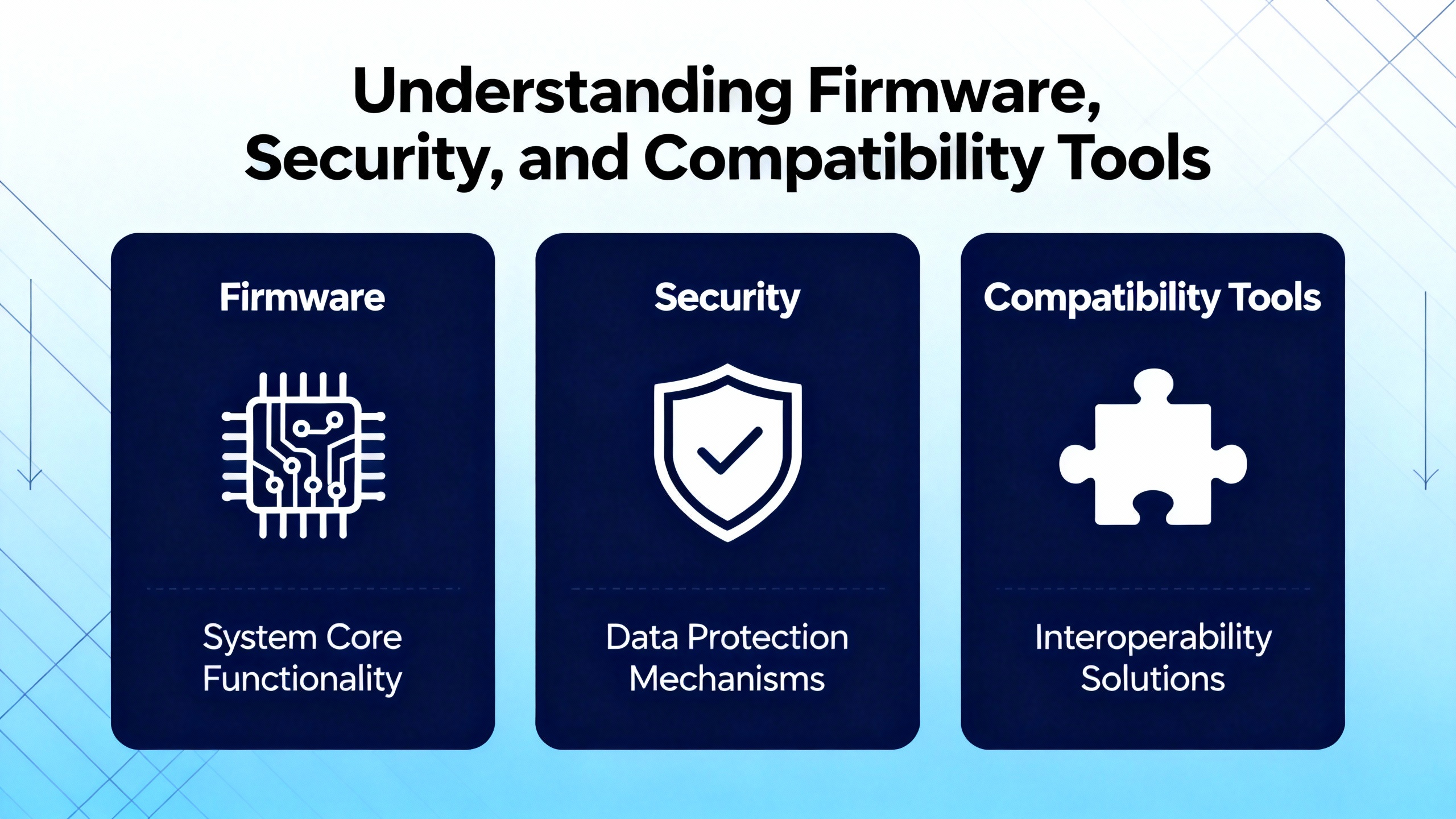
The multi‑product comparison view allows engineers to select multiple controllers and compare supported firmware versions side by side. Controllers such as 1756‑L1, 1756‑L55Mxx, and 1756‑L71 appear repeatedly with the same revision numbers across different sections, indicating which firmware baselines are most relevant. Each firmware entry is linked to release notes that are structured by topics such as General, Add‑On Instructions, Alarms and Events, Integrated Motion on EtherNet/IP, SERCOS motion, module replacement, programming, Sequential Function Charts, and security.
Those release notes explicitly separate “Anomalies” from “Functional Changes.” Anomalies describe problem reports; functional changes describe intentional behavior changes and new features. For engineers deploying power system logic, this distinction is crucial. A firmware version that resolves a motion anomaly but introduces a change in alarm behavior may be acceptable on one process line and unacceptable on a feeder protection scheme.
Security has its own topic area in the release notes, underscoring that certain firmware revisions have specific security considerations. For facilities that have seen OT security programs accelerate—particularly in energy and oil and gas—this section should be treated as mandatory reading before selecting an equivalent module or firmware baseline. Rockwell Automation also offers AI‑powered assistance tools, but their own data use notices emphasize that AI responses do not overrule official product documentation or professional advice; release notes and selection guides remain the authoritative source.
A Practical Replacement Strategy for Power and UPS Projects
In power and UPS projects, the best replacement strategies start from a system view. In audits and upgrades, I find that the most successful teams proceed in a sequence that looks more like an engineering study than a parts search.
The first step is to map the installed base around the functions that matter: which 1756 controllers, communication modules, and I/O modules directly affect critical loads such as UPS‑protected feeders, generator paralleling, or static transfer switches. Alongside the catalog numbers, record lifecycle status where available, such as active, active mature, or retired, based on Rockwell Automation’s lifecycle information and the 17xx hardware overview.
Next, identify where an equivalent module can be a simple swap and where it implies an architectural change. Replacing a 1756‑ENBT with a 1756‑EN2T is typically a straightforward equivalence that improves connection capacity, as long as you adjust the configuration and confirm network connections. Replacing an early 5550/L1 controller or a non‑redundant controller in a system that demands high availability, by contrast, is not just a CPU swap; it may require a redesign around 5570 or 5580 controllers, redundant 1756‑RM2 modules, and 1715 redundant I/O.
Once candidate equivalents are identified, use Rockwell’s Compatibility & Downloads Center to evaluate firmware baselines that support all relevant modules and controllers. Read the release notes for anomalies, functional changes, and security items relevant to your application. For example, if your ControlLogix program uses Add‑On Instructions heavily or relies on Alarms and Events to drive HMI behavior, the sections on those topics are directly connected to how your operators experience alarms during a transfer or fault.
In parallel, examine electrical and environmental parameters. For any I/O module change, compare isolation ratings, type tests, and whether channels are isolated from each other or only from the backplane. For controllers and communication modules, confirm thermal and environmental ratings, especially in rooms that already run near enclosure limits. If your plant uses extended‑temperature XT or conformal‑coated controllers, the equivalent needs to match those ratings, not just the functional spec.
Finally, treat cutover as a power system operation, not an IT task. Coordinate module and controller replacements with UPS bypass windows, generator availability, and safe work practices. Use nonvolatile memory cards or structured download procedures so that program loads and firmware updates are consistent and repeatable. On controllers that still use Energy Storage Modules instead of batteries, confirm ESM type and health; on newer 5580 controllers that do not use ESMs, adapt your power‑loss procedures accordingly.
Frequently Asked Questions on 1756 Equivalent Modules
Is there a defined replacement for the 1756‑ENBT Ethernet module? According to a detailed EtherNet/IP configuration tutorial, Rockwell Automation discontinued the 1756‑ENBT as of the end of 2021 and recommends the 1756‑EN2T as its replacement. The EN2T occupies the same single slot, provides one RJ45 port, supports similar 10 to 100 Mbps Ethernet speeds, and, based on system selection data, roughly doubles the maximum EtherNet/IP connection count compared with the ENBT. In power systems where a single ENBT card is close to its connection limit, moving to an EN2T is not just an availability decision; it also increases headroom for future intelligent devices.
When should I consider replacing controllers rather than just I/O or communication cards? If your plant uses early ControlLogix controllers such as the 5550 L1 or L60, and the system is critical to power protection, the published guidance strongly favors migrating toward 5570 or 5580 controllers rather than staying on legacy hardware. The newer controllers bring more memory, better task performance, integrated Ethernet, and stronger lifecycle support. In many facilities, it is still possible to keep existing 1756 I/O and network architectures while upgrading the controller, but the decision should be driven by lifecycle, security posture, and the complexity of your power logic.
How do hazardous‑area I/O replacements fit into a 1756‑based system? For hazardous areas, Rockwell’s 1718 and 1719 intrinsically safe I/O families are described as active Ethernet/IP distributed I/O that integrate with Studio 5000 Logix Designer and effectively replace the older 1797 FLEX Ex line. In a ControlLogix environment, that means an intrinsically safe equivalent is not another 1797 module but a 1718 or 1719 solution that maintains hazardous‑area approvals while offering modern diagnostics and configuration. When those I/O modules are part of a UPS or generator system in a classified area, it is essential to coordinate the I/O replacement with both controls engineering and process safety reviews.
Closing Thoughts
Selecting an “equivalent” Allen‑Bradley 1756 module is not only about getting the plant running again tomorrow; it is about preserving the long‑term reliability and safety of your power system. When you anchor replacements in Rockwell’s lifecycle guidance, compatibility tools, and isolation data—and treat controller, network, I/O, and power redundancy as one integrated design—you can modernize ControlLogix hardware without sacrificing protection or uptime. That is the mindset I recommend every time you open a 1756 chassis in a room full of UPS cabinets and switchgear: treat module equivalence as a reliability decision, not just a parts decision.

References
- http://www.people.vcu.edu/~iahmed3/publications/2022a-dfrws-eu.pdf
- https://www.plctalk.net/forums/threads/controllogix-complete-list-of-possible-i-o-modules.109716/
- https://www.classicautomation.com/1756-rmb?srsltid=AfmBOoplPdGJj81pqjMuWEKO3acfZowkl_caMHaQpKVV9-PL9fHqzMFc
- https://www.ebay.com/itm/157313769384
- https://www.qualitrol.com/assets/1756-OB16.pdf?srsltid=AfmBOoq8rA04JM5wiULWYGEeh3c2uAZpXif9H8jP5JaB7MP5PYjjUvPw
- https://www.qualitymag.com/articles/97722-replacement-option-for-controllogix-motion-modules
- https://rabwellplc.com/collections/1756?srsltid=AfmBOorlEbhwYZ-loyYOPfbjCz3J_K1488XedjaJLk9dStxX8aYED5Pc
- https://compatibility.rockwellautomation.com/Pages/MultiProductCompareSelections.aspx?crumb=113&toggleState=&versions=184,195,240,241,242,243,244,245,246,51410,51407,50607,51414,51221,51228,51226,51224,51222,50538,268,51412
- https://www.solisplc.com/tutorials/1756-enbt-controllogix-ethernet-ip-communication-allen-bradley-plc-1756-en2t-1756-en3t-programming
- https://control.com/technical-articles/understanding-the-17xx-your-rockwell-allen-bradley-hardware-encyclopedia/


 Videos
 News
News Applications





Leave Your Comment