Schneider contactors sit at the heart of many industrial and commercial power systems, from UPS input and bypass panels to motor control centers feeding critical loads. When a contactor fails, it rarely starts with a dramatic flashover. Much more often, the first symptom is a barely noticeable rise in contact resistance that slowly drives localized heating, phase imbalance, and nuisance trips. If you only look at coil continuity and mechanical motion, you can easily miss the early warning signs.
Contact resistance testing is the most direct way to see what is really happening inside those closed contacts. In this article, I will walk through how to diagnose Schneider contactor issues using contact resistance measurements, how to choose test methods, and how to interpret the numbers in a way that supports reliability-centered maintenance for UPS and power protection applications.
Why Contact Resistance Matters In Schneider Contactors
Electrical contact resistance is the additional resistance that appears at the interface where two conductors touch each other. Carelabz describes it as distinct from the bulk resistance of the copper or aluminum itself, and notes that it changes over time due to wear, contamination, and “resistance creep.”
In a Schneider contactor, each pole ideally behaves like a solid copper bar when closed. In reality, you have plated contact tips pressed together under spring force, with microscopic asperities carrying the current. Over years of switching and fault duty, the true contact area shrinks and becomes contaminated. Demikspower points out that in power equipment, contact resistance typically lives in the milliohm or micro-ohm range, and must remain low and stable to avoid inefficient energy transfer, overheating, and failures.
Several sources highlight the risks of letting this resistance quietly drift upward. Amperis notes that excessively high contact resistance can cause overheating, arcing, single phasing, and even fire in high-current paths. Demikspower emphasizes that localized Joule heating accelerates insulation breakdown and material aging, potentially leading to thermal runaway and unplanned downtime. For contactors feeding UPS rectifiers, bypass lines, or large inverter output feeders, that translates directly into reduced system reliability and higher operating cost.
In practice, a Schneider contactor with rising contact resistance may show up as a slightly warm line side on a thermal image, a small but persistent phase imbalance, or a cable lug that looks more “cooked” than its neighbor. Contact resistance testing lets you quantify that degradation instead of relying on guesswork.
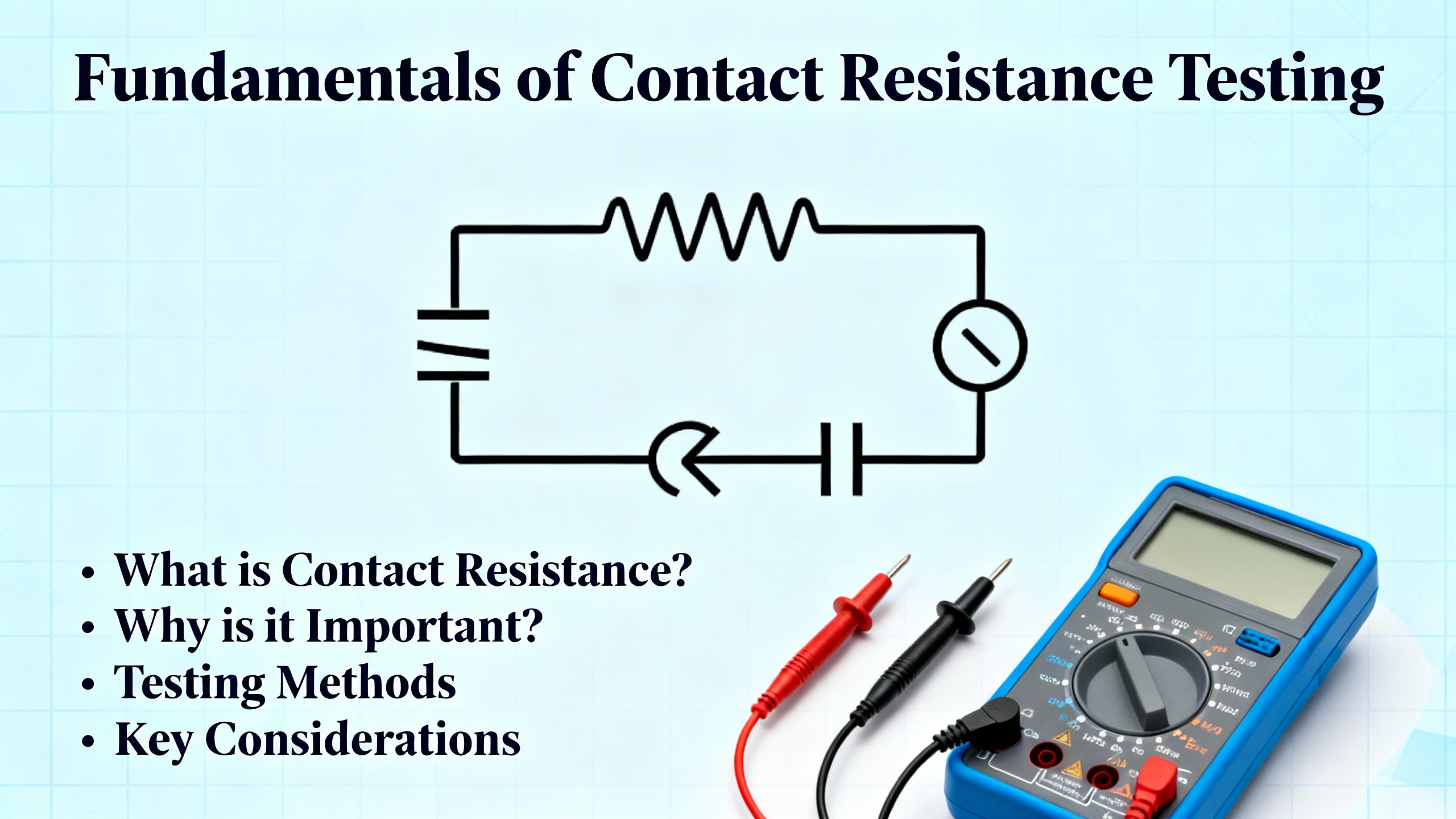
Fundamentals Of Contact Resistance Testing
At its core, every contact resistance test does the same thing: drive a known current through the closed contact and measure the resulting voltage drop. Ohm’s law gives you the resistance. The difference between a rough check and a high-confidence diagnostic lies in how you inject the current, how you measure the voltage, and how you control sources of error such as lead resistance and thermal electromotive forces.
Electrical Contact Resistance Defined
Carelabz and Fiveable both stress that contact resistance should be thought of as an extra resistor in series with your intended circuit. In an ideal Schneider contactor, that resistor is extremely small. In real contactors, it is influenced by surface roughness, oxidation, contamination, and the actual mechanical force that the mechanism applies to keep the contacts closed.
Demikspower summarizes the key physical factors:
Surface condition. Clean, oxide-free surfaces can lower resistance significantly compared with rough, contaminated surfaces. Their discussion notes that clean surfaces can reduce resistance on the order of tens of percent compared to rough ones.
Material conductivity and hardness. High-conductivity materials such as copper behave very differently from steel. Softer materials can deform slightly under pressure, increasing the true contact area and lowering resistance.
Contact force. Higher contact pressure tends to reduce resistance; Demikspower cites examples where increasing pressure by roughly a quarter cuts resistance on the order of ten to fifteen percent.
Thermal effects. Localized heating causes thermal expansion, which can change contact geometry and accelerate oxidation, creating a feedback loop where resistance and temperature drive each other upward.
For Schneider contactors running at or near their thermal ratings in compact UPS cubicles, these effects stack up fast.
Basic Test Principle
Carelabz, Kritester, EZT Tester, and Demikspower all describe a similar DC voltage-drop method. A test instrument, typically a low-resistance ohmmeter or micro-ohmmeter, injects a fixed DC current through the closed contact, often in the range of dozens to hundreds of amperes for power equipment. The device then measures the millivolt-level voltage drop across the test points and computes resistance as R = V / I.
Several best-practice points are consistent across these sources:
Use enough current to be representative. IEC and ANSI guidance cited by Carelabz recommends minimum DC test currents of about 50 A and 100 A respectively for power switchgear, with a common rule of thumb to stay around ten percent of rated current and never exceed the device rating.
Match operating conditions as closely as possible. Carelabz and Kritester emphasize that measurements should be made under conditions similar to service (in terms of conductor temperature and mechanical configuration) and in a consistent way across time so that trending is meaningful.
Repeat questionable readings at higher current. Both Carelabz and Kritester note that a joint that looks high at very low test current may look more realistic when driven harder because higher current helps overcome minor oxidation or poor probe contact.
This same approach applies cleanly to Schneider contactors, whether they are feeding 480 V motor loads or acting as UPS bypass contactors.
Test Methods For Schneider Contactor Contacts
Different instruments and setups give you different levels of diagnostic confidence. From a reliability perspective, the goal is not just to “get a number,” but to choose a method whose weaknesses you understand.
Quick Screening With A Digital Multimeter
Fluke describes how to measure resistance with a digital multimeter (DMM). The procedure is straightforward: de-energize the circuit, discharge any capacitors, select the resistance function, connect the COM and VΩ jacks, and read the value.
For contactors, a DMM is useful as a screening tool when the contact resistance has already become very high, for example due to a badly burnt tip or a nearly open joint. However, Fluke notes that test lead resistance alone is often in the range of a few tenths of an ohm, and the reading always includes all parallel paths between the probes. For a Schneider contactor whose healthy contact resistance should be down in the micro-ohm or low milliohm range, this conventional two-wire method is simply not precise enough to characterize subtle degradation.
DMM resistance tests are still worth doing during bench repair to confirm that a completely open contact has been resolved, but they are not a substitute for dedicated low-resistance testing on in-service contactors.
Four-Wire (Kelvin) Micro-Ohmmeter Testing
For serious fault diagnosis, a four-wire Kelvin measurement is the standard. Carelabz, Camiresearch, EZT Tester, Kritester, and multiple other sources converge on this method as the correct way to measure low contact resistance.
A micro-ohmmeter uses two separate pairs of leads. The first pair carries the test current through the contactor pole; the second pair measures the voltage drop directly at the connection points. Because the voltage-sense circuit draws negligible current, its lead resistance does not affect the reading. Camiresearch explains that this approach allows accurate measurements well below a tenth of an ohm and down into the milliohm and micro-ohm range.
Modern contact-resistance testers, such as the micro-ohmmeters described by Amperis and Megger, add several capabilities that are particularly relevant to Schneider contactors in mission-critical panels:
A stable, high-current source in a portable form factor. The instruments discussed by Amperis can source very high currents while remaining portable, with features like thirty-foot test cables and weather-resistant cases for field work. Another micro-ohmmeter example highlighted by Megger provides approximately 300 A of test current in a lightweight, battery-powered package weighing roughly 2.4 lb, which is ideal when you are moving around a UPS room or MCC.
Four-wire connections with practical clamps. Kelvin clamps or dedicated four-wire probes grip busbars, contact studs, or cable lugs in one motion, reducing setup error and ensuring consistent placement.
Thermal EMF mitigation. Kritester and EZT Tester describe how thermal electromotive forces—tiny thermocouple voltages generated where different metals meet—can distort micro-ohm measurements. Many micro-ohmmeters automatically reverse current polarity and average the results or measure and subtract the thermal EMF directly.
Data logging and trend analysis. Amperis notes that field micro-ohmmeters can store data from more than a hundred tests. That capability is particularly valuable when you are trending Schneider contactor poles across multiple maintenance outages to see which units are drifting.
In day-to-day reliability work, a four-wire micro-ohmmeter is the most powerful single tool for diagnosing contactor degradation before it becomes a failure.
Dynamic Contact Resistance Concepts
For high-voltage circuit breakers, EPRI and Lax Energy Solutions describe an advanced technique called Dynamic Contact Resistance Measurement (DCRM or DRM). Instead of measuring resistance only when the contacts are stationary, DCRM tracks the resistance continuously while the breaker opens or closes under a high test current. The resulting resistance curve reveals subtle issues such as abnormal arcing contact timing, misalignment, or inadequate pressure that static tests cannot see.
EPRI’s technical update on circuit breaker diagnostics reports that dynamic resistance curves can be captured repeatably in the lab and that changes in these curves can indicate different levels of contact degradation. Lax Energy Solutions explains how field DCRM tests combine current injection, motion sensing, and timing analysis in one integrated test of breaker performance.
While this research focuses on high- and medium-voltage breakers, the underlying idea is instructive for Schneider contactors. Many of the same failure mechanisms exist: bouncing contacts, worn linkages, and mis-timed poles. In critical applications, you can complement static micro-ohm measurements with timing and motion tests on the contactors, and you can use the DCRM literature as a conceptual reference for what dynamic resistance behavior can reveal. For most low-voltage Schneider contactors, however, static four-wire resistance checks combined with visual and thermal inspections will deliver the majority of the diagnostic value at reasonable effort.
Thermal And Visual Checks As Complementary Tools
Contact resistance testing does not exist in a vacuum. Several practical sources emphasize the value of simple visual and thermal checks.
TestGuy’s guidance on new power circuit breakers stresses detailed visual and mechanical inspection of contacts, finger clusters, lubrication, and cell alignment before you even apply a test current. The same thinking applies to Schneider contactors: look for discoloration, pitting, cracking of insulation, and any change in how smoothly the mechanism operates.
A discussion on neutral-wire issues from DIY Stackexchange points out that a resistive connection under load generates a lot of heat, often detectable with a thermal camera long before failure. In contactor panels, a thermal scan at full or near-full load is an efficient way to identify suspect phases that should be prioritized for micro-ohm testing.
In practice, I rely on thermal images to select which Schneider contactors deserve detailed resistance measurements and then use four-wire testing to quantify the extent of degradation and support a repair-or-replace decision.
How To Perform A Contact Resistance Test On A Schneider Contactor
Although different instruments have slightly different procedures, the underlying workflow is consistent across the practical guides from EZT Tester, Carelabz, Demikspower, and Kritester. The following describes how you would apply that workflow to a Schneider contactor feeding a critical load.
Start by de-energizing and isolating. Verify that the UPS input or motor feeder is safely shut down, open upstream protective devices, and apply lockout and tagout. Confirm with a properly rated meter that there is no voltage on the line and load terminals.
Carry out a focused visual inspection. Check the contactor body, terminals, and any associated busbars for discoloration, soot, swollen insulation, or obvious mechanical damage. If the design permits safe access, inspect the contact tips themselves for pitting, erosion, or misalignment. Carelabz notes that a contact is only considered healthy when both visual inspection and resistance values are acceptable.
Prepare and verify the instrument. EZT Tester recommends using a dedicated micro-ohmmeter or contact resistance tester with a four-wire Kelvin configuration. Before connecting to the contactor, confirm the instrument’s calibration with a known reference shunt or by using the manufacturer’s built-in verification procedure. Vocal-media guidance on accurate contact resistance measurement adds that you should ensure test probes are clean, leads are in good condition, and the instrument has been recently calibrated against known standards.
Connect the four test leads. Attach the current leads to the line and load terminals of the contactor pole you are testing so that the test current flows through exactly the same path as the service current. Place the voltage-sense leads within that current loop, as close as possible to the actual contact points, as Kritester and EZT Tester recommend. For Schneider contactors with screw or stud terminals, this usually means clamping the sense leads directly onto the terminal hardware rather than on the cable a few inches away.
Select an appropriate test current and duration. Drawing on Carelabz, Demikspower, and EZT Tester, a typical current for low-voltage power gear is in the 50 to 100 A range, always within the device’s continuous current rating. For larger Schneider contactors feeding several hundred amperes, a test current equal to roughly ten percent of the nameplate current is a practical starting point. Many micro-ohmmeters let you control how long the current flows, often from a few seconds up to tens of seconds; longer durations can reveal temperature-related changes but also add heating, so stay conservative for lightly built contactors.
Mitigate thermal EMF and stabilize the reading. As Kritester explains, thermal EMF at dissimilar metal junctions can perturb the voltage measurement. Modern instruments address this by reversing current polarity and averaging readings or by directly measuring the thermal EMF with current off and subtracting it. In the field, it is also good practice, as Vocal-media notes, to wait a few seconds for the reading to stabilize and to repeat the measurement at least once, checking for consistency.
Repeat for each pole and for comparable contactors. Test all three poles of the Schneider contactor under identical conditions, then repeat the process on similar contactors in the same panel. Maintaining identical test current, lead placement, and temperature conditions is crucial if you want to compare results and identify outliers, as emphasized by Demikspower, Carelabz, and Kritester.
Record your results thoroughly. EZT Tester and Demikspower both stress the importance of documenting not only the resistance values but also the test current, the configuration, the contactor model and serial number, and the ambient conditions. Many micro-ohmmeters, such as those discussed by Amperis, include internal memory to store dozens of test results, which greatly simplifies later trend analysis.
By following this methodical approach, you turn a one-time measurement into a valuable data point in a long-term reliability story for each Schneider contactor.
Interpreting Contact Resistance Results For Contactors
Knowing how to measure is only half the job; knowing what the number means is where diagnostic value emerges. The literature offers a mix of absolute values and relative rules that you can adapt judiciously to Schneider contactors.
Typical Magnitudes And Manufacturer Limits
Demikspower reports that in power equipment, acceptable contact resistance values generally fall in the range of about 10 to 300 micro-ohms, depending on the device and application. They give examples where breaker contacts are preferred below roughly 100 micro-ohms and switchgear connections below roughly 150 micro-ohms, while precision instruments may demand values under about 10 micro-ohms.
Carelabz emphasizes that there is no universal code-defined minimum, and that acceptable levels depend heavily on connection type, surface area, and contact pressure. For that reason, the first reference for any Schneider contactor should always be the manufacturer’s datasheet or test guide. When Schneider specifies a maximum millivolt drop at rated current, you can convert that to an ohmic value and use it as an acceptance limit.
In the absence of explicit manufacturer values, the ranges cited by Demikspower are still helpful as sanity checks: a three-pole contactor with all poles measuring several hundred micro-ohms at modest test current is unlikely to be in healthy condition.
Phase Balance And NETA-Based Rules
TestGuy summarizes NETA guidance for interpreting low-resistance measurements across phases. For circuit breaker and switch contacts, the maximum allowable deviation between phases is typically taken as fifty percent above the lowest measured phase. In other words, the highest acceptable value is one and a half times the lowest value. If one phase exceeds that, it deserves investigation.
Although this rule is formulated for breakers and other switching devices, the same logic applies cleanly to the three poles of a Schneider contactor that share the same design and loading. If two poles measure close together and the third is significantly higher, even if all three values are within a broad absolute range, you have reason to suspect uneven wear, misalignment, or a localized defect on that high-resistance pole.
NETA and IEEE also emphasize that all pass–fail judgments should be based on the lowest resistance value obtained so far. If a later test reveals a new, lower “best” phase, you must recalculate acceptable limits for all phases from that new baseline rather than from older, higher numbers. This approach keeps your criteria aligned with the best-performing pole rather than allowing standards to drift downward with the fleet.
Trending Over Time
Demikspower cites studies indicating that routine contact resistance testing can reduce unexpected outages in power distribution systems by up to about sixty percent. That benefit comes from trending, not from a single measurement.
Electrical connections usually degrade slowly. TestGuy notes that readings taken on hot, in-service connections can differ greatly from installation readings, and that tracking results over time is essential to see the direction of change. Demikspower recommends integrating contact resistance tests into regular maintenance schedules, with shorter intervals in harsh environments with humidity, corrosion, or significant contamination.
For Schneider contactors in UPS and power protection systems, a practical strategy is to:
Measure baseline contact resistance at commissioning or immediately after retrofit.
Repeat measurements at each major maintenance outage, keeping current, lead placement, and test configuration consistent, as Kritester and Carelabz advise.
Flag any pole whose resistance shows a sustained upward trend or violates the phase-balance rule, even if absolute values remain within generic limits.
The combination of absolute thresholds, phase comparison, and trending allows you to schedule contactor replacement or refurbishment before failures manifest as trips or equipment damage.
Integrating Contact Resistance Testing Into UPS And Power Protection Maintenance
EPRI’s work on circuit breaker diagnostics frames contact resistance testing as part of a broader condition-based maintenance strategy. The goal is to minimize intrusive internal inspections and focus maintenance budgets where the risk is highest. Lax Energy Solutions describes a similar philosophy for breakers: use diagnostic tests to detect early abnormalities, reduce downtime, and extend equipment life.
For Schneider contactors in UPS, inverters, and power distribution equipment, a similar approach works well:
Identify high-criticality contactors. These include UPS input and bypass contactors, static transfer switch contactors, and any contactors that feed large, mission-critical motors or distribution feeders.
Combine thermal scanning, visual inspection, and micro-ohm testing. Use thermal imaging under load to select suspect devices, then apply four-wire resistance measurements to quantify degradation, following the procedures summarized by EZT Tester and Carelabz.
Align test currents with equipment ratings. As Demikspower and Carelabz note, test currents should reflect the mechanical and thermal design of the device. Sensitive electronics need low currents, while rugged power gear may require higher currents up to hundreds of amperes for representative results, always respecting nameplate limits.
Document and trend across outages. Use the data-logging and export capabilities of modern micro-ohmmeters, like those described by Amperis, to build a multi-year record of Schneider contactor performance. This creates a defendable basis for capital replacement decisions and supports audits.
By embedding contact resistance testing into your existing UPS and power protection maintenance routines, you turn a specialized diagnostic into a routine reliability tool.
Common Pitfalls And How To Avoid Them
Real-world measurement conditions are rarely perfect. Several sources highlight pitfalls that can easily invalidate contact resistance tests if you are not watching for them.
Poor surface preparation and dirty probes. Vocal-media’s guidance on accurate contact resistance measurements stresses the importance of cleaning contact surfaces with appropriate solvents and ensuring secure probe connections. Dirt, corrosion, or loosely attached clamps introduce instability that can look like a bad contact when the problem is actually your test setup.
Using the wrong instrument or range. Keysight’s overview of resistance measurement tools explains that micro-ohmmeters are designed specifically for ultra-low resistance, whereas general-purpose multimeters and even some ohmmeters are not. Trying to characterize a Schneider contactor’s contacts with a tool that cannot resolve micro-ohms is a recipe for misleading results.
Ignoring thermal effects and EMF. Kritester and other sources warn about thermal EMF at metal junctions and about the effect of test current heating the conductor under test. Always allow readings to stabilize, use instruments that reverse polarity or compensate for thermal EMF, and avoid long test durations or currents that significantly heat the contactor.
Inconsistent test conditions across time. Demikspower, Carelabz, and Kritester all stress that to make trending meaningful, you must keep measurement conditions consistent: same test current, same lead type and placement, and similar temperature. Changing any of these between tests can create artificial “trends” that reflect your method rather than the contactor’s condition.
Relying on a single measurement. Vocal-media recommends taking multiple measurements and comparing them. When values disagree, first suspect setup issues and repeat the test more carefully before condemning a Schneider contactor. Only consistent, repeatable high readings should drive maintenance decisions.
By anticipating these pitfalls and building your procedures around the practices described by these measurement specialists, you greatly improve the reliability of your Schneider contactor diagnostics.

Comparison Of Test Methods In Practice
The following table summarizes how the main contact resistance test methods relate to Schneider contactor fault diagnosis.
| Method | Typical use on contactors | Advantages | Limitations |
| Two-wire DMM resistance check | Basic continuity and obvious open or severely burnt poles | Inexpensive, widely available, fast | Insufficient resolution for micro-ohm levels, includes lead and parallel path resistance |
| Four-wire micro-ohmmeter (static) | Detailed health assessment of each pole under test current | High accuracy at very low resistance, compensates leads, supports data logging and trending | Requires specialized equipment and proper setup; test current must be chosen carefully |
| Dynamic resistance concepts (DCRM/DRM) | Advanced diagnostics inspired by breaker testing, conceptually applicable to contactor motion | Can reveal timing- and motion-related issues not seen in static tests | More complex instrumentation and analysis; mostly developed for breakers, not standard for low-voltage contactors |
| Thermal imaging under load | Screening for hot spots in UPS panels and MCCs | Non-contact, fast, shows real thermal impact of resistance | Qualitative; must be followed by electrical measurement to quantify contact resistance |
This combination of methods, applied thoughtfully, gives you both breadth and depth in Schneider contactor fault diagnosis.

FAQ
Can I diagnose a Schneider contactor with only a handheld multimeter?
A handheld digital multimeter, as described by Fluke, is excellent for verifying that a coil is intact and that a contact is not completely open. However, its two-wire resistance measurements are not accurate in the micro-ohm range where healthy power contacts operate. You can use a multimeter to catch gross failures, but for early-stage degradation or for acceptance testing after maintenance, you should rely on a four-wire micro-ohmmeter or dedicated contact resistance tester.
How often should I test contact resistance on Schneider contactors?
Demikspower recommends integrating contact resistance tests into regular maintenance schedules and increasing frequency in harsh environments. For Schneider contactors in critical UPS and power protection roles, a reasonable starting point is to test at commissioning, at the first major maintenance outage, and then at intervals aligned with your breaker and UPS maintenance program. The key is consistency: use the same method each time and trend the results.
Does a high contact resistance reading always mean I must replace the contactor?
Not necessarily. EZT Tester’s practical procedure highlights that high readings can result from poor surface preparation, loose terminations, or test setup issues. When a Schneider contactor shows elevated contact resistance, first verify that all terminations are properly tightened to the manufacturer’s torque values, clean accessible surfaces, and repeat the test. If resistance remains high, or if one pole is consistently far above the others according to NETA-style phase-balance rules, then replacement or refurbishment becomes the prudent choice.
In reliability work on UPS and industrial power systems, Schneider contactors are too important to leave to chance. By combining four-wire contact resistance testing, thermal and visual inspections, and disciplined trending, you turn these devices from hidden risks into well-understood assets and make your power protection strategy measurably more robust.
References
- https://umaec.umich.edu/desguide/tech/26/DG260800.pdf
- https://eastnow.net/en/testing-for-success-best-practices-for-electrical-wiring/
- https://wiki.testguy.net/t/10-critical-tests-for-new-power-circuit-breakers/113
- https://carelabz.com/what-contact-resistance-test-why-contact-resistance-testing-done/
- https://www.crestech.co.in/contact-resistance-testing-mistakes-to-avoid/
- https://smart.dhgate.com/a-step-by-step-guide-to-accurately-measuring-electrical-resistance-for-any-project/
- http://www.ezttester.com/resources/how-we-conduct-contact-resistance-test.html
- https://www.kritester.com/new/measure-the-contact-resistance-contained-in-the-loop-without-changing-the-circuit.html
- https://vocal.media/education/tips-for-getting-accurate-contact-resistance-measurements
- https://www.apiele.com/blogs/basic-switch-knowledge/how-to-test-pushbutton-switch-resistance?srsltid=AfmBOopNZIqiu0tkrADYLAwkKx6IcJ3ILIIriZFpVaox9UdLLPdRxs4F


 Videos
 News
News Applications






Leave Your Comment