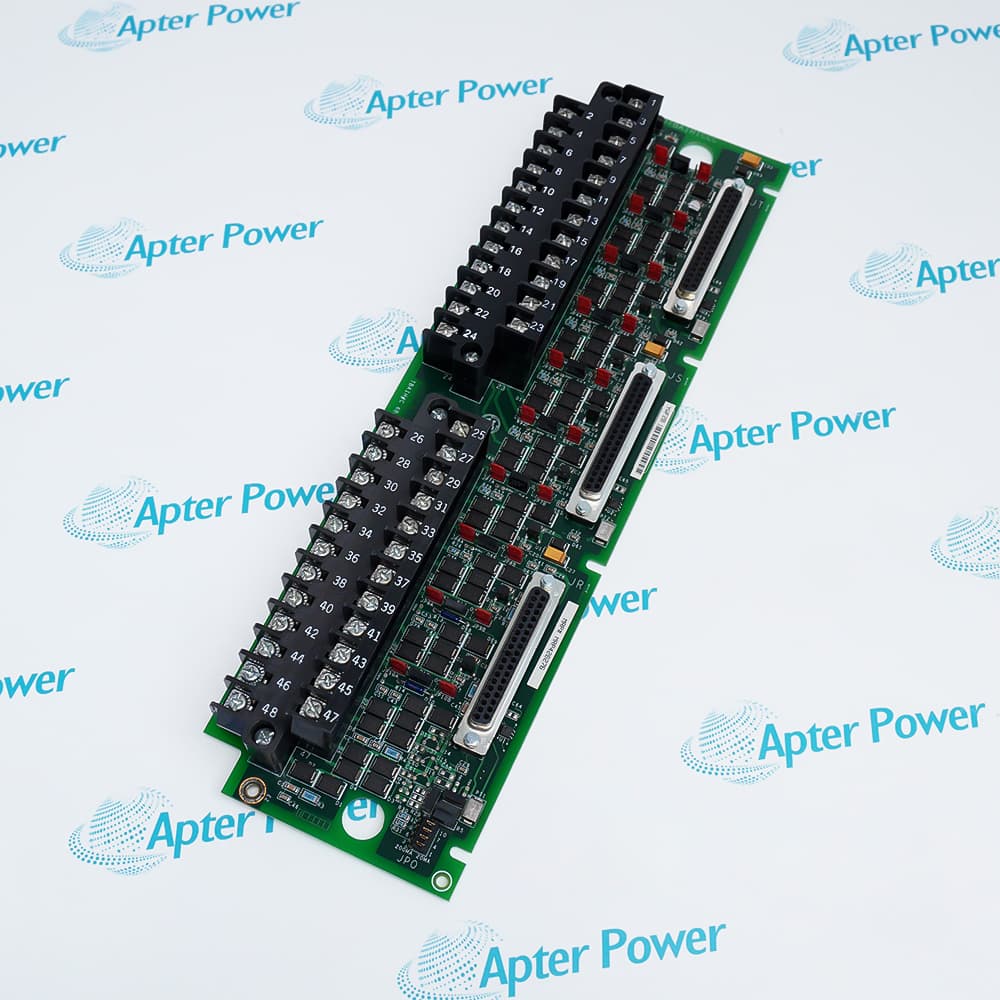
The DS215TCCAG1BZZ01
is a General Electric (GE) Mark V or Mark VI series Common Analog I/O Board. It functions as a circuit board designed to manage analog input and output signals within GE speedtronic control systems, often utilized in turbine control environments.
- Versatile Analog I/O
- Specialized Shaft Monitoring
- TMR Architecture Support
The board is equipped with a high-performance Intel 80196 series 16 bit microprocessor, which surpasses the scope of traditional passive acquisition cards and has powerful local computing capabilities.
Important Notice:
Other accessories, manuals, cables, calibration data, software, etc. are not included with this equipment unless listed in the above stock item description.
GE DS215TCCAG1BZZ01 Analog I/O Board Manuals, Datasheets, Drivers, Link
Important Notice: Other accessories, manuals, cables, calibration data, software, etc. are not included with this equipment unless listed in the above stock item description.
1. Diversified analog signal acquisition (Analog Input)
This is the most basic function of the board, responsible for converting the physical signals of on-site sensors into digital data:
Thermocouple processing: directly receives various thermocouple signals (such as K, J, T type) from the TBQA terminal board, and performs cold junction compensation (CJC) and linearization calculations.
RTD (Thermistor) monitoring: By connecting the TBCA terminal board, accurately measure the resistance changes of key parts such as bearing temperature.
Standard current signal: Receive 4-20 mA or 0-1 mA transmitter signals for monitoring process parameters such as pressure, flow rate, displacement, etc.
2. Accurate Analog Output Control
The TCCA board is not only responsible for receiving signals, but also for sending instructions to execute actions:
Drive actuator: Output 4-20 mA current signal to control servo valves, regulating valves, or other proportional control components.
Remote instrument drive: Provide real-time analog feedback to the central control room instruments or third-party systems.
3. Dedicated Shaft Monitoring function
This is the special core function of TCCA board that distinguishes it from ordinary I/O boards:
Shaft voltage and shaft current detection: Real time monitoring of the electrical status of the turbine shaft through JBB connectors. This is crucial for preventing bearing erosion (electrical discharge machining effect) caused by shaft current.
4. Redundant Data Voting and Communication (TMR&Communication)
In the Mark V's Triple Modular Redundancy (TMR) architecture, TCCA serves as a data bridge:
Signal synchronization: Send the collected analog signals to STCA (Control Application Board) through a 3PL connector.
Voting: In the control core, the TCCA signal participates in the system's voting logic, ensuring that even if a single board data is abnormal, the system can still output the correct control instructions.
Self diagnosis: The onboard microprocessor (80196 series) continuously performs self check. Once A/D conversion deviation or hardware failure is detected, an alarm is immediately issued to the system.
The core of its internal equipment protection lies in signal isolation and surge suppression. By integrating a resistance capacitance filtering network and a transient voltage suppressor (TVS) in the input circuit, it effectively blocks electromagnetic interference and induced surges from long-distance cables on site. In addition, the board has comprehensive power supply abnormality protection.
When receiving 5V and ± 15V power through 2PL connectors, the onboard voltage regulator circuit and fuse protection can prevent voltage fluctuations from causing damage to the 80196 microprocessor and precision A/D converter.
For analog output circuits, TCCA also has current limiting and short-circuit protection functions, which can prevent current overload from burning out internal components of the board even if external actuators have wiring faults. This comprehensive hardware level protection, combined with real-time redundant voting logic, constitutes the underlying cornerstone of the Mark V system's high reliability.


 Videos
 News
News Applications