Schneider Altivar drives sit at the heart of countless industrial and commercial power systems, from HVAC plants and pump rooms to production lines and material handling. When an Altivar trips on a fault, it is doing exactly what it was designed to do: protect the motor, the driven equipment, and the power system. The question is whether you treat that trip as a nuisance reset, or as a data point in a performance analysis that can improve uptime and reliability.
Approaching Altivar fault codes as a power system specialist means reading them as evidence. Each fault tells you something about loading, power quality, wiring integrity, or even hidden mechanical and civil risks, as shown by real Altivar field experience. This guide walks through how Schneider fault codes are structured, how to interpret the most critical ones, and how to turn recurrent trips into a structured reliability and performance improvement program.
Fault Codes As a Diagnostic Interface, Not Just Alarms
Variable frequency drives are smart motor controllers. Across brands, they use short alphanumeric messages to signal overvoltage, undervoltage, overcurrent, overheating, ground faults, communication errors, and a range of internal issues. Schneider Altivar drives follow the same pattern. The labels differ from other vendors, but the underlying categories line up surprisingly well.
When an abnormal condition is detected, the drive cuts output and latches a fault. Typical meanings are straightforward. Overvoltage codes indicate a DC bus that has risen too high, often during aggressive deceleration or when the supply is running hot. Undervoltage codes flag weak supply or momentary dips. Overcurrent and overload codes point to jammed loads or mis-sized equipment. Ground faults and short circuits point toward insulation or cable damage. Communication faults tell you the drive has lost contact with its controller or option card.
The most important mindset shift is to treat each code as a protective warning message. The objective is not to clear the drive as quickly as possible, but to understand why it tripped. Altivar 71 and its relatives are particularly rich in diagnostics: the codes tell you not only that there is a problem, but also where to start looking, whether at analog inputs, encoders, braking hardware, power stages, memory, safety inputs, or external interlocks.
How Altivar Organizes Faults
Schneider Electric groups Altivar faults along functional lines rather than only by severity. That structure is visible in the Altivar 71 documentation and in independent application notes that catalog its codes.
There is a family of input and feedback faults. Codes such as AI2F and the LFF2–LFF4 group indicate missing or incorrect process signals on the 4–20 mA analog inputs. Encoder and feedback issues appear as AnF, ECF, EnF, or SPF. These do not necessarily mean the drive or motor is bad; they often mean the drive can no longer trust the reference or feedback signal, which is why they are valuable for process diagnostics.
Another family focuses on braking and the power stage. Altivar codes like bOF, brF, bUF, CrF1, CrF2, SCF4, and tJF cover everything from braking resistor overload and braking circuit shorts to charge circuit failures and IGBT module issues. When one of these appears, you are firmly in the territory of high-energy hardware and should expect to perform physical inspection, not just parameter tweaks.
Motor and output faults form a third cluster. Codes such as HdF, SCF1–SCF3, SCF5, OCF, and OLF appear when the drive detects short circuits or earth faults on its outputs, or when motor or converter overload thresholds are exceeded. These push you toward checking cabling, insulation, motor condition, and mechanical loading before you blame the drive itself.
Supply and voltage related faults, including LCF, USF, OSF, and OPF1/OPF2, point upstream. They reflect input power circuit problems, low or high voltage conditions, or broken input and output power paths. Here, the right move is to think in terms of power quality, fuses, contactors, and wiring continuity.
Control, memory, and communication faults form another group. Codes such as EEF1, EEF2, APF, ILF, FCF1, lnF1, CnF, and PrF point to EEPROM issues, controller malfunction, expansion or control board communication errors, power board mismatches, or errors in the power removal function. These are where you transition from normal maintenance into advanced diagnostics or specialized repair.
Thermal and PTC related faults, including OHF, OtF1, OtF2, OtFL, PtF1, PtF2, and PtFL, tell you about the thermal environment and the integrity of temperature sensor circuits. Overheating, open or shorted PTC wiring, and failing fans are typical causes.
Finally, there are external and safety related faults. EPF1 and EPF2 capture external interlocks or safety chains, sometimes over dry contacts and sometimes via the communication network. OPF1 and OPF2 often indicate break-type power circuit issues such as an opened disconnect or contactor. In many Altivar installations, these codes correspond to plant safety functions rather than drive failures.
The result is that when you look at an Altivar drive, you are really looking at a dense diagnostic front end for the entire motor and power chain.
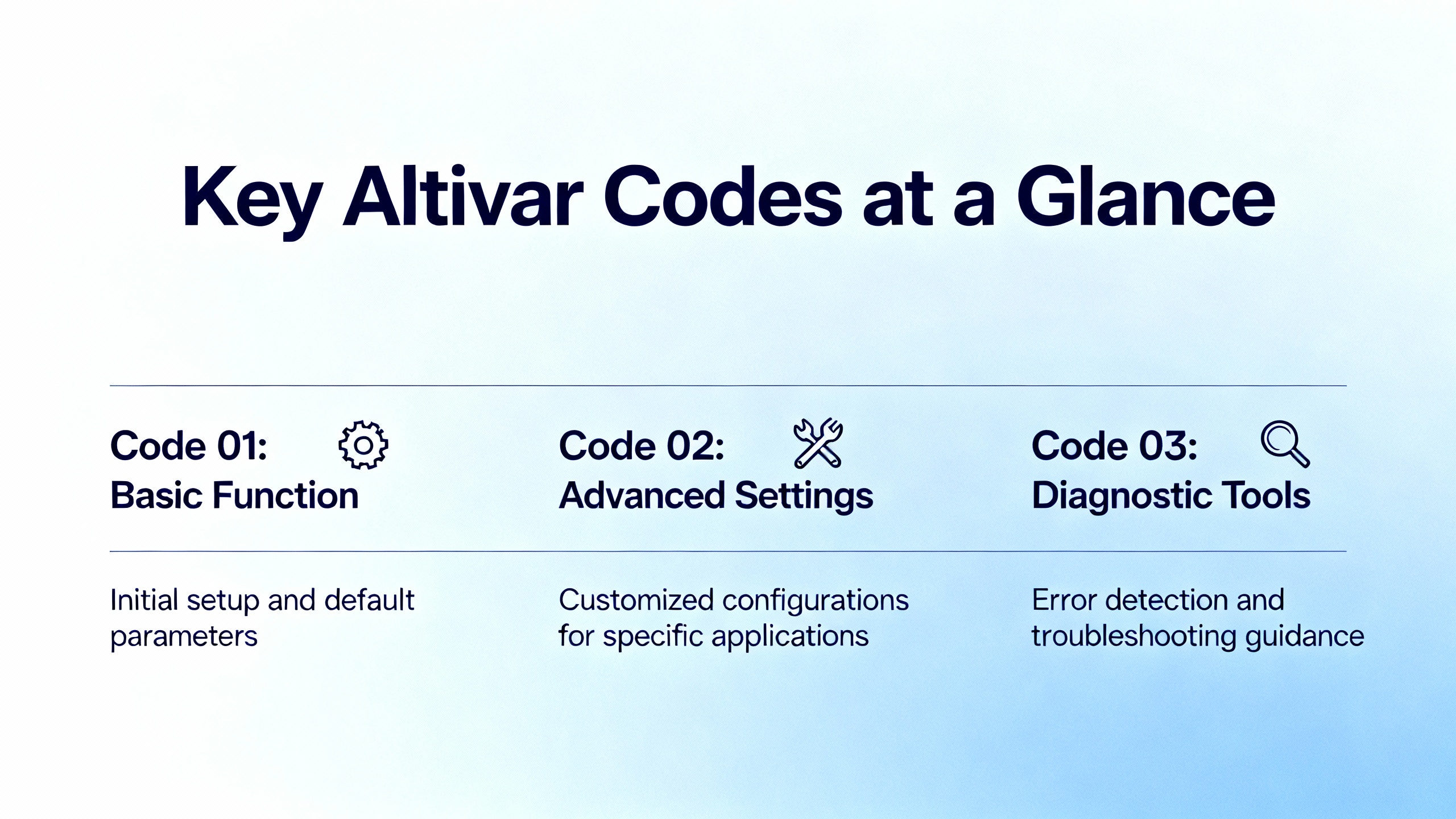
Key Altivar Codes at a Glance
For quick reference, it is useful to map a few high-impact codes to their dominant failure modes and first checks. The following table consolidates guidance from Altivar 71 technical notes, Schneider documentation references, and industry field experience.
| Code family | Category | Typical meaning in Altivar context | First checks to prioritize |
| OCF / OLF | Overcurrent / overload | Converter overload or motor overload | Mechanical binding, load changes, drive and motor sizing |
| SCF1–SCF3, SCF5 / HdF | Short or ground fault | Motor short, earth fault, or output short to ground | Motor insulation, cable damage, water ingress, terminations |
| SCF4 / tJF | Power stage fault | IGBT output module short circuit or overtemperature | Heat sink condition, fans, drive internals, component tests |
| OSF / USF | Overvoltage / undervoltage | DC bus or input supply outside acceptable limits | Supply voltage, deceleration ramps, braking hardware |
| bOF / brF / bUF / ObF | Braking issues | Braking resistor overload, braking feedback error, too fast braking | Braking resistor sizing, wiring, decel time, bus voltage |
| AI2F / LFF2–LFF4 | Analog input loss | Missing 4–20 mA process signal on AI2–AI4 | Transmitter power, loop integrity, shielding, configuration |
| AnF / ECF / EnF / SPF | Encoder and feedback | Encoder malfunctions or communication errors | Encoder cabling, pulse integrity, configuration parameters |
| OPF1 / OPF2 / EPHO | Output phase issues | Output phase not connected or broken power path | Disconnect position, loose terminals, contactor status |
| EPF1 / EPF2 | External fault | External interlock or safety chain opened | E‑stop circuits, safety relays, networked interlocks |
| OHF / OtF / PtF family | Thermal and PTC faults | Drive overtemperature or PTC circuit open/short | Ventilation, ambient temperature, fan operation, PTC wiring |
| SLF / SLF1 / CF / CnF | Communication faults | Loss of communication on a network or option card | Network wiring, addressing, protocol settings, EMC |
| EEF1 / EEF2 / APF / lnF1 | Internal electronics | EEPROM, controller, or board mismatch problems | Board seating, correct option boards, service evaluation |
The codes are descriptive enough that, once you understand the family, you can narrow down the probable cause before you even open the panel.
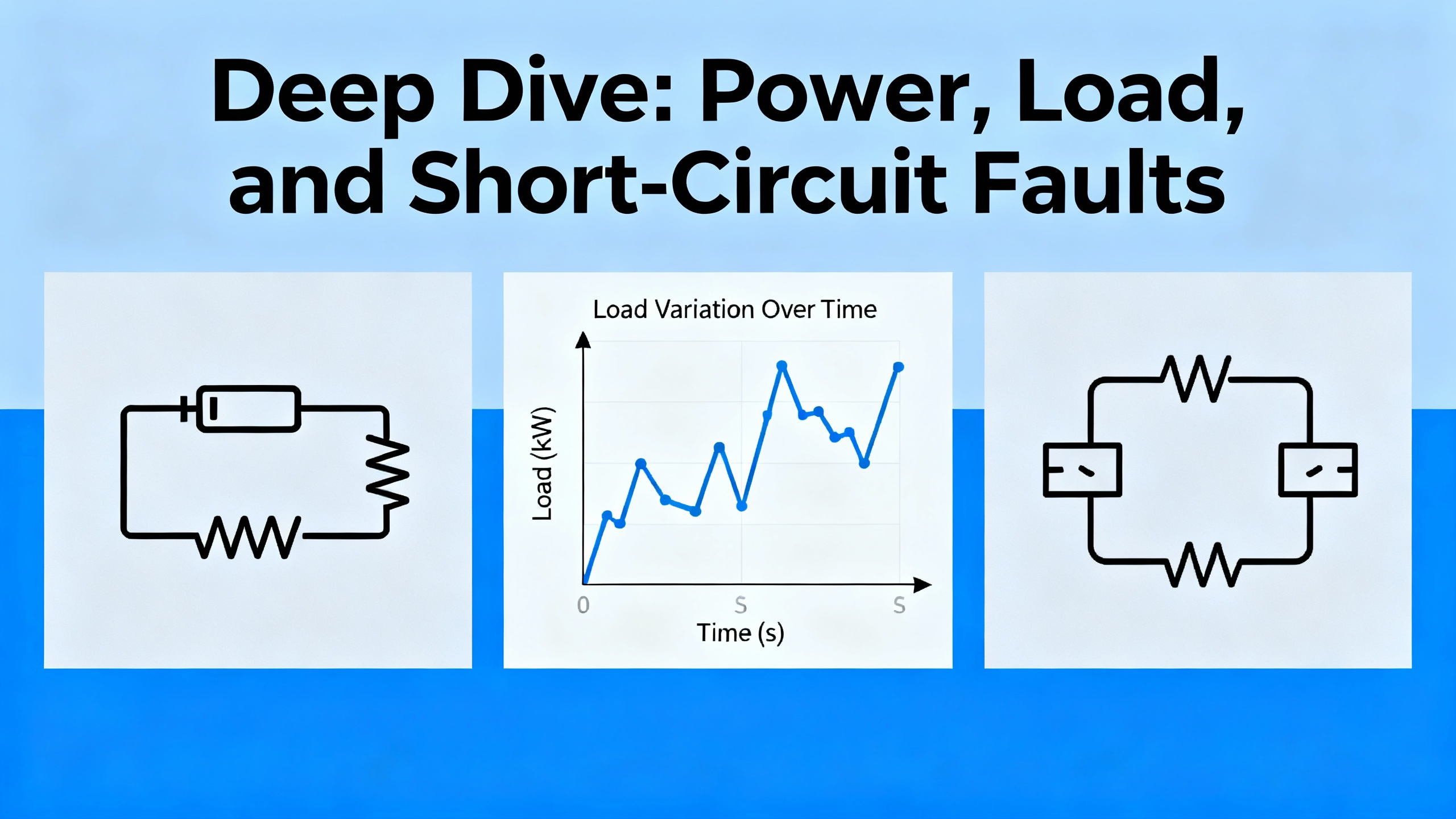
Deep Dive: Power, Load, and Short-Circuit Faults
In most industrial installations, the most disruptive Altivar events are overvoltage, overcurrent, and short-circuit faults, because they shut down critical processes abruptly.
Overvoltage faults, signaled as OV or the OSF family in Schneider language, are usually tied to deceleration and power quality. When a motor with significant inertia is forced to decelerate too quickly, it acts as a generator and pumps energy back into the DC bus. If the braking path cannot absorb that energy, the bus voltage rises and the drive trips to protect its IGBTs. Industry case studies describe plants that cut overvoltage errors dramatically by introducing properly sized braking resistors and tuning deceleration ramps, rather than blaming the drives.
Undervoltage faults, often UV or USF, push you to think about upstream conductors, transformers, and utility stability. Long cable runs and sags can create conditions where starting a heavy load drags voltage down enough for the drive to see undervoltage. In that case, you need to address the power system as much as the drive settings.
Overcurrent and overload faults, including OCF and OLF, are often where technicians start by suspecting the drive, but the root cause is frequently mechanical. A dough mixer that has changed product, a pump with debris lodged in its impeller, a conveyor dragging due to misalignment – these all show up as excessive current. Joliet-based analysis of overload behavior emphasizes the difference between normal duty ratings for variable torque loads such as fans and pumps, and heavy-duty ratings for constant torque loads. A single drive may carry two nameplate ratings depending on how it is applied. If you size a drive only on motor nameplate current and ignore duty profile, you invite recurrent overload trips.
Short-circuit and ground-fault codes such as SCF1–SCF5 and HdF must always be taken seriously. The Altivar 71 documentation and later Schneider notes make it clear that these are associated with short circuits or significant leakage at the drive output or motor terminals. SCF4, for example, points to the IGBT output module rather than the external wiring. The prescribed response is to verify motor and cable insulation, minimize parallel motor connections, and in some cases add chokes in series to manage leakage and switching stress.
A striking real‑world example comes from an Altivar 630 installation at a corn processing facility in Los Angeles. Persistent ground and motor short-circuit trips could not be explained by standard insulation tests. The motor leads ran about 150 ft through buried conduit under a driveway. When the conductors were eventually pulled, the conduit was found full of wastewater. Megger tests with the cables lying dry on the ground showed them to be electrically sound, and the drive stopped tripping. The best hypothesis was that water in the conduit altered cable capacitance and leakage enough to trigger the Altivar’s sensitive ground-fault protection. Further investigation revealed an underground wastewater leak that was undermining the roadway and creating a sinkhole risk. In that case, the nuisance tripping was an early warning for both electrical and civil failures.
The lesson is that when Altivar short-circuit or ground-fault codes appear on long underground runs, you must think beyond obvious insulation breakdown and consider moisture, capacitance, and buried infrastructure problems.
Inputs, Feedback, and Control: When Sensors Misbehave
Altivar drives are increasingly embedded in closed-loop systems where analog inputs and encoder feedback are critical. Fault codes around these signals are invaluable for process diagnostics.
Loss of a 4–20 mA signal on AI2, AI3, or AI4 is indicated by Altivar 71 codes like AI2F and LFF2–LFF4. When these appear, you are not dealing with a motor problem at all; you are dealing with a process signal that has vanished. Recommended practice from Schneider-oriented application notes is to verify current loop integrity end to end. That means checking transmitter power, cable continuity, shielding and routing, and confirming that the drive’s analog input configuration matches the actual loop type. Because these codes are specific to particular inputs, they also help distinguish between an instrument problem and a misconfigured channel.
Encoder and speed feedback issues are captured by codes such as AnF, ECF, EnF, and SPF. Industry servo-drive troubleshooting guides emphasize what Altivar users already know: encoder errors can be rooted in mechanical damage, misalignment, vibration, or the simplest of cabling mistakes. If the drive cannot trust the encoder, position or speed regulation is compromised, so it trips. The right response is to verify encoder wiring, confirm that signal levels and resolution line up with the drive’s expectations, and review mechanical coupling for damage or backlash, not to bypass the fault.
Communication codes such as SLF, SLF1, CnF, and network-specific codes in Schneider servo libraries underscore the same point at a different layer. When the drive cannot communicate with a controller or option card, you have to treat the fieldbus as part of the drive system. General Modbus and CANopen guidance from Schneider and their partners highlights the need for consistent baud rate, parity, unique node addresses, correct termination, and robust cabling practices. Heartbeat or node-guarding timeouts, PDO timeouts, and “no target values received” in Lexium 28 servo systems translate conceptually to the Altivar world: the drive is telling you that its command channel is unreliable.
Thermal and Environmental Performance: Hidden Deratings
Modern drives are thermally dense devices. Thermal faults such as OHF combined with PTC sensor related OtF and PtF codes are not just internal hardware events; they are system-level performance indicators.
Schneider Altivar guidance and independent drive-overload analysis both point to a typical full rating up to about 104 °F, with derating as ambient approaches roughly 122 °F. A 30 hp class drive can dump on the order of several hundred watts of heat into a cabinet. If filters are clogged, fans are failing, or enclosures are exposed to direct sun, internal temperatures climb quickly.
When an Altivar reports OHF, you need to treat it as evidence that the thermal design and maintenance regime are not doing their job. Practical steps include confirming fan operation, checking for dust and contamination, ensuring clear ventilation paths, and reevaluating enclosure design. PTC-related faults such as OtF1, OtF2, and PtF families, especially where PTC sensors are wired into logic inputs, deserve the same rigor. These can indicate real motor overheating, broken sensor wiring, or shorts across PTC circuits. The correct move is to verify wiring, sensor resistance behavior, and motor thermal conditions rather than simply bypassing protection.
Servo drive documentation from Schneider’s Lexium range shows that the manufacturer takes a similar approach in servo systems, with detailed codes for drive overtemperature, motor overtemperature, and temperature sensor failure, and clear instructions to improve ventilation, prevent dust ingress, and ensure appropriate motor sizing. The same philosophy should guide Altivar deployments.
External Faults, Safety Chains, and Status Codes
In many installations, what operators refer to as “drive faults” are actually the drive faithfully reporting external safety or interlock conditions.
Altivar codes EPF1 and EPF2 exist precisely to represent external contacts or networked fault inputs. They trip when an emergency stop, safety relay, or supervisory system opens the chain. OPF1 and OPF2, as well as EPHO on hydronic car-wash Altivar installations, are associated with opened disconnects and broken output phases. Field experiences in wash systems show that a simple turned-off disconnect or a loose output connector can generate OPF-family codes, sometimes accompanied by burnt terminations if loose connections are allowed to arc.
Not every code on the Altivar display is a fault. Some indications represent states. On Altivar 310, for example, the “–06” code on a seven-segment display indicates a freewheel stop state, not a failure. In that state, a digital input assigned to freewheel stop is active, output is disabled, and the motor free-runs. Similar ready and stop codes exist on the same platform. Understanding which display states represent healthy but stopped conditions versus active fault conditions is part of a robust diagnostic culture.
From Fault to Root Cause: A Practical Workflow
When a drive trips, the temptation is to hurry through the reset sequence. In my experience, high-performing plants do something different. They follow a repeatable workflow that moves from code to root cause with minimal wasted effort.
The first step is always to capture the exact fault code and relevant context. That means recording the code, whether the drive was starting, running at steady speed, or decelerating, and noting any unusual process conditions, such as a clogged filter, a sudden product change, or upstream breakers operating. Many Altivar models store fault history internally. Those logs are invaluable in seeing patterns, such as repeated OCFs during heavy starts or USFs during specific shifts when large loads come online.
The second step is to make it safe before you touch anything. Schneider documentation and third‑party Altivar guides are explicit about isolating the drive from its power supply and any external power sources before physical intervention. That includes ensuring the DC bus has discharged completely and guarding against unintended motor starts. This is not optional; high energy stored in the DC bus can create lethal hazards.
The third step is to ask whether the root cause is more likely in the process, the motor, or the drive. Overload and overcurrent codes almost demand mechanical inspection: couplings, belts, bearings, blocked pumps, and conveyors. Overspeed and SOF-type codes point toward control loop tuning, sensor reliability, or unexpected process dynamics. Ground-fault and short-circuit codes require insulation resistance tests and cable inspections. Communication codes push you toward the PLC, SCADA system, fieldbus wiring, and EMC environment.
Once you have corrected the likely cause, the next move is a controlled reset and soak test. Schneider provides several reset mechanisms on Altivar 71 and related drives. You can power-cycle the unit, use a dedicated digital input or control bit configured for Fault Reset, press the STOP/RESET key on the HMI, or in expert-access cases use the Device Reset parameter without cycing mains. Automatic restart functions can be configured to attempt a restart when a transient fault disappears, but these should only be used where the process can tolerate unexpected restarts and where you trust that faults are genuinely transient.
During the soak test, you watch not just the absence of faults, but stability of current, speed, temperature, and process variables under normal and slightly stressed conditions. If faults recur, they should drive a deeper review rather than repeated resets.
Finally, you document the event. Good maintenance practice, as recommended in Altivar application literature, includes capturing the code, suspected cause, actions taken, and diagnostic findings. Over time, this history becomes the backbone of reliability analysis and supports decisions on resizing, reconfiguring, or replacing drives and motors.
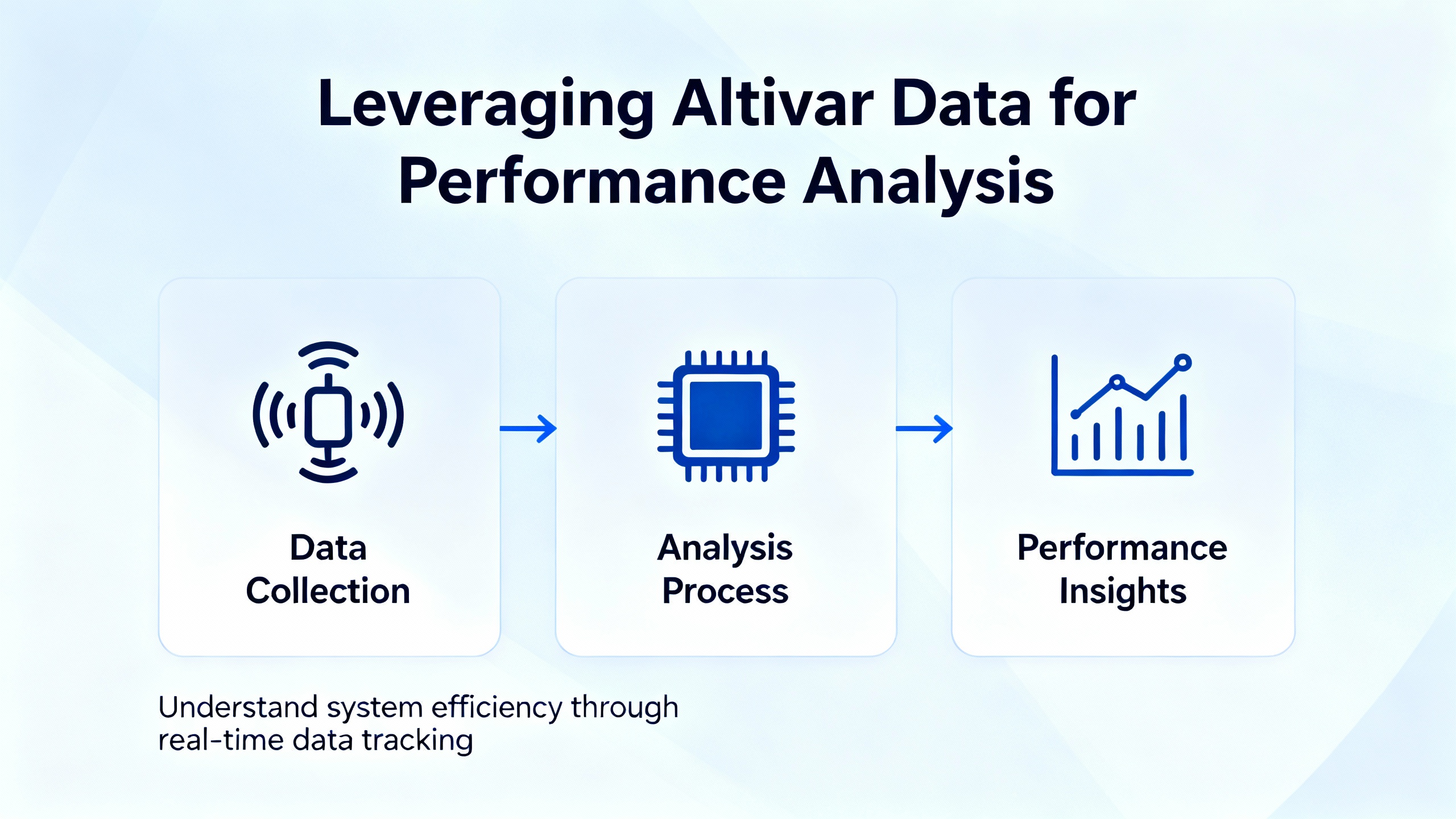
Using Altivar Data for Performance Analysis
Altivar drives are rich sources of performance data. Fault logs, event histories, and run-time variables like current, voltage, bus level, and thermal status can all be mined for reliability insights.
The first layer of analysis is recurrence. Which codes appear most often, and under what conditions? If OCF and OLF are recurring, you may have mis-sized hardware or a process that demands more torque than originally assumed. A drive overload brief from the VFD industry underscores how often constant torque applications are mistakenly applied on normal-duty ratings intended for variable torque loads. Pairing Altivar fault history with motor nameplate data and real current measurements can highlight this mismatch long before catastrophic failure.
Another layer is environmental correlation. Drives that exhibit frequent OHF or other thermal warnings may share enclosure designs, ambient locations, or contamination profiles. Industry guidance notes that contaminants such as moisture, dust, and oil-laden particles can block cooling paths and create shorts. Routinely inspecting fans, heat sinks, filters, and cabinet cleanliness at least monthly in demanding environments is not overkill; it is basic reliability hygiene.
A third layer involves evaluating supply conditions. High DC bus faults and undervoltage trips can often be linked to supply disturbances, long feeders, or other large loads coming online. Logging incoming voltage, DC bus level, and trip times helps identify whether line reactors, better distribution, or coordination with facility power upgrades would be cost-effective.
Finally, Altivar logs should be integrated into broader fault-tolerant design thinking. Research on fault-tolerant control for industrial systems emphasizes that the ability to accommodate faults depends on explicit design decisions. Altivar drives already provide the diagnostics; your system design must ensure those diagnostics are visible and actionable.
Ground Faults, Cables, and Hidden Infrastructure
The Altivar 630 wastewater example illustrates a broader point for power system reliability advisors: VFD trips can reveal non-electrical infrastructure problems.
Long underground conduits are prone to water ingress, especially where wastewater lines and process fluids are nearby. VFDs with sensitive ground-fault detection will see the resulting leakage as an electrical anomaly long before it is severe enough to show up as a low megger reading under dry conditions. When you see inexplicable SCF or HdF codes associated with specific conduits, you should think about moisture, degraded conduit seals, and potential structural issues such as roadbed undermining.
A thorough investigation may involve pulling cables, blowing out conduits, retesting insulation, and comparing behavior with the cables laid dry versus in‑conduit. In that sense, Altivar fault diagnostics are an early warning system not only for motor insulation but also for the physical environment surrounding your cables.
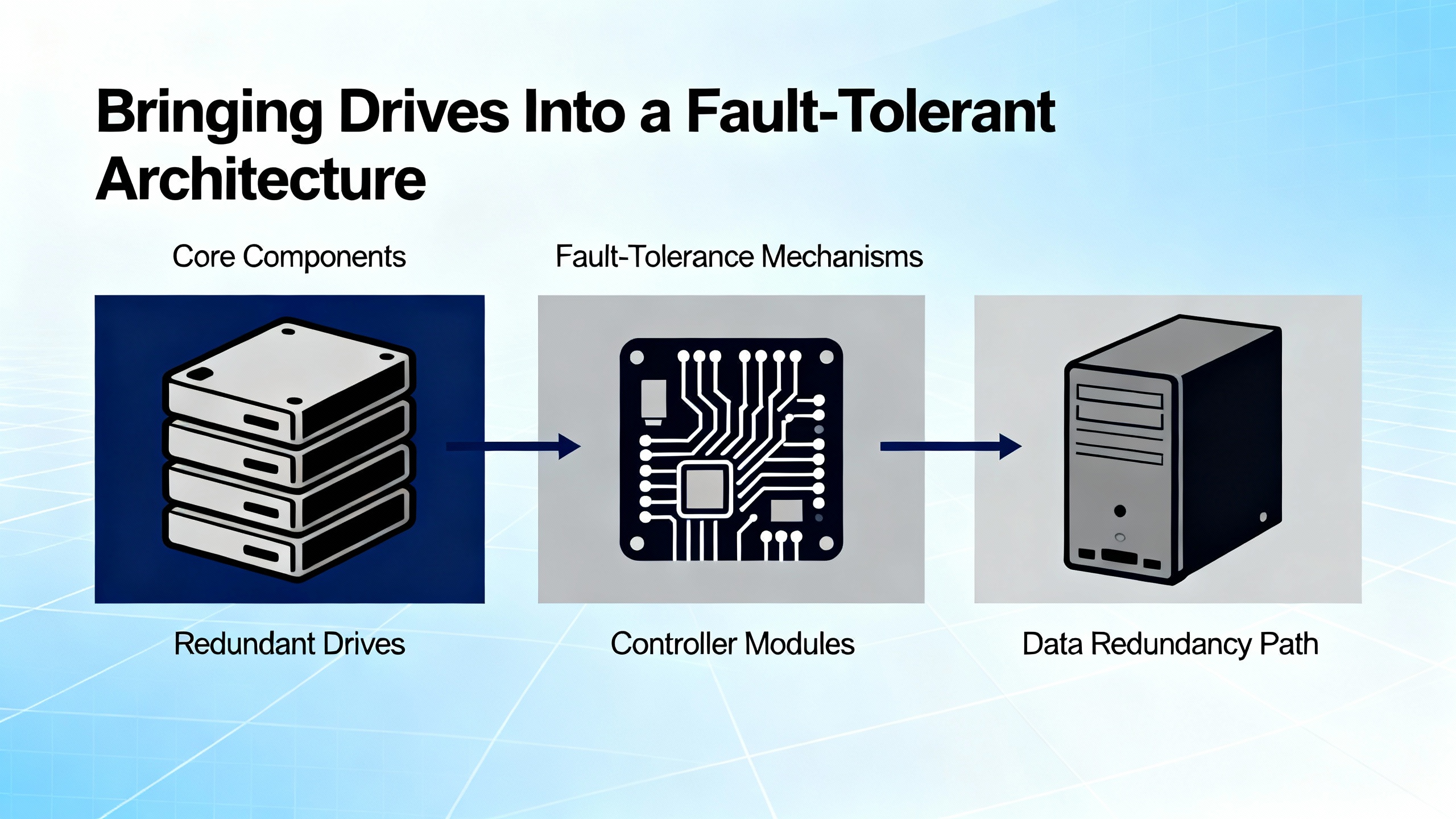
Bringing Drives Into a Fault‑Tolerant Architecture
In modern plants, drives do not live in isolation. They are nodes in larger automation and energy management systems. A fault-tolerant design perspective treats Altivar drives as both actuators and sensors.
Research on fault-tolerant design for automated guided vehicles and multi-axis machines stresses redundancy and diagnosability. Redundancy is more than duplication. It includes diverse sensors, model-based observers, and multiple communication paths. Altivar fault codes can connect into this architecture as one layer of diagnostic evidence. When combined with external sensors such as vibration, temperature, or process flow, they support more robust fault detection and isolation.
Practically, this means mapping Altivar fault words and status registers into PLCs and SCADA systems, as Schneider’s own FAQs suggest. Remote systems can then log codes, trigger alarms, and provide guided troubleshooting for operators. Testing that integration requires simulated faults or controlled trips to verify that fault codes propagate correctly, an approach discussed in Schneider FAQs on fault simulation for Altivar drives.
For critical applications, some designers adopt redundancy at the drive level, either through standby drives or modular spares that can be swapped quickly. Others use Altivar fault histories as part of condition-based maintenance programs, pulling drives long before catastrophic failure based on patterns of overloads, thermal warnings, or intermittent communication faults.
In all cases, the principle is the same as that advocated in fault-tolerant design literature: the capability to accommodate faults must come from conscious design choices, not ad‑hoc reactions after the fact.
Short FAQ
How often should I review Altivar fault logs?
For drives on critical loads, a monthly review of fault and warning histories is a reasonable minimum, with immediate review after any unplanned trip. Even in seemingly stable systems, these logs can reveal rising overload frequencies, marginal power quality, or early thermal issues long before they become production-stopping failures.
Is it safe to rely on automatic restart after a fault?
Automatic restart functions built into Altivar drives are designed for specific scenarios where a transient condition disappears and a restart is safe. They are not a substitute for root-cause analysis. Use auto restart only when the process can tolerate unexpected restarts, when you are confident the fault type can genuinely be transient, and when you have independent protection against unsafe motion.
When should I send a drive for professional repair rather than continue field troubleshooting?
When codes point to internal memory faults such as EEF1 or EEF2, controller failures like APF, power board mismatches such as lnF1, or repeated power-stage faults after all external checks are exhausted, the drive should be evaluated by qualified service. Schneider’s own repair literature for major brands emphasizes that troubleshooting energized drives is hazardous and that severe internal damage is best handled by specialized repair teams who can test under controlled conditions.
In practice, the dividing line is clear. If the evidence indicates wiring, loading, environmental, or configuration issues, field teams can usually correct them. If diagnostics consistently indicate internal electronics or power modules, or if a drive fails to energize at all despite correct power and commands, professional repair or replacement is the safer and more reliable path.
Viewed through a reliability lens, Schneider Altivar fault codes are not annoyances to be cleared but data to be mined. When you read them carefully, connect them to process and power conditions, and feed them into a deliberate fault-tolerant strategy, they become one of the most powerful tools you have for keeping industrial power systems stable, safe, and productive.
References
- https://www.cs.cornell.edu/fbs/publications/SMSurvey.pdf
- https://pmc.ncbi.nlm.nih.gov/articles/PMC9227458/
- https://www.longi.net/troubleshooting-schneider-atv310-drive-displaying-06-and-failing-to-start-or-run/?srsltid=AfmBOoq-MkwBTOsB8MhbXWmk1klieltHZAiQr6YIoMyyXrc1zKz2ayhV
- https://anadiautomation.com/blog-details/vfd-fault-codes
- https://eltra-trade.com/blog/schneider-electric-altivar-71-fault-codes
- https://www.schneiderelectricrepair.com/allen-bradley-drive-does-not-energize/
- https://devancocanada.com/files/brochures/BCSI-HV:Diagnostics-Troubleshooting.pdf
- https://industrialautomationco.com/blogs/news/servo-drive-errors-solved-a-technician-s-troubleshooting-guide?srsltid=AfmBOooGXNwDtFT3rPYYDa0NM0HsLX6vlguY_Pfo_tYh1ts-tPslVa5D
- https://joliettech.com/blog/typical-variable-speed-drive-faults-and-how-to-troubleshoot-them-drive-overload/
- https://forums.mikeholt.com/threads/altivar-630-ground-motor-short-circuit-faults-motor-trouble-too.2575587/


 Videos
 News
News Applications





Leave Your Comment