When a control system fails in the middle of a production run, it usually is not the lights that go out first. It is the programmable logic controller that drops a rack, a drive that refuses to enable, or a network switch that suddenly goes dark. Even in facilities with solid UPS coverage and good inverter-backed power protection, a dead PLC CPU or comms module can turn a critical line into an expensive sculpture.
As a reliability advisor working with industrial and commercial power systems, I see the same pattern repeatedly. Plants invest heavily in UPS systems, inverters, surge protection, and switchgear, but they often underestimate how long it will take to obtain a replacement PLC part once something fails. In a world where certain OEM components routinely have lead times measured in weeks, the difference between having a true same-day path to PLC parts and simply “expediting an order” is the difference between a controlled interruption and a multi‑day outage.
Emergency PLC parts same-day delivery is not just fast shipping. One specialist in this space describes it as the coordinated same‑day or overnight specifying, sourcing, and receiving of critical control components such as PLCs, drives, HMIs, power supplies, and communications gear to restore production quickly. In other words, it is an engineered response to a line‑down event, not a tracking number.
This article explains why same‑day emergency PLC parts matter so much in power‑critical environments, what these services can realistically deliver, and how to integrate them into a broader reliability strategy for UPS, inverters, and power protection systems.
Why PLC Failures Hit Power‑Critical Operations So Hard
In modern logistics and manufacturing facilities, PLCs sit at the heart of automation. Industry analyses from logistics system providers describe PLCs as rugged industrial processors that execute automation programs in real time, processing instructions and driving machine movements through input and output channels. They receive commands from higher‑level software such as warehouse control and warehouse management systems, then translate those into deterministic control of motors, actuators, and safety devices.
Shenzhen QIDA electronic highlights that automation controllers, including PLCs, HMIs, and microcontrollers, now form the backbone of supply chains, synchronizing machinery and data acquisition to reduce errors and improve decisions. In other words, if these devices stop, your material flow stops. For a power‑critical site—a data center support plant, a large hospital laundry, a food plant with temperature‑sensitive product—the impact is immediate.
From the power side, the PLC is often orchestrating the behavior of UPS‑fed distribution, automatic transfer switches, cooling systems, and process loads. Even if the UPS and inverters hold the bus rock‑steady, a failed PLC CPU, I/O rack, or power supply can freeze breakers in place, stop fans and pumps, or leave critical loads stuck in a safe state with no easy way to restart. The facility has clean power but no way to use it.
The risk increases sharply with age. The CMM Group notes that older or obsolete PLC systems significantly increase the risk of unplanned equipment downtime. As PLC hardware ages, replacement parts become obsolete and harder to find, stretching lead times and making extended downtime almost inevitable. They point out that a failed PLC in an obsolete platform can result in shutdowns lasting several days or even weeks. That is the scenario emergency PLC parts strategies are designed to avoid.
The Real Cost of Waiting for OEM Lead Times
Downtime is not abstract. Industrial Automation Co. documents a case where a failed Siemens drive at a food processor in North Carolina threatened about $50,000 in lost product. Because they had compatible inventory on the shelf and could ship overnight, the plant was back in operation in under 24 hours. In another case, a failed Allen‑Bradley PLC caused an automotive line stoppage; using in‑stock components and express shipping, they restored operations in less than 36 hours. A packaging facility facing a six‑week OEM lead time for a replacement HMI avoided that extended outage because a compatible unit could ship the same day.
These examples illustrate a simple truth: the cost of a few thousand dollars in hardware and emergency logistics is trivial compared with the cost of a day or more of lost production. One emergency PLC‑parts provider puts it bluntly: from a risk‑cost perspective, one hour of downtime often costs more than the price difference between a refurbished on‑hand spare and an emergency new unit. That is particularly true in peak seasons when staffing is thin, shipping lanes are congested, and there is little slack in delivery commitments.
Analysts at QIDA Automation report that automation controllers can cut logistics operational costs by roughly 30 to 45 percent, mostly through labor reduction and better process efficiency. That same math applies to downtime prevention. When you factor in the cost of waste, missed shipments, and overtime, a robust spare‑parts and emergency‑delivery strategy is not a luxury; it is a structured way to protect the return on your investment in automation and power infrastructure.
The risk is not only financial. CMM Group emphasizes that as PLC platforms go end‑of‑life, sourcing replacement parts becomes harder and slower. The plant can be forced into a rushed, unplanned migration because the old hardware simply cannot be supported. Relying solely on standard OEM lead times, without any contingency path for same‑day parts, effectively transfers that risk onto your production schedule.

What Emergency PLC Parts Same Day Delivery Really Involves
Emergency PLC parts delivery is fundamentally about coordination. The best description from industry practice frames it as three activities happening in parallel: specifying the exact part needed, sourcing it from wherever it is physically available, and arranging same‑day or overnight logistics to get it into your panel.
A key point that experienced suppliers highlight is that speed depends less on shipping distance than on how precisely the part is specified. A vague request like “I need a CPU for an S7 rack, anything that will work” slows everything down, even if a warehouse is across town. On the other hand, a detailed request with full part number, series, and firmware requirements can turn distant stock into a same‑day solution because the vendor can commit immediately and route it through the fastest channel.
Several patterns show up repeatedly in the market.
Mitsubishi Electric Americas offers after‑hours emergency parts shipping for its automation lineup. Their guidance is clear: parts can fail any time; downtime can be very costly; and they commit to support customers 24 hours a day, seven days a week, with an emergency shipping desk available outside normal business hours for shipments in the continental United States. That is a classic OEM emergency program, ideal when you are standardised on a brand and need factory‑supported parts.
Independent replacement specialists such as Industrial Automation Co. position themselves around emergency replacements for drives, PLCs, and HMIs. Their model is to hold significant multi‑brand inventory and ship same day for orders placed before a mid‑afternoon cutoff, with typical deliveries arriving within 24 to 48 hours. They back parts with a two‑year warranty and case studies show that this combination of on‑hand stock and rapid shipping can resolve serious line‑down situations in one to two days instead of weeks.
Logistics providers play a complementary role. Reliable Couriers, for example, focuses on same‑day rush delivery of manufacturing and production line parts. They emphasize nationwide coverage with strategically placed hubs, deliveries often within hours, and real‑time tracking. From a plant’s perspective, this can allow you to leverage inventory held by distributors, integrators, or sister facilities and still achieve same‑day arrival, especially for critical but physically small PLC cards and power supplies.
Some distributors lean heavily into emergency sourcing for automation components. Santa Clara Systems, which concentrates on factory automation and industrial controls, emphasizes overnight and same‑day shipping and even after‑hours emergency shipping services, using their inventory of both current and obsolete parts. DO Supply similarly promotes “need‑it‑now” replacement parts and repair for PLCs, drives, motors, and HMIs, positioning speed and expert support as their differentiators. Next Day Automation advertises same‑day delivery offerings and highlights the importance of knowledgeable staff who can help specify and source the correct item.
A simplified way to think about these options is summarized below, using only capabilities explicitly described by the providers themselves.
| Provider type | Example capabilities from industry sources | Best fit use cases |
| OEM emergency service | Mitsubishi Electric Americas supports 24/7 after‑hours emergency parts shipping within the continental US for its automation products. | Current‑generation parts from that OEM, where factory support and configuration guidance are critical. |
| Stocking replacement specialist | Industrial Automation Co. ships in‑stock drives, PLCs, and HMIs the same day when ordered before the cutoff, typically achieving 24–48 hour delivery and offering a two‑year warranty; Santa Clara Systems offers overnight and same‑day shipping and after‑hours emergency shipping; DO Supply and Next Day Automation position themselves around rapid‑response parts availability. | Line‑down scenarios that demand compatible replacements faster than OEM lead times, including many legacy PLC platforms. |
| Same‑day courier logistics | Reliable Couriers provides same‑day rush delivery of manufacturing and production line parts within hours, with real‑time tracking and specialized handling. | Bridging the last‑mile gap between regional inventory and your plant, and enabling leaner on‑site spares by relying on just‑in‑time delivery. |
In practice, the most resilient plants deliberately combine these channels. They standardize on OEM emergency programs for current platforms, maintain relationships with stocking specialists for legacy and multi‑vendor assets, and have a courier strategy ready for truly urgent moves.
Designing a Tiered PLC and Power Parts Strategy
Same‑day delivery is only fast if you know exactly what you need and why. One emergency PLC specialist recommends structuring your spare‑parts strategy in tiers based on the impact of a failure.
Tier 1 items are those that stop the line outright. Their examples include PLC CPUs, primary variable‑frequency drives or servo drives, and main HMIs. These are the components that, if they fail, leave you with no safe or practical workaround. The recommendation is to hold tested spares for these items on‑site, with documented firmware levels and backed‑up programs, and then use emergency delivery as a way to replenish those spares after use.
Tier 2 items are those where you could, in theory, limp along with workarounds, but at real risk. Typical examples include I/O modules and communication adapters. You might be able to bypass a failed card, de‑rate a machine, or run in manual mode temporarily, but every minute in that state increases safety risk and quality drift. For these components, having at least one spare per critical type and clear, documented swap plans is essential.
Tier 3 items are low‑cost but surprisingly disruptive when missing: cables, relays, SD cards, and similar accessories. The advice here is to bundle and label them by machine. In a power‑control context, that same thinking applies to power‑supply fuses, low‑voltage cabling, and network patch leads in UPS and inverter control panels.
The following table captures this tiering model as it is described by practitioners.
| Tier | Typical examples from published guidance | Recommended strategy |
| Tier 1: Line‑stoppers | PLC CPUs, primary VFDs and servos, main HMIs | Keep tested, documented spares on‑site; treat emergency delivery as backfill, not first line of defense. |
| Tier 2: Risky workarounds | I/O modules, communication adapters | Maintain at least one spare per critical type and documented swap procedures; use emergency sourcing if a second failure occurs. |
| Tier 3: Nuisance but essential | Cables, relays, SD cards, similar accessories | Pre‑bundle and label by machine; these can often be replenished quickly but cause disproportionate downtime when overlooked. |
Embedded in this framework is an important insight: many hidden failure points are not in the PLC rack at all, but in the control network and low‑voltage infrastructure. Industry notes highlight managed switches, SFPs, and serial‑Ethernet gateways as common weak points that are rarely stocked as spares. Reviewing switch logs regularly and holding at least one spare switch and common media converters can turn a potential multi‑hour network diagnostics exercise into a quick swap.
For power‑critical facilities, these network and control components are as vital as the UPS modules themselves, because they carry the status and control signals that decide how loads are shed or transferred during an event.

How to Prepare for the Emergency RFQ You Hope You Never Need
When a PLC or drive fails unexpectedly, it is very tempting to call your supplier and say, “I just need the fastest replacement you have.” The problem is that this forces the vendor to do the hard work of identifying exactly what you own, what firmware it runs, and what options it has. That eats into the very time you are trying to save.
Emergency‑sourcing specialists recommend building a repeatable template for urgent RFQs long before you need it. The details they highlight are highly practical. At a minimum, you should be ready to provide the full part number and series, not just a family name. You should include the target firmware or revision level you require, based on your last known‑good backup. You should state exactly where the part is installed—machine name, cabinet, and slot—so there is no confusion about form factor or bus type.
Accessories frequently cause surprise delays, so your RFQ should say clearly whether you need operator keypads or HIMs for drives, programming keys, termination resistors, or mounting adapters. Suppliers also stress the value of declaring whether you have a last known‑good backup for the device and whether you want the replacement pre‑flashed to that level.
Finally, do not forget logistics constraints. If your receiving dock is closed at night, or if the part must be routed through a secure area, that needs to be visible in the RFQ so dispatchers can select the right courier option.
The table below shows how each of these data points directly affects speed and risk.
| RFQ data point | Why it matters for same‑day PLC parts delivery |
| Full part number and series | Eliminates back‑and‑forth over compatibility and prevents shipping the wrong variant. |
| Target firmware or revision | Avoids version mismatches that can prevent a downloaded program from running. |
| Machine and slot location | Confirms physical format and ensures items like rack depth, bus type, and I/O count match. |
| Required accessories | Prevents arrivals that are technically correct but unusable without missing keypads, resistors, or adapters. |
| Backup availability | Lets the supplier propose pre‑flashed or preconfigured units, reducing commissioning time. |
| Shipping and receiving constraints | Allows dispatchers to select a courier and route that actually reach your plant when you need it. |
| Acceptance criteria for pass/fail | Enables bench testing at the supplier or integrator, so failures are discovered before the truck rolls. |
The more of this you can standardize and keep up to date in your maintenance documentation, the more likely it is that a distant warehouse can become a same‑day solution instead of a second emergency.
Firmware, Testing, and Risk in Same‑Day Swaps
When you are under pressure to get a line running again, it is very easy to accept “close enough” on firmware and hardware revisions. Unfortunately, field experience shows that firmware and revision mismatches are major risk drivers in emergency PLC replacements.
Specialists advise asking suppliers directly which major firmware version they have in stock and comparing that against your backups. In many cases, vendors can pre‑flash a replacement to your required revision before shipping. That small extra step can turn a high‑risk install into a straightforward card swap.
Bench testing against your last known‑good program is equally important, especially for refurbished or cross‑compatible parts. Industrial Automation Co. reports that carefully validated refurbished units and compatible alternatives can end outages faster and at lower cost, and that some replacements have delivered hardware savings in the range of 30 to 50 percent. However, those savings are only meaningful when the hardware, firmware, and application compatibility have been rigorously verified ahead of time. If a “cheaper” part fails during commissioning, you are simply trading spare‑parts savings for additional downtime.
In the context of power‑critical systems, it is also wise to treat networked components like switches and protocol gateways as software‑bearing devices that require the same discipline. A preconfigured managed switch stored as a spare, with its firmware level and configuration documented, can be a lifesaver during a chaotic outage.
When the Exact Part Is Not Available
Supply‑chain realities matter. One industry guide notes that for many Siemens, Yaskawa, and ABB items, lead times can stretch to two to eight weeks if the part is not already on a shelf. OEM and distributor quick‑ship programs, such as the quick‑ship options offered by major drives and PLC vendors, can cut those delays drastically, but only for specific SKUs and in specific regions. Batteries or other elements inside shipped equipment can introduce additional hazmat‑related delays if they are not planned for explicitly.
When the exact part is simply not available in the time window your plant can tolerate, you are left with a choice between accepting extended downtime or using a compatible or refurbished alternative. As mentioned earlier, emergency replacement specialists report that cross‑compatible tested alternatives and refurbished units can close outages more quickly and at lower hardware cost. This is particularly relevant for legacy PLCs where OEM support is fading and CMM Group’s concern about component obsolescence is already visible.
The trade‑off is engineering effort and risk. A compatible module with a different revision may require more careful testing. A refurbished CPU should be bench‑tested with your actual application, power‑quality conditions consistent with IEEE guidance, and, ideally, simulation of key I/O sequences. The standards often cited in this context—IEC 61131‑3 for PLC programming, NFPA 79 for industrial electrical safety, ISA/IEC 62443 for industrial cybersecurity, and UL 508A for control panels—exist precisely to make this kind of cross‑platform or cross‑vendor substitution predictable and safe.
From a risk‑cost angle, the question is often not “Is this refurbished unit cheaper?” but “Is the combined cost of an emergency alternative and the engineering effort to vet it lower than another twelve hours of downtime?” For most power‑critical operations, the answer is yes far more often than it first appears.
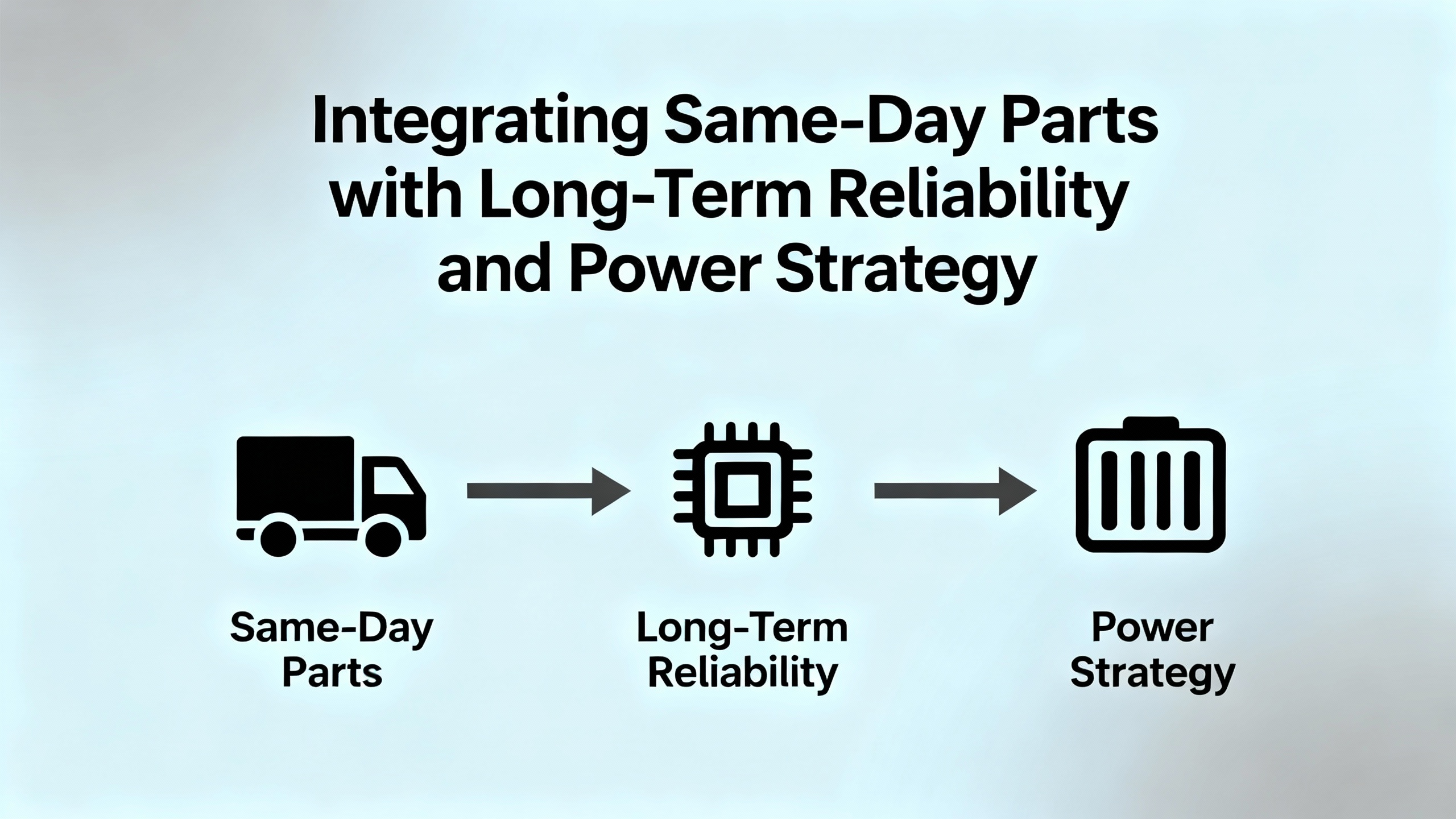
Integrating Same‑Day Parts with Long‑Term Reliability and Power Strategy
Emergency delivery only pays off when replacements land in a system that is ready to accept them. A spare PLC CPU is no help if the latest program is sitting on an engineer’s laptop that is off‑site, or if nobody can remember which port on a fanless switch connects to the UPS monitoring card.
Experienced providers emphasize robust maintenance habits as the multiplier on fast delivery. That includes proactive inspections; stable, well‑protected power; verified and version‑controlled backups; current as‑built electrical drawings; and accurate network topology diagrams. When those elements are in place, a same‑day replacement can be slotted in and validated quickly. When they are not, the clock keeps ticking while engineers reconstruct the system.
QIDA Automation’s research on automation controllers in supply chains reinforces that theme. They highlight the importance of real‑time data visibility for agile decision‑making and show that companies using integrated automation and HMI systems see significant gains in responsiveness and productivity. They also note that automation controllers, when deployed strategically, can reduce logistics operational costs by up to around 45 percent. The same digital maturity that delivers those day‑to‑day efficiencies also makes emergency recovery faster.
Planning ahead matters seasonally as well. Integrators and suppliers report that waiting until late in the year to build a parts plan is often too late, because shipping lanes are congested and OEMs are already backed up. A practical approach is to review twelve to eighteen months of failure history early in the fall, identify repeat offenders and single points of failure, check lead times on problematic SKUs, and close the most impactful gaps first. In UPS‑heavy facilities, that review should explicitly cover control‑power transformers, UPS communication cards, PLC power supplies, and the PLC modules that supervise critical transfer logic.
Modernization is another long‑term lever. The CMM Group recommends proactively upgrading obsolete PLC platforms and HMIs before they become unserviceable. They offer complete PLC replacement solutions, including preassembled racks and HMI upgrades, precisely to avoid the scenario where a single failed card triggers weeks of downtime. Used alongside a same‑day sourcing strategy, that kind of planned migration keeps your emergency moves focused on truly unpredictable failures, not preventable obsolescence.
Cybersecurity, Standards, and Safe Power‑Up Under Pressure
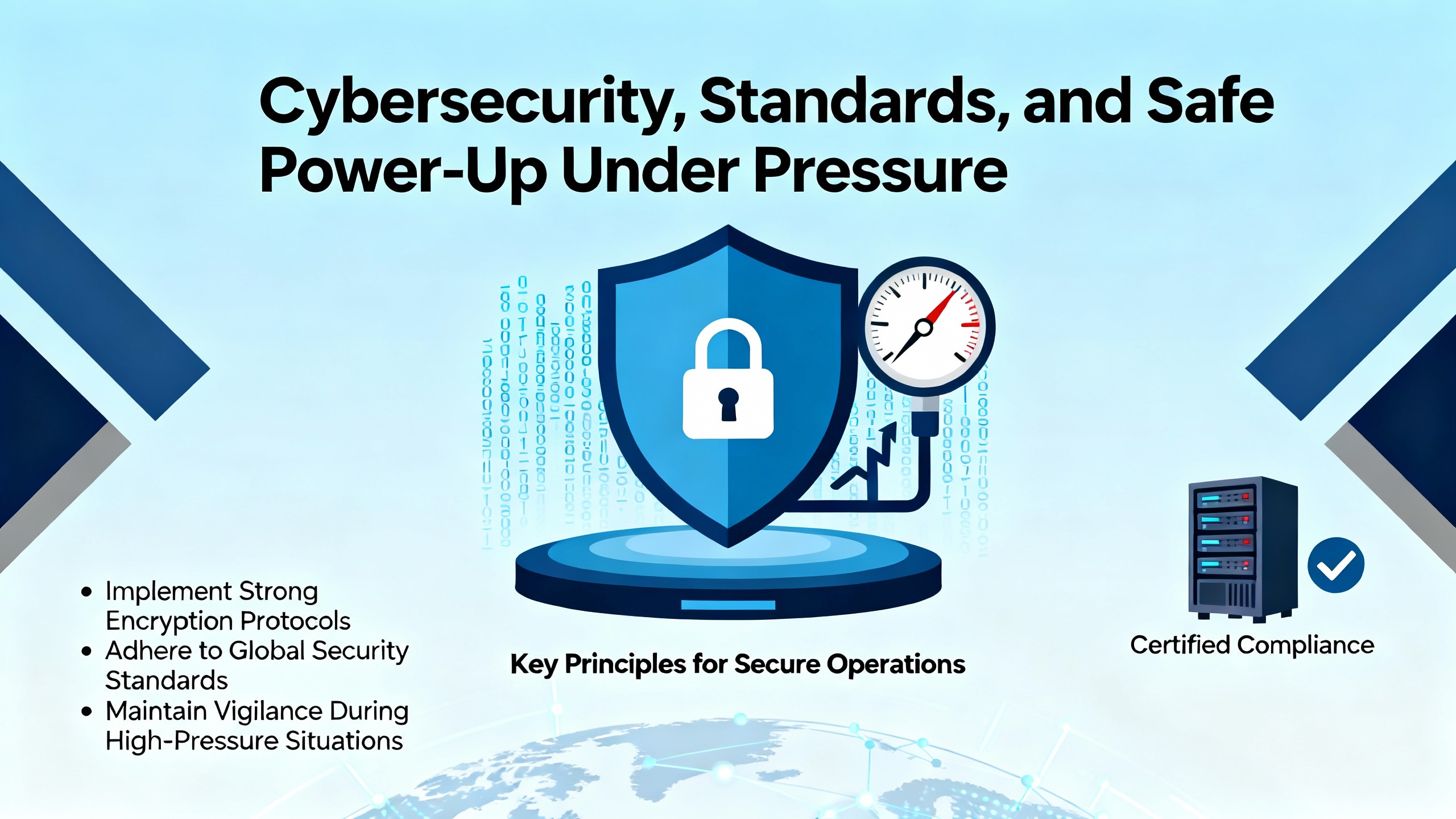
As more PLCs and drives become connected—often over the same Ethernet infrastructure that links UPS monitoring, power‑quality meters, and plant historians—the cyber dimension of emergency work becomes harder to ignore. QIDA Automation notes that cyber attacks on connected supply chains have risen by about 20 percent in a single year, and they recommend measures such as regular security audits, encrypted communications, and real‑time monitoring.
In a line‑down event it is tempting to bypass normal change‑control and security practices in the name of speed, especially if a vendor is remotely assisting with configuration. That temptation is dangerous. The industrial cybersecurity standard ISA/IEC 62443 exists to keep control networks robust precisely when they are under stress. Even in an emergency, it is essential to use authenticated, encrypted channels, to avoid exposing PLC ports unnecessarily, and to document what was changed.
The more traditional electrical standards still matter too. NFPA 79 and UL 508A codify safe wiring and panel practices, including the segregation and protection of control power and UPS circuits, while IEEE power‑quality guidance helps ensure that sensitive PLC electronics are not immediately stressed by harmonics, sags, or transients when they are re‑energized. IEC 61131‑3 provides a common language framework for PLC programs, which helps teams and vendors understand and validate logic changes made under time pressure.
Reliable spare‑parts care is another pillar of safe power‑up. Industry guidance points to labeling each spare with the machine, slot, and firmware it belongs to; storing electronics in ESD‑safe, climate‑controlled conditions; rotating batteries on a schedule; staging drives with any required accessories; and allowing cold deliveries to reach room temperature before powering them. Network spares, especially preconfigured managed switches, should receive the same discipline as PLC spares. In practice, these habits eliminate many of the last‑minute surprises that turn a simple card swap into a complicated troubleshooting session.
FAQ: Practical Questions from Plant Teams
Is same‑day PLC parts delivery a substitute for on‑site spares?
It is better to treat same‑day delivery as a second line of defense, not a primary plan. The tiered strategy used by emergency‑parts specialists is a good guide: true line‑stopping components such as PLC CPUs, primary drives, and main HMIs should have tested, documented spares on‑site. Same‑day sourcing is then used to replenish those spares after a failure or to cover secondary events. For lower‑tier items like cables and relays, or for non‑critical modules, it is often acceptable to rely more heavily on fast shipping and local couriers.
How does this apply specifically to UPS and power‑protection systems?
In most industrial plants, PLCs supervise not only mechanical processes but also key elements of the power system: generator start sequences, automatic transfer switches, static transfer switches, and sometimes even inverter or rectifier operating modes. A failed PLC or network component can therefore compromise how your UPS and power‑protection equipment behave during a disturbance. For that reason, control‑layer components that directly influence power behavior—PLC racks in transfer‑switch panels, power‑supply modules feeding those controllers, and the network switches that carry power‑system status—should be treated as Tier 1 or Tier 2 assets and covered by both on‑site spares and credible same‑day sourcing options.
When is it worth paying a premium for same‑day versus waiting 24–48 hours?
The answer lies in your downtime cost and risk appetite. Case studies from emergency replacement providers show that even a single incident can threaten tens of thousands of dollars in product, not to mention schedule penalties or contractual fines. Industry reports on automation controllers suggest that operational cost reductions of 30 to 45 percent are achievable when systems run well; those gains evaporate quickly during outages. If your estimated cost of one hour of downtime exceeds the incremental cost of a same‑day replacement or courier move, it is rational to pay the premium. In power‑critical sectors such as healthcare support services, cold storage, or high‑throughput logistics, that threshold is reached very quickly.
Emergency PLC parts same‑day delivery is not a magic trick; it is a disciplined mix of spare‑parts strategy, supply‑chain design, rigorous documentation, and reliable power and cybersecurity practices. When you combine robust UPS and inverter protection with tiered spares, well‑prepared RFQs, and trusted emergency sourcing channels, you turn what could have been a multi‑day crisis into a controlled, recoverable event—exactly the outcome a power system specialist should be engineering toward.
References
- https://www.dosupply.com/?srsltid=AfmBOoor_vhjKNlC4oFjH6GuOkv7NAGv8KM6KMsb5YzjMoG8H2nt4Uih
- https://www.nextdayautomation.com/
- https://www.radwell.com/?srsltid=AfmBOooK8Fjba70P8u8No6B-m_1FWduz5wAJBpKe3zSkvKOnrahA6H9U
- https://www.santaclarasystems.com/
- https://industrialautomationco.com/pages/emergency-replacements-in-24-48-hours?srsltid=AfmBOooTmHUk-5Nu5i4zZs2Z1WpD2-G-3_AjbcwGMASXpfoNi0RcUiYv
- https://www.interlakemecalux.com/blog/programmable-logic-controller-plc-logistics
- https://www.lafayette-engineering.com/lei-plc-controls/
- https://www.mooreplc.com/blog/the-future-of-industrial-automation-how-ai-is-revolutionizing-plc-systems_b52
- https://neutronictechnologies.com/plc-repairs/?srsltid=AfmBOoqHyA9vzntmDGlFiW4gS-bx9ElHhwzynJYllhW2NUi4PSZHsHGJ
- https://www.omch.com/best-industrial-automation-parts-suppliers/


 Videos
 News
News Applications





Leave Your Comment