Industrial and commercial power systems live or die on reliability. Your UPS, inverters, and power distribution equipment can be perfectly sized, but if a CompactLogix CPU or I/O module in the control chain fails without a spare strategy, you still lose the load. As a power system specialist, I see this pattern in data centers, process plants, and hospitals again and again: the automation layer is the smallest piece of the architecture by cost, yet it is often the single point that decides whether your critical power rides through a disturbance or trips offline.
This guide focuses on Allen-Bradley CompactLogix replacement parts from a reliability and lifecycle perspective. It draws on recent material from Rockwell Automation, Industrial Automation Co., Roc Industrial, and others, combined with field experience in power-critical environments. The goal is practical: help you understand what each module does, how to think about repair versus replacement, and how to source and standardize spares without overspending.
Where CompactLogix Fits in Your Power System
CompactLogix is Rockwell Automation’s mid-range programmable logic controller platform. Rockwell introduced it in 2008 as a bridge between the earlier MicroLogix controllers from the mid‑1990s and the larger ControlLogix platform that arrived in 1999. All three share a common Logix architecture and the Studio 5000 engineering environment, which simplifies engineering and migration.
CompactLogix targets small to mid-sized applications in manufacturing, material handling, packaging, and food and beverage. In power systems, the same characteristics are attractive in UPS and inverter controls, automatic transfer switches, generator switchgear, static transfer switches, and integrated power management systems. A CompactLogix controller can coordinate measurements, interlocks, and transfer logic in a compact footprint, leaving space in crowded switchgear or UPS cabinets.
Depending on the model, CompactLogix controllers support analog, digital, and thermocouple inputs, accept multiple I/O modules, and include built-in memory and USB or SD card interfaces. Network topologies typically include linear chains, device-level rings, and classic star layouts over EtherNet/IP. That means the same controller that sequences a generator paralleling switch can also talk directly to PowerFlex drives, intelligent trip units, and building automation systems on a converged network.
From a protection standpoint, CompactLogix integrates cleanly with auxiliary contacts, magnetic contactors, relay interfaces, sensors, and thermal protection devices. In a UPS or inverter lineup this might include breaker auxiliary contacts, DC bus temperature sensors, fan status relays, or battery monitoring I/O, all tied back to the PLC to trigger alarms or safe shutdowns.
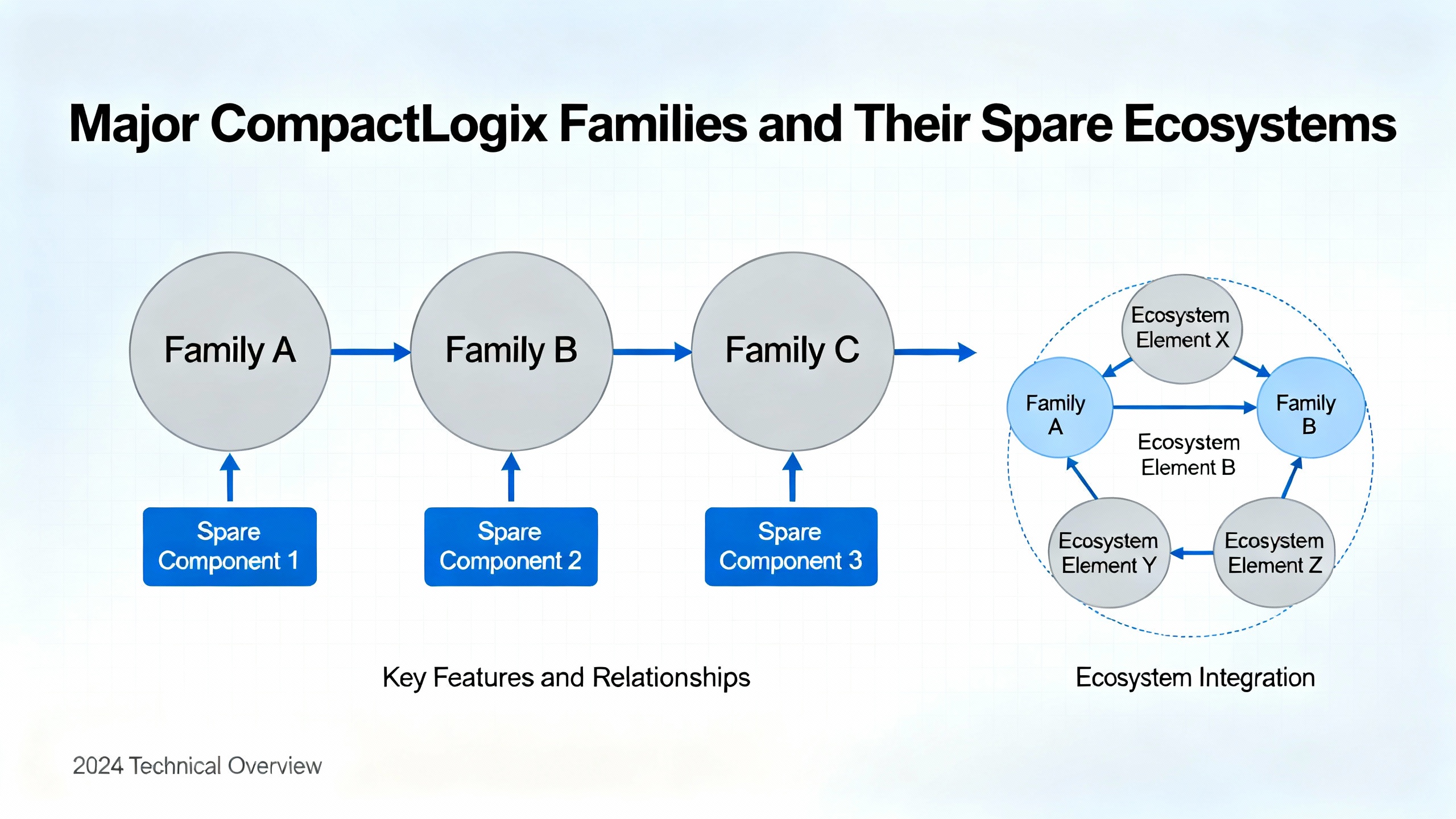
Major CompactLogix Families and Their Spare Ecosystems
Understanding which CompactLogix family you have is the starting point for any spare-part decision. Different generations use different I/O platforms and have different performance and support expectations.
Legacy 1769 CompactLogix and 1769 Compact I/O
The early CompactLogix controllers in the 1769 family use 1769 Compact I/O modules. These are modular I/O cards that plug onto a common bus and cover digital, analog, and specialty functions. Rockwell’s 1769 Compact I/O literature emphasizes insulation, working voltage, and dielectric withstand ratings between the field connections and the backplane.
Low-voltage communication interfaces such as USB and Ethernet typically use basic insulation with a continuous working voltage of about 30 V and are type-tested at around 500 V AC for 60 seconds. Some input circuits and group-to-bus paths are tested at roughly 1,200 V AC or close to 1,700 V DC for a second or two, and certain higher-voltage paths are tested around 1,800 V AC or roughly 2,600 V DC. Other paths specify IEC Class 2 reinforced insulation at 30 V AC or 30 V DC and working voltages around 132 V AC or up to 265 V AC for basic insulation.
The practical takeaway for replacement planning is straightforward. When you replace 1769 I/O modules, you are also implicitly making insulation and working-voltage choices. If those modules sit on circuits tied to switchgear, UPS inputs, or control power transformers, you want the replacement module’s working voltage and insulation category to be at least as robust as the original, not an arbitrary alternative with lower isolation barriers.
CompactLogix 5370 Controllers
Industrial Automation Co. highlights the CompactLogix 5370 family as a widely used, compact, and cost-effective platform. These controllers are well suited for small and medium systems in manufacturing, packaging, and material handling where machines need many inputs and tight integration of automation, process monitoring, and temperature control.
CompactLogix 5370 controllers typically use 1769 Compact I/O and offer embedded EtherNet/IP, making them a natural choice for controlling PowerFlex drives, coordinating UPS status signals, and interfacing with HMIs and supervisory systems. The family supports standard IEC-style programming languages such as ladder logic, function blocks, structured text, and sequential function charts, which makes it easy for control engineers to maintain and extend existing applications.
For operators of power-critical facilities, 5370 controllers often sit in the middle of the lifecycle: new enough to still be supported, but old enough that you may be balancing between buying new units and relying on refurbished or repaired spares.
CompactLogix 5380 and 5480
Later-generation CompactLogix families introduce more performance and new I/O platforms. Guidance compiled from Rockwell literature and selection overviews shows that CompactLogix 5380 controllers use the 5069 I/O platform and offer significantly higher performance and capacity than 5370 units. Rockwell sources have cited up to roughly twenty-times faster execution in some applications, along with more EtherNet/IP connections and higher supported motion-axis counts.
CompactLogix 5480 goes a step further by combining a Logix controller and a Windows 10 IoT Enterprise computer in a single chassis. This architecture suits applications that need tight coupling between deterministic control and PC-based analytics, HMIs, or data logging, which is increasingly common where power systems tie into predictive maintenance analytics or enterprise dashboards.
According to Atlas OT, Rockwell Automation often recommends the CompactLogix 5380 platform as the primary migration target when replacing older SLC 500 systems. This is relevant when you are not just swapping modules but considering a broader modernization of the power control layer.
Compact GuardLogix Safety Controllers
GuardLogix Compact controllers are safety-rated versions of CompactLogix, intended for applications that require integrated safety along with standard control. A selection guide summarizes them as combining standard and safety control in a single controller, with typical certifications up to SIL 2 or SIL 3 and Performance Level d or e when used with approved safety hardware and proper design practices.
In a power context, GuardLogix Compact may supervise emergency-stop chains, safe torque-off functions on drives, or safety-rated inputs from critical switches. When replacing or stocking spares for these controllers, the safety rating is not negotiable. An ordinary CompactLogix controller is not a safe drop-in for a GuardLogix role, even if the I/O and memory appear similar.
Typical CompactLogix Replacement Parts and Their Roles
CompactLogix-based systems are built from a predictable set of hardware blocks. A clear mapping of part types to functions helps when you are standardizing spares or evaluating repair options.
| Part type | Example references in sources | Primary role in the system | Replacement focus |
| Controllers / CPUs | CompactLogix 5370, 5380, 5480; 1769-L1x/L2x/L3x; Compact GuardLogix | Execute user logic, manage communications, coordinate all I/O | Performance, memory, network ports, safety rating, firmware and lifecycle support |
| Local I/O modules (rack / 1769) | 1769 Compact I/O isolation and insulation ratings | Bring field signals into PLC and drive outputs back to equipment | Channel type, insulation category, working voltage, module form factor |
| Distributed I/O | 1733 ArmorBlock and 1738 ArmorPoint EtherNet/IP modules | Move I/O closer to the field via EtherNet/IP | Environmental rating (IP67), connectivity (dual Ethernet, SD slot, USB) |
| Communication interfaces | Embedded EtherNet/IP; CPU communication ports | Link PLC to drives, HMIs, remote I/O, and higher-level systems | Port count, supported protocols, data throughput, topology support |
| Memory modules and SD cards | CompactLogix memory modules in secondary markets; SD slots on CPUs | Store user programs, recipes, configuration, and backups | Capacity, CPU compatibility, firmware alignment, quality of used or surplus stock |
| Refurbished and repaired assemblies | Industrial Automation Co refurbished units; Roc Industrial board-level repair | Extend life of controllers and key modules at lower cost | Warranty length, test procedures, experience, and turnaround time |
Each of these categories has its own replacement considerations in power-critical environments.
Controllers and CPU Modules
The controller is the brain of the CompactLogix system. Roc Industrial describes common failure modes they address at the CPU board level: CPU faults, internal power supply failures, communication errors on EtherNet/IP, ControlNet, or DeviceNet, memory corruption, backplane faults, overheating, blown fuses, firmware corruption, real-time clock issues, and damaged communication ports.
Industrial Automation Co. notes that repairing automation parts typically costs about thirty to sixty percent less than buying new, with many repaired units carrying warranties of up to two years. For expensive or obsolete controllers, particularly where you want to preserve the existing configuration, this economics is compelling. A repaired CompactLogix CPU with a two-year warranty can be a rational choice in a UPS or inverter control system where full redesign is not on the immediate roadmap.
At the same time, the Industrial Automation Co. guidance is clear that replacement is usually better when a controller has intermittent glitches, recurring failures even after repair, or when you already plan to modernize for better lifecycle and firmware support. In those cases, moving to a modern platform such as CompactLogix 5380, as recommended in Rockwell migration material cited by Atlas OT, can reduce long-term risk and give you performance headroom for future analytics, advanced protection schemes, or tighter integration with SCADA.
In practical terms, this often leads to a hybrid strategy. Sites keep at least one refurbished or repaired drop-in CPU spare for the existing platform, while planning a phased migration to a newer CompactLogix family during scheduled outages or capital projects.
Local I/O Modules: 1769 Compact I/O
Local I/O modules are usually the components most exposed to electrical and environmental stress, especially in switchgear rooms and UPS lineups. The 1769 Compact I/O documentation emphasizes dielectric withstand levels between input groups, outputs, and the internal bus, with test values ranging from around 500 V AC for low-voltage circuits to well above 1,500 V AC or 2,100 V DC for some higher-voltage paths.
Many channels are categorized as IEC Class 2 reinforced insulation at about 30 V AC or 30 V DC, which is intended for SELV and PELV-class low-voltage circuits. Others support working voltages around 132 V AC or up to approximately 265 V AC with corresponding higher test voltages, distinguishing between basic and reinforced insulation levels.
When you replace these modules in power applications, you are not just selecting channel counts. You are locking in how much separation you have between field circuits and the PLC backplane under fault conditions. For control power at 120 V or 240 V, surge exposure from transfer events, or nearby fault currents in switchgear, matching or improving on the original working voltage and insulation category is the conservative approach. Designers should treat listed working voltages as continuous operating limits, not as targets to be exceeded, and use the high AC and DC test voltage values only as proof of insulation strength.
Distributed ArmorBlock and ArmorPoint I/O
Accessories such as the 1733 ArmorBlock and 1738 ArmorPoint modules extend CompactLogix I/O over EtherNet/IP into harsh environments. The DoSupply repair notes highlight benefits such as IP67-rated enclosures, an extra SD card slot, dual Ethernet ports, and a USB port.
In power equipment rooms and outdoor switchyards, these features matter. IP67 enclosures resist dust and moisture; dual Ethernet ports support ring topologies for better resilience; SD card slots simplify configuration backups near the field; and USB ports can ease maintenance. When one of these distributed I/O blocks fails, the replacement choice should always preserve these environmental and network capabilities, not just the raw number of I/O points.
Communications and Network Capacity
DoSupply’s CompactLogix overview stresses that these controllers are designed for EtherNet/IP as their primary communication option, handling data transfers between multiple devices at typical rates ranging from about ten to one hundred megabytes per second, with some models supporting up to around one gigabyte per second. Many controllers include embedded EtherNet/IP, with optional communication modules for additional networks where needed.
From a replacement standpoint, network capacity and port count are critical in power systems. Your CompactLogix CPU and comm modules may be handling links to drives, UPS controllers, meter gateways, HMIs, and higher-level SCADA platforms. When selecting replacement hardware, you want at least the same number of Ethernet ports and the same protocol support, with headroom for additional devices or future segments. If the current CPU is near its EtherNet/IP connection limit, that can be a legitimate trigger for an upgrade rather than a like-for-like replacement.
Memory Modules and SD Cards
Memory modules for CompactLogix controllers appear in large numbers on secondary markets; an eBay category snapshot lists well over a thousand items. These modules store user programs, recipes, and critical configuration. The high count of listings suggests a mature aftermarket with a mix of new, surplus, and used hardware.
The research notes about this marketplace emphasize the need to verify compatibility with specific CPU models and firmware revisions and to check seller ratings and return policies carefully. In power-critical systems, the incremental savings on a gray-market memory card may not justify the risk versus buying from a supplier that tests and warranties their stock.
CompactLogix CPUs and distributed I/O such as ArmorBlock and ArmorPoint also use SD card slots. These cards are not just file storage; they are often central to disaster recovery. A practical habit is to maintain at least two verified, labeled SD cards for each critical controller: one in service and one on the shelf, with refresh procedures after any configuration change. That way, replacing a failed CPU or chassis does not require rebuilding programs from scratch.
Refurbished, Repaired, and Surplus Assemblies
Industrial Automation Co. positions itself as a global supplier focused on legacy, mature, and end-of-life automation products, including CompactLogix controllers and modules. They stock more than four dozen CompactLogix-related options and other Allen-Bradley parts. Products are available as new surplus sealed, new surplus open-box, and refurbished units, all backed by a two-year warranty. For lighter orders under about twenty pounds within the continental United States, they offer free delivery, and in-stock items often ship the same day through major carriers.
Roc Industrial, on the other hand, focuses on board-level repair of CompactLogix CPUs and related hardware. They emphasize more than thirty years of industrial electronics repair experience, ISO-certified processes, thousands of spare parts in stock, and a defined repair process that includes free evaluation, detailed quotes, component-level diagnostics, real-world load testing, and warranty-backed return.
These two models—specialized resellers and specialized repair centers—complement each other. For some parts, especially obsolete controllers or I/O, the best option is a refurbished unit from a reseller. For failed CPUs and complex assemblies where you want to preserve configuration and wiring, a board-level repair with a solid warranty can be the most efficient path.

Repair or Replace: A Structured Approach for CompactLogix Parts
Deciding whether to repair or replace a failed CompactLogix module is both a technical and a financial decision. Industrial Automation Co. points out that in today’s environment of tariffs, shipping delays, and rising component prices, that decision has become more consequential for drives, PLCs, and HMIs.
Repairing industrial automation parts generally costs about thirty to sixty percent less than buying new units. HMI repairs—things like cracked screens, dim backlights, or unresponsive touch overlays—often come in around thirty to fifty percent less than new hardware. Those savings become particularly attractive when you are working with legacy systems or when budgets are tight.
Key decision factors include the hourly cost of downtime, the lead time for new parts, repair turnaround time, the age and obsolescence status of the hardware, and the failure history. New parts can be backordered for anywhere from two to eight weeks or more, while repair providers typically target about three to five days plus shipping. That difference can easily dominate the economic analysis in a facility where an hour of power-system downtime costs tens of thousands of dollars.
Repair generally makes sense when the part is expensive or obsolete, when replacement lead times are long, and when failures are isolated rather than systemic. For CompactLogix controllers, that might mean a stable legacy platform with a clear, one-time fault and no history of intermittent behavior. It also makes sense when you want to preserve existing configurations and wiring and when you do not have hot spares on the shelf.
Replacement is a better choice when a module has failed multiple times in a short period, when damage is catastrophic or systemic—such as burnt power sections or corroded backplanes—or when you are already planning an upgrade. Replacement also tends to be the default when the component is low cost and easier to swap than diagnose, for example simple communication adapters or smaller I/O modules, especially in non-critical circuits.
A practical workflow many facilities follow is to send failed parts for free evaluation. Providers such as Industrial Automation Co. and Roc Industrial will typically return a diagnosis, a repair quote, a failure-cause summary, and an estimated turnaround. This lets you make a data-driven decision about repair versus replacement without committing in advance.
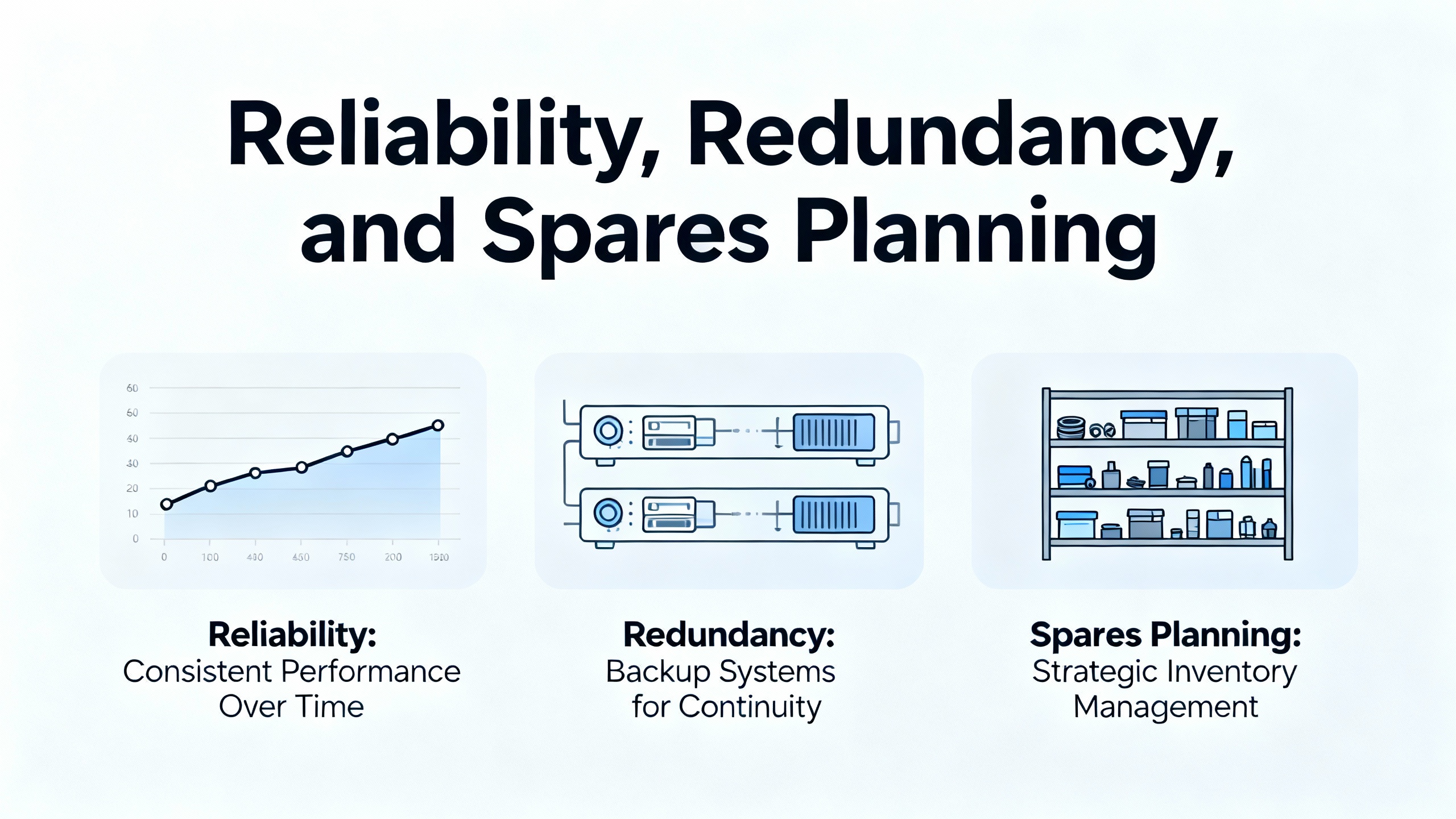
Reliability, Redundancy, and Spares Planning
Reliability in power systems is not just about individual part quality; it is about system structure. A research article on PLC-based control for black salt production illustrates this with a k-out-of-n model. In that system, raw salt is placed in multiple funnels, each heated by two burners in parallel and monitored by temperature sensors. The PLC oversees the process, and the overall structure is modeled such that any k out of n funnels operating correctly is sufficient. When one fails, the PLC starts a standby funnel to maintain production.
Burners and sensors in the model are treated as multi-state components, not just working or failed, and all components are considered repairable over time. The universal generating function method is used to evaluate system reliability.
The direct details of burners and funnels may be far from your UPS or inverter plant, but the reliability logic carries over. Think of each CompactLogix-controlled subsystem—each static transfer switch, generator breaker, or UPS string—as one funnel in a k-out-of-n arrangement. As long as you can maintain at least k healthy subsystems and have preplanned standby capacity or backup controls, your system remains functional.
Spare parts strategy is one tool to support this structure. Holding at least one spare CPU and a representative set of critical I/O modules for each CompactLogix family, combined with standardized programming and SD card backups, allows you to restore any failed subsystem quickly enough that the overall k-out-of-n system remains “good” in reliability terms.
Beyond hardware, Rockwell Automation’s case study about OT security improvements for a major oil and gas producer shows that strategic investments in operational technology can reduce risk and cost simultaneously. In that project, the producer achieved about a seventy percent reduction in OT security labor costs while improving visibility and reducing risk. The same philosophy applies to spare-part and modernization planning: deliberate investment in a structured automation strategy can both strengthen reliability and simplify operations over time.
Sourcing CompactLogix Parts Without Sacrificing Reliability
Sourcing strategies for CompactLogix parts typically span several channels, each with its own advantages.
Specialized resellers such as Industrial Automation Co. maintain inventories of CompactLogix controllers and modules, including legacy, mature, and end-of-life products. They offer multiple condition levels—new surplus sealed, new surplus open-box, and refurbished—backed by a two-year warranty on products and repairs. In-stock orders generally ship the same day through major carriers, with international options and customer-account billing. For lighter shipments under about twenty pounds within the continental United States, free delivery can keep logistics costs low. These resellers also emphasize professional guidance in selecting components and providing post-purchase support.
Repair-focused firms like Roc Industrial offer board-level repair of CompactLogix CPUs and related modules, supported by decades of experience, ISO-certified processes, and large stocks of spare components. They often serve customers nationwide, including major metropolitan areas, with fast shipping and quick turnaround, sometimes even same-day service. Their value proposition is to restore failed controllers and boards at lower cost than outright replacement, with warranties and technical support.
Large catalog distributors such as Cambia Automation list hundreds or thousands of Allen-Bradley products, often including PLCs, ControlLogix modules, PanelView HMIs, and drives. While specific CompactLogix details are not captured in the research snapshot, the general pattern is to provide robust search and sort options by price, date, or popularity. A typical workflow is to identify catalog numbers from engineering documents and then use these tools to confirm availability and compare alternatives.
Secondary markets such as eBay host substantial inventories of CompactLogix memory modules and other spares, often including new, surplus, and used items. The research notes emphasize the importance of verifying module compatibility with target CPUs and firmware, and of checking seller ratings and return policies due to the mix of stock conditions. For non-critical spares or lab environments, these sources can be economical, but for production power systems, many operators lean toward warrantied parts from established suppliers.
Smaller suppliers and brokers exist as well, sometimes exposing only a contact form rather than a structured catalog. The brief snapshot of a NEW SOURCE AUTOMATION supplier page, for example, shows a “Leave a Message” form with constraints on message length and emphasis on detailed inquiry content. When working with such vendors, clarity about part numbers, quantities, and application details helps ensure you receive suitable parts and realistic lead times.

A Practical Selection Method for CompactLogix Replacement Parts
A structured selection method reduces the risk of overlooking critical details when choosing replacement parts or planning spares. Industrial Automation Co. and Atlas OT both stress starting from application requirements rather than brand loyalty, and a forum discussion on SLC 500 replacement choices reinforces the value of explicit requirements lists.
A practical approach begins with an inventory of the existing system. For controllers, document CPU family, memory usage, communication ports, and safety requirements. For I/O, list counts of digital inputs and outputs, analog channels, thermocouple points, and any specialty cards. For communications, map out networks, EtherNet/IP device counts, HMIs, drives, and links to higher-level systems.
The next step is to distinguish between must-have requirements and nice-to-have features. The Electrician Talk discussion summarized in the research suggests classifying features into four buckets: non-negotiable must-haves, very valuable but not deal-breaking features, lower-impact tiebreakers, and features you would prefer to avoid. This exercise often reduces a long list of theoretical options down to a small number of viable replacement configurations.
Guidance from the CompactLogix selection overview recommends sizing I/O, communication, and motion requirements first, then choosing the smallest CompactLogix family that meets those needs with headroom, often around twenty to thirty percent spare CPU and memory resources. Only then should you refine choices around physical footprint and cost. For example, smaller 5370 L1 or L2 controllers with integrated I/O may be enough for stand-alone power panels, while larger systems with many I/O racks or network segments might justify 5380 controllers with higher performance and more EtherNet/IP connections.
Lifecycle cost deserves equal attention. The Electrician Talk contributor notes that thumbnailing a representative system and analyzing life-cycle costs—initial hardware, maintenance, training, and long-term support—can be more informative than comparing only upfront prices. A pilot project, such as converting one non-critical system to an alternative platform or to a modern CompactLogix family, can yield practical insights before committing to a fleet-wide change.
Finally, evaluate the supply chain. Consider lead times for new hardware, the availability of refurbished units with solid warranties, and the capacity of repair providers to support your installed base. The combination of short repair turnaround, two-year warranties from reputable resellers, and a thoughtful spare-parts standard can dramatically reduce downtime risk without requiring a complete control-system overhaul.
Short FAQ
Q: Are refurbished CompactLogix parts a safe choice for UPS and inverter control systems? A: Refurbished CompactLogix parts can be a sound option if they come from suppliers that test hardware thoroughly and back it with strong warranties. Industrial Automation Co., for example, backs both products and repairs with a two-year warranty, and Roc Industrial uses ISO-certified repair processes with real-world load testing. In critical power applications, those kinds of assurances, plus clear return policies and support, are more important than whether the hardware is technically described as “new” or “refurbished.”
Q: How should I decide between repairing a failed CompactLogix controller and replacing it? A: Use both economic and technical criteria. Industrial Automation Co. notes that repairs typically cost thirty to sixty percent less than new parts and can be turned around in about three to five days, while new hardware may have lead times of two to eight weeks or more. Repair is usually attractive for expensive or obsolete controllers with isolated failures and no history of intermittent problems, especially where configuration preservation matters. Replacement is more appropriate when there are repeated failures, catastrophic damage, or a planned modernization to newer platforms such as CompactLogix 5380 to gain performance and lifecycle benefits.
Q: When does a CompactLogix hardware replacement become an opportunity for wider modernization? A: Atlas OT emphasizes that modernization should be framed as more than swapping hardware. If your plant still relies on older platforms such as SLC 500, a major CompactLogix replacement is an opening to reassess I/O needs, communications with SCADA and higher-level systems, and future data and analytics requirements. Rockwell’s tools such as Integrated Architecture Builder and Studio 5000 conversion utilities can ease migration to CompactLogix 5380, and system integrators can help design phased or hot-cutover strategies that minimize downtime. When a series of replacements starts to look like a patchwork, that is often the moment to step back and plan a structured modernization project.
In power-critical facilities, the automation layer should be treated with the same discipline you apply to UPS, inverters, and switchgear. CompactLogix replacement parts are not just catalog numbers; they are design decisions about reliability, safety, and lifecycle. With a clear understanding of the platform, a structured repair-versus-replace strategy, and a disciplined sourcing and spares plan, you can keep your control systems as resilient as the power systems they protect.
References
- https://www.researchgate.net/publication/373736723_Reliability_evaluation_of_a_programmable_logic_controller_based_system
- https://www.plctalk.net/forums/threads/allen-bradley-compact-logix-series-a-or-b.94380/
- https://www.partsplc.com/supplier-3727266-allen-bradley-plc-parts
- https://www.cambiaplc.com/collections/allen-bradley?srsltid=AfmBOooQXqGgCShbs0HW9Xrd2wIyrMZ0HR7guhX7Y99lO-P9S9zfWOfu
- https://gesrepair.com/allen-bradley-repair/
- https://industrialautomationco.com/collections/compactlogix-control-systems-5370-controllers-allen-bradley?srsltid=AfmBOooYervIjcOJKIqimfnDRIsCSCblBZVoA1Ns7za09Wcipj3U5gYT
- https://www.petrospare.com/collections/allen-bradley-compactlogix
- https://www.rocindustrial.com/repair-page/compactlogix-plc-cpu-board-level-repair-and-troubleshooting
- https://tcisupply.com/1769-compactlogix-by-allen-bradley-buyers-guide/?srsltid=AfmBOopCjickdTClzmGRAxvzJqZ8EWwrkFtPsNZQsvG0eh86pxOp-pqp
- https://www.atlas-ot.com/blogs/post/why-and-how-to-replace-your-rockwell-slc-500-plc-a-guide-to-modernization


 Videos
 News
News Applications





Leave Your Comment