Modern industrial and commercial power systems depend on rotating machinery that simply cannot be allowed to fail without warning. Gas and steam turbines that feed critical UPS-backed buses, high-inertia generators, large compressors feeding process loads, and major pumps all sit upstream of inverters and power protection equipment. For that layer of the system to be truly reliable, the machinery protection layer has to be smarter than ever.
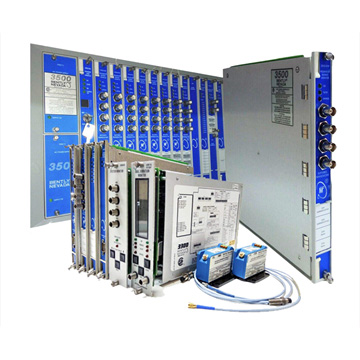
The Bently Nevada 3500 platform sits right at that interface. It is a rack-based machinery protection and condition monitoring system designed for critical rotating equipment such as turbines, compressors, generators, motors, and large pumps. It continuously monitors vibration, shaft position, speed, temperature, and related variables, and ties directly into DCS, PLC, and trip systems. When you treat the 3500 as just a “trip box,” you leave a lot of diagnostic power untapped.
This article looks at Bently Nevada 3500 fault diagnosis from a system-analysis perspective. Drawing on established condition monitoring practice, vendor guidance from Bently Nevada and other reliability sources, and recent research in advanced fault detection and diagnostics, the goal is to show how to move from basic alarm response to a structured, data-driven diagnostic strategy around your 3500 racks.
Why the 3500 Matters for Power System Reliability
A 3500 rack is usually installed on the most consequential assets in a power or process plant: turbine-generator trains, big boiler feed pumps, major process compressors, and other equipment whose trip can cascade through switchgear, UPS systems, and critical loads. Vendor literature positions the 3500 as the primary online protection layer for these high-value machines, not just as a data logger.
The system’s modular rack accepts monitor modules, relay cards, and communication interfaces. It collects signals from proximity probes, accelerometers, temperature sensors, and process transmitters. It then drives relays for alarm and trip, interfaces with plant DCS or PLC systems, and feeds detailed data into higher-level condition monitoring platforms such as Bently Nevada System 1.
A blog from an industrial automation supplier highlights that each 3500 alarm code maps to a specific fault, and that power supply issues, communication failures, sensor and transmitter faults, monitor module problems, ground loops, and configuration errors are common root causes. That directly affects power system reliability. A nuisance trip from a noisy vibration signal or a ground loop is just as disruptive to your UPS-backed loads as a legitimate bearing failure.
From a power system specialist’s viewpoint, the 3500’s role is twofold. First, it must act as a fast, dependable protection system that meets machinery protection practices such as API 670. Second, it should serve as a rich sensor hub for condition monitoring and advanced diagnostics, feeding the analytics that help you avoid trips in the first place.

Fundamentals of Fault Detection and Diagnostics in a 3500 Environment
Fault detection and diagnosis (FDD) is a well-developed discipline in industrial operations. Greg Stanley and Associates describe a fault as any problem or non-optimal condition, not just outright failure, and they distinguish between detection, isolation, and identification. Detection means recognizing that something abnormal has occurred. Isolation means pinpointing which component or subsystem is at fault. Identification means characterizing the underlying cause well enough to prescribe a corrective action.
Building and manufacturing FDD guides from sources such as Facilio, Fogwing, and Zoidii describe a broadly similar workflow. Data is collected from sensors and control systems, then analyzed to look for deviations from expected performance. Once a fault is detected, diagnostic logic tries to determine root cause. Confirmed faults are turned into actions, usually via work orders in a maintenance management system.
These sources also separate fault detection from diagnostics. Detection is about spotting symptoms: a vibration level that drifts up, a temperature trending too high, a shaft position pushing toward a limit. Diagnostics is about figuring out why it is happening: imbalance, misalignment, a rub, a lubrication problem, a sensor failure, or a configuration issue.
In the context of a 3500 system, detection happens in several layers at once. Monitor modules watch individual channels against configured alarm and trip thresholds. System-level logic aggregates channel states into machine and rack health indications. External software layers watch trends, spectra, and process data tied to 3500 channels. Diagnostics is the set of activities that begins once those layers tell you something is wrong.
Research summarized in MDPI’s Sensors journal and in broader reviews of intelligent condition monitoring emphasizes that FDD methods fall into four main groups: rule-based (fixed thresholds and logic), model-based (comparing plant signals to physics-based models), data-driven (statistical and machine learning models), and hybrids that combine these. A 3500-based system can support all of them, as long as you treat the rack as a data source and not the entire solution.
Inside the 3500 Measurement Chain: Probes, Monitors, and Alarms
Proximity probes and vibration channels
Most 3500 installations rely heavily on proximity probes and vibration sensors for critical machinery protection. Bently Nevada proximity systems, such as those used with 3300 and 3500 series monitors, are eddy-current probes that measure shaft vibration and position relative to a conductive target. According to testing guidance documented by AutomationForum, the probe connects through an extension cable to a proximitor. The proximitor drives a low-power RF signal down to the probe; eddy currents induced in the shaft or target cause RF power loss, which the proximitor converts into a negative DC voltage proportional to the probe-to-target gap.
In practice, a typical proximity system is powered with roughly minus eighteen to minus twenty-four volts DC at the proximitor. The installed gap is usually set so that the output voltage sits around minus eight to minus twelve volts DC. More negative voltage indicates a smaller gap; less negative voltage indicates a larger gap. Sensitivity is typically about two hundred millivolts DC per mil of shaft motion, where one mil is one thousandth of an inch.
Functional testing of probes uses a spindle micrometer jig, such as the TK-3. The probe is mounted facing a clean target plate. The micrometer gap is set to zero, the proximitor is powered from a known DC source, and the output is measured with a multimeter. The technician increases the gap in fixed steps, for example every ten mils up to about eighty or ninety mils, and records the output voltage at each point. A good probe and proximitor combination will produce a nearly straight-line relationship between gap and voltage from roughly ten to eighty mils. Flattening, curvature, or irregular jumps in that curve are strong indicators of sensor damage, cable issues, or calibration errors.
This level of basic instrumentation discipline is foundational. Research surveys and diagnostic guides are very clear that automated diagnosis relies heavily on sensors and derived metrics and that sensor failures are common. Before you engage any advanced analytics on 3500 data, you must be confident that the probes, extension cables, proximitor modules, and wiring are in good condition and properly calibrated.
Rack, power, and communication layers
The 3500 platform itself is a modular rack system. Automation and reliability articles describe it as a continuous machinery protection and condition monitoring platform for gas and steam turbines, compressors, generators, and similar assets. The rack hosts various monitor modules for vibration, position, speed, and temperature, relay modules for alarms and trips, and communication interfaces that connect to DCS, PLC, and higher-level software such as System 1.
Troubleshooting field experience summarized by industrial automation suppliers highlights several recurring system-level fault categories. Power supply problems in the rack, including voltage fluctuations or faulty supply modules, can cause unexpected rack shutdowns and widespread alarms. Communication faults between the 3500 and plant DCS or PLC systems are often traced back to bad network cabling, failing switches, or misconfigured protocol and IP settings. Monitor module failures show up as channel-level faults with red LEDs on the affected modules and associated alarm codes. Configuration issues, such as incorrect channel types, alarm setpoints, or speed-source associations, can drive misleading alarms or leave protection gaps.
Ground loops are another practical issue. When multiple grounding paths exist between sensors, proximitor racks, and system grounds, unwanted electrical noise can be superimposed on vibration signals. This shows up as erratic readings, bogus alarms, or inconsistent spectra. Recommended mitigation includes using isolated signal conditioners where necessary and ensuring that grounds terminate at a single defined point.
From a power system reliability viewpoint, these are not minor housekeeping concerns. A trip caused by a noisy signal or a misconfigured channel looks like a mechanical failure to the power system. The only way to distinguish spurious events from genuine machine distress is to treat the entire measurement chain, from probe tip to communication interface, as part of your diagnostic problem.
Alarm philosophy and governance
Condition monitoring guidance from Bently Nevada’s ORBIT publication emphasizes that alarm levels on vibration data are central to efficient monitoring. Industry standards and OEM recommendations such as ISO, API, and VDI primarily define overall vibration severity limits, often in terms of velocity RMS over a defined frequency band. These limits are necessary for acceptance testing and protection systems, but they are not sufficient to capture the full story of machine condition.
For condition monitoring, practitioners routinely set multiple alarm levels on trends: early warning, alert, high, and high-high or danger. Platforms such as System 1 Evo support up to four alarm levels per trend. Control-room operators generally only want to see the higher levels that demand immediate action, while reliability engineers benefit from earlier warnings that give them time to schedule inspections and planned outages.
Setting these levels can be done manually, statistically, or with advanced analytics. Manual methods often define alarm thresholds as a fixed increment or multiplier above a known healthy baseline. Statistical methods use historical data, for example setting lower alarms at the mean plus three standard deviations and higher alarms at scaled combinations of the mean and standard deviation. More recent approaches incorporate AI-based models that combine vibration and process data to detect abnormalities earlier and adapt thresholds to changing operating regimes.
Alarm governance is as important as the thresholds themselves. ORBIT guidance stresses that organizations need clear rules for who can create or change alarm levels. Allowing multiple users to independently modify thresholds on the same measurement invites inconsistency, confusion, and missed alarms. Effective practice includes maintaining audit trails for alarm changes, standardizing templates for similar machine types, and periodically reviewing alarm performance to tune sensitivity versus false alarm rates.
When an alarm triggers, the first responsibility is to determine whether it represents a real condition or a nuisance alarm. Analysts should look at spectra and waveforms, not just overall trends, and verify sensor health using diagnostics such as accelerometer bias voltages and proximity probe gap voltages. Only when the instrumentation is confirmed healthy does it make sense to attribute an alarm to a genuine mechanical or process fault.

Advanced System Analysis Techniques for 3500 Data
The 3500 rack is designed primarily as a real-time protection system, but the data it generates is perfectly suited for advanced fault detection and diagnosis once it is made available to external analytics. Recent research on process monitoring, rotating machinery diagnostics, and intelligent algorithms offers a roadmap for what is possible when that data is used well.
Rule-based, model-based, and hybrid diagnostics
Conceptual overviews from Greg Stanley and Associates and building FDD sources such as Facilio and Fogwing describe several families of diagnostic methods that are directly relevant to 3500 users.
Rule-based approaches rely on explicit rules and thresholds: if a particular vibration band exceeds a set limit while running speed is within a given range, flag a possible imbalance; if axial position exceeds a defined offset while thrust-bearing temperature is rising, flag a potential thrust issue. These methods are straightforward, transparent, and relatively easy to maintain. They form the backbone of many 3500-based alarm strategies.
Model-based approaches compare actual signals to predictions from physics-based or empirical models. In process industries, this often takes the form of observers or residuals: differences between measured and modeled outputs are monitored, and persistent deviations trigger fault codes. One study summarized in a medical-engineering context describes an online stage that computes error signals between process outputs and model outputs, generating a binary fault code, and an offline stage that is invoked only when the primary model set cannot localize the fault. Student’s t-tests are used to determine whether observed behavior matches specific fault models. The machinery protection world has analogous techniques in the form of shaft orbit analysis, rotor-dynamic models, and thermal models of bearings and lubrication systems.
Hybrid approaches combine these with pattern recognition. Fault signatures are defined as vectors of symptoms across multiple measurements, and classification logic matches current observations to the nearest signature. Practical tools in other industries, such as pipeline leak detection and network management, use combinations of residuals, causal models, and pattern recognition. The same philosophy can be applied to 3500 data by building cataloged signatures for imbalance, misalignment, rubs, and bearing defects, then using real-time measurements to match against that library.
Deep learning on time-series data: RNNs and LSTMs
A major review of intelligent condition monitoring for industrial plants describes how recurrent neural networks (RNNs) and their variants have been used to detect and diagnose faults in complex dynamic processes. A widely used benchmark in that literature is the Tennessee Eastman Process, a simulation of a chemical plant with forty-one process variables, twelve manipulated variables, and twenty-one predefined faults. Some of those faults, such as those labeled three, nine, and fifteen, are deliberately subtle and difficult to detect.
Standard RNNs capture temporal dependencies in sequential data but suffer from training issues such as vanishing or exploding gradients. Long Short-Term Memory networks introduce gated memory cells that allow learning over longer time horizons. Gated Recurrent Units provide a more lightweight alternative with fewer parameters. In the Tennessee Eastman studies, LSTM-based fault diagnosis models often require little manual feature extraction and achieve high performance. Reported average fault detection rates reach about ninety-nine and a half percent with stacked three-layer LSTMs, and around ninety-five percent accuracy in other configurations. GRU architectures generally match or slightly outperform LSTMs while consuming less computation, with one study achieving about ninety-six percent average accuracy and better detection of the hardest fault.
Bidirectional recurrent models also show promise. When networks are allowed to consider information from both past and future points in a sequence, they can improve classification of difficult, low-amplitude, or slowly evolving faults. Fusion models that combine convolutional feature extractors with bidirectional recurrent layers achieve precision values above ninety-four percent on all faults in the Tennessee Eastman dataset.
Although these results come from chemical process simulations rather than directly from 3500 data, the structure of the problem is similar. A 3500 system produces dense time-series data from vibration, position, and process sensors on rotating machinery. Exporting that data into an analytics platform and training recurrent models to classify machine states or predict future vibration levels is technically straightforward. The research evidence suggests that such models can detect subtle changes long before simple thresholds or trend charts would.
Convolutional networks and feature engineering
Convolutional Neural Networks were initially developed for image pattern recognition, but they have been widely applied to time-series and frequency-domain data in fault detection. The intelligent condition monitoring overview highlights several CNN-based approaches on the Tennessee Eastman Process and related benchmarks.
One early application used a deep CNN with dropout on time-series data and achieved an average fault detection rate of about eighty-eight percent for twenty faults. Subsequent work modified CNN architectures with residual connections, inception modules, and dilated convolutions to improve generalization and reduce overfitting. These enhancements produced F1 scores around zero point nine one for hard-to-detect faults. Other studies used Fast Fourier Transform preprocessing to feed frequency-domain features into CNNs, with fault detection rates approaching ninety-seven percent when certain toughest faults were excluded.
Further developments introduced multi-head attention mechanisms on top of CNN feature maps, multiblock temporal CNNs that consider both cross-correlation and temporal correlation across variables, and wavelet-based feature extraction feeding multichannel one-dimensional CNNs. Reported average recognition accuracies for all twenty-one Tennessee Eastman faults range from about ninety-two to ninety-nine percent, depending on architecture complexity and coverage of the most challenging faults.
For a 3500 user, these methods translate directly into practical options. You can convert vibration time histories from proximitor channels into spectrograms or wavelet scalograms and use CNNs to learn discriminative features. You can also use one-dimensional CNNs directly on time-series segments to distinguish normal behavior from fault patterns. The research shows that carefully designed CNN variants can capture both localized and multi-scale features in the data, which is critical for detecting early-stage bearing defects, rubs, or resonance conditions.
Compressed sensing and lightweight embedded models
A separate line of work, documented in an open-access study on fast fault diagnosis in industrial embedded systems, addresses the challenge of massive high-frequency data streams under resource constraints. Modern systems collect high-rate vibration signals from many sensors, and transmitting and analyzing all of that data at full resolution can overwhelm networks and processors.
The proposed solution integrates compressed sensing with a Deep Kernel Extreme Learning Machine, forming a method referred to as CS-DKELM. Using the Case Western Reserve University bearing dataset as a benchmark, the researchers first apply a sparse-basis transform to the vibration signals, then compress each sample using a measurement matrix that exploits sparsity. In their example, each segment of four thousand eight hundred points is reduced to nine hundred sixty points, a compression rate of one-fifth, while retaining fault information.
The compressed samples feed a diagnosis module built on stacked autoencoders and a kernel-based extreme learning machine. Particle Swarm Optimization tunes hyperparameters such as hidden-layer sizes and kernel parameters. On the bearing dataset, which includes normal bearings and faults on the inner race, outer race, and balls with damage diameters around three, six, and eight mils, the method achieves high classification accuracy while significantly reducing computation time. The authors highlight that this approach is more lightweight and suitable for real-time embedded deployment than conventional deep neural networks.
If your 3500 system is streaming vibration data to an edge device near the machine, compressed sensing combined with a lightweight model such as DKELM becomes attractive. It allows you to run advanced fault classification close to the source, keeping network loads and processing requirements manageable, while still leveraging rich machine-learning representations.
Comparative view of diagnostic approaches
The main diagnostic approaches discussed above can be compared in terms of their role around a 3500 system, strengths, and constraints. The following table summarizes key points based on the cited research and practice-oriented sources.
| Approach | Typical data and source | Strengths | Limitations | How it complements a 3500 rack |
| Rule-based thresholds and alarms | Overall vibration, process values, 3500 trend data | Simple, transparent, easy to configure; aligns with standards and operator expectations | Prone to false alarms or missed subtle faults; hard to tune for changing conditions | Forms the core of protection logic and initial alarm detection |
| Model-based residuals and causal models | Measured vs modeled signals, shaft dynamics, process models | Leverages physics knowledge; good at explaining behavior; supports structured fault codes | Requires accurate models; can be difficult to maintain over asset life | Enhances interpretation of 3500 measurements and supports structured diagnosis codes |
| Pattern recognition and fault signatures | Multichannel time-series and spectra from 3500 | Captures complex multivariate patterns; works with hybrid evidence | Needs representative data for each fault; can be opaque without visualization | Helps classify alarms into known fault classes using historical 3500 data |
| Recurrent networks (RNN, LSTM, GRU) | Time-series windows of vibration, position, process data exported from 3500 | Models temporal dependencies; high fault detection rates in benchmarks; can handle subtle or slowly developing faults | Requires substantial labeled data and careful training; computational cost | Predicts future behavior and detects anomalies earlier than thresholds, supporting predictive maintenance |
| Convolutional networks (CNN variants) | Time-series or spectral images derived from 3500 vibration data | Strong at feature extraction; can exploit time and frequency structures; achieves high accuracy in research cases | Architecture complexity; training time; may need careful regularization | Automates feature engineering on 3500 data, improving classification and reducing analyst workload |
| Compressed sensing plus lightweight classifiers (CS-DKELM) | Compressed vibration segments from 3500 channels | Reduces data volume; suitable for embedded and edge devices; maintains high accuracy on benchmark bearing data | Requires design of measurement matrices and sparse bases; currently more specialized | Enables advanced classification using 3500 data near the machine, with lower bandwidth and processing overhead |
All of these methods rely on clean, well-instrumented data. That brings us back to the practical diagnostic workflow around the 3500 platform.
Practical Diagnosis Workflow for Bently Nevada 3500 Systems
Start with the symptom and context
When a 3500 alarm appears, the first step is to interpret the alarm code and context. Vendor and third-party guidance emphasizes that each alarm code maps to a specific fault condition, whether it is a channel alarm, rack power supply issue, communication failure, or configuration error. The system manual should always be the first reference.
Context matters as much as the code. You should immediately consider which asset is affected, what operating state it is in, and what changed recently. Was there a load change, a startup, a maintenance intervention, or a configuration update? Is the alarm isolated to one channel, one monitor module, or multiple racks? Understanding these patterns helps distinguish local sensor issues from machine-wide conditions or system-level failures such as bad power or network problems.
Verify instrumentation before blaming the machine
Diagnostic theory and practical guides agree that sensor failures are common, and failing to distinguish sensor problems from process problems leads to wasted effort and sometimes to unnecessary shutdowns. For a 3500 system, basic instrumentation checks are often the highest-leverage action.
For proximity probes, follow the functional testing practice described in AutomationForum. Inspect probes and cables for physical damage, such as cuts, kinks, or compression marks. Measure probe and cable resistances with a multimeter and verify that they fall in the expected ranges for the model in use. Check proximitor supply voltage and polarity before energizing, and confirm that gap voltage readings make sense given the installation geometry. If needed, remove a suspected probe and test it on a micrometer jig to verify linearity over the usable gap range.
For accelerometers and other vibration sensors, check mounting integrity, bias voltage, and cable continuity. Cross-check readings between redundant sensors or between channels on the same module. If a monitor module is suspected, swap it with a known-good spare and see whether the fault follows the module.
Electrical noise and ground loops deserve special scrutiny when vibration readings are erratic or inconsistent. Ensure that sensor shields and grounds are terminated as designed and that multiple ground paths are not inadvertently created between sensors, proximitor racks, and system grounding points.
Analyze vibration and process signatures, not just trends
Once instrumentation health is established, attention shifts to the machine itself. The ORBIT guidance stresses that analysts must look beyond overall vibration trends. A trend crossing an alarm threshold may be the first indication of trouble, but spectra, orbits, time waveforms, and cross-channel relationships hold the diagnostic information.
Key tasks include comparing current signatures with historical baselines for the same operating conditions and verifying whether changes are broadband or narrowband, synchronous with running speed, or tied to harmonics or sidebands. Combining vibration signatures with process data (such as load, speed, pressure, or temperature) helps distinguish operational change from mechanical degradation.
This is also where advanced analytics can augment human judgment. Pattern recognition systems can map spectral and time-domain patterns to known fault signatures. Recurrent and convolutional models trained on historical 3500 data can flag anomalies whose patterns deviate significantly from the learned definition of normal, even before absolute levels breach conventional alarm thresholds.
Differentiate protection from diagnosis and connect to maintenance
A 3500 rack’s primary obligation is protection. Its alarm and trip logic must remain simple, deterministic, and predictable for operators and safety systems. Advanced diagnostics should not compromise that role. Instead, they should run alongside the protection system, consuming the same data but operating under a different philosophy.
In practice, this means using 3500 measurements as inputs to condition monitoring platforms, FDD engines, and maintenance systems. Building FDD and maintenance sources such as Fogwing and Limble CMMS recommend integrating fault detection outputs with a computerized maintenance management system so that confirmed faults create work orders automatically, prioritized by asset criticality and risk.
Metrics such as detection rate, false alarm rate, mean time to detection, and mean time between failures can be tracked using CMMS data. Alarm governance and diagnostic processes can then be tuned based on these metrics. For example, if you see a pattern of alarms that consistently lead to “no problem found” outcomes, you likely need to adjust thresholds, address sensor issues, or refine diagnostic rules.
Common Fault Scenarios and the Role of Advanced Analysis
Power and communication issues masquerading as machinery faults
Field case studies reported by industrial automation suppliers include power plants that experienced repeated communication drops between 3500 systems and PLCs. In one instance, the root cause was a failing network switch and outdated firmware. Replacing the switch and updating firmware resolved instability and restored continuous data flow.
From a distance, intermittent communication or power issues can look like machinery problems. Monitors may show status changes, loss of data, or apparently random alarm clears and setpoints. Systematic diagnostics in these cases start with power quality and network checks, not with the machine. Alarm histories, error logs, and communication diagnostics from both 3500 and control systems are crucial. Advanced analytics can help by correlating alarm events across systems and recognizing patterns that are inconsistent with mechanical faults, but consistent with infrastructure failures.
Noisy vibration channels caused by ground loops or configuration errors
Erratic vibration readings that do not correlate with process changes are classic symptoms of electrical noise and ground loops. If multiple channels spike simultaneously or readings fluctuate far faster than any mechanical phenomenon can justify, it is wise to suspect electrical causes.
Here, advanced analytics again play a supporting role. Statistical analysis of noise characteristics and cross-correlation between channels can reveal coupling patterns typical of electrical interference rather than mechanical vibration. For example, identical noise patterns across channels that share a cable tray or grounding point strongly suggest an electrical common cause.
Configuration errors can present similarly. If a channel is misconfigured for the wrong sensor type, sensitivity, or filtering, its readings will not be directly comparable to others. Configuration management discipline, including backups, change logs, and periodic audits, is therefore a diagnostic tool as much as an administrative task.
Emerging bearing or rotor faults on critical machines
When instrumentation and infrastructure are sound, rising vibration levels or changing spectral patterns often reflect genuine machine degradation. Research on bearing fault diagnosis using datasets such as the Case Western Reserve bearing data shows that high-resolution vibration signals contain rich information about fault type and severity. Methods that combine time-domain segmentation, compressed sensing, and lightweight classifiers have achieved fast, accurate classification of normal, inner-race, outer-race, and ball faults across several damage sizes.
For a turbine, compressor, or generator monitored by a 3500 rack, adopting similar techniques means streaming or periodically collecting time-series data from proximity and vibration channels at sufficient resolution. That data can be analyzed offline to develop baseline models and fault classifiers. Once validated, those models can run in near real time, either in an edge device near the machine or in a centralized analytics platform, providing early warning labels that complement traditional alarms.
The benefit in a power system setting is clear. Early classification of bearing or rotor faults allows planners to schedule outages, adjust loading, or bring redundant equipment online before a forced trip occurs. That directly supports higher availability for UPS-backed loads and critical power buses.
Implementing an Advanced Diagnostic Strategy Around 3500
Building an advanced diagnostic strategy around Bently Nevada 3500 systems is not primarily a software exercise. It is a systems engineering task that spans instrumentation, data infrastructure, analytics, and maintenance practice.
On the instrumentation side, ensure that proximity probes, vibration sensors, and temperature and process transmitters feeding the 3500 are well selected, installed, and tested. Follow structured functional testing procedures with tools such as micrometers and multimeters to confirm probe linearity, cable integrity, and proximitor behavior before relying on any analytic outputs.
On the data infrastructure side, provide robust pathways for 3500 data to reach your analytics environment. That may mean configuring communication interfaces for high-resolution waveform capture to System 1 or another condition monitoring platform, setting up data historians that can store the necessary bandwidth, and ensuring that network and power systems are stable and well monitored.
On the analytics side, start with rule-based and model-based methods that your teams can understand and maintain. As data volumes and confidence grow, introduce more advanced data-driven models such as pattern recognition, RNNs, CNNs, or CS-DKELM-style compressed-sensing classifiers on selected assets. Recent research in Sensors and other journals shows that such models can achieve classification accuracies well above ninety-five percent on benchmark datasets when designed and trained carefully, but they must be integrated thoughtfully into existing workflows to be credible and sustainable.
Finally, connect diagnostics to action. Integrate fault detection outputs with your CMMS so that alarms and diagnostic findings generate structured work orders. Train operators and maintenance technicians to interpret diagnostic information, not just raw vibration levels. Use performance metrics such as reduction in unplanned downtime, improvement in detection lead time, and lower false alarm rates to demonstrate value and guide continuous improvement.
Short FAQ
How is fault detection different from fault diagnosis in a 3500 system?
Fault detection in a 3500 context means recognizing that something abnormal is happening, usually via an alarm, trip, or warning trend on a monitored variable. Fault diagnosis goes further by determining the likely root cause and location of the problem, such as distinguishing between a real bearing defect, a misalignment, a process upset, or a faulty probe. Conceptual guides from Greg Stanley and Associates and building FDD sources emphasize this distinction, and it is helpful to keep in mind when designing alarm and analysis strategies.
Can I rely only on overall vibration alarms from the 3500?
Overall vibration alarms are necessary but not sufficient. Industry standards such as ISO and API define overall severity limits that are appropriate for acceptance testing and basic protection, but ORBIT guidance and practical experience show that effective condition monitoring requires deeper analysis of spectra, waveforms, and multi-channel relationships. Overall alarms should be treated as triggers for diagnostic investigation rather than as complete diagnostic conclusions.
Where do advanced AI models actually run relative to the 3500 rack?
The 3500 rack itself focuses on deterministic protection logic. Advanced AI models, such as recurrent or convolutional networks or compressed-sensing classifiers, typically run in external platforms that consume data from the 3500, such as System 1, data historians, or edge-computing devices. This separation keeps protection simple and certifiable, while allowing sophisticated analytics to evolve more rapidly.
A well-instrumented Bently Nevada 3500 system, combined with disciplined alarm management and modern diagnostic analytics, can significantly improve the reliability of the rotating machinery that underpins your industrial and commercial power supply. Used in this way, the 3500 becomes not just a protection rack, but a central pillar in a resilient, insight-driven power system strategy.
References
- https://pmc.ncbi.nlm.nih.gov/articles/PMC11053866/
- https://docs.nrel.gov/docs/fy19osti/72801.pdf
- https://do-server1.sfs.uwm.edu/mirror/3A8I696197/journal/8A1I283/bently_nevada__3500__42__vibration__monitoring__system-manual.pdf
- https://arxiv.org/html/2401.10266v3
- https://dl.acm.org/doi/10.1145/3729605.3729679
- https://www.researchgate.net/publication/380560834_Enhancing_the_Accuracy_of_Machinery_Fault_Diagnosis_through_Fault_Source_Isolation_of_Complex_Mixture_of_Industrial_Sound_Signals
- https://automationforum.co/functional-testing-of-bently-nevada-vibration-probes/
- https://www.infinite-uptime.com/fault-detection-diagnostics-for-industrial-operations-a-comprehensive-guide/
- https://www.instrumart.com/assets/3500-System-Datasheet.pdf?srsltid=AfmBOooAUx2lCSC_lKT4OwpmC0vHxqxWh6OBDAsnvdtdL4PjhzjOtU9w
- https://zoidii.com/glossary-post/fault-detection


 Videos
 News
News Applications






Leave Your Comment